How Rādhā-kuṇḍa appeared: the accounts side by side
राधा-कुण्ड कैसे प्रकट हुआ: सभी वृत्तान्त साथ-साथ
In short
Rādhā-kuṇḍa (Radha Kund) and Śyāma-kuṇḍa are two sacred ponds at the north-eastern foot of Govardhana Hill. The Varāha Purāṇa and the Gosvāmīs say that after Kṛṣṇa killed the bull-demon Ariṣṭa, He made a pond with His heel and bathed in it. Śrī Rādhā then made Her own pond close by. The Bhāgavatam tells the killing but names no pond.[1–8]
On this page
At a glance
- Śrīmad-Bhāgavatam 10.36 tells how Kṛṣṇa killed Ariṣṭa, a demon in the form of a bull. It names no kuṇḍa and no exact spot.[5–8]
- The Varāha Purāṇa, an old Sanskrit scripture, says that Kṛṣṇa made a tīrtha, a holy bathing place, with His heel. Śrī Rādhā, it says, made a kuṇḍa known by Her name not far away.[2–4]
- The three great commentators on the Tenth Canto say that a rāsa dance took place that night; Śrīla Jīva Gosvāmī puts it in the middle of spring.[1, 9–12]
- The fullest account is in twenty verses in Śrīla Viśvanātha Cakravartī Ṭhākura's commentary. The BBT prints them in English in the purport to ŚB 10.36.16.[1 +2]
- Śrīla Rūpa Gosvāmī places Rādhā-kuṇḍa above every other holy place and says that one bath there awakens pure love of Kṛṣṇa.[14–18]
- Two modern guidebooks say that the kuṇḍas appeared at midnight on Bahulāṣṭamī in the month of Kārttika (October–November). Older texts praise a bath on that day but do not say that the kuṇḍa appeared then.[19–23]
What does the Bhāgavatam say about Ariṣṭa?
The story begins in the Tenth Canto of Śrīmad-Bhāgavatam, chapter 36. The demon Ariṣṭa comes to the cowherd village in the form of a huge bull. He makes the earth tremble as he tears it up with his hooves.[5 +3]
Kṛṣṇa seizes him by the horns, throws him down and kills him.[5 +4] The chapter's last verse on the fight reads:
evaṃ kukudminaṃ hatvā stūyamānaḥ dvijātibhiḥ / viveśa goṣṭhaṃ sa-balo gopīnāṃ nayanotsavaḥ //
Having thus killed the bull demon Ariṣṭa, He who is a festival for the gopīs’ eyes entered the cowherd village with Balarāma.
Translation: Śrīla Prabhupāda's disciples (BBT)The Bhāgavatam names no kuṇḍa, or sacred pond, and no exact spot.[5 +5] Śrīla Prabhupāda's Kṛṣṇa book retells the chapter in the same way, again without a kuṇḍa:
General teaching (does not name the place)“Once a demon named Ariṣṭāsura entered the village in the form of a great bull with a gigantic body and huge horns, digging up the earth with his hooves. … He roared fiercely, and after digging up the earth on the riverside, he entered the village proper. … With Balarāma, He triumphantly entered Vṛndāvana village”
Śrīla Prabhupāda, Kṛṣṇa, the Supreme Personality of Godhead (Kṛṣṇa book), Chapter 36, 'Kaṁsa Sends Akrūra for Kṛṣṇa' · vedabase.io
Śrīla Prabhupāda names the place in a purport, his explanation of a verse, on Śrī Caitanya Mahāprabhu's visit there. Āriṭ-grāma, he writes, is also called Ariṣṭa-grāma, and Śrī Caitanya Mahāprabhu understood that Ariṣṭāsura had been killed in that village. Āriṭ is the village of Rādhā-kuṇḍa.[1 +5]
The commentators add a detail. Śrīla Sanātana Gosvāmī reads the verse to mean that Kṛṣṇa had gone a little way out of the village to meet the demon. Śrīla Jīva Gosvāmī says that Kṛṣṇa called Ariṣṭa to Himself far from the village, to keep the trouble away from it (summarised here, not translated).[1, 12]
Quoting the Varāha Purāṇa, Śrīla Jīva Gosvāmī places the great fight on the round of Govardhana, north of the Gaṅgā. He explains that this Gaṅgā is the Mānasa-gaṅgā, the lake at Govardhana.[1 +5]
Was there a rāsa dance on the night Ariṣṭa was killed?
The rāsa is Kṛṣṇa's circle dance with the gopīs, the cowherd girls of Vraja. The three great commentators on the Tenth Canto are Śrīla Sanātana Gosvāmī, Śrīla Jīva Gosvāmī and Śrīla Viśvanātha Cakravartī Ṭhākura. All three quote the Viṣṇu Purāṇa on the first verse of the chapter: Ariṣṭa came at dusk, just as Kṛṣṇa was setting out for the rāsa (summarised here, not translated).[1, 9–12]
On verse 15, Śrīla Sanātana Gosvāmī and Śrīla Jīva Gosvāmī cite the Harivaṁśa to show that the rāsa still took place that night. Śrīla Jīva Gosvāmī explains that Kṛṣṇa went home after the killing, stayed a short while and went out again.[1, 9–12]
On the next verse he calls this the rāsa at Govardhana. He says that it is known to have taken place in the middle of spring.[1, 10] It is a different rāsa from the one on autumn nights that the Bhāgavatam tells in chapters 29 to 33, on the sandy bank of the Yamunā.[32, 33]
How did Śyāma-kuṇḍa come to be?
The Varāha Purāṇa tells this part in chapter 164, on its round of Govardhana, and Śrīla Sanātana Gosvāmī and Śrīla Jīva Gosvāmī follow it. After killing Ariṣṭa, Kṛṣṇa struck the earth with His heel. A tīrtha, a holy bathing place, came into being, and He bathed there.[1 +2]
The Purāṇa calls this pond Ariṣṭa. The Bhakti-ratnākara, a Bengali book of pilgrimage, says that it is the kuṇḍa everyone calls Śyāma-kuṇḍa, Kṛṣṇa's pond.[3 +5]
Śrīla Jīva Gosvāmī tells it again in his Gopāla-campū. The ground split by the heel became a tīrtha. Kṛṣṇa bathed in it with His friends and announced that a great tīrtha had risen from Pātāla, the lower world (summarised here, not translated).[39, 40]
Did Kṛṣṇa need to be purified?
The Purāṇa, as Śrīla Jīva Gosvāmī quotes it, speaks of this bath as a purification, because the demon had come in a bull's shape. Śrīla Jīva Gosvāmī explains what this means. The bull was a demon who only had a bull's form, and no sin at all arose for Kṛṣṇa. He only acted out a purification, to show the glory of the tīrtha He had made.[1, 39]
Kṛṣṇa is the Supreme Personality of Godhead, and no sinful reaction touches Him. As Śrīla Jīva Gosvāmī explains, the talk of sin and atonement belongs to a loving, joking exchange between Kṛṣṇa and the gopīs. Out of that exchange the two kuṇḍas came.[1 +2]
In the Gopāla-campū the exchange is plainly a joke. Kṛṣṇa shows the gopīs His pond and teases Śrī Rādhā that She has done no such pious deed. Her friends answer that they have killed no bull and need no atonement, and Kṛṣṇa replies that the bull was a demon.[42, 43]
Śrīla Baladeva Vidyābhūṣaṇa says the same. He explains one of Śrī Rādhā's names in Śrīla Rūpa Gosvāmī's Stava-mālā. There he calls the gopīs' charge, that after killing a cow Kṛṣṇa could not touch them, a jest (summarised here, not translated).[41]
How did Śrī Rādhā make Her kuṇḍa?
The older books tell Śrī Rādhā's part briefly, each in its own way. All of them are summarised here, not translated.[1–4]
- The Varāha Purāṇa. Śrī Rādhā, embracing Kṛṣṇa, made a kuṇḍa known by Her own name not far away. A bath in the two kuṇḍas, it says, gives the merit of the great Rājasūya and Aśvamedha sacrifices.[2–4, 34]
- Śrīla Sanātana Gosvāmī, on ŚB 10.36.15, says that after a joke about the killing of a bull She made a second kuṇḍa. The Lord made it known by Her name.[1, 2]
- Śrīla Jīva Gosvāmī, on the same verse, says that She made it Herself on the path of the rāsa, where Ariṣṭa had been killed. A hundred thousand friends helped Her clear away the earth crushed by Ariṣṭa's hooves, a little at first and more fully later.[1, 2]
- *His Saṅkalpa-kalpadruma*** says that Kṛṣṇa, the joker, made His own kuṇḍa and then caused Śrī Rādhikā to make another.[44]
- Śrīla Raghunātha dāsa Gosvāmī gives Śrī Rādhā a name which says that She made Her own lake after the joking words about the bull.[45]
- *His Rādhā-kuṇḍāṣṭaka***, a prayer of eight verses, begins with the kuṇḍa made full with one's own hand, together with all one's friends. The verse does not say clearly whose hand is meant.[46–48]
Śrīla Sanātana Gosvāmī and Śrīla Jīva Gosvāmī say that the pair of kuṇḍas could still be seen in their own day. The first places them at the eastern edge of Govardhana, the second at its north-eastern corner.[1]
What do the twenty verses tell?
The fullest account is in twenty Sanskrit verses. Śrīla Viśvanātha Cakravartī Ṭhākura sets them down in his commentary on ŚB 10.36.15. He calls them the story of the Purāṇas about how the two kuṇḍas arose, full of Rādhā's and Kṛṣṇa's joking talk, but he names no Purāṇa.[1 +2]
One Sanskrit edition prints them as a separate short work and calls it his composition, so who composed them is not certain. The BBT edition gives them in English with ŚB 10.36.16.[1 +2] Here is the story they tell, step by step.[1 +2]
The gopīs' joke. The gopīs tell Kṛṣṇa not to touch them. He has killed a bull, they say, and must bathe in every holy place of the three worlds before He is pure.[1 +5]
The innocent young gopīs said, ‘Ah, Kṛṣṇa, don’t touch us now, O killer of a bull! Alas, even though Ariṣṭa was a terrible demon, still he was a male cow, so You will have to undergo atonement, just as Lord Indra did after killing Vṛtrāsura. But how can You purify Yourself without going to the trouble of visiting every single holy place in the three worlds?’
Translation: Śrīla Prabhupāda's disciples (BBT)Kṛṣṇa's pond. Kṛṣṇa answers that He will bring all the holy places here. He strikes the ground with His heel and calls them into the water. They come and name themselves to the doubting gopīs: the ocean of milk, the Sindhu, the Yamunā, Prayāga and others.[1 +6]
Śrī Rādhā's pond. Śrī Rādhā tells Her friends that they must make a still finer pond. They find a shallow ditch left by Ariṣṭa's hooves just west of Kṛṣṇa's pond, and they dig it out with their hands.[11 +3]
kāryaṁ mayāpy ati-manohara-kuṇḍam ekaṁ
tasmād yatadhvam iti tad-vacanena tābhiḥ
śrī-kṛṣṇa-kuṇḍa-taṭa-paścima-diśya-mando
gartaḥ kṛto vṛṣabha-daitya-khurair vyaloki … tatrārdra-mṛn-mṛdula-gola-tatīḥ prati-sva-
hastoddhṛtā anati-dūra-gatā vidhāya
divyaṁ saraḥ prakaṭitaṁ ghaṭikā-dvayena
tābhir vilokya sarasaṁ smarate sma kṛṣṇaḥ
“‘I must create an even more beautiful pond. So go to work!’ Having heard these words, the gopīs saw that Ariṣṭāsura’s hooves had dug a shallow ditch just west of Śrī Kṛṣṇa’s pond.” … “At that nearby spot, all the gopīs began digging up lumps of soft mud with their hands, and in this way a divine pond manifested in the short span of an hour. Kṛṣṇa was astonished to see the lake they produced.”
Translation: Śrīla Prabhupāda's disciples (BBT)The water. Kṛṣṇa invites Her to fill it from His pond. Keeping up the joke, She refuses and says that Her friends will bring water from the Mānasa-gaṅgā in countless pots.[1 +2] At a sign from Kṛṣṇa, the holy places living in His pond pray to Śrī Rādhā to let them come into Her lake. She smiles at Her beloved and invites them in.[1 +2] They break through the wall of His pond and fill Rādhā-kuṇḍa.[11 +5]
The blessings. Kṛṣṇa wishes Her pond to become better known than His own and says He will always bathe in it. Śrī Rādhā answers that She too will bathe in His pond. Whoever has strong devotion for this lake and bathes or lives there, She says, will be very dear to Her.[31 +2]
proce hariḥ priyatame tava kuṇḍam etan
mat-kuṇḍato ’pi mahimādhikam astu loke
atraiva me salila-kelir ihaiva nityaṁ
snānaṁ yathā tvam asi tadvad idaṁ saro me … rādhābravīd aham api sva-sakhībhir etya
snāsyāmy ariṣṭa-śata-mardanam astu tasya
yo ’riṣṭa-mardana-sarasy uru-bhaktir atra
snāyād vasen mama sa eva mahā-priyo ’stu
“Lord Hari then said, ‘My dear Rādhā, may this pond of Yours become even more world-renowned than Mine. I will always come here to bathe and to enjoy My water pastimes. Indeed, this lake is as dear to Me as You are.’” … “Rādhā replied, ‘I will come to bathe in Your pond as well, even though You may kill hundreds of Ariṣṭa demons here. In the future, anyone who has intense devotion for this lake, which is on the spot where You chastised Ariṣṭāsura, and who bathes or resides here is sure to become very dear to Me.’”
Translation: Śrīla Prabhupāda's disciples (BBT)That night, the last verse says, Kṛṣṇa began a rāsa dance there.[11]
How do the later books tell it?
Later books tell the story with their own differences. All of them are summarised here, not translated.[64–67]
*The Bhakti-ratnākara.* In this Bengali book by Śrīla Narahari Cakravartī Ṭhākura, Śrīla Rāghava Paṇḍita Gosvāmī tells the story to Śrīla Śrīnivāsa Ācārya at Āriṭ. Here it is Śrī Rādhikā who, smiling, tells Kṛṣṇa that He cannot touch Her until He has bathed in all the holy places. He strikes the ground with His foot, and the pond fills with their waters.[64, 65] All of it, the book says, was over by midnight, and people still bathe there in the same way.[19 +2]
Then Śrī Rādhikā and Her friends dig their own kuṇḍa. In the 1912 printing, She fills it with water from the Mānasī-gaṅgā, which the book says holds all holy places. The holy places, knowing Her wish, enter it from Śyāma-kuṇḍa at Kṛṣṇa's direction. A digital copy typed from the same printing reads "would fill" instead.[60 +2]
*The Vraja-bhakti-vilāsa.* In this book by Śrīla Nārāyaṇa Bhaṭṭa Gosvāmī, Kṛṣṇa first bathes with the sixty-eight holy places at two kuṇḍas named Lalitā and Mohana. Then, in the same loving exchange with Śrī Rādhā, He calls the holy places to the kuṇḍa before Them, and the kuṇḍas of Śrī Kṛṣṇa and Śrī Rādhā become known. In this telling no one digs.[66] The Lalitā-kuṇḍa part is a separate tradition, told in “How Lalitā-kuṇḍa and Mohana-kuṇḍa became known”.[66]
*The Vraja-rīti-cintāmaṇi.* Here Śrīla Viśvanātha Cakravartī Ṭhākura offers, as his own thought, that Rādhā and Kṛṣṇa melted with joy at the sight of each other and became the two kuṇḍas. So the pair of kuṇḍas is Their love, and a bath in them gives that love (3.34–36).[67]
Why do devotees honour Rādhā-kuṇḍa above other holy places?
For the followers of Śrī Caitanya Mahāprabhu, the answer comes from Śrīla Rūpa Gosvāmī's Upadeśāmṛta, The Nectar of Instruction. It places Rādhā-kuṇḍa above Govardhana, the forest of Vṛndāvana, Mathurā and even Vaikuṇṭha. It says that the kuṇḍa is as dear to Kṛṣṇa as Śrī Rādhā Herself, and that even great devotees rarely attain it.[14–18]
कृष्णस्योच्चैः प्रणयवसतिः प्रेयसीभ्योऽपि राधा कुण्डं चास्या मुनिभिरभितस्तादृगेव व्यधायि ।
यत्प्रेष्ठैरप्यलमसुलभं किं पुनर्भक्तिभाजां तत्प्रेमेदं सकृदपि सरः स्नातुराविष्करोति ॥ ११ ॥
kṛṣṇasyoccaiḥ praṇaya-vasatiḥ preyasībhyo ’pi rādhā
kuṇḍaṁ cāsyā munibhir abhitas tādṛg eva vyadhāyi
yat preṣṭhair apy alam asulabhaṁ kiṁ punar bhakti-bhājāṁ
tat premedaṁ sakṛd api saraḥ snātur āviṣkaroti
Of the many objects of favored delight and of all the lovable damsels of Vraja-bhūmi, Śrīmatī Rādhārāṇī is certainly the most treasured object of Kṛṣṇa’s love. And, in every respect, Her divine kuṇḍa is described by great sages as similarly dear to Him. Undoubtedly Rādhā-kuṇḍa is very rarely attained even by the great devotees; therefore it is even more difficult for ordinary devotees to attain. If one simply bathes once within those holy waters, one’s pure love of Kṛṣṇa is fully aroused.
Translation: Śrīla A.C. Bhaktivedanta Swami PrabhupādaŚrīla Prabhupāda explains this in his purport. Love of Kṛṣṇa overflows at Rādhā-kuṇḍa, he writes, and advanced devotees prefer to live there, because it holds many memories of the eternal loving pastimes of Kṛṣṇa and Rādhārāṇī.[17]
He adds that its importance is understood mainly by the Gauḍīya Vaiṣṇavas, the followers of Śrī Caitanya Mahāprabhu.[17] In the Caitanya-caritāmṛta he writes that Śrīmatī Rādhikā is very dear to Kṛṣṇa, and so are Her ponds, Śyāma-kuṇḍa and Rādhā-kuṇḍa.[70] On bathing there he writes:
Names this place“It is stated that a devotee will at once develop pure love of Kṛṣṇa in the wake of the gopīs if he once takes a bath in Rādhā-kuṇḍa. Śrīla Rūpa Gosvāmī recommends that even if one cannot live permanently on the banks of Rādhā-kuṇḍa, he should at least take a bath in the lake as many times as possible.”
Śrīla Prabhupāda, The Nectar of Instruction (Śrī Upadeśāmṛta), Text 11, purport · vedabase.io
- Śyāma-kuṇḍa: Kṛṣṇa's pond, which the Varāha Purāṇa calls Ariṣṭa, beside Rādhā-kuṇḍa.[3 +5]
- Saṅgama-ghāṭa: the place where the two kuṇḍas meet; a commentary on the Kṛṣṇa-bhāvanāmṛta says that this meeting place is known as the Saṅgama.[71]
- Mānasī-gaṅgā: the lake at Govardhana from which, in the twenty verses, Śrī Rādhā planned to bring water.[1, 11]
- Lalitā-kuṇḍa: the pond that the Vraja-bhakti-vilāsa connects with Kṛṣṇa's bath after the killing.[66]
How the kuṇḍa, lost for a time, was found again by Śrī Caitanya Mahāprabhu is told in “How Rādhā-kuṇḍa was found and dug out again”.[27]
Where the sources differ
The accounts differ, as the books tell them, on how the kuṇḍa came to be, who dug it and how it was filled. They are listed here, not ranked.[1 +4]
Accounts differ How Rādhā-kuṇḍa came into being.
- Varāha Purāṇa 164.32–37After killing Ariṣṭa Kṛṣṇa makes a tīrtha with His heel and bathes; Rādhā, embracing Him, makes not far away a kuṇḍa known by Her own name.
- Gopāla-campū and Saṅkalpa-kalpadruma (Śrīla Jīva Gosvāmī)Kṛṣṇa makes His tīrtha and teases Rādhā; Her friends say that Her lake will come to be (Gopāla-campū [72]); after the night's rāsa the text names the pond that Rādhā, with countless friends, formed with Her own hands. In the Saṅkalpa-kalpadruma (v. 106) the joker, having made His kuṇḍa, causes Śrī Rādhikā to make another (anyat kārayāmāsa).
- Rādhā-kuṇḍāṣṭaka (Śrīla Raghunātha dāsa Gosvāmī)After the bull-demon's death, amid joking talk about dharma, the kuṇḍa was made full 'with (one's) own hand' (sva-hastena) together with all (one's) own female friends (nikhila-nija-sakhībhiḥ); whose hand is meant is a reading question.
- Purāṇic verses quoted by Śrīla Viśvanātha CakravartīRādhā and Her friends dig a pond in a shallow ditch left by Ariṣṭa's hooves, west of Kṛṣṇa's pond, and the tīrthas fill it from Kṛṣṇa-kuṇḍa.
The wording of these accounts is our summary of the sources, not a published translation.
Accounts differ How Rādhā-kuṇḍa was first filled with water.
- Purāṇic verses quoted by Śrīla Viśvanātha Cakravartī (BBT ŚB 10.36.16 purport)Rādhā refuses Kṛṣṇa's water and says her friends will bring Mānasa-gaṅgā water in pots; the tīrthas then pray to her and, with her leave, break through from Kṛṣṇa-kuṇḍa and fill Rādhā-kuṇḍa.
- The Colour Guide to Rādhā-kuṇḍa (1999); Śrī Vraja-maṇḍala Parikramā (2007); Govardhana Hill: India's Most Sacred Mountain (2001)Rādhā only proposed or prepared to bring Mānasī-gaṅgā water (The Colour Guide to Rādhā-kuṇḍa (1999): 'they would form a line'); the holy places then broke through from Śyāma-kuṇḍa.
- Vṛndāvana-Dhāma Ki Jaya! (c. 1986); the undated parikramā notes Rādhā-kuṇḍaThe gopīs formed a line to the Mānasī Gaṅgā and began filling the hole, passing water from hand to hand, before the sacred rivers came and entered with Rādhā's permission.
- Bhakti-ratnākaraRādhikā filled the kuṇḍa with the water of the Mānasī-gaṅgā; knowing this wish, the tīrthas entered Rādhikā-kuṇḍa from Śyāma-kuṇḍa and both kuṇḍas became full of tīrtha water. The Grantha Mandira text typed from the same edition reads 'karibena' ('would fill') and kṛṣṇa tīrthe nirdeśite (when Kṛṣṇa directed the tīrthas), which would make the Bhakti-ratnākara agree with the first two positions; the print (Bhakti-ratnākara (Śrīla Narahari Cakravartī), Bengali, 2nd ed. (1912) and Bhakti-ratnākara (Śrīla Narahari Cakravartī), Bengali (1913)) has 'করিলেন'.
The wording of these accounts is our summary of the sources, not a published translation.
Who composed the twenty verses is not settled. Śrīla Viśvanātha Cakravartī Ṭhākura calls them the story of the Purāṇas but names no Purāṇa, and they are not known from any Purāṇa.[1 +2]
Accounts differ Who composed the twenty verses on the origin of the two kuṇḍas found in Śrīla Viśvanātha Cakravartī's commentary on ŚB 10.36.15.
- BBT purport to ŚB 10.36.16 (Śrīla Prabhupāda's disciples)'From the Purāṇas, Śrīla Viśvanātha Cakravartī Ṭhākura has quoted twenty verses describing a joking conversation between Rādhā and Kṛṣṇa that took place after Kṛṣṇa had killed the demon Ariṣṭa.' No Purāṇa is named.
- Śrīla Viśvanātha Cakravartī's own introductionThe Purāṇic (paurāṇikī) story of the origin of the two kuṇḍas 'is set down (nibadhyate) in twenty verses'; he names no Purāṇa and does not say whether the verses themselves are a Purāṇa's or his own.
- Grantha Mandira text of the verses as a separate work, Rādhā-kuṇḍotpatti-varṇanaHeading and colophon call the work composed (viracitam) by Śrī Viśvanātha Cakravartī Ṭhākura, included in his commentary on ŚB 10.36.15; the text's editor (2006) adds that, according to Śrīla Vṛndāvana Cakravartī's comment on Govinda-līlāmṛta 7.26, the narrative comes from the Varāha Purāṇa (that comment is not among the texts read: Govinda-līlāmṛta, sargas 1–14 has no ṭīkā on sargas 7–10, its sarga labelled (7) being mūla sarga 11; in the mūla, GL 7.26 is the verse on Ariṣṭa-kuṇḍa born from Kṛṣṇa's foot and joined to Rādhā-kuṇḍa).
- Varāha Purāṇa, adhyāya 164Tells a short version (Kṛṣṇa's heel-tīrtha; Rādhā, embracing Kṛṣṇa, makes a kuṇḍa by her name not far away) but contains none of the twenty verses.
The wording of these accounts is our summary of the sources, not a published translation.
The sources also differ on the time. The commentators put Ariṣṭa's coming at dusk on a rāsa night, and Śrīla Jīva Gosvāmī puts that rāsa in spring. The twenty verses say only that Rādhā's pond appeared within an hour. The Bhakti-ratnākara has Kṛṣṇa's bath over by midnight and names no month.[1 +7]
Two modern guidebooks, The Colour Guide to Rādhā-kuṇḍa (1999) and Śrī Vraja-maṇḍala Parikramā (2007), say that the kuṇḍas appeared at midnight on Bahulāṣṭamī. That is the eighth day of the dark fortnight of Kārttika. They report that thousands bathe in Rādhā-kuṇḍa at that hour.[19–23]
Older texts do praise a bath on that day. Śrīla Rūpa Gosvāmī's Mathurā-māhātmya and the Bhakti-ratnākara quote a passage from the Padma Purāṇa: one who bathes in Rādhā-kuṇḍa on that day becomes dear to Hari (Kṛṣṇa). A story in the Bhaviṣya Purāṇa tells of such a bath. None of these texts says that the kuṇḍa appeared on that day.[3 +2]
Accounts differ When Ariṣṭa was killed and the two kuṇḍas appeared (time of day and season).
- Śrīmad-Bhāgavatam 10.36.1'Then' (tarhi) Ariṣṭa came to the cowherd village; no time of day, month or season is given.
- Śrīla Sanātana Gosvāmī, Śrīla Jīva Gosvāmī and Śrīla Viśvanātha Cakravartī on ŚB 10.36.1 (quoting the Viṣṇu Purāṇa)Ariṣṭa came at dusk (pradoṣa), when Kṛṣṇa was setting out for the rāsa; no month is given.
- Śrīla Jīva Gosvāmī on ŚB 10.36.16 (and Vaṁśīdhara)The rāsa at Govardhana of that night is well known to have taken place in the middle of spring.
- Śrīla Jīva Gosvāmī, Gopāla-campū, Pūrva 31.57Sets the rāsa of that night in spring; at dawn after it the pair's joy spread in the pond Rādhā had formed with Her own hands; whether She formed it at that dawn the sentence does not settle. No month is given.
Places in this article
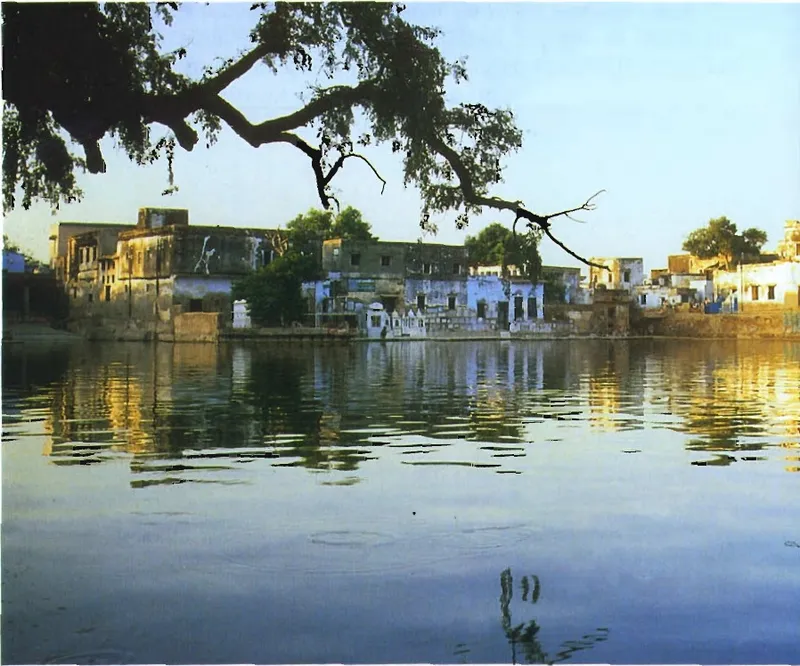
Rādhā-kuṇḍa
राधा-कुण्डRādhā-kuṇḍa is the lake of Śrī Rādhā at the foot of Govardhana Hill, in the village of Āriṭa.
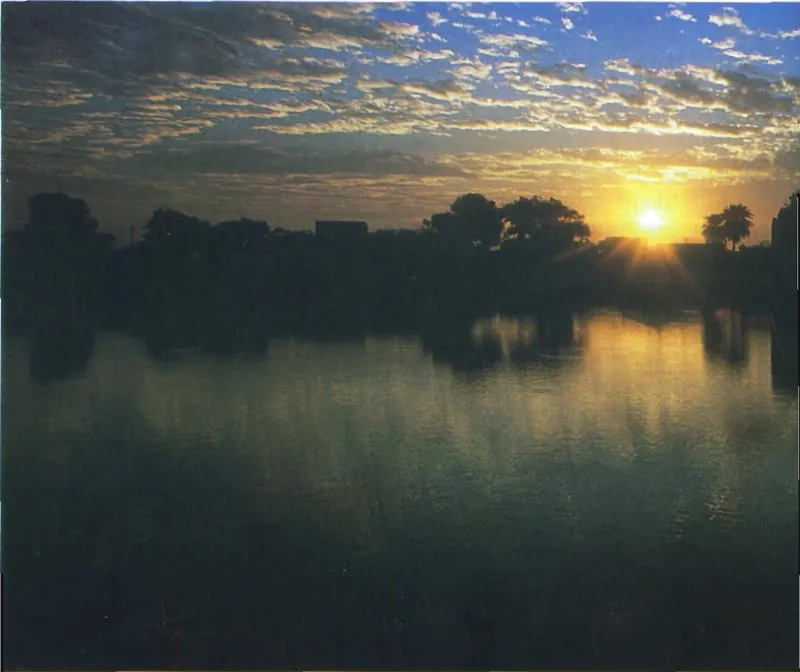
Śyāma-kuṇḍa (Rādhā-kuṇḍa)
श्याम-कुण्ड (राधा-कुण्ड)Śyāma-kuṇḍa, also called Kṛṣṇa-kuṇḍa, is Kṛṣṇa's lake beside Rādhā-kuṇḍa at the foot of Govardhana Hill.
Rādhā-kuṇḍa (village)
राधा-कुण्ड (गाँव)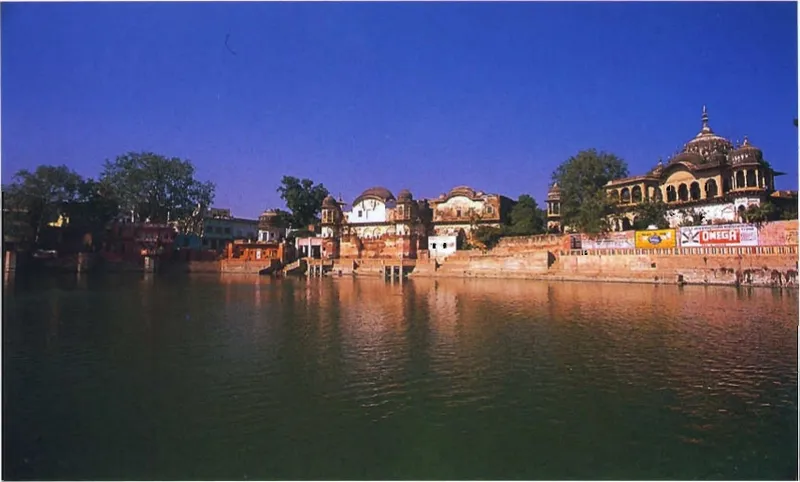
Mānasī-gaṅgā
मानसी-गंगाMānasī-gaṅgā is the large lake in the middle of Govardhana town, on Govardhana Hill.
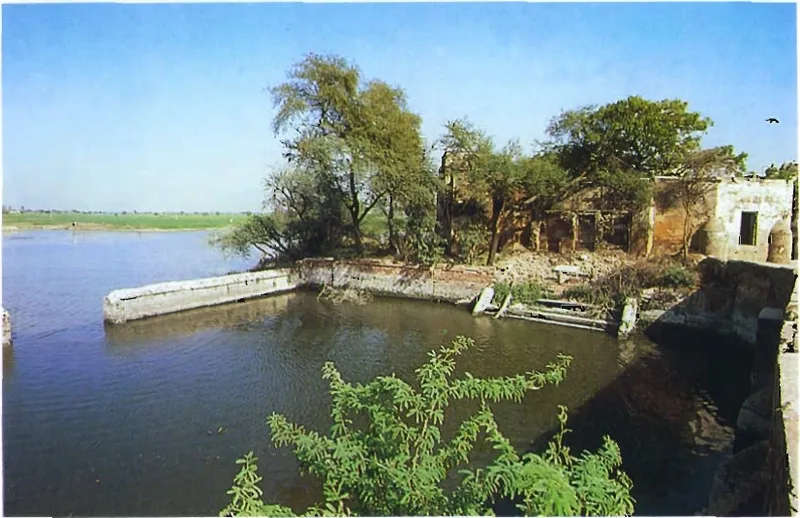
Lalitā-kuṇḍa (Rādhā-kuṇḍa)
ललिता-कुण्ड (राधा-कुण्ड)Lalitā-kuṇḍa is the kuṇḍa of Lalitā, Śrī Rādhā's sakhī (companion), north of Rādhā-kuṇḍa and Śyāma-kuṇḍa.
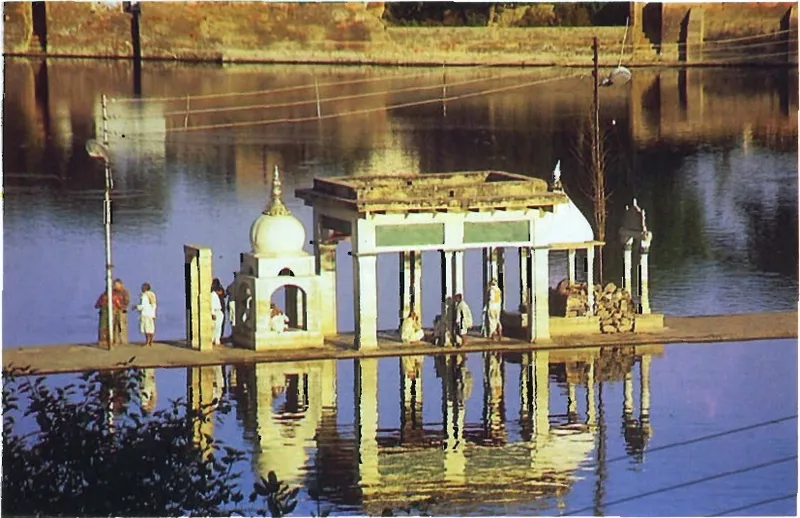
Saṅgama-ghāṭa
संगम-घाटSaṅgama-ghāṭa is the meeting place of Rādhā-kuṇḍa and Śyāma-kuṇḍa, where the banks of the two kuṇḍas (sacred ponds) touch.
Questions and answers
After Kṛṣṇa killed the bull-demon Ariṣṭa, He made a pond with His heel and bathed in it. After a joking exchange about the killing, Śrī Rādhā made Her own kuṇḍa close by with Her friends. This is how the Varāha Purāṇa, the Gosvāmīs' commentaries and the twenty verses tell it, each with its own details.[1 +3]
No. Śrīmad-Bhāgavatam 10.36 tells how Kṛṣṇa killed Ariṣṭa but names no kuṇḍa and no exact spot. The story of the two kuṇḍas comes from the commentators, the Varāha Purāṇa they quote and later books.[5–8]
The pond that Kṛṣṇa made with His heel after killing Ariṣṭa, and bathed in. The Varāha Purāṇa calls it Ariṣṭa, and the Bhakti-ratnākara says that everyone calls it Śyāma-kuṇḍa.[3 +6]
No. Śrīla Jīva Gosvāmī explains that Ariṣṭa was a demon who only had a bull's form, and that no sin arose for Kṛṣṇa. He only acted out a purification to show the glory of His tīrtha. The gopīs' charge was part of a loving joke.[1 +2]
Śrīla Rūpa Gosvāmī's Upadeśāmṛta places it above Govardhana, Vṛndāvana, Mathurā and Vaikuṇṭha, and says it is as dear to Kṛṣṇa as Śrī Rādhā Herself. Śrīla Prabhupāda explains that love of Kṛṣṇa overflows there.[14–18]
In his purport to Upadeśāmṛta 11 he writes that one bath in Rādhā-kuṇḍa awakens pure love of Kṛṣṇa in the wake of the gopīs. One who cannot live on its banks should at least bathe in it as many times as possible.[18]
Two modern guidebooks report that thousands bathe at midnight on Bahulāṣṭamī, the eighth day of the dark fortnight of Kārttika, which they take to be the day the kuṇḍas appeared. Older texts praise a bath on that day without saying that the kuṇḍa appeared then.[19–23]
Sources
- Śrīla Sanātana Gosvāmī: commentary on ŚB 10.36.15, Bhagavata Vidya Pith edition, ed. Bhagavata Rishi and Krishna Shankar Shastri, 1996
- Varāha Purāṇa, adhyāya 164, verses 32–37, Sanskrit Wikisource
- Śrīla Narahari Cakravartī, Bhakti-ratnākara, Pañcama-taraṅga (5th wave), printed page 193, 2nd ed., 1912
- Śrīla Rūpa Gosvāmī, Mathurā-māhātmya, part 1 vv. 418–419, section 'śrī-rādhā-kuṇḍādikasya'
- Śrīmad-Bhāgavatam 10.36.1, GRETIL
- Śrīmad-Bhāgavatam 10.36.13, GRETIL
- Śrīmad-Bhāgavatam 10.36.15, GRETIL
- Śrīla Prabhupāda, Kṛṣṇa, the Supreme Personality of Godhead (Kṛṣṇa book), Chapter 36, 'Kaṁsa Sends Akrūra for Kṛṣṇa' · vedabase.io
- Śrīla Sanātana Gosvāmī, Śrīla Jīva Gosvāmī: commentary on ŚB 10.36.1, Bhagavata Vidya Pith edition, ed. Bhagavata Rishi and Krishna Shankar Shastri, 1996
- Śrīla Jīva Gosvāmī: commentary on ŚB 10.36.16, Bhagavata Vidya Pith edition, ed. Bhagavata Rishi and Krishna Shankar Shastri, 1996
- Purāṇic verses quoted by Viśvanātha Cakravartī Ṭhākura, ŚB 10.36.16, purport, online edition · vedabase.io
- Śrīla Jīva Gosvāmī: commentary on ŚB 10.36.5–6, Bhagavata Vidya Pith edition, ed. Bhagavata Rishi and Krishna Shankar Shastri, 1996
- Rādhā-kuṇḍotpatti-varṇana, part 1 v.1, with the text's heading (Rādhā-kuṇḍotpatti-varṇana)
- Śrīla Rūpa Gosvāmī, Upadeśāmṛta 9 (The Nectar of Instruction, text 9), online edition · vedabase.io
- Śrīla Rūpa Gosvāmī, Upadeśāmṛta, Śrī Upadeśāmṛta, text 10, online edition · vedabase.io
- Śrīla Rūpa Gosvāmī, Upadeśāmṛta, Śrī Upadeśāmṛta, text 11, online edition · vedabase.io
- Śrīla Prabhupāda, The Nectar of Instruction (Śrī Upadeśāmṛta), Text 9, purport · vedabase.io
- Śrīla Prabhupāda, The Nectar of Instruction (Śrī Upadeśāmṛta), Text 11, purport · vedabase.io
- The Colour Guide to Rādhā-kuṇḍa (1999), Rājaśekhara dāsa Brahmacārī, PDF p. 31
- Śrī Vraja-maṇḍala Parikramā (2007), PDF p. 85
Show all 71 references
- Śrī Vraja-maṇḍala Parikramā (2007), PDF p. 76
- Bhaviṣya Purāṇa, parva 3 (Pratisarga), khaṇḍa 2, adhyāya 14, vv. 40–41
- Śrīla Rūpa Gosvāmī, Mathurā-māhātmya, part 1 vv. 420–423
- Śrīmad-Bhāgavatam 10.36.9, GRETIL
- Śrīmad-Bhāgavatam 10.36.13-15, GRETIL
- Garga-saṁhitā, Mādhurya-khaṇḍa (4), adhyāya 24, verse 21, Sanskrit Wikisource
- Śrīla Prabhupāda, Śrī Caitanya-caritāmṛta, Madhya-līlā 18.3, purport · vedabase.io
- Śrī Vraja-maṇḍala Parikramā (2007), PDF p. 83
- Varāha Purāṇa, adhyāya 164, verses 32-33, Sanskrit Wikisource
- Śrīla Sanātana Gosvāmī: commentary on ŚB 10.36.9, Bhagavata Vidya Pith edition, ed. Bhagavata Rishi and Krishna Shankar Shastri, 1996
- Śrīmad-Bhāgavatam 10.36.16, purport, verse 19 of the twenty quoted verses, online edition · vedabase.io
- Śrīmad-Bhāgavatam 10.32.11–12, GRETIL
- Śrīla Prabhupāda, Kṛṣṇa, the Supreme Personality of Godhead (Kṛṣṇa book), Chapter 32, Kṛṣṇa Returns to the Gopīs (the scene before the rāsa dance of ch. 33) · vedabase.io
- Varāha Purāṇa, adhyāya 164, verses 35-37, Sanskrit Wikisource
- Śrīla Raghunātha dāsa Gosvāmī, Vraja-vilāsa-stava, verse 58
- Śrīla Raghunātha dāsa Gosvāmī, Govardhanāśraya-daśaka, verse 5
- Śrīla Kṛṣṇadāsa Kavirāja Gosvāmī, Govinda-līlāmṛta, sarga 7, verse 26 (last verse of the kulaka 7.1–26 on Rādhā-kuṇḍa), after the editions of Haridas Das and Haridas Shastri
- Govinda-līlāmṛta, sarga 18, verse 59, with the ṭīkā, after Haridas Shastri's edition, 1981
- Śrīla Jīva Gosvāmī, Gopāla-campū, Pūrva-campū, pūraṇa 31 (Ariṣṭa episode), prose [56], [59], [60], GRETIL
- Śrīla Jīva Gosvāmī, Gopāla-campū, Pūrva-campū 31, prose [56]–[60], GRETIL
- Śrīla Rūpa Gosvāmī, Stava-mālā, Prema-sudhā-satra, verse 23, with Baladeva's comment, after the edition of Bhakti Saranga Goswami and Purushottam Das, Vrindavan, 1959
- Śrīla Jīva Gosvāmī, Gopāla-campū, Pūrva-campū, pūraṇa 31, prose [65]-[66], GRETIL
- Śrīla Jīva Gosvāmī, Gopāla-campū, Pūrva-campū 31, prose [65]–[69], GRETIL
- Śrīla Jīva Gosvāmī, Saṅkalpa-kalpadruma, verses 104–106, GRETIL
- Śrīla Raghunātha dāsa Gosvāmī, Śrī Rādhikāṣṭottara-śata-nāma-stotra, Stavāvalī hymn (13) Śrī-śrī-rādhikāṣṭottara-śata-nāma-stotram, v. 32
- Śrīla Raghunātha dāsa Gosvāmī, Rādhā-kuṇḍāṣṭaka, verses 1–2 and 9
- Śrīla Raghunātha dāsa Gosvāmī, Vraja-vilāsa-stava, verses 52–54
- Śrīla Raghunātha dāsa Gosvāmī, Muktā-carita, invocation, fourth verse, GRETIL
- Śrīmad-Bhāgavatam 10.36.16, purport, verse 2 of the twenty quoted verses, online edition · vedabase.io
- Śrīmad-Bhāgavatam 10.36.16, purport, verse 3 of the twenty quoted verses, online edition · vedabase.io
- Śrīmad-Bhāgavatam 10.36.16, purport, verse 6 of the twenty quoted verses, online edition · vedabase.io
- Śrī Vraja-maṇḍala Parikramā (2007), PDF p. 84
- The Colour Guide to Rādhā-kuṇḍa (1999), Rājaśekhara dāsa Brahmacārī, PDF p. 29
- Śrīla Viśvanātha Cakravartī Ṭhākura: commentary on ŚB 10.36.15, Bhagavata Vidya Pith edition, ed. Bhagavata Rishi and Krishna Shankar Shastri, 1996
- Śrīla Viśvanātha Cakravartī Ṭhākura: commentary on ŚB 10.36.15, verses iv–v, Bhagavata Vidya Pith edition, ed. Bhagavata Rishi and Krishna Shankar Shastri, 1996
- Śrīmad-Bhāgavatam 10.36.16, purport, verse 7 of the twenty quoted verses, online edition · vedabase.io
- The Colour Guide to Rādhā-kuṇḍa (1999), Rājaśekhara dāsa Brahmacārī, PDF p. 30
- Śrī Vraja-maṇḍala Parikramā (2007), PDF p. 101
- Śrīmad-Bhāgavatam 10.36.16, purport, verse 17 of the twenty quoted verses, online edition · vedabase.io
- Śrīla Narahari Cakravartī, Bhakti-ratnākara, Fifth Wave, 1912 ed. p. 191, 2nd ed., 1912
- the undated parikramā notes Rādhā-kuṇḍa, ¶79
- Śrīmad-Bhāgavatam 10.36.16, purport, verse 18 of the twenty quoted verses, online edition · vedabase.io
- Śrī Vraja-maṇḍala Parikramā (2007), PDF p. 87
- Śrīla Narahari Cakravartī, Bhakti-ratnākara, Fifth Wave (pañcama taraṅga), 1912 ed. p. 190, 2nd ed., 1912
- Śrīla Narahari Cakravartī, Bhakti-ratnākara, Fifth Wave (pañcama taraṅga), 1912 ed. p. 191, 2nd ed., 1912
- Śrīla Nārāyaṇa Bhaṭṭa, Vraja-bhakti-vilāsa, adhyāya 4, printed page 85, 1st ed., publ. Bābā Kṛṣṇadāsa, Kusuma-sarovara, Saṁvat 2008
- Śrīla Viśvanātha Cakravartī Ṭhākura, Vraja-rīti-cintāmaṇi, tṛtīyaḥ sargaḥ, vv. 34 and 36
- Śrīla Narahari Cakravartī, Bhakti-ratnākara, Pañcama-taraṅga (5th wave), printed page 190, 2nd ed., 1912
- Śrīla Narahari Cakravartī, Bhakti-ratnākara, Pañcama-taraṅga (5th wave), printed page 191, 2nd ed., 1912
- Śrīla Prabhupāda, Śrī Caitanya-caritāmṛta, Ādi-līlā 7.18–19, purport · vedabase.io
- Śrīla Viśvanātha Cakravartī Ṭhākura, Kṛṣṇa-bhāvanāmṛta, sarga 14 (jala-vihāra-līlāsvādana), verse 15, with the ṭīkā, after the edition of Radhikanath Goswami, Vrindavan, 1906
Further sources
- Śrīmad-Bhāgavatam 10.36 (translation of Canto 10 from chapter 14 by the disciples of Śrīla Prabhupāda, BBT), with the purport to 10.36.16, which prints the twenty verses in English; Śrīla Prabhupāda, Kṛṣṇa, the Supreme Personality of Godhead, chapter 36; Śrī Caitanya-caritāmṛta, Ādi-līlā 7.18–19 and Madhya-līlā 18.3, purports; The Nectar of Instruction, texts 9–11 (BBT).
- Commentaries on Śrīmad-Bhāgavatam 10.36 by Śrīla Sanātana Gosvāmī, Śrīla Jīva Gosvāmī and Śrīla Viśvanātha Cakravartī Ṭhākura (Gaudiya Grantha Mandira digital edition): summarised here, not translated.
- Varāha Purāṇa 164.32–37 and Bhaviṣya Purāṇa, Pratisarga-parva 3.2.14 (Sanskrit); Śrīla Jīva Gosvāmī, Gopāla-campū and Saṅkalpa-kalpadruma; Śrīla Raghunātha dāsa Gosvāmī, Stavāvalī; Śrīla Rūpa Gosvāmī, Stava-mālā with the commentary of Śrīla Baladeva Vidyābhūṣaṇa, and Mathurā-māhātmya; Śrīla Viśvanātha Cakravartī Ṭhākura, Vraja-rīti-cintāmaṇi; Śrīla Viśvanātha Cakravartī Ṭhākura's Kṛṣṇa-bhāvanāmṛta with its commentary: summarised here, not translated.
- Bhakti-ratnākara, Fifth Wave (Bengali, 1912 edition); Vraja-bhakti-vilāsa, chapter 4; The Colour Guide to Rādhā-kuṇḍa (1999); Śrī Vraja-maṇḍala Parikramā (2007).