Yugala-kiśora Mandira (Mirror Temple)
युगल-किशोर मन्दिर (काँच का मन्दिर) Hindi name proposed
Also called Kanch Mandīr, temple of Jugal Kiśore, Śrī Yugala-Kiśorajī
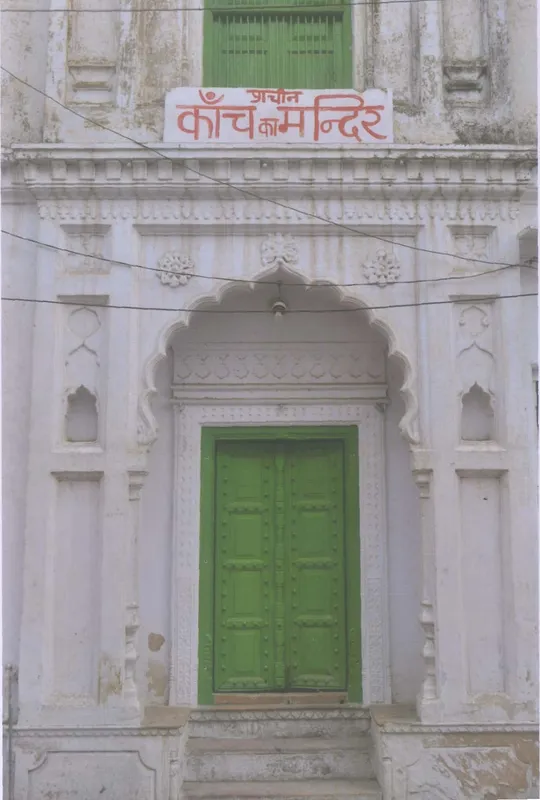
- What it is
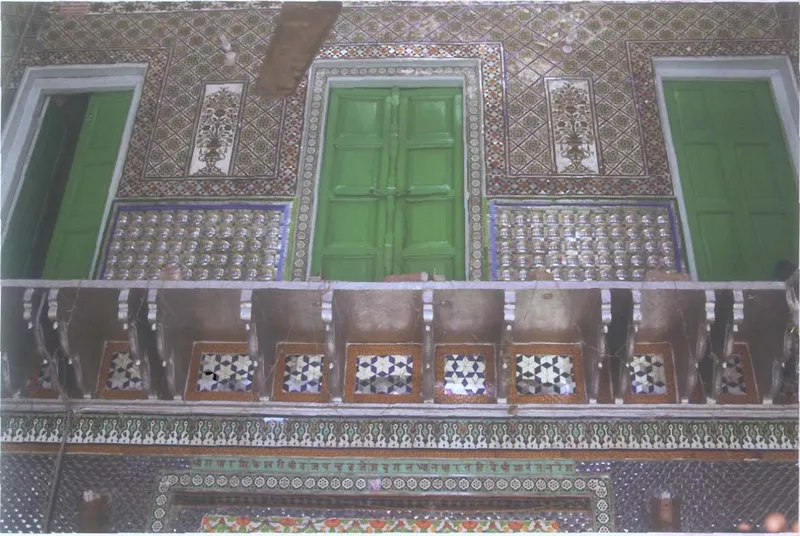
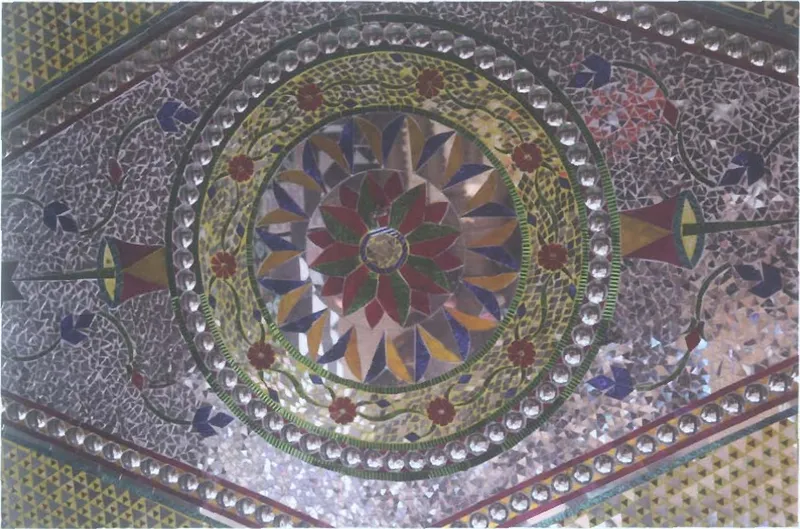
- The Yugala-kiśora Mandira of Vyāsa-gherā in Vṛndāvana town is better known as the Kanch Mandir, the Mirror Temple, because its walls and ceiling are covered with small mirrors.
- Visiting
- The photographs in Vṛndāvana, the Playground of God show a signboard over the entrance that reads, in Hindi, "the old glass temple", and a banner naming Vṛndāvana-bihārī Yugala-kiśora; The Color …
- Places here
- Samādhi of Vyāsajī, Rādhā Nāma Bank
In short
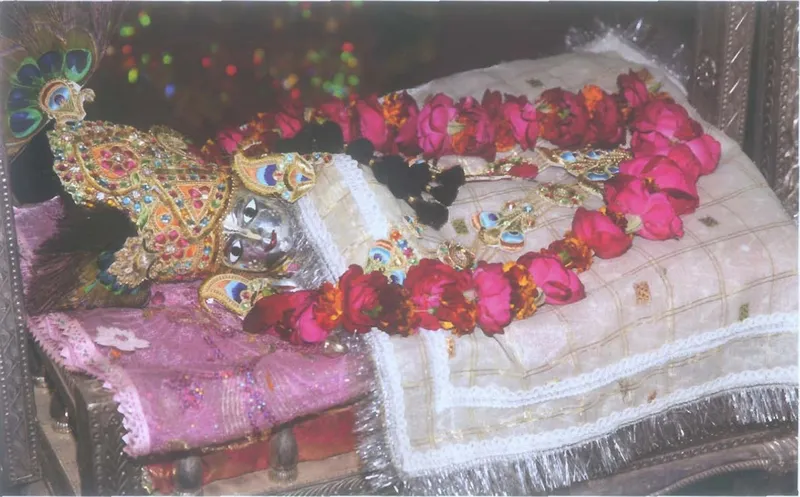
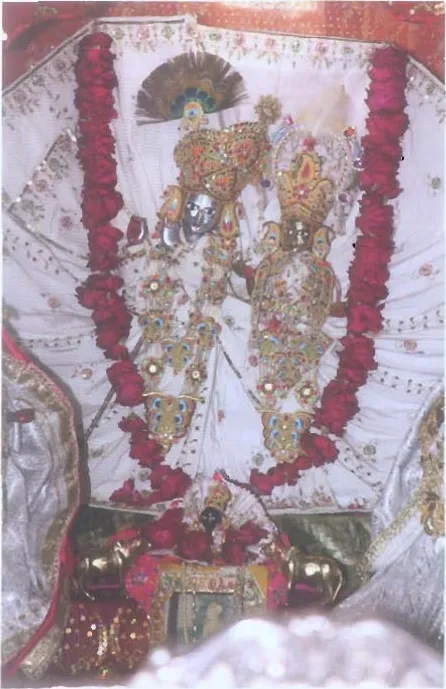
The Yugala-kiśora Mandira of Vyāsa-gherā in Vṛndāvana town is better known as the Kanch Mandir, the Mirror Temple, because its walls and ceiling are covered with small mirrors.[1 +6] The guidebooks connect its Deities, Yugala-kiśora, "the youthful Couple", with Śrī Harirāma Vyāsa, and Śrī Vraja-maṇḍala Parikramā (2007) places the samādhi of Śrī Vyāsajī in the garden nearby.[1 +3] A small Deity of baby Kṛṣṇa lies in a swinging cradle before the altar.[1 +1] The sources differ on who built the temple, on where the Deities were found and on Śrī Harirāma Vyāsa's line of teachers. No scripture, Gosvāmī text or statement of Śrīla Prabhupāda that names the temple has been found in the works searched.[1 +2]
Key facts
| Kind | temple |
|---|---|
| Region · area | Vṛndāvana · Vyāsa-gherā |
| Ācāryas | Harirāma Vyāsa (Hari Rāma Vyāsa; no profile on nandgramdham.org/acharyas/), Śrīla Mādhavendra Purī |
Traditional accounts
According to Vṛndāvana, the Playground of God (2010), Śrī Harirāma Vyāsa found the Deities who are now on the altar and named Them Yugala-kiśora; Śrī Vraja-maṇḍala Parikramā says that the Deity was revealed "through Harirāma Vyāsajī". The books tell his life and the finding of the Deity in different ways (see below), and the Kiśorī-kuñja page gives the story of his austerities there.[1 +3]
Visiting today
The temple
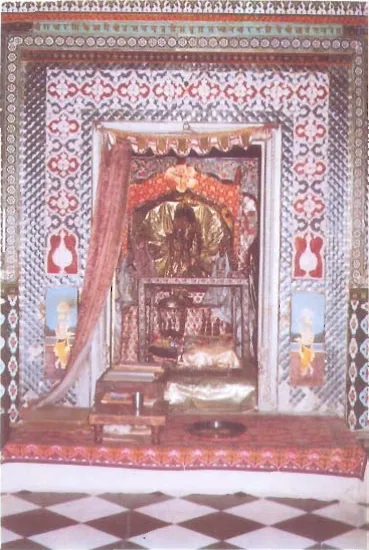
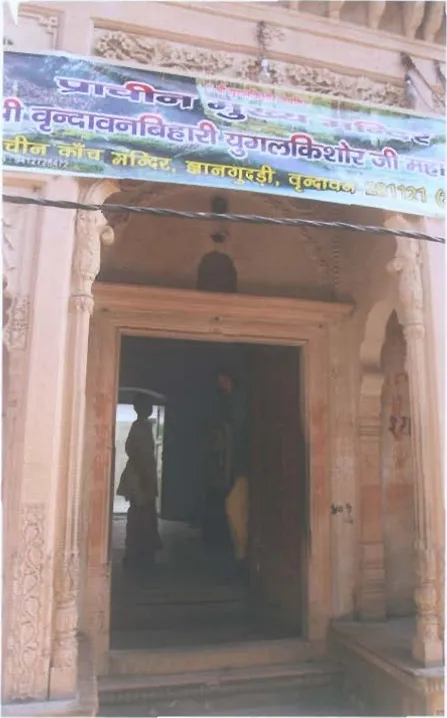
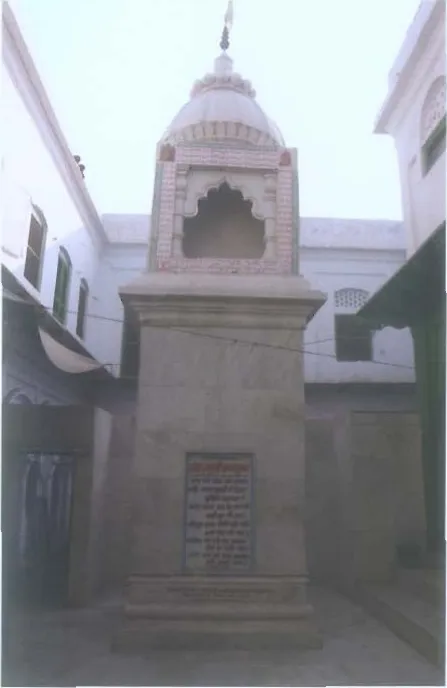
The photographs in Vṛndāvana, the Playground of God show a signboard over the entrance that reads, in Hindi, "the old glass temple", and a banner naming Vṛndāvana-bihārī Yugala-kiśora; The Color Guide to Vṛndāvana (2000) speaks of thousands of small mirrors on the walls and says that the temple is very popular with pilgrims.[1 +4] Both books describe the small Deity of baby Kṛṣṇa lying in a swing in front of the main altar, and both describe the temple's Rādhā-nāma Bank, a square pillar with a small domed top in the courtyard, where pilgrims write a holy name as many times as they can and deposit the pages. They differ on which name is written (see below).[1 +1]
Śrī Vraja-maṇḍala Parikramā places the temple in Kiśorīvana, or Vyāsa-gherā, near Sevā-kuñja, and lists Vyāsa-gherā among the quarters of the town; the temple's own banner, in the photograph, gives Jñāna-gudaḍī as its address.[1 +2] In 2010 the sevaite, the priest in charge, was a Gauḍīya Vaiṣṇava whom Vṛndāvana, the Playground of God calls a descendant of Śrī Harirāma Vyāsa in the twenty-seventh generation; this family descent is the book's report and may not be certain.[1]
Smaller places described here
- The samādhi of Śrī Vyāsajī: Śrī Vraja-maṇḍala Parikramā says only that it is nearby in the garden. The same entry names both Abhirāma Vyāsa of Orachā and Śrī Harirāma Vyāsa, and it does not say which Vyāsa lies here, so the samādhi may be Śrī Harirāma Vyāsa's but no source says so. F. S. Growse's book of 1883 also mentions a tomb of a "Vyas Ji of Orchha" in Vṛndāvana, without saying where it is.[2 +1]
Location
| Where it is | in Vyāsa Ghera[11] Rādhā-nāma Bank in the far right-hand corner of the courtyard[12] |
|---|
Places at Yugala-kiśora Mandira (Mirror Temple)
2 places
Nearby places
Sevā-kuñja
Pictures
7 pictures
History
Two historians write of an older Yugala-kiśora temple in this quarter, without saying whether the Mirror Temple continues it. A. W. Entwistle (1987) says that Śrī Harirāma Vyāsa founded the temple of Yugala-kiśora in Vyāsa-gherā in the middle of the sixteenth century, that the Deity he worshipped was by then in Pannā, and that his descendants kept other private temples in the quarter.[9] Prabhudayāl Mītal (1966) also says that the Deity of Śrī Harirāma Vyāsa's temple at Vyāsa-gherā was then in Pannā and that the ruins of that temple lay scattered there; he lists a "glass temple" of Vṛndāvana separately, by name only.[10]
Vṛndāvana, the Playground of God says that in 1940 the then king of Madhya Pradeśa bought the mirrors and glass from Belgium and had them set on the walls and ceilings. The book names no king and cites no record, so the date may not be certain.[1 +1] Who built the temple itself, the guidebooks tell differently (see below).
Where the sources differ
Who built the Yugala-Kiśora (Mirror) temple in Vyāsa-gherā, and when.
Accounts differ Who built the Yugala-Kiśora (Mirror) temple in Vyāsa-gherā, and when.
- Vṛndāvana, the Playground of God (2010), entry 69The Deities' first temple there was built by Mahārāja Vīrasingh (name read with uncertain diacritics) in the 16th century; in 1940 'the then king of Madhya Pradeśa' installed the Belgian mirrors.
- The Color Guide to Vṛndāvana (2000), entry 71'The temple was built by the Mahārāja of Begawar (M.P.), Sawan Singh Juedeva. He was a disciple of Hari Rāma Vyāsa Gosvāmī.' No date.
- Śrī Vraja-maṇḍala Parikramā (2007)Names no builder; the Deity was revealed by Abhirāma Vyāsa 'through Harirāma Vyāsajī'.
- Entwistle (1987), p. 408The temple of Jugal Kishor in Vyāsa-gherā was founded in the mid-sixteenth century by Śrī Harirāma Vyāsa; the original Deity is now in Pannā, and other private temples in this quarter are kept by his descendants. No mirrors, Vīrasingh, Begawar or 1940; he does not say whether the Mirror Temple is that temple.
Accounts differ Kiśorī-kuñja, Kiśorīvana and Vyāsa-gherā: where the Deities were found and where Their temple is.
- Vṛndāvana, the Playground of God (2010), entry 69Śrī Harirāma Vyāsa found the Deities while doing austerities in Kiśorī-kuñja, next to Sevā-kuñja; later They were brought across to Vyāsa Ghera, where Their temple now is.
- Śrī Vraja-maṇḍala Parikramā (2007)'Śrī Yugala-Kiśorajī is situated in Kiśorīvana, or Vyāsa-gherā, near Śrī Sevā-kuñja' (the two names given for one place); no move of the Deities is mentioned.
- The temple's banner (photograph in Vṛndāvana, the Playground of God (2010)); the walking order of Vṛndāvana, the Playground of God (2010) and The Color Guide to Vṛndāvana (2000)The banner's address line names 'ज्ञानगुदड़ी, वृन्दावन' (Jñāna-gudaḍī, Vṛndāvana, the first letters partly blurred). Vṛndāvana, the Playground of God (2010) (entries 69-70) and The Color Guide to Vṛndāvana (2000) (entries 69-71) list the temple next to Jñāna Gudri. …
Accounts differ Śrī Harirāma Vyāsa's line of teachers (as each source states it).
- Vṛndāvana, the Playground of God (2010), entry 69; The Color Guide to Vṛndāvana (2000), entry 71Vṛndāvana, the Playground of God (2010) names no teacher but calls the present sevaite, his 27th-generation descendant, a Gauḍīya Vaiṣṇava; The Color Guide to Vṛndāvana (2000) calls him 'Hari Rāma Vyāsa Gosvāmī' and names no teacher.
- the Bengali Bhaktamāla of Kṛṣṇadāsa Bābājī (1905) (Kolkata 1905 edition, the Bengali Bhaktamāla of Kṛṣṇadāsa Bābājī (1905))Śrīman Mādhavendra Purī Gosvāmī's disciple was Śrīmatī Mādhava, and Mādhava's disciple was Harirāma Gosāñi ('tāṁra śiṣya śrīla-harirāma ye gosāñi'), so his line is the Mādhvī sampradāya; no Abhirāma is named; his country is called Jhannāpannā.
- the Hindi Bhaktamāla (1904) with Rūpakalā's Hindi prose commentary (Banaras 1904, the Hindi Bhaktamāla (1904))Nābhā dāsa's verse calls Vyāsa the son of Sumokhan Śukla ('sukula sumokhana suvana') and names no teacher. Rūpakalā's commentary is headed 'śrīharivaṁśajī ke śiṣya śrīvyāsajī' (Śrī Vyāsajī, disciple of Śrī Harivaṁśajī) and puts him in the Śrī Rādhāvallabhīya sampradāya; first named Harī Rāma, of Oṛchā; came to Vṛndāvana in saṁvat 1612.
Accounts differ Which Vyāsa the samādhi belongs to, and who revealed the Deity of the neighbouring temple (each source's statement).
- Śrī Vraja-maṇḍala Parikramā (2007)'the samādhi of Śrī Vyāsajī' (not identified); Mādhava dāsa, a disciple of Śrīla Mādhavendra Purī, is named with 'His disciple, Abhirāma Vyāsa, a resident of Orachā', who 'revealed this deity through Harirāma Vyāsajī'.
- Vṛndāvana, the Playground of God (2010); The Color Guide to Vṛndāvana (2000)Vṛndāvana, the Playground of God (2010): Śrī Harirāma Vyāsa came from Orsha 'in the 15th century', did austerities in Kiśorī-kuñja and himself discovered the Yugala-kiśora Deities; his 27th-generation descendant, the sevaite, is a Gauḍīya Vaiṣṇava; no teacher is named and no samādhi is mentioned. The Color Guide to Vṛndāvana (2000): 'Hari Rāma Vyāsa Gosvāmī', no teacher named, no samādhi mentioned.
Accounts differ Which holy name pilgrims write at the Rādhā-nāma Bank.
- Vṛndāvana, the Playground of God (2010)The name of Śrīmatī Rādhārāṇī, as many times as possible.
- The Color Guide to Vṛndāvana (2000)The holy name of Śrī Śrī Rādhā and Krishna, in a book or on paper, deposited 'for the eternal benefit of the writer'.
References
12 references
- Vṛndāvana, the Playground of God (2010), Bhakti Caitanya Svāmī, PDF p. 220
- Śrī Vraja-maṇḍala Parikramā (2007), PDF p. 335
- Śrī Vraja-maṇḍala Parikramā (2007), PDF p. 344
- Vṛndāvana, the Playground of God (2010), Bhakti Caitanya Svāmī, PDF p. 221
- Vṛndāvana, the Playground of God (2010), Bhakti Caitanya Svāmī, PDF p. 222
- Vṛndāvana, the Playground of God (2010), Bhakti Caitanya Svāmī, PDF p. 223
- The Color Guide to Vṛndāvana (2000), Written and Photographed by Rājaśekhara dāsa Brahmacārī, PDF p. 134
- F. S. Growse, Mathurá: A District Memoir
- A. W. Entwistle, ch. 8 §66.20 'Vyas Ghera', printed p. 408, Egbert Forsten, Groningen, 1987
- Prabhudayāl Mītal, part 1 ('ब्रज-संस्कृति की भूमिका'), 'Braj-yātrā', Vṛndāvana: 'Śrī Yugalakiśora-jī', printed p. 136
- Vṛndāvana, the Playground of God (2010), Bhakti Caitanya Svāmī, p. 220
- The Color Guide to Vṛndāvana (2000), Written and Photographed by Rājaśekhara dāsa Brahmacārī, p. 120