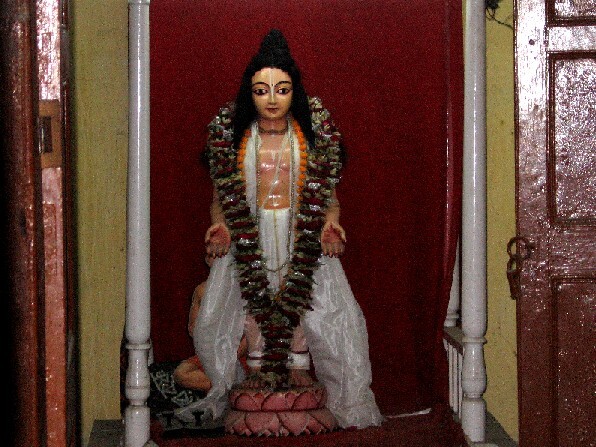
Abhirama Gopala Thakura's clearest appearance in the texts is short but specific. Krishnadasa Kaviraja Goswami names him, as Sri Ramadasa, in the eleventh chapter of the Adi-lila of Sri Chaitanya-charitamrita. That chapter is devoted entirely to listing the expansions and associates of Nityananda Prabhu. The place where he is named itself tells us something. Abhirama's story cannot be separated from Nityananda Prabhu's. But the text is equally clear that his service reached back directly to Sri Chaitanya Mahaprabhu.
| Detail | Description |
|---|---|
| Primary textual source | Sri Chaitanya-charitamrita, Adi-lila 11.13-15 |
| Constant companion mentioned alongside him | Gadadhara dasa |
| Household he and Gadadhara dasa stayed with | Sri Virabhadra Gosani (Nityananda Prabhu's son) |
| Order to preach in Bengal | Given by Sri Chaitanya Mahaprabhu, carried out through Nityananda Prabhu |
| Reported Puri connection | Testing Gopala Guru Goswami as a boy, protected by Mahaprabhu's own mercy |
Counted Among Both Circles #
Chaitanya-charitamrita states plainly that "two devotees of Lord Chaitanya named Sri Ramadasa and Gadadhara dasa always lived with Sri Virabhadra Gosani." Virabhadra Gosani is Nityananda Prabhu's own son. So this single verse shows that Abhirama's service reached across more than one generation of Nityananda Prabhu's family. He is remembered as a companion from Nityananda Prabhu's own early years in Bengal. He is also remembered as someone who continued serving that household afterward. The very next verses explain why he can be called a devotee of both Lords: "when Nityananda Prabhu was ordered to go to Bengal to preach, these two devotees were ordered to go with Him. Thus they are sometimes counted among the devotees of Lord Chaitanya and sometimes among the devotees of Lord Nityananda." In other words, the order to preach came from Mahaprabhu himself, and Abhirama's entire mission in Bengal exists because of it.
The Order to Preach in Gauda-desha #
This detail is easy to miss, but it is the single clearest link between Abhirama and Sri Chaitanya Mahaprabhu in the most authoritative source we have. Mahaprabhu directed Nityananda Prabhu to preach in Gauda-desha, Bengal, and Mahaprabhu sent Abhirama and Gadadhara dasa along with him. Everything that follows in Abhirama's story happens inside a mission that Mahaprabhu himself started. This includes the preaching house that never slept, the Deity later found at Khanakula Krishnanagara, and the whip and the flute described on spiritual-identity-and-teachings.
Testing Gopala Guru Goswami in Puri #
A separate tradition is recorded in the Bhakti-ratnakara and repeated in modern retellings. It places Abhirama in Puri during Sri Chaitanya Mahaprabhu's own lifetime. There he is said to have tested the young Gopala Guru Goswami, who was then a small boy living in Mahaprabhu's company. He tested the boy with the same unusual pranama that could crack an ordinary stone. Because Mahaprabhu had placed His own potency in the boy, the story goes, Gopala Guru Goswami came through unharmed. This episode does not have a Chaitanya-charitamrita citation, as Adi 11.13-15 does. So it should be read as devotional tradition, not as an event recorded in scripture. But it is worth including, because it is the one place where several independent retellings put Abhirama close to Mahaprabhu Himself, and not only to Nityananda Prabhu's circle.
What This Says About His Place in the Movement #
Taken together, the Chaitanya-charitamrita verses and the Puri tradition give a consistent picture. Abhirama Gopala Thakura was never simply a regional Bengali preacher working far away from Sri Chaitanya Mahaprabhu. He is named together with Gadadhara dasa as a devotee who moved between Mahaprabhu's own circle and Nityananda Prabhu's household. He was sent out on a mission that both Lords helped to set up. Kavi Karnapura's Gaura-ganoddesha-dipika says who he actually is in Krishna's own pastimes. This deeper spiritual identity behind his mission is the subject of spiritual-identity-and-teachings.
