Srila Abhirama Gopala Thakura
Nityananda Prabhu's Preacher-Associate at Khanakula Krishnanagara
The complete life, on one page: The main biography and every pastime page, in order, in one place
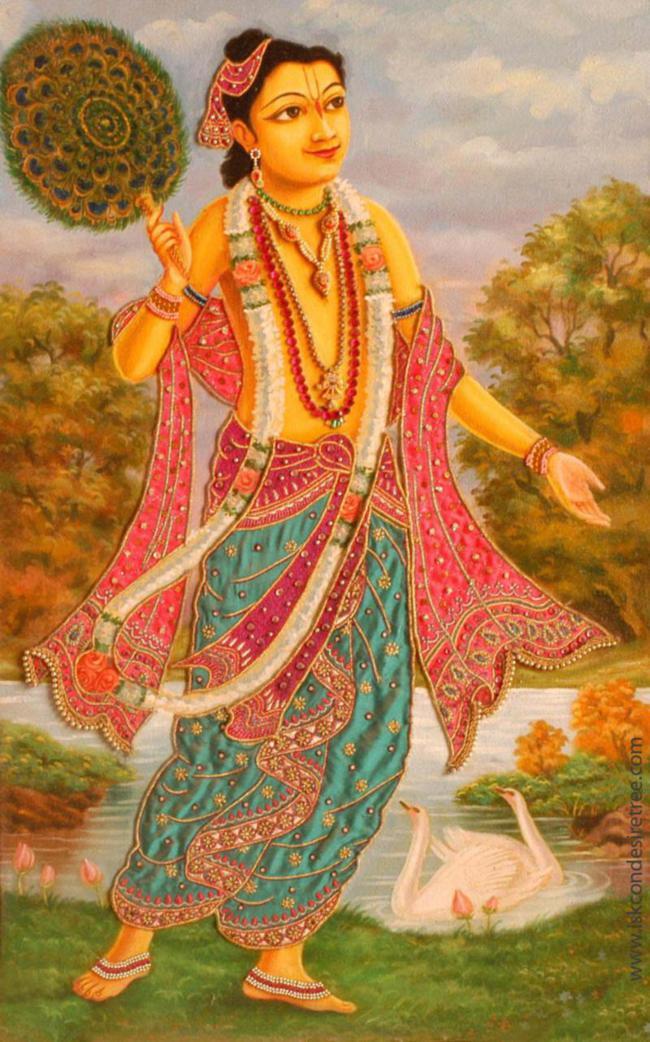
Introduction
Srila Abhirama Gopala Thakura was a Bengali devotee of the fifteenth and sixteenth centuries. He is remembered as one of the most vigorous preachers among the associates of Nityananda Prabhu. Sri Chaitanya-charitamrita counts him, under the name Ramadasa, among the "chief branches" of Nityananda Prabhu's own devotional family. Gaudiya tradition places his sripat at Khanakula Krishnanagara in the Hooghly district of Bengal, where the Gopinatha Deity he established is still worshiped today. Almost everything told about him later, such as his giant flute, his whip of prema, and his temple, comes back to one simple picture of him. He was so fully devoted to Sri Chaitanya Mahaprabhu's sankirtana movement that he used his own house only for kirtana and for feeding Vaishnava pilgrims, never for sleep.
| Detail | Description |
|---|---|
| Also known as | Abhirama Thakura, Rama Dasa, Ramadasa, Bhirama Dasa |
| Family | Born a brahmana; wife Sri Malini-devi |
| Spiritual authority | Empowered and directed by Nityananda Prabhu |
| Sripat / temple | Khanakula Krishnanagara, Hooghly district, Bengal |
| Deity worshiped | Sri Gopinathaji, with a Salagrama-sila and other Deities |
| Identity | Sridama, cowherd friend of Krishna in Vraja (Gaura-ganoddesha-dipika 126; Chaitanya-charitamrita Adi 11.13 purport) |
| Disappearance day observed | Krishna Saptami, the dark seventh of the month of Chaitra |
At a Glance
- Counted among Nityananda Prabhu's own circle of twelve gopalas, and identified in Kavi Karnapura's Gaura-ganoddesha-dipika as Sridama, one of Krishna's closest cowherd friends in Vrindavana.
- Sent to Bengal by Sri Chaitanya Mahaprabhu's own order, together with Gadadhara dasa, to assist Nityananda Prabhu's preaching there.
- Remembered for pulling a huge log from the forest, one that many men together could not lift, and turning it into a flute in a burst of sakhya-rasa.
- Carried a whip named Jaya-mangala, said to awaken Krishna-prema in anyone it touched, including a young Srinivasa Acharya.
- Excavated the Gopinatha Deity at Khanakula Krishnanagara after the Deity appeared to him in a dream, founding a temple and pilgrimage site still active today.
Scriptural evidence for the introduction (1)
पुरा श्रीदामनामासीदभिरामोऽधुना महान् ।
द्वात्रिंशता जनैरेव बाह्यं काष्ठमुवाह यः ॥१२६॥
purā śrīdāma-nāmāsīd abhirāmo’dhunā mahān |
dvātriṁśatā janair eva bāhyaṁ kāṣṭham uvāha yaḥ ||126||
The cowherd boy named Sridama appeared in Lord Caitanya's pastimes as Ramadasa Abhirama dasa...
From the purport: Śrī Rāmadāsa, later known as Abhirāma Ṭhākura, was one of the twelve gopālas, or cowherd boyfriends, of Śrī Nityānanda Prabhu. The Gaura-gaṇoddeśa-dīpikā (126) states that Śrī Rāmadāsa was formerly Śrīdāmā.
Identifies Abhirama (Ramadasa) as Sridama. The second line speaks of the log he carried; only the first sentence of the published English is given here, because that English renders the second line differently (as a bamboo flute). Sanskrit: diacritic edition of the Gaura-ganoddesha-dipika; English translation as published at bvmlu.org. Purport excerpt: Srila Prabhupada, Chaitanya-charitamrita Adi 11.13.
Chapter 1
Birth and Early Life
A brahmana household, a name among Nityananda Prabhu's twelve gopalas, and a marriage made at the Lord's own request.
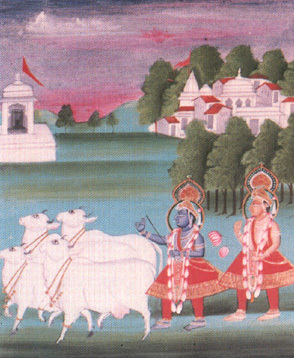
No source gives Abhirama Gopala Thakura a birth year, a birthplace, or the names of his parents. We state this gap plainly and do not hide it, because for most other Gaudiya Vaishnava acharyas of this era at least an approximate decade or a home village is recorded. The little that can be said with reasonable confidence comes from later devotional biographies, mainly the Bhakti-ratnakara of Narahari Chakravarti, and from Bhaktisiddhanta Sarasvati Thakura's own Anubhasya commentary on Sri Chaitanya-charitamrita.
| Detail | Description |
|---|---|
| Family background | Born a brahmana; became learned in scripture, music, dance |
| Wife | Sri Malini-devi |
| Marriage arranged by | Nityananda Prabhu's own request |
| Other names | Rama Dasa, Ramadasa, Bhirama Dasa |
| Gaura-lila grouping | One of Nityananda Prabhu's twelve gopalas |
A Scholar's Household #
Abhirama was born into a brahmana family, and all accounts agree that he made good use of that upbringing. He became a genuine scholar of the scriptures. He was also a skilled musician, singer and dancer, which was unusual for an ascetic-minded devotee. In a later English translation, the Bhakti-ratnakara's own description calls him a man who "became a scholar in all the scriptures and was an unequalled musician, not only in song and playing musical instruments, but in dance also." The exact wording may not match Narahari Chakravarti's original Bengali closely. But the basic claim is the same in every source. Abhirama did not come to Krishna consciousness from ignorance. He brought real learning and real artistic skill into the service of Nityananda Prabhu's mission.
One of Nityananda Prabhu's Twelve Gopalas #
Gaudiya tradition speaks of a circle of twelve gopalas around Nityananda Prabhu. They correspond to the twelve cowherd-boy companions of Krishna Himself in Vrindavana. This is a way of saying that Nityananda Prabhu's own close associates in Gaura-lila reflect the eternal friendships of Krishna-lila. Abhirama Gopala Thakura is counted in this circle. His double name, Abhirama Gopala ("the cowherd who delights"), reflects that identity directly. The page spiritual-identity-and-teachings explains exactly what identity the Gaura-ganoddesha-dipika gives him, and how confidently the tradition holds to it.
A Marriage at the Lord's Request #
Every biographical source agrees that Abhirama married Sri Malini-devi because Nityananda Prabhu asked him to. It was not a decision he made on his own. It was an order from the Lord he served. Malini-devi herself is remembered as a woman of real spiritual power, not only as a supporting figure. Later tradition says she had enough wisdom, and enough authority in her own household, to step in directly when her husband's ecstatic behavior threatened to overwhelm a young guest. That story is told in full on spiritual-identity-and-teachings. Abhirama's intensity as a devotee was plain to see, yet he was directed toward marriage and not renunciation. This itself tells us something. Nityananda Prabhu's preaching mission in Bengal needed householders who could open their homes to the public, not solitary ascetics.
A House That Never Slept #
The clearest single description of Abhirama's early adult life is repeated in similar words in several sources. It says that he "used his home for preaching and serving Vaishnava pilgrims, not for sleeping." His house is remembered as a place that resounded constantly with kirtana and with Krishna-katha, discussion of Krishna's pastimes. It was also a stopping place for genuine devotees passing through the region. This detail is more important than it may first seem. It is the earliest reliable sign of what Abhirama actually did with his life, years before any Deity was dug up or any temple built at Khanakula Krishnanagara. So even before he founded a temple, he was already living as a full-time preacher under Sri Chaitanya Mahaprabhu's sankirtana movement. This role is explored further on association-with-sri-chaitanya-mahaprabhu.
Scriptural evidence for this chapter (1)
He was intoxicated as though he had been possessed by Nityananda Prabhu, and his enchanting mercies are famed throughout the world. Taking birth in a brahmana family, he became a scholar in all the scriptures and was an unequalled musician, not only in song and playing musical instruments, but in dance also.
Rendered in Srila Bhakti Ballabh Tirtha Maharaja's Sri Chaitanya: His Life and Associates, quoted via gaudiyahistory.iskcondesiretree.com; not independently checked against a scholarly edition of Bhakti-ratnakara, so treated here as a secondary source rather than a vedabase-verified citation.
Chapter 2
Association with Sri Chaitanya Mahaprabhu
Sent to Bengal by Mahaprabhu's own order, and remembered for testing a boy in Puri who was protected by the Lord's mercy.
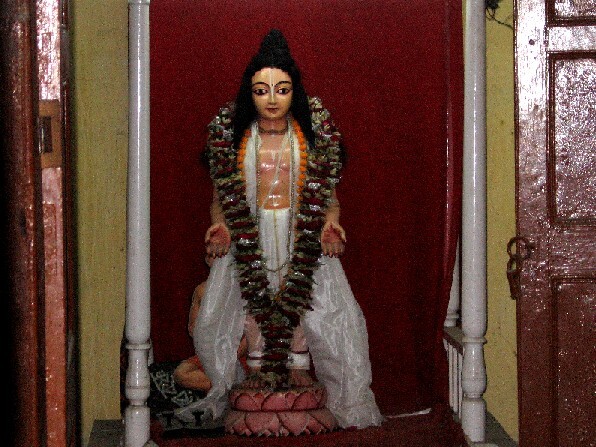
Abhirama Gopala Thakura's clearest appearance in the texts is short but specific. Krishnadasa Kaviraja Goswami names him, as Sri Ramadasa, in the eleventh chapter of the Adi-lila of Sri Chaitanya-charitamrita. That chapter is devoted entirely to listing the expansions and associates of Nityananda Prabhu. The place where he is named itself tells us something. Abhirama's story cannot be separated from Nityananda Prabhu's. But the text is equally clear that his service reached back directly to Sri Chaitanya Mahaprabhu.
| Detail | Description |
|---|---|
| Primary textual source | Sri Chaitanya-charitamrita, Adi-lila 11.13-15 |
| Constant companion mentioned alongside him | Gadadhara dasa |
| Household he and Gadadhara dasa stayed with | Sri Virabhadra Gosani (Nityananda Prabhu's son) |
| Order to preach in Bengal | Given by Sri Chaitanya Mahaprabhu, carried out through Nityananda Prabhu |
| Reported Puri connection | Testing Gopala Guru Goswami as a boy, protected by Mahaprabhu's own mercy |
Counted Among Both Circles #
Chaitanya-charitamrita states plainly that "two devotees of Lord Chaitanya named Sri Ramadasa and Gadadhara dasa always lived with Sri Virabhadra Gosani." Virabhadra Gosani is Nityananda Prabhu's own son. So this single verse shows that Abhirama's service reached across more than one generation of Nityananda Prabhu's family. He is remembered as a companion from Nityananda Prabhu's own early years in Bengal. He is also remembered as someone who continued serving that household afterward. The very next verses explain why he can be called a devotee of both Lords: "when Nityananda Prabhu was ordered to go to Bengal to preach, these two devotees were ordered to go with Him. Thus they are sometimes counted among the devotees of Lord Chaitanya and sometimes among the devotees of Lord Nityananda." In other words, the order to preach came from Mahaprabhu himself, and Abhirama's entire mission in Bengal exists because of it.
The Order to Preach in Gauda-desha #
This detail is easy to miss, but it is the single clearest link between Abhirama and Sri Chaitanya Mahaprabhu in the most authoritative source we have. Mahaprabhu directed Nityananda Prabhu to preach in Gauda-desha, Bengal, and Mahaprabhu sent Abhirama and Gadadhara dasa along with him. Everything that follows in Abhirama's story happens inside a mission that Mahaprabhu himself started. This includes the preaching house that never slept, the Deity later found at Khanakula Krishnanagara, and the whip and the flute described on spiritual-identity-and-teachings.
Testing Gopala Guru Goswami in Puri #
A separate tradition is recorded in the Bhakti-ratnakara and repeated in modern retellings. It places Abhirama in Puri during Sri Chaitanya Mahaprabhu's own lifetime. There he is said to have tested the young Gopala Guru Goswami, who was then a small boy living in Mahaprabhu's company. He tested the boy with the same unusual pranama that could crack an ordinary stone. Because Mahaprabhu had placed His own potency in the boy, the story goes, Gopala Guru Goswami came through unharmed. This episode does not have a Chaitanya-charitamrita citation, as Adi 11.13-15 does. So it should be read as devotional tradition, not as an event recorded in scripture. But it is worth including, because it is the one place where several independent retellings put Abhirama close to Mahaprabhu Himself, and not only to Nityananda Prabhu's circle.
What This Says About His Place in the Movement #
Taken together, the Chaitanya-charitamrita verses and the Puri tradition give a consistent picture. Abhirama Gopala Thakura was never simply a regional Bengali preacher working far away from Sri Chaitanya Mahaprabhu. He is named together with Gadadhara dasa as a devotee who moved between Mahaprabhu's own circle and Nityananda Prabhu's household. He was sent out on a mission that both Lords helped to set up. Kavi Karnapura's Gaura-ganoddesha-dipika says who he actually is in Krishna's own pastimes. This deeper spiritual identity behind his mission is the subject of spiritual-identity-and-teachings.
Scriptural evidence for this chapter (2)
Quoted in the text above:
- Adi 11.13 Sri Chaitanya-charitamrita
Further verses:
নিত্যানন্দে আজ্ঞা দিল যবে গৌড়ে যাইতে ।
মহাপ্রভু এই দুই দিলা তাঁর সাথে ॥ ১৪ ॥
অতএব দুইগণে দুঁহার গণন ।
মাধব–বাসুদেব ঘোষেরও এই বিবরণ ॥ ১৫ ॥
nityanande ajna dila yabe gaude yaite
mahaprabhu ei dui dila tanra sathe
ataeva dui-gane dunhara ganana
madhava-vasudeva ghoserao ei vivarana
Word for word
nityanande: unto Lord Nityananda; ajna: order; dila: gave; yabe: when; gaude: to Bengal; yaite: to go; mahaprabhu: Sri Chaitanya Mahaprabhu; ei dui: these two; dila: gave; tanra sathe: with Him; ataeva: therefore; dui-gane: in both the parties; dunhara: two of them; ganana: are counted.
When Nityananda Prabhu was ordered to go to Bengal to preach, these two devotees [Sri Ramadasa and Gadadhara dasa] were ordered to go with Him. Thus they are sometimes counted among the devotees of Lord Chaitanya and sometimes among the devotees of Lord Nityananda.
This verse is the direct textual basis for saying that Sri Chaitanya Mahaprabhu himself, not only Nityananda Prabhu, sent Abhirama Thakura to preach in Bengal.
Chapter 3
Spiritual Identity and Teachings
Sridama of Vrindavana in Krishna's own pastimes, and the ecstatic feats that made Abhirama Thakura famous in Gaura-lila.
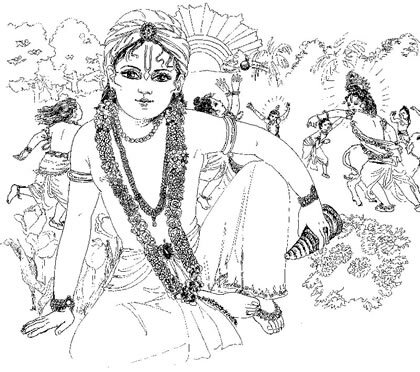
Kavi Karnapura's Gaura-ganoddesha-dipika is the traditional key to who Sri Chaitanya Mahaprabhu's associates were in Krishna's own Vraja pastimes. It gives a direct answer for Abhirama. Verse 126 states that Ramadasa (Abhirama's name in Chaitanya-charitamrita) was formerly Sridama, one of Krishna's closest cowherd-boy friends in Vrindavana. Every source gives the same identification, and none proposes a different one. The sources do not differ about who he is. They differ only in how much detailed story has grown up around that identity in later retellings, and we keep these two things clearly separate.
| Detail | Description |
|---|---|
| Identity in Gaura-ganoddesha-dipika | Sridama, cowherd friend of Krishna (verse 126) |
| Devotional mood | Sakhya-rasa, fraternal love of Krishna |
| Signature flute | Made from a giant log, per Sri Chaitanya-charitamrita Adi 11.16 |
| Signature whip | Jaya-mangala, said to awaken Krishna-prema on contact |
| Best-known recipient of the whip | Srinivasa Acharya, as a young man |
Sridama in Krishna's Vrindavana #
Sridama is remembered in Krishna-lila as one of the boldest and most senior of Krishna and Balarama's cowherd companions. He was a friend close enough to argue with Krishna, tease Him, and even wrestle with Him as an equal. Later Vaishnavas felt that this same boldness clearly appeared again in Abhirama Gopala Thakura's behaviour in Gaura-lila. He could perform astonishing feats of strength and showed unrestrained ecstasy, and he was completely at ease in his close friendship with Nityananda Prabhu. This sakhya-rasa mood is a mood of friendship, not of servitude, parental affection, or conjugal love. It is the one thread that ties together nearly every specific story told about him.
The Log That Became a Flute #
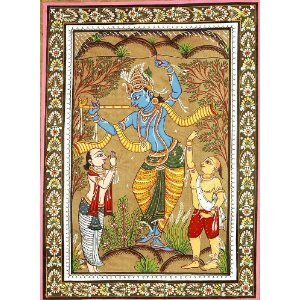
Chaitanya-charitamrita records the episode plainly: "Ramadasa, one of the chief branches, was full of fraternal love of Godhead. He made a flute from a stick with sixteen knots." Later retellings turn this into a fuller scene. In them, Abhirama is overwhelmed with longing to play a cowherd boy's flute, and he searches the forest. He finds a log so large that sixteen men together could not lift it, or thirty-two in some versions. He picks it up by himself and makes it into a flute. The core fact, an act of superhuman strength done in a mood of pure sakhya-prema, is what Chaitanya-charitamrita itself records. The exact number of men and knots varies between sources. This is a small but honest reminder that popular stories tend to become more detailed each time they are retold.
The Whip Called Jaya-Mangala #
Abhirama is remembered for carrying a whip named Jaya-mangala. It is said to have awakened symptoms of Krishna-prema in anyone it touched. The best-known story about it involves a young Srinivasa Acharya. He came to see Abhirama Thakura and was struck three times with the whip. At that point Malini-devi, Abhirama's wife, stepped in and asked her husband to stop. She was worried that so young a boy could not bear the strong effect the whip produced. Srinivasa Acharya is remembered as having been immersed in Krishna-prema by this meeting. He was never formally Abhirama's initiated disciple, but tradition treats him as truly dear to Abhirama in every important way. The whip itself is said to be still preserved and worshiped at the Khanakula Krishnanagara temple. Its place in Abhirama's wider legacy is discussed on disappearance-and-legacy.
A Fiery, Ecstatic Temperament #
Bhaktisiddhanta Sarasvati Thakura's own Anubhasya commentary keeps one especially vivid detail: "it is said that if he offered obeisances to any stone other than a shalagrama-shila, it would immediately fracture." Several sources add that nondevotees were frightened simply to be near him. His devotion is not described as soft or sentimental. Abhirama Gopala Thakura's devotion is remembered as forceful, even frightening. This is just how one might expect a bold, unrestrained sakhya-rasa nature to show itself once it is turned toward Krishna consciousness instead of away from it.
A Visit to Sri Khanda #
One further episode, again told through the Bhakti-ratnakara, shows how widely this reputation traveled among Sri Chaitanya Mahaprabhu's other associates. Abhirama Thakura once came to Sri Khanda hoping to meet Raghunandana Thakura, the young son of Mukunda dasa. Mukunda dasa knew what meeting Abhirama's ecstasy could do to his son. So he told Abhirama that Raghunandana was not there, and Abhirama turned back disappointed. Later Raghunandana learned that Abhirama Thakura had come looking for him. He ran to catch up, and the two met and danced together in ecstasy at a place called Bor Danga. During that dance Raghunandana's ankle-bracelet came loose and fell at a spot called Akaihat, where a devotee named Kaliya Krishna dasa had his own place of bhajana. Tradition says that the anklet is still worshiped there today, together with Kaliya Krishna Thakura's own Deity. It is a small story, but it places Abhirama within a real network of Bengali Vaishnava households in named places (Sri Khanda, Bor Danga, Akaihat). It shows that he was not an isolated figure known only through Khanakula Krishnanagara.
A Word on the Popular Retelling #
One widely circulated modern account turns the Sridama connection into a long story. In it, Krishna and Balarama forget Sridama during a game of hide-and-seek in Vraja. Then Nityananda Prabhu, as Balarama, travels back to fetch him, and there is a long exchange of dialogue. This version appears consistently across a handful of contemporary Gaudiya history and devotional websites. But it cannot be traced to Sri Chaitanya-charitamrita, Sri Chaitanya-bhagavata, or any dated Prabhupada lecture. It reads as a devotional story built up around the Gaura-ganoddesha-dipika identification, not as a pastime taken from scripture. So it is reported here only as a tradition devotees repeat, not as a verified episode from the texts.
Scriptural evidence for this chapter (2)
Quoted in the text above:
- Adi 11.16 Sri Chaitanya-charitamrita
Further verses:
Two devotees of Lord Chaitanya named Sri Ramadasa and Gadadhara dasa always lived with Sri Virabhadra Gosani.
From the purport: Purport excerpt: "It is said that if he offered obeisances to any stone other than a salagrama-sila, it would immediately fracture."
This line from Bhaktisiddhanta Sarasvati Thakura's Anubhasya is the textual basis for the story of Abhirama Thakura's obeisances cracking ordinary stones.
Chapter 4
Deity Worship at Khanakul Krishnanagar
How a dream led to the discovery of Sri Gopinathaji, and the pilgrimage site that grew up around Him.
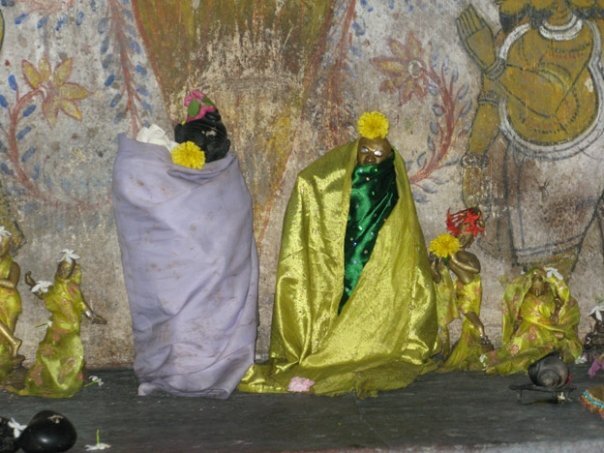
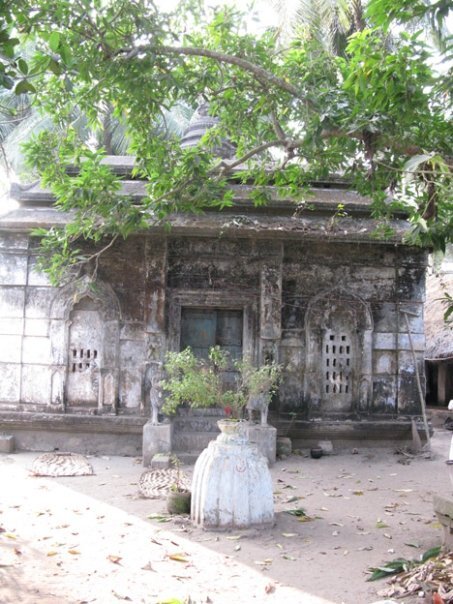
Khanakula Krishnanagara is a small town in the Hooghly district of West Bengal. It stands on the bank (kula) of the Dvarakeshvara River, which is locally called the Khana. Together, "Khana-kula" and "Krishnanagara" give the site its full name. Wikipedia's entry on Khanakul separately confirms the district location and a Gopinath Temple standing in the area today. This outside confirmation is useful, because the fuller history of the place comes down to us mainly through Gaudiya Vaishnava sources, not through general reference works.
| Detail | Description |
|---|---|
| Location | Khanakula Krishnanagara, on the Dvarakeshvara (Khana) River, Hooghly district, Bengal |
| Deity | Sri Gopinathaji; one source also names Vrajavallabha, Gopala and a Salagrama-sila in the temple |
| Discovery site | A tank known as Rama Kunda (also called Sri Abhirama Kunda) |
| Landmark tree | Siddha-bakula, just outside the temple |
| Annual festival | Krishna Saptami, the dark seventh of Chaitra (March-April) |
| Notable visitor | Bhaktisiddhanta Sarasvati Thakura, during his Gaura Mandala parikrama |
A Dream and a Buried Deity #
Every source agrees on the basic shape of the story: the Deity of Sri Gopinatha appeared to Abhirama Thakura in a dream and told him, in effect, "I am buried in the earth here; take Me out and worship Me." Abhirama went to the indicated spot and began digging, and after some time uncovered what is described as an extraordinarily beautiful form of Gopinatha. Bhakti-ratnakara's own account of the aftermath, as rendered in a later translation, describes the site this way: "In the place where Sri Gopinatha appeared a lake was formed, and the water contained therein was sweet as nectar. Whoever bathed in or drank that water became beside himself with ecstasy." That lake is remembered today as Rama Kunda.
Rama Kunda and the Siddha-bakula #
Two physical landmarks from this story are still pointed out at the site. One is Rama Kunda itself, the tank formed where the Deity was dug out. The other is a large bakula tree just outside the temple, known as Siddha-bakula-kunja, where Abhirama Thakura is remembered to have liked sitting. Bhaktisiddhanta Sarasvati Thakura's Anubhasya gives exact directions for pilgrims of his own generation. It names the nearby railway stations and the route from Howrah. It also notes that by his time the temple's history was already very old, and that a number of sevaita families lived near it to maintain the Deity's worship. A large fair is still held at Khanakula Krishnanagara every year on the Krishna Saptami in the month of Chaitra. According to the Anubhasya's own description, it draws hundreds and thousands of visitors. This is the same date kept as Abhirama Thakura's disappearance day. That connection is followed further on disappearance-and-legacy.
Finding the Way There #
Bhaktisiddhanta Sarasvati Thakura's Anubhasya describes the route to Khanakula Krishnanagara so exactly that it reads almost like a pilgrim's travel note. The town is ten miles southwest of the Chapadanga railway station, on the narrow-gauge line running from Howrah to Amta, in the Hooghly district. He adds that during the rainy season, when that route floods, pilgrims had to go another way. They travelled by the South Eastern Railway to a station called Kolaghat, then by steamer to Ranichawk, and from there seven and a half miles north to reach Khanakula itself. This is not the kind of specific, practical detail a later writer would invent. So it is itself a small piece of evidence that the site was already a well-established place of pilgrimage by Bhaktisiddhanta Sarasvati Thakura's own time.
A Living Pilgrimage Site #
It is recorded that Bhaktisiddhanta Sarasvati Thakura personally visited Khanakula Krishnanagara while touring on parikrama of Sri Gaura Mandala. It is also recorded that the families still responsible for the temple's seva received him there with special hospitality. This detail connects Bhaktisiddhanta Sarasvati Thakura himself, generations later, directly to the site Abhirama founded. Khanakula Krishnanagara is not the only place where a Deity came to light because a devotee acted on an unusual sign. Gauridasa Pandit's neem-wood Deities of Gaura-Nitai at Ambika Kalna have a similarly direct story of how the Deities came to be there. In both cases the site is still an active place of worship and pilgrimage centuries later, not just a piece of history. What became of Abhirama's own disciples and the temple's worship after his disappearance is told on disappearance-and-legacy.
Scriptural evidence for this chapter (2)
Two devotees of Lord Chaitanya named Sri Ramadasa and Gadadhara dasa always lived with Sri Virabhadra Gosani.
From the purport: Purport excerpt: "The temple where Abhirama Thakura worshiped is situated in Krishnanagara, which is near the kula (bank) of the Khana (Dvarakesvara River); therefore this place is celebrated as Khanakula-krishnanagara."
Bhaktisiddhanta Sarasvati Thakura's Anubhasya, quoted in this purport, is the source for the place-name etymology of Khanakula Krishnanagara.
In the place where Sri Gopinathaji appeared a lake was formed, and the water contained therein was sweet as nectar. Whoever bathed in or drank that water became beside himself with ecstasy. Thereafter, this land has become famous as Rama Kunda.
Cited here as the traditional account of how Rama Kunda got its name at the site of the Gopinatha Deity's discovery; this English rendering comes via a modern retelling rather than a scholarly edition of Bhakti-ratnakara, so it is reported as devotional tradition rather than a vedabase-verified translation.
Chapter 5
Disappearance and Legacy
The children he tested, the whip still preserved at his temple, and what is still uncertain about his final years.
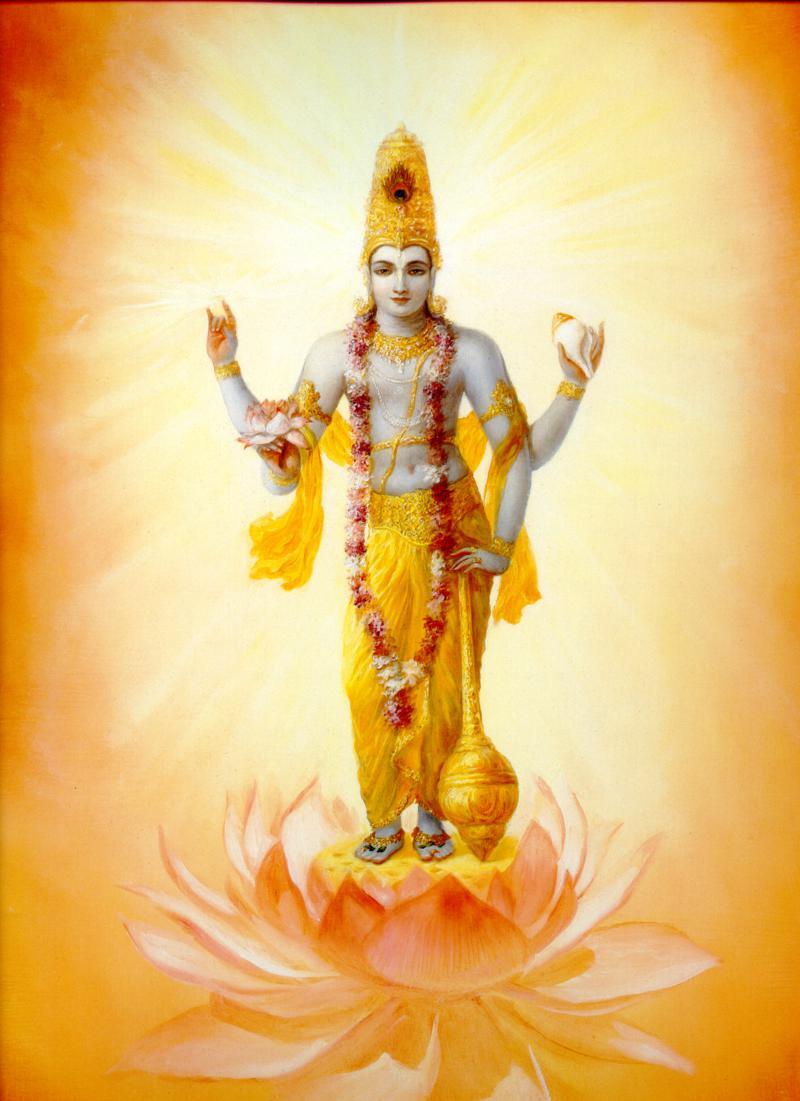
Devotees keep Abhirama Gopala Thakura's disappearance day on Krishna Saptami, the seventh day of the dark fortnight of the month of Chaitra. This is the same date as the large annual mela held at his temple in Khanakula Krishnanagara. No source records a year for either his birth or his disappearance, so we report that gap here instead of guessing.
| Detail | Description |
|---|---|
| Disappearance day observed | Krishna Saptami of Chaitra (year not recorded) |
| Composed in tribute | Verses for Ganga-devi; Sri Virabhadrastakam for Virachandra Prabhu |
| Whip preserved today | Jaya-mangala, said to still be kept at the Khanakula Krishnanagara temple |
| Associated site in Puri | Bali Math, by tradition ("many people say") |
| Most celebrated recipient of his grace | Srinivasa Acharya, though not his formally initiated disciple |
Testing the Children of Nityananda Prabhu #
One of the more striking stories told about Abhirama concerns his obeisances to the newborn children of Nityananda Prabhu and Vasudha-devi. His pranama was said to be powerful enough to crack an ordinary stone. Tradition holds that for this reason several of Nityananda Prabhu's children did not survive when these same obeisances were offered to them as infants. Then a daughter, Ganga-devi, was born, and she was not affected. Seeing this, Abhirama is remembered as exclaiming his relief that "this time we haven't been deceived," and as composing a hundred verses in her honor. Later a son, Virachandra Prabhu, was born, and he too was not harmed by Abhirama's obeisances. Abhirama then composed Sri Virabhadrastakam, eight verses in his praise. According to the tradition's own reasoning, this confirmed that both children had a truly divine nature.
Sri Virabhadrastakam and the Surviving Verses #
Two compositions are said to be Abhirama's. They are the verses for Ganga-devi and the Sri Virabhadrastakam for Virachandra Prabhu. No surviving text of either one could be found in an independent source. They are only mentioned in retellings of the Bhakti-ratnakara by later writers. So they are recorded here as part of how he is remembered, not as texts that can be quoted or checked directly. Readers looking for the actual verses will need to look in a scholarly edition of the Bhakti-ratnakara itself.
The Whip That Outlived Him #
The page spiritual-identity-and-teachings describes in full what the whip called Jaya-mangala was said to do to a young Srinivasa Acharya. More than one source reports that this whip is preserved and still worshiped at the Khanakula Krishnanagara temple today. It is a physical link between the living pilgrimage site described on deity-worship-at-khanakul-krishnanagar and the specific pastimes told about its founder, Abhirama.
What Remains Open #
Several details about Abhirama's later life and legacy cannot be confirmed with confidence. Tradition credits him with founding the Bali Math in Puri. But the available sources are themselves careful about this claim. The phrase one retelling uses is "many people say," and that is not the same as a recorded founding. One brief modern account places his samadhi at a site described only as a "64 Samadhis Area," but it does not say where that is or how it relates to his own temple at Khanakula Krishnanagara. We could not verify or explain that reference further. Every source agrees that Srinivasa Acharya was never formally initiated by Abhirama, even though he is remembered as receiving deep grace from him. Beyond Srinivasa Acharya, no source names a recorded chain of initiated disciples who carried Abhirama's own diksha line forward. What remains clear, and is not disputed, is the temple itself: Sri Gopinathaji is still worshiped at Khanakula Krishnanagara, and an annual festival on Krishna Saptami continues to draw devotees to the site four centuries after the events it celebrates.
- Sri Chaitanya-charitamrita, Adi-lila 11.13, with Bhaktisiddhanta Sarasvati Thakura's Anubhasya commentary
- Sri Chaitanya-charitamrita, Adi-lila 11.14-15
- Sri Chaitanya-charitamrita, Adi-lila 11.16
- Gaudiya History (ISKCON Desire Tree): Abhirama Gopala Thakura
- Gaudiya History (ISKCON Desire Tree): Abhirama Gopala Thakura - Biography
- Gaudiya History (ISKCON Desire Tree): Abhirama Gopala Thakura - Biography (2)
- Gaudiya History (ISKCON Desire Tree): Abhirama Gopala Thakura (2)
- Gaudiya History (ISKCON Desire Tree): Sri Abhirama Gopala Thakura
- Dandavats: Abhirama Thakura
- ISVARA.org Vedic Library: Abhirama Gopal (Thakura)
