No source gives Abhirama Gopala Thakura a birth year, a birthplace, or the names of his parents. We state this gap plainly and do not hide it, because for most other Gaudiya Vaishnava acharyas of this era at least an approximate decade or a home village is recorded. The little that can be said with reasonable confidence comes from later devotional biographies, mainly the Bhakti-ratnakara of Narahari Chakravarti, and from Bhaktisiddhanta Sarasvati Thakura's own Anubhasya commentary on Sri Chaitanya-charitamrita.
| Detail | Description |
|---|---|
| Family background | Born a brahmana; became learned in scripture, music, dance |
| Wife | Sri Malini-devi |
| Marriage arranged by | Nityananda Prabhu's own request |
| Other names | Rama Dasa, Ramadasa, Bhirama Dasa |
| Gaura-lila grouping | One of Nityananda Prabhu's twelve gopalas |
A Scholar's Household #
Abhirama was born into a brahmana family, and all accounts agree that he made good use of that upbringing. He became a genuine scholar of the scriptures. He was also a skilled musician, singer and dancer, which was unusual for an ascetic-minded devotee. In a later English translation, the Bhakti-ratnakara's own description calls him a man who "became a scholar in all the scriptures and was an unequalled musician, not only in song and playing musical instruments, but in dance also." The exact wording may not match Narahari Chakravarti's original Bengali closely. But the basic claim is the same in every source. Abhirama did not come to Krishna consciousness from ignorance. He brought real learning and real artistic skill into the service of Nityananda Prabhu's mission.
One of Nityananda Prabhu's Twelve Gopalas #
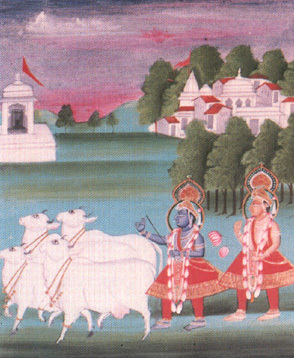
Gaudiya tradition speaks of a circle of twelve gopalas around Nityananda Prabhu. They correspond to the twelve cowherd-boy companions of Krishna Himself in Vrindavana. This is a way of saying that Nityananda Prabhu's own close associates in Gaura-lila reflect the eternal friendships of Krishna-lila. Abhirama Gopala Thakura is counted in this circle. His double name, Abhirama Gopala ("the cowherd who delights"), reflects that identity directly. The page spiritual-identity-and-teachings explains exactly what identity the Gaura-ganoddesha-dipika gives him, and how confidently the tradition holds to it.
A Marriage at the Lord's Request #
Every biographical source agrees that Abhirama married Sri Malini-devi because Nityananda Prabhu asked him to. It was not a decision he made on his own. It was an order from the Lord he served. Malini-devi herself is remembered as a woman of real spiritual power, not only as a supporting figure. Later tradition says she had enough wisdom, and enough authority in her own household, to step in directly when her husband's ecstatic behavior threatened to overwhelm a young guest. That story is told in full on spiritual-identity-and-teachings. Abhirama's intensity as a devotee was plain to see, yet he was directed toward marriage and not renunciation. This itself tells us something. Nityananda Prabhu's preaching mission in Bengal needed householders who could open their homes to the public, not solitary ascetics.
A House That Never Slept #
The clearest single description of Abhirama's early adult life is repeated in similar words in several sources. It says that he "used his home for preaching and serving Vaishnava pilgrims, not for sleeping." His house is remembered as a place that resounded constantly with kirtana and with Krishna-katha, discussion of Krishna's pastimes. It was also a stopping place for genuine devotees passing through the region. This detail is more important than it may first seem. It is the earliest reliable sign of what Abhirama actually did with his life, years before any Deity was dug up or any temple built at Khanakula Krishnanagara. So even before he founded a temple, he was already living as a full-time preacher under Sri Chaitanya Mahaprabhu's sankirtana movement. This role is explored further on association-with-sri-chaitanya-mahaprabhu.
