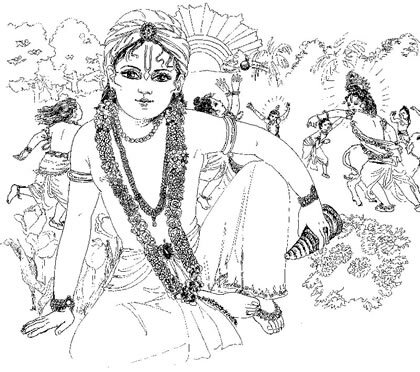
Kavi Karnapura's Gaura-ganoddesha-dipika is the traditional key to who Sri Chaitanya Mahaprabhu's associates were in Krishna's own Vraja pastimes. It gives a direct answer for Abhirama. Verse 126 states that Ramadasa (Abhirama's name in Chaitanya-charitamrita) was formerly Sridama, one of Krishna's closest cowherd-boy friends in Vrindavana. Every source gives the same identification, and none proposes a different one. The sources do not differ about who he is. They differ only in how much detailed story has grown up around that identity in later retellings, and we keep these two things clearly separate.
| Detail | Description |
|---|---|
| Identity in Gaura-ganoddesha-dipika | Sridama, cowherd friend of Krishna (verse 126) |
| Devotional mood | Sakhya-rasa, fraternal love of Krishna |
| Signature flute | Made from a giant log, per Sri Chaitanya-charitamrita Adi 11.16 |
| Signature whip | Jaya-mangala, said to awaken Krishna-prema on contact |
| Best-known recipient of the whip | Srinivasa Acharya, as a young man |
Sridama in Krishna's Vrindavana #
Sridama is remembered in Krishna-lila as one of the boldest and most senior of Krishna and Balarama's cowherd companions. He was a friend close enough to argue with Krishna, tease Him, and even wrestle with Him as an equal. Later Vaishnavas felt that this same boldness clearly appeared again in Abhirama Gopala Thakura's behaviour in Gaura-lila. He could perform astonishing feats of strength and showed unrestrained ecstasy, and he was completely at ease in his close friendship with Nityananda Prabhu. This sakhya-rasa mood is a mood of friendship, not of servitude, parental affection, or conjugal love. It is the one thread that ties together nearly every specific story told about him.
The Log That Became a Flute #
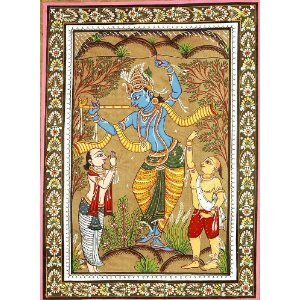
Chaitanya-charitamrita records the episode plainly: "Ramadasa, one of the chief branches, was full of fraternal love of Godhead. He made a flute from a stick with sixteen knots." Later retellings turn this into a fuller scene. In them, Abhirama is overwhelmed with longing to play a cowherd boy's flute, and he searches the forest. He finds a log so large that sixteen men together could not lift it, or thirty-two in some versions. He picks it up by himself and makes it into a flute. The core fact, an act of superhuman strength done in a mood of pure sakhya-prema, is what Chaitanya-charitamrita itself records. The exact number of men and knots varies between sources. This is a small but honest reminder that popular stories tend to become more detailed each time they are retold.
The Whip Called Jaya-Mangala #
Abhirama is remembered for carrying a whip named Jaya-mangala. It is said to have awakened symptoms of Krishna-prema in anyone it touched. The best-known story about it involves a young Srinivasa Acharya. He came to see Abhirama Thakura and was struck three times with the whip. At that point Malini-devi, Abhirama's wife, stepped in and asked her husband to stop. She was worried that so young a boy could not bear the strong effect the whip produced. Srinivasa Acharya is remembered as having been immersed in Krishna-prema by this meeting. He was never formally Abhirama's initiated disciple, but tradition treats him as truly dear to Abhirama in every important way. The whip itself is said to be still preserved and worshiped at the Khanakula Krishnanagara temple. Its place in Abhirama's wider legacy is discussed on disappearance-and-legacy.
A Fiery, Ecstatic Temperament #
Bhaktisiddhanta Sarasvati Thakura's own Anubhasya commentary keeps one especially vivid detail: "it is said that if he offered obeisances to any stone other than a shalagrama-shila, it would immediately fracture." Several sources add that nondevotees were frightened simply to be near him. His devotion is not described as soft or sentimental. Abhirama Gopala Thakura's devotion is remembered as forceful, even frightening. This is just how one might expect a bold, unrestrained sakhya-rasa nature to show itself once it is turned toward Krishna consciousness instead of away from it.
A Visit to Sri Khanda #
One further episode, again told through the Bhakti-ratnakara, shows how widely this reputation traveled among Sri Chaitanya Mahaprabhu's other associates. Abhirama Thakura once came to Sri Khanda hoping to meet Raghunandana Thakura, the young son of Mukunda dasa. Mukunda dasa knew what meeting Abhirama's ecstasy could do to his son. So he told Abhirama that Raghunandana was not there, and Abhirama turned back disappointed. Later Raghunandana learned that Abhirama Thakura had come looking for him. He ran to catch up, and the two met and danced together in ecstasy at a place called Bor Danga. During that dance Raghunandana's ankle-bracelet came loose and fell at a spot called Akaihat, where a devotee named Kaliya Krishna dasa had his own place of bhajana. Tradition says that the anklet is still worshiped there today, together with Kaliya Krishna Thakura's own Deity. It is a small story, but it places Abhirama within a real network of Bengali Vaishnava households in named places (Sri Khanda, Bor Danga, Akaihat). It shows that he was not an isolated figure known only through Khanakula Krishnanagara.
A Word on the Popular Retelling #
One widely circulated modern account turns the Sridama connection into a long story. In it, Krishna and Balarama forget Sridama during a game of hide-and-seek in Vraja. Then Nityananda Prabhu, as Balarama, travels back to fetch him, and there is a long exchange of dialogue. This version appears consistently across a handful of contemporary Gaudiya history and devotional websites. But it cannot be traced to Sri Chaitanya-charitamrita, Sri Chaitanya-bhagavata, or any dated Prabhupada lecture. It reads as a devotional story built up around the Gaura-ganoddesha-dipika identification, not as a pastime taken from scripture. So it is reported here only as a tradition devotees repeat, not as a verified episode from the texts.
