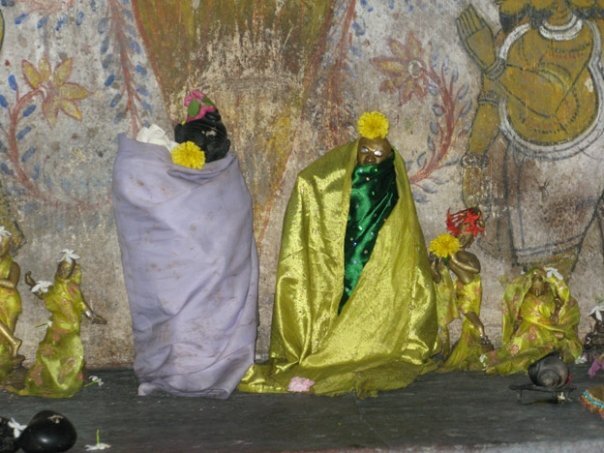
Khanakula Krishnanagara is a small town in the Hooghly district of West Bengal. It stands on the bank (kula) of the Dvarakeshvara River, which is locally called the Khana. Together, "Khana-kula" and "Krishnanagara" give the site its full name. Wikipedia's entry on Khanakul separately confirms the district location and a Gopinath Temple standing in the area today. This outside confirmation is useful, because the fuller history of the place comes down to us mainly through Gaudiya Vaishnava sources, not through general reference works.
| Detail | Description |
|---|---|
| Location | Khanakula Krishnanagara, on the Dvarakeshvara (Khana) River, Hooghly district, Bengal |
| Deity | Sri Gopinathaji; one source also names Vrajavallabha, Gopala and a Salagrama-sila in the temple |
| Discovery site | A tank known as Rama Kunda (also called Sri Abhirama Kunda) |
| Landmark tree | Siddha-bakula, just outside the temple |
| Annual festival | Krishna Saptami, the dark seventh of Chaitra (March-April) |
| Notable visitor | Bhaktisiddhanta Sarasvati Thakura, during his Gaura Mandala parikrama |
A Dream and a Buried Deity #
Every source agrees on the basic shape of the story: the Deity of Sri Gopinatha appeared to Abhirama Thakura in a dream and told him, in effect, "I am buried in the earth here; take Me out and worship Me." Abhirama went to the indicated spot and began digging, and after some time uncovered what is described as an extraordinarily beautiful form of Gopinatha. Bhakti-ratnakara's own account of the aftermath, as rendered in a later translation, describes the site this way: "In the place where Sri Gopinatha appeared a lake was formed, and the water contained therein was sweet as nectar. Whoever bathed in or drank that water became beside himself with ecstasy." That lake is remembered today as Rama Kunda.
Rama Kunda and the Siddha-bakula #
Two physical landmarks from this story are still pointed out at the site. One is Rama Kunda itself, the tank formed where the Deity was dug out. The other is a large bakula tree just outside the temple, known as Siddha-bakula-kunja, where Abhirama Thakura is remembered to have liked sitting. Bhaktisiddhanta Sarasvati Thakura's Anubhasya gives exact directions for pilgrims of his own generation. It names the nearby railway stations and the route from Howrah. It also notes that by his time the temple's history was already very old, and that a number of sevaita families lived near it to maintain the Deity's worship. A large fair is still held at Khanakula Krishnanagara every year on the Krishna Saptami in the month of Chaitra. According to the Anubhasya's own description, it draws hundreds and thousands of visitors. This is the same date kept as Abhirama Thakura's disappearance day. That connection is followed further on disappearance-and-legacy.
Finding the Way There #
Bhaktisiddhanta Sarasvati Thakura's Anubhasya describes the route to Khanakula Krishnanagara so exactly that it reads almost like a pilgrim's travel note. The town is ten miles southwest of the Chapadanga railway station, on the narrow-gauge line running from Howrah to Amta, in the Hooghly district. He adds that during the rainy season, when that route floods, pilgrims had to go another way. They travelled by the South Eastern Railway to a station called Kolaghat, then by steamer to Ranichawk, and from there seven and a half miles north to reach Khanakula itself. This is not the kind of specific, practical detail a later writer would invent. So it is itself a small piece of evidence that the site was already a well-established place of pilgrimage by Bhaktisiddhanta Sarasvati Thakura's own time.
A Living Pilgrimage Site #
It is recorded that Bhaktisiddhanta Sarasvati Thakura personally visited Khanakula Krishnanagara while touring on parikrama of Sri Gaura Mandala. It is also recorded that the families still responsible for the temple's seva received him there with special hospitality. This detail connects Bhaktisiddhanta Sarasvati Thakura himself, generations later, directly to the site Abhirama founded. Khanakula Krishnanagara is not the only place where a Deity came to light because a devotee acted on an unusual sign. Gauridasa Pandit's neem-wood Deities of Gaura-Nitai at Ambika Kalna have a similarly direct story of how the Deities came to be there. In both cases the site is still an active place of worship and pilgrimage centuries later, not just a piece of history. What became of Abhirama's own disciples and the temple's worship after his disappearance is told on disappearance-and-legacy.
