Devotees keep Abhirama Gopala Thakura's disappearance day on Krishna Saptami, the seventh day of the dark fortnight of the month of Chaitra. This is the same date as the large annual mela held at his temple in Khanakula Krishnanagara. No source records a year for either his birth or his disappearance, so we report that gap here instead of guessing.
| Detail | Description |
|---|---|
| Disappearance day observed | Krishna Saptami of Chaitra (year not recorded) |
| Composed in tribute | Verses for Ganga-devi; Sri Virabhadrastakam for Virachandra Prabhu |
| Whip preserved today | Jaya-mangala, said to still be kept at the Khanakula Krishnanagara temple |
| Associated site in Puri | Bali Math, by tradition ("many people say") |
| Most celebrated recipient of his grace | Srinivasa Acharya, though not his formally initiated disciple |
Testing the Children of Nityananda Prabhu #
One of the more striking stories told about Abhirama concerns his obeisances to the newborn children of Nityananda Prabhu and Vasudha-devi. His pranama was said to be powerful enough to crack an ordinary stone. Tradition holds that for this reason several of Nityananda Prabhu's children did not survive when these same obeisances were offered to them as infants. Then a daughter, Ganga-devi, was born, and she was not affected. Seeing this, Abhirama is remembered as exclaiming his relief that "this time we haven't been deceived," and as composing a hundred verses in her honor. Later a son, Virachandra Prabhu, was born, and he too was not harmed by Abhirama's obeisances. Abhirama then composed Sri Virabhadrastakam, eight verses in his praise. According to the tradition's own reasoning, this confirmed that both children had a truly divine nature.
Sri Virabhadrastakam and the Surviving Verses #
Two compositions are said to be Abhirama's. They are the verses for Ganga-devi and the Sri Virabhadrastakam for Virachandra Prabhu. No surviving text of either one could be found in an independent source. They are only mentioned in retellings of the Bhakti-ratnakara by later writers. So they are recorded here as part of how he is remembered, not as texts that can be quoted or checked directly. Readers looking for the actual verses will need to look in a scholarly edition of the Bhakti-ratnakara itself.
The Whip That Outlived Him #
The page spiritual-identity-and-teachings describes in full what the whip called Jaya-mangala was said to do to a young Srinivasa Acharya. More than one source reports that this whip is preserved and still worshiped at the Khanakula Krishnanagara temple today. It is a physical link between the living pilgrimage site described on deity-worship-at-khanakul-krishnanagar and the specific pastimes told about its founder, Abhirama.
What Remains Open #
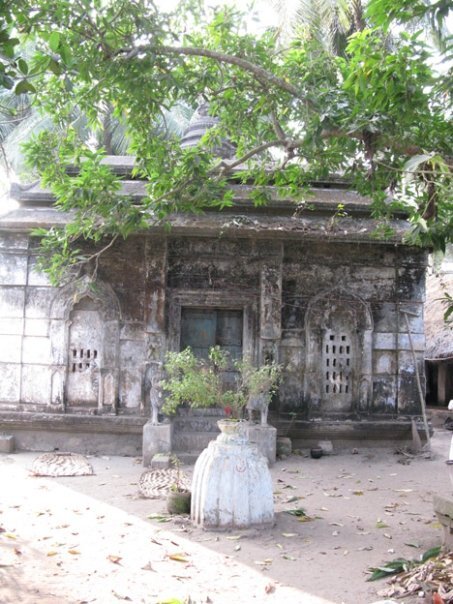
Several details about Abhirama's later life and legacy cannot be confirmed with confidence. Tradition credits him with founding the Bali Math in Puri. But the available sources are themselves careful about this claim. The phrase one retelling uses is "many people say," and that is not the same as a recorded founding. One brief modern account places his samadhi at a site described only as a "64 Samadhis Area," but it does not say where that is or how it relates to his own temple at Khanakula Krishnanagara. We could not verify or explain that reference further. Every source agrees that Srinivasa Acharya was never formally initiated by Abhirama, even though he is remembered as receiving deep grace from him. Beyond Srinivasa Acharya, no source names a recorded chain of initiated disciples who carried Abhirama's own diksha line forward. What remains clear, and is not disputed, is the temple itself: Sri Gopinathaji is still worshiped at Khanakula Krishnanagara, and an annual festival on Krishna Saptami continues to draw devotees to the site four centuries after the events it celebrates.
