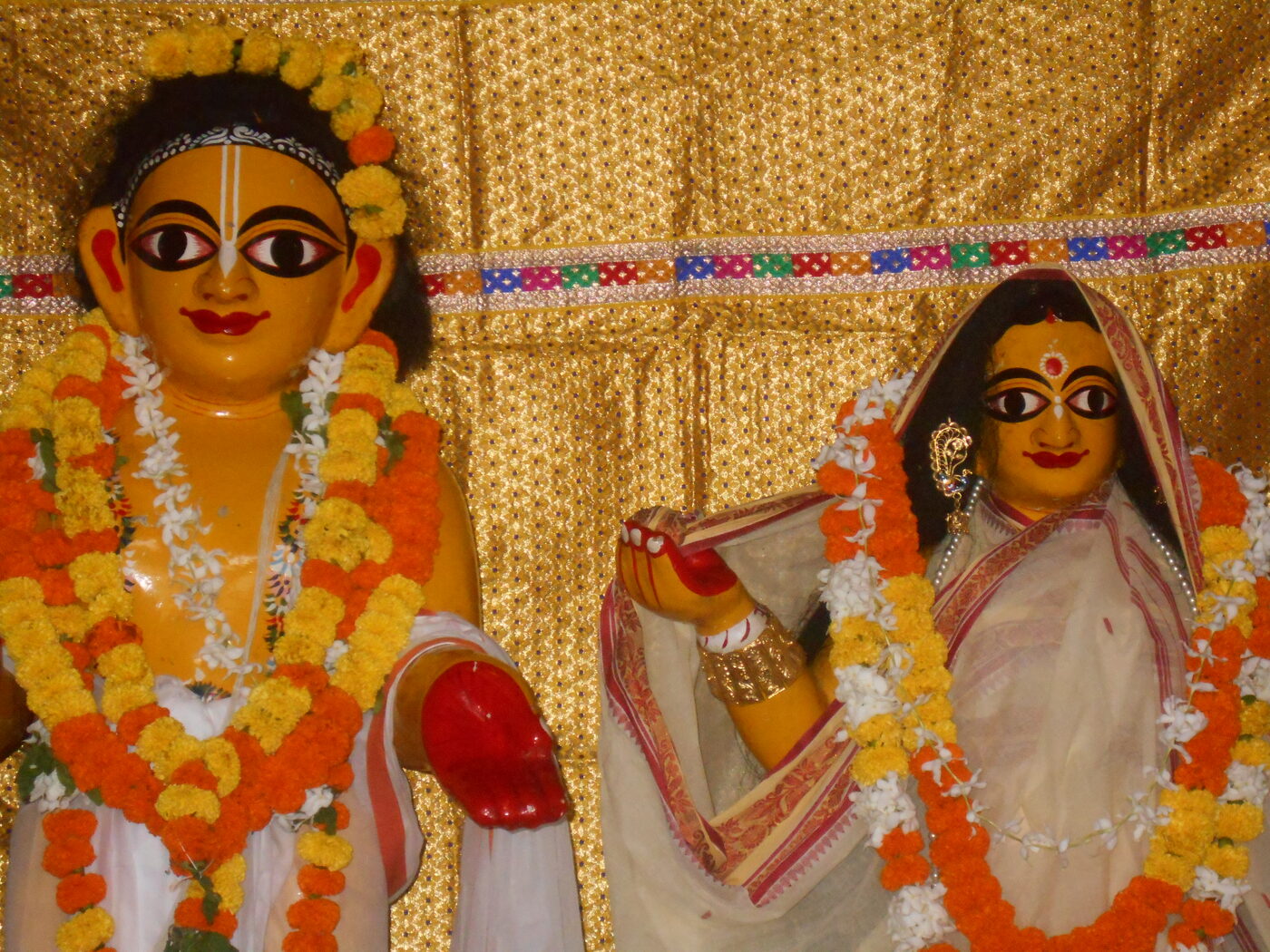
Advaita Acharya's wife was Sita Thakurani, the daughter of Sri Nrsimha Bhaduri. She is honoured throughout Bengal for herself, not only as the Acharya's wife. Vaishnava literature treats her as an incarnation of Yogamaya, the Lord's internal potency in its role of arranging the Lord's pastimes. The episode she is best remembered for fits that role completely. She was among the first outside the immediate family to go and see the newborn Mahaprabhu.
| Family member | Description |
|---|---|
| Advaita Acharya | Head of the household at Shantipura |
| Sita Thakurani | His wife, daughter of Sri Nrsimha Bhaduri, treated as an incarnation of Yogamaya |
| Acyutananda | The eldest son, a devotee of note from childhood |
| Other sons named | Krishna Mishra, Gopala, Balarama, Svarupa and Jagadisha |
| Note on the lists | The sources differ on the number of sons and on their order |
Naming the Newborn Nimai at Mayapur #
The accounts describe her setting out for Mayapur when word came that a son had been born to Jagannatha Mishra and Sachi Devi. She took with her the things one takes to a newborn: ornaments, cloth, turmeric, sandalwood, garlands, and gifts for the mother. She is said to have understood at once who the child really was. Sita Thakurani gave the child the name Nimai, after the nimba tree beside the house. Her reasoning was that a name taken from a bitter tree would protect Him from the attention of evil spirits. The name stayed with Him for twenty-four years, and Bengal still uses it.
Shantipura as the House of Refuge #
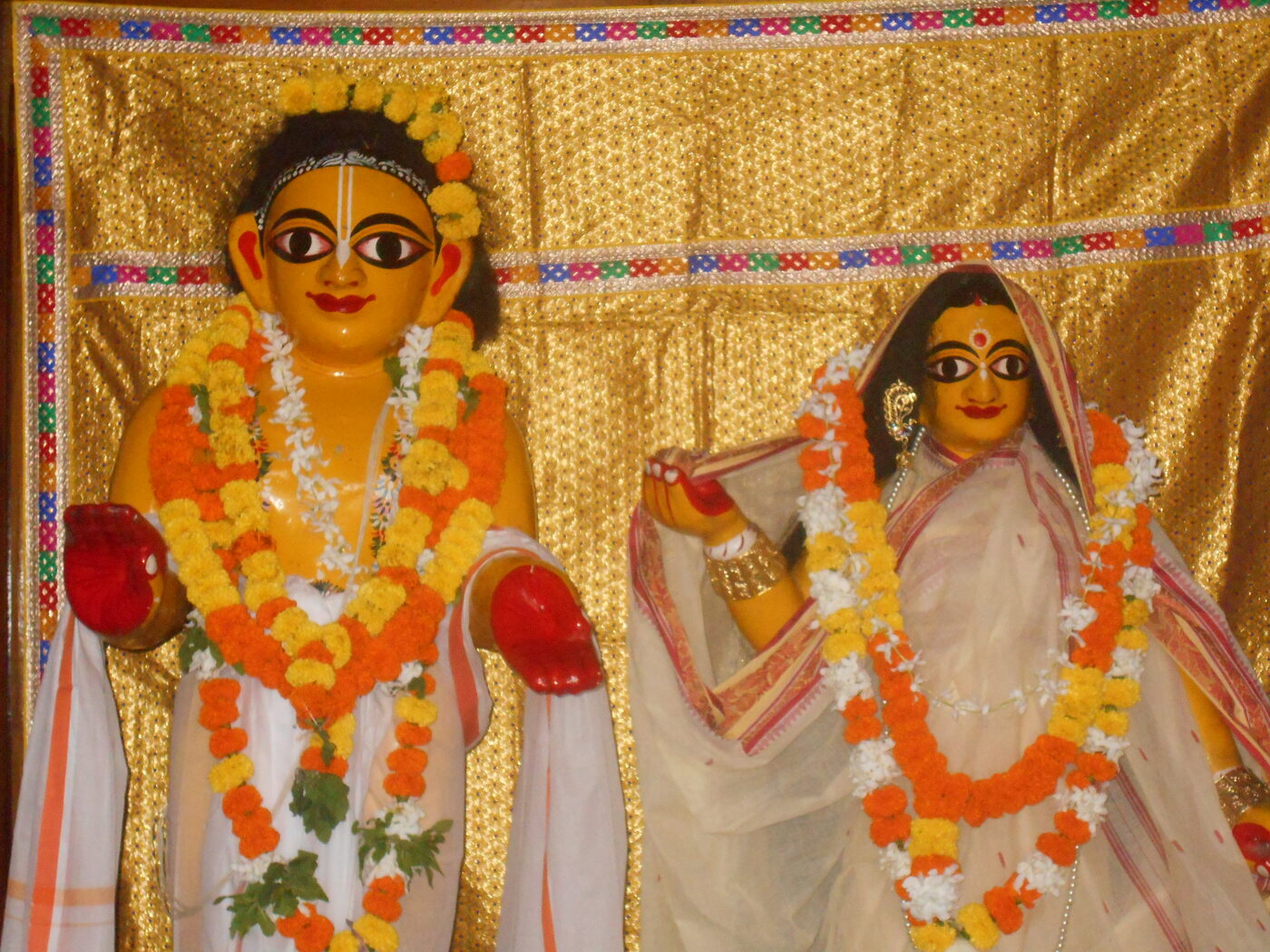
The household she and Advaita Acharya kept at Shantipura became one of the two or three main centres of the movement. Its role was different from the others. Srivasa Angan at Nabadwip was where the sankirtana began. Puri was where the Lord finally settled. Shantipura was the place of refuge and of hospitality. It was the house the Lord was brought to after sannyasa, where Sachi Devi could reach Him, and where devotees travelling between Bengal and Puri stopped. The Chaitanya-charitamrita describes Mahaprabhu eating there many times, with Sita Thakurani cooking and the house filling up with devotees. These homely scenes are part of why the place is remembered warmly.
The Sons of Advaita Acharya #
They had several sons. The eldest, Acyutananda, was a well-known devotee from childhood. The Chaitanya-charitamrita records that, while still a boy, he corrected an adult on a point of doctrine so directly that everyone present was astonished. Krishna Mishra, Gopala, Balarama, Svarupa and Jagadisha are also named in the various lists, though the sources differ on the number and the order.
The Division in the Family Line #
The tradition itself records a division in the family, so this account records it too. Not all of Advaita Acharya's sons continued in their father's line. Some left His teaching. The later Gaudiya literature speaks of them with real sorrow, as sons who abandoned the path He had established. The split ran so deep that the descendants of the two branches were afterwards treated as distinct from each other. Vaishnava writers of the following generations treat the matter as a true grief for the tradition, not as an embarrassment to be hidden. Acyutananda and those who remained with him are honoured. The others are not. It is a sad note in the story of a family otherwise remembered for its hospitality and its devotion, and a truthful account must include it.
Sita Thakurani as a Teacher of Women #
Bengali Vaishnava tradition also remembers Sita Thakurani as a teacher. Women of the devotee families are described as coming to her, and she is remembered as having instructed them. The same pattern appears again in the tradition a generation later, with Jahnava Mata. The Gaudiya line has been clearly more willing to make room for this than most Indian religious movements of that time were. Her samadhi and the family Deities are at Shantipura, and the site is still visited.
What the Shantipura Household Gave the Movement #
We can best see what the household at Shantipura gave the movement by asking what would have been missing without it. For its first years, the sankirtana movement was a gathering of young men, held at night with the doors shut, and it drew on the energy of people in their twenties. Shantipura supplied something else. It was an established, respected Vaishnava household, settled in worldly life and headed by an elderly couple whose good name no one could question. It could receive the Lord after His renunciation. It could help a grieving mother accept what her son had done. And it could give the whole movement a kind of respect in society that a courtyard full of ecstatic young men could not have earned on its own.
