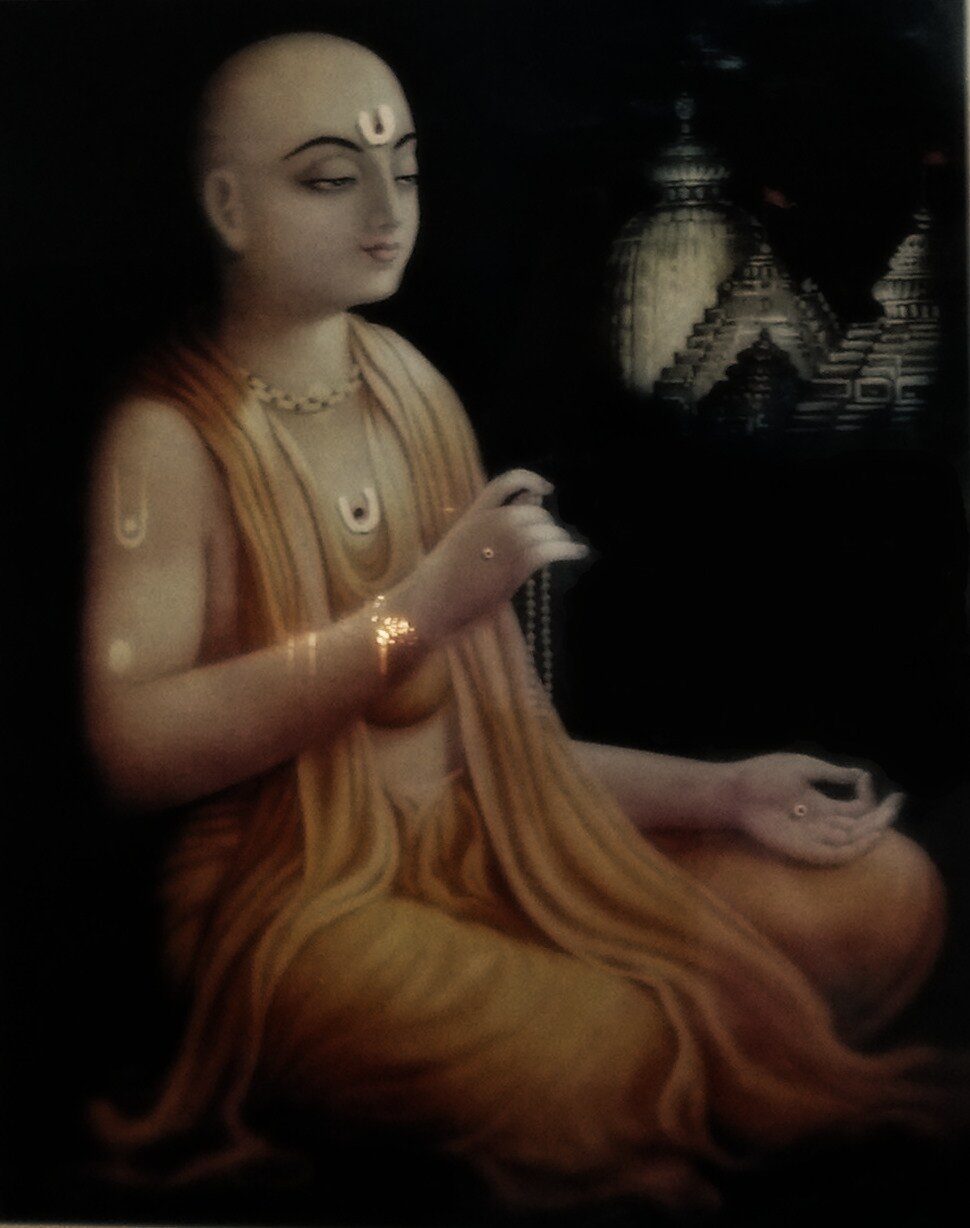
By the middle of the 1480s Advaita Acharya had come to a conclusion, and the Vaishnava biographers report it plainly. He concluded that the situation could not be put right by ordinary means. He had spent decades teaching devotional service in Bengal and had made converts. But to Him the general condition of the age seemed to be getting worse, not better. People were religious only in the sense that they performed rituals correctly and argued philosophy skilfully. Almost nobody loved God. He judged that no amount of preaching by a teacher, however qualified, was going to change this. Nothing less than Krishna's own personal coming would be enough.
The Decision to Compel a Descent #
What He did next followed logically from that judgement. If the Lord alone can fix this, then the Lord must be made to come. So Advaita Acharya set out, quite deliberately, to make the Lord descend.
Worship With Ganges Water and Tulasi Leaves #
His method was worship, continued far past the point where ordinary worship stops. Vaishnava accounts describe Him at Shantipura offering Ganges water and tulasi leaves to a salagrama-sila. They describe Him calling out, loudly and continuously, over a long period, for Krishna to appear. The tradition explains that this worked not because of how loud He was, but because of a technical point of devotional practice. Krishna is said to be bound by an offering of tulasi and Ganges water made by a pure devotee who feels real distress for the world. It is said that He cannot keep refusing such an offering for ever. The biographers present the result as a kind of exchange that the Lord could not honourably refuse.
The accounts focus on how intense it was. He was not simply worshipping and hoping for an answer. Advaita Acharya is described as roaring and weeping. He is described as continuing for so long and with such force that the sound was heard at a distance, and as making it clear that He did not intend to stop. His mood was closer to a demand than a request. Bengali Vaishnavas have never been embarrassed by that. In fact, they admire this very boldness.
The Advent at Mayapur as the Answer #
Sri Chaitanya Mahaprabhu appeared at Sridhama Mayapur on the full-moon evening of Phalguna in February 1486. The tradition regards this as the direct answer. This is the reason Advaita Acharya is counted among the five features of the Lord's own descent. The reason is not that He was a great teacher, or a great scholar, or an incarnation of Maha-Vishnu. Krishnadasa Kaviraja puts the matter in a single line: it was through Advaita Acharya that Lord Chaitanya spread the sankirtana movement, and through Him that He delivered the world.
The Long Wait at Shantipura #
Bengali devotional literature returns with pleasure to one detail in this story. Advaita Acharya was living at Shantipura, some distance from Nabadwip, and did not immediately know what had happened. The Lord He had called down was born and grew into a boy. He became a famous logician and married, and for some years He was the most argumentative young pandit in Nadia. All this time the elderly Advaita Acharya, who had called Him down, went on with His Bhagavatam classes at Shantipura, waiting. Only after Nimai returned from Gaya, when the great change in Him was clear for all to see, did the two come together. Then the purpose behind all of this became clear to everyone involved.
Why One Devotee's Prayer Was Enough #
Gaudiya theology draws a clear and powerful teaching from this episode, and its importance goes well beyond the story itself. The claim is that the appeal of a single devotee is enough to move the Supreme Lord to act. It does not need a mass movement, an institution or a favourable turn in history. It needs only one person, praying seriously enough and for long enough. Advaita Acharya is the tradition's lasting evidence for it. Vaishnava teachers also say openly that the same way is still open. If it is not taken more often, the reason is not that it has been closed. The reason is that almost nobody is willing to pray like that.
His Diagnosis of an Outwardly Flourishing Religion #
There is also a more serious lesson in the same story, and the tradition does not hide it. Advaita Acharya was distressed by a religious culture that looked flourishing from outside but was empty inside. It was well attended, well funded and learned, and correct in its observances. His judgement was not obvious to the people of His time. Most of them would have said that religion in Nadia was in excellent health. It took a man of unusual seriousness to look at such a thriving religious world and see that the most important thing had gone out of it. The tradition keeps His judgement as a warning to every generation after Him.
