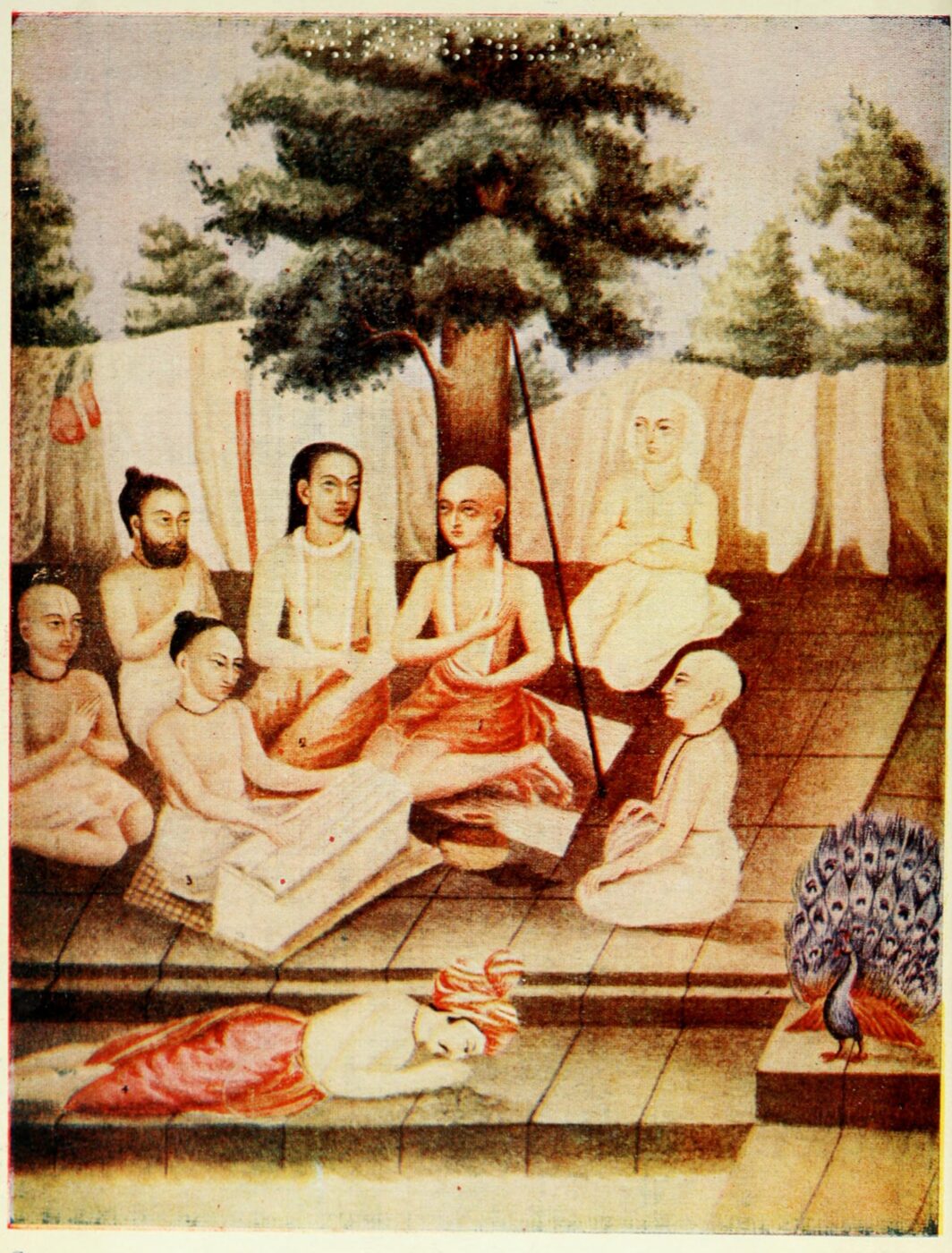
The relationship between Advaita Acharya and Sri Chaitanya Mahaprabhu is the most unusual in the whole of Gaudiya Vaishnava literature, and the biographers do not try to make it simpler than it is. Advaita was fifty-two years older. He was a disciple of Madhavendra Puri. The Lord Himself had taken initiation in Madhavendra Puri's line, through Ishvara Puri. This placed Advaita in the position of a senior godbrother of Mahaprabhu's own guru. He was the most respected Vaishnava in the region before Mahaprabhu was born. And it was Advaita's own prayers that had brought the Lord.
Each Treating the Other as Master #
Krishnadasa Kaviraja records how the Lord handled this. Considering Advaita Acharya to be a disciple of Madhavendra Puri, Mahaprabhu obeyed Him and offered Him the respect due to a spiritual master. Advaita Acharya, for His part, regarded Mahaprabhu as His master and Himself as Mahaprabhu's servant. He forgot Himself completely in the joy of this feeling. He went about telling everyone He met that they too were servants of Sri Chaitanya Mahaprabhu. The Chaitanya-charitamrita describes Advaita Acharya reflecting that the Lord considers Him a spiritual master, while He feels Himself to be only a servant. It explains this puzzle by saying that this is simply what love for Krishna does. It gives superiors, equals and inferiors alike the spirit of service.
Teaching Mayavada to Provoke the Lord #
The most famous episode between them comes directly from this relationship. Advaita Acharya wanted the Lord to reveal Himself, and He worked out a way to make this happen. He began teaching an interpretation of the Bhagavad-gita that He did not Himself hold. He explained it in the impersonal way that makes liberation the final goal, a view He had spent His life opposing. And He did so publicly, knowing what the effect would be. Mahaprabhu heard that Advaita Acharya, of all people, was spreading Mayavada. He came to Advaita in fury and scolded Him. In that show of divine anger, Mahaprabhu revealed exactly what Advaita Acharya had been trying to make Him reveal. The accounts describe Advaita Acharya as delighted. They say He explained afterwards that this had been His whole purpose.
The tradition does not read this as deception, and this is typical of how it treats Him. It sees it as a kind of devotional strategy that only someone of His position could use. Vaishnava commentators note that a devotee in an ordinary position could not have done it, and would have been wrong to try. The story does not teach that provoking the Lord is a technique. Its point is that Advaita Acharya was so close to the Lord that He knew exactly what to do.
Bringing the Lord to Shantipura After Sannyasa #
The other great episode came after Mahaprabhu's sannyasa. When the Lord took the renounced order at Katwa at the age of twenty-four, His intention was to go to Vrindavana, and He set out. Nityananda Prabhu judged that the devotees of Nabadwip, and above all Sachi Devi, could not simply be abandoned. For three days the Lord travelled through Radha-desha, in a state of almost continuous ecstasy. So Nityananda Prabhu arranged for Him to be brought instead to the western side of Shantipura, and for Him to be made to believe that the Ganges was the Yamuna. While He was worshipping the river, Advaita Prabhu arrived by boat, told Him to bathe, and took Him home.
Sachi Devi's Last Days With Her Son #
What followed at Advaita Acharya's house is among the most tender passages in the Chaitanya-charitamrita. Word went to Nabadwip. The devotees came, and Sachi Devi came. The Lord now had a shaven head and wore the cloth of a sannyasi. In the eyes of society He was no longer anyone's son or husband. Yet for some days He stayed under the roof of the man who had called Him into the world. Sachi Devi cooked for Him and for Nityananda Prabhu. There was joking at the meal. These were, in practice, the household's last few days with Him before He left for Puri. They happened at Shantipura because Advaita Acharya's house was the one place where such a meeting could be arranged.
Why the Lord Chose to Be a Servant #
The tradition draws a theological point from all this. It is easy to miss, because the story is so full of affection. According to Gaudiya teaching, Advaita Acharya is the Supreme Lord. He is Maha-Vishnu, the material cause of creation, the maker of countless universes. Even so, what He wanted was to be a servant. The Chaitanya-charitamrita observes that even the goddess of fortune, who lives on Krishna's chest, prays for the joy of the service that Advaita Acharya was tasting. It says that Brahma, Siva, Narada and the rest are pleased in the same mood. For the tradition, He is the proof that being a servant is not a lower position, accepted unwillingly by those fit for nothing better. It is what even God chooses when He is free to choose.
