Sri Brahmanya Tirtha
Guardian and Guru of Vyasa Tirtha
The complete life, on one page: The main biography and every pastime page, in order, in one place
Introduction
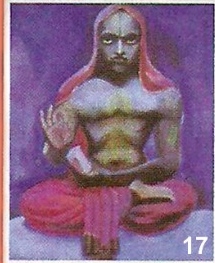
Sri Brahmanya Tirtha was a leader of the Dvaita Vedanta tradition in the fifteenth century. His name might have been known only among scholars, except for one thing. He raised the boy who grew up to become Vyasa Tirtha. Vyasa Tirtha became a great philosopher and later served as rajaguru, the royal guru, at the court of the Vijayanagara Empire. He stood at the center of a golden age for Dvaita learning and for the Haridasa devotional-song movement. Brahmanya Tirtha educated that boy and personally gave him sannyasa.
Matha records, an early Sanskrit biography called the Vyasayogicharita, and modern research on the Madhva sampradaya all describe Brahmanya Tirtha as the eleventh leader of the matha at Abbur in Karnataka, and as the direct disciple of Purushottama Tirtha. Apart from the fact that he raised Vyasa Tirtha, very little about Brahmanya Tirtha's own life has come down to us. This page tells only what is truly known.
| Detail | Description |
|---|---|
| Guru | Purushottama Tirtha |
| Most famous disciple | Vyasa Tirtha, later rajaguru of the Vijayanagara Empire |
| Matha headed | The matha at Abbur, Karnataka, the line later renamed Vyasaraja Matha |
| Pre-monastic name | Narasimhacharya |
| Tenure (approx.) | Mid-15th century CE; demise dated either 1467 or 1475-1476 (sources disagree) |
| Samadhi | Abburu, on the banks of the river Kanva, Karnataka |
Scriptural evidence for the introduction (1)
jayadharma-dasye khyati, sri purusottama-jati, ta ha'te brahmanya-tirtha suri
Purushottama Tirtha gained his fame in the service of Jayadharma; from him came the learned Brahmanya Tirtha.
This traditional Gaudiya guru-parampara prayer directly names Brahmanya Tirtha himself as Purushottama Tirtha's disciple, one generation before Vyasa Tirtha. Independently matches the order given in Sri Chaitanya-charitamrita Madhya 9.245 and in the Vyasaraja Matha's own institutional succession record. The same verse is also cited on Purushottama Tirtha's own page.
Chapter 1
Eleventh Pontiff of the Abbur Matha
How a dispute among Madhvacharya's successors over who should lead his order created the separate matha line that Brahmanya Tirtha would one day head.
Brahmanya Tirtha's place in Dvaita Vedanta history begins two generations before his own birth. It begins with a dispute about who should lead the sannyasa order that Madhvacharya himself founded. Madhvacharya's disciple Jayatirtha was one of the most important early writers of commentaries in the Dvaita tradition. Some generations after Jayatirtha came a head of the order named Vidyadhiraja Tirtha. When it was time to choose Vidyadhiraja Tirtha's own successor, the seat went to a monk named Kavindra Tirtha. His branch became what is known today as the Uttaradi Matha. Together with the Vyasaraja Matha and the Raghavendra Matha, it is one of three institutions still called the Mathatraya, the "three mathas". These three carried Dvaita learning forward after Madhvacharya's own disappearance.
| Detail | Description |
|---|---|
| Matha founded by | Rajendra Tirtha, after a succession dispute with Kavindra Tirtha's line |
| Original names | Rajendra Tirtha Matha, also called Poorvadi Matha |
| Later name | Vyasaraja Matha, after Vyasa Tirtha's own fame |
| Brahmanya Tirtha's position | Eleventh pontiff; third in succession from Rajendra Tirtha |
| Immediate predecessor and guru | Purushottama Tirtha |
A Rival Seat Under Rajendra Tirtha #
Not everyone accepted Kavindra Tirtha's succession. Another monk, Rajendra Tirtha, also claimed the seat and set up a separate seat of his own. It was first known simply as the Rajendra Tirtha Matha, or by its other name, Poorvadi Matha. Brahmanya Tirtha would later come to head this second, separate line, not the Uttaradi Matha. It received its present, better-known name, Vyasaraja Matha, only generations later. By then Brahmanya Tirtha's own famous disciple, Vyasa Tirtha, had made it well known across South India. Two more heads come between Rajendra Tirtha and Brahmanya Tirtha in this line. The first was Vijayadhvaja Tirtha, also known as Jayadharma. The second was Purushottama Tirtha, who personally gave Brahmanya Tirtha sannyasa and gave the matha into his care as its eleventh head.
From Narasimhacharya to Pontiff #
Before he took sannyasa, Brahmanya Tirtha was known by the name Narasimhacharya. The matha records keep this name but say nothing more about it. This is because, as more than one source on his life says plainly, very little else about his personal background survives. But this much can be said. By the time he was installed as head of the matha, he had made the matha at Abbur, near Channapatna in present-day Karnataka, his home. The events of his life for which he is actually remembered took place there, not at any of the matha's later, better-known locations. The most important of them was the arrival of a young boy named Yatiraja, the subject of the next page in this account.
Chapter 2
Raising the Boy Who Became Vyasa Tirtha
A boon to a childless couple, a boy handed over after his sacred thread ceremony, and a vision that turned a runaway back toward sannyasa.
The one episode from Brahmanya Tirtha's life that survives in real detail is not really his own story. It is the opening chapter of someone else's. The Vyasayogicharita, an early Sanskrit biography of Vyasa Tirtha, tells this story. A childless brahmana couple in the village of Bannur, Ramacharya and Lakshmi Bai, came to Brahmanya Tirtha to ask for his blessing to have children. He blessed them to have three, on one condition: their second child would belong to him. That child was born and named Yatiraja.
| Detail | Description |
|---|---|
| Source | Vyasayogicharita, an early Sanskrit biography of Vyasa Tirtha |
| Parents | Ramacharya (Ballanna) and Lakshmi Bai (Akkamma) of Bannur |
| Boy's birth name | Yatiraja |
| Age at ordination | About sixteen |
| Name given at ordination | Vyasatirtha |
A Boy Given Over After His Upanayana #
Yatiraja received his upanayana, the sacred-thread ceremony that marks the start of a brahmana boy's formal education. Then, as promised, his parents handed him over to Brahmanya Tirtha. The older sannyasi took full responsibility for raising and teaching him. Tradition says Brahmanya Tirtha was struck almost at once by the boy's unusually sharp intelligence. He decided that Yatiraja should not remain a householder. He should take sannyasa in the same renounced order Brahmanya Tirtha himself belonged to.
A Vision That Sent Him Back #
Yatiraja sensed what his guardian intended and tried to avoid it. The Vyasayogicharita says he ran away from the hermitage instead of accepting sannyasa. While he was resting under a tree during his flight, he is said to have had a vision of Lord Vishnu, who told him to turn back. He did, and soon after, Brahmanya Tirtha gave him diksha. The scholar B. N. K. Sharma estimates that he was about sixteen at the time. Brahmanya Tirtha gave him the monastic name by which the world would come to know him, Vyasatirtha.
A Disciple Who Outgrew His Guru's Own Fame #
The rest belongs to Vyasa Tirtha's own life story. He went on to study the six orthodox schools of Vedic philosophy at Kanchi. Then he had twelve years of advanced Dvaita training under Sripadaraja at Mulbagal. In time he became rajaguru, first to Saluva Narasimha Deva Raya and then, most famously, to Krishna Deva Raya at the height of the Vijayanagara Empire. In that role Vyasa Tirtha shaped the Dvaita philosophy of the scholars. Through disciples such as Purandara Dasa and Kanaka Dasa, he also shaped the popular Haridasa devotional-song tradition of Karnataka. Tradition says that none of that would have happened without the guardianship, education, and diksha that Brahmanya Tirtha gave him at Abbur. This is the single most important thing Brahmanya Tirtha is known to have done. Vyasa Tirtha's life is told in full on Vyasa Tirtha's own page.
Chapter 3
Writings, Miracles and a Disputed Death Date
A lost commentary, two different temple traditions, a set of miracle stories told as pious tradition, and an eight-year gap between two accounts of his death.
Compared with his disciple's record, very little is recorded of Brahmanya Tirtha's own work as a scholar and builder. Matha tradition says that he wrote a commentary on the Tattvaprakashika. The Tattvaprakashika is Jayatirtha's own commentary on Madhvacharya's Anuvyakhyana, a basic text of the Dvaita school. No copy of Brahmanya Tirtha's commentary is known to survive. So what it said, and even whether it existed, is known only from tradition, not from a text that scholars can examine today.
Temples Remembered Differently by Different Sources #
Devotional accounts also credit Brahmanya Tirtha with founding at least one Deity temple in the area around Abbur, but the sources do not agree on the details. One account describes a temple to Mukhyaprana, Hanuman, founded at a place called Brahmanyapura near Abbur. Another describes a temple to Krishna worshiped as Pranadeva, built at Satenahally in the Dharwar district. According to this second account, it was built after Brahmanya Tirtha received a Deity of Vittala from a local king's treasury. We do not try to force these different accounts into one neat story. Both are given here as tradition, and we honestly leave the difference between them open.
Miracle Stories Told as Tradition #
Like many Vaishnava saints of this period, Brahmanya Tirtha is remembered in devotional literature for miracles. These cannot be checked in other sources. He is said to have brought rain during a drought and restored the dead to life. The same story that tells of the Vittala Deity mentioned above also tells how he cured a local prince's physical disability. These stories are given here as what they are, devotional tradition, not recorded history.
| Detail | Description |
|---|---|
| Work credited to him | Commentary on the Tattvaprakashika (no known copy) |
| Temple tradition (version 1) | Mukhyaprana (Hanuman) temple at Brahmanyapura, near Abbur |
| Temple tradition (version 2) | Krishna as Pranadeva at Satenahally, Dharwar district |
| Miracle traditions | Rain during drought; raising the dead; curing a prince's disability |
| Death (matha lists) | 1467 CE |
| Death (modern research) | Famine of 1475-1476 CE |
A Death Remembered Two Different Ways #
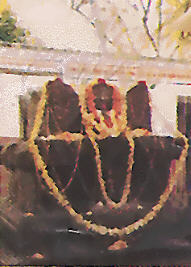
The clearest gap in Brahmanya Tirtha's record is the year of his own death. Several matha-tradition lists state plainly that he passed away in 1467 CE. But modern research on Vyasa Tirtha's life, based on the work of the scholar B. N. K. Sharma, places Brahmanya Tirtha's death in the famine of 1475-1476 CE instead. In this view, Vyasa Tirtha formally succeeded him as head of the Abbur matha only in 1478, after a gap the sources do not fully explain. Two separate lines of evidence give these dates, and each of them deserves respect. There is no way to settle the eight-year difference between them, and we do not try to force a choice. But both traditions agree on his resting place. Brahmanya Tirtha's samadhi, or brindavana, stands today at Abburu, on the banks of the river Kanva, and it is still a place of pilgrimage.
Chapter 4
Brahmanya Tirtha in the Gaudiya Parampara
Unlike several other names in this same guru chain, Brahmanya Tirtha's links to his guru and his disciple are also confirmed by independent sources from the Dvaita tradition.
There are six figures in this guru chain between Madhvacharya and Madhavendra Puri. Of these, Brahmanya Tirtha's place in the chain turns out to be unusually well supported. The Gaudiya Vaishnava guru-parampara list handed down by Srila Bhaktisiddhanta Sarasvati Thakura places him as the disciple of Purushottama Tirtha and the guru of Vyasa Tirtha. On this pair of links, independent Dvaita-tradition sources really do agree. They do not stay silent or point somewhere else.
The Same Five Names, Independently #
Srila Prabhupada's own purport to Sri Chaitanya-charitamrita, Madhya 9.245, is already the single most important Gaudiya source for this whole guru chain. It quotes a succession list from the South Kanara Manual and the Bombay Gazette:
"After the sixteenth acharya (Vidyadhiraja Tirtha), there was another disciplic succession, including Rajendra Tirtha, 1254; Vijayadhvaja; Purushottama; Subrahmanya; and Vyasa Raya, 1470-1520."
The Gaudiya parampara verses give their own chain: Rajendra Tirtha, Vijayadhvaja Tirtha (Jayadharma), Purushottama Tirtha, Brahmanya Tirtha, Vyasa Tirtha. Set side by side, the two lists name the same five people in the same order. In Prabhupada's purport, Brahmanya Tirtha appears under a different spelling, Subrahmanya, which only adds the syllable 'Su' to the name used here. The dates given for Vyasa Raya, 1470 to 1520, also fit easily within Vyasa Tirtha's own well-recorded lifetime, 1447 to 1539.
| Detail | Description |
|---|---|
| Gaudiya parampara list | Purushottama Tirtha (guru), Brahmanya Tirtha, Vyasa Tirtha (disciple) |
| South Kanara Manual / Bombay Gazette list (quoted in CC 9.245 purport) | Purushottama, Subrahmanya, Vyasa Raya, 1470-1520 |
| Independent matha-tradition sources and modern research | Confirm the same guru-disciple pairs directly, by name |
| Contrast | Unlike the link from Lakshmipati Tirtha to Madhavendra Puri, which the other list in the same purport does not confirm |
A Contrast Worth Naming Plainly #
This needs to be said plainly, because it is not the situation for every teacher in this chain. The question is discussed on Madhvacharya's own page and on Madhavendra Puri's Life in the Madhva Sampradaya. As explained there, historians such as B. N. K. Sharma, S. K. De, and Friedhelm Hardy, among others, have found nothing in the Madhva sampradaya's own recognized succession records to show that Lakshmipati Tirtha or Madhavendra Puri belong anywhere in that tradition's lists. Brahmanya Tirtha's own two links in the chain, to his guru Purushottama Tirtha and to his disciple Vyasa Tirtha, do not have that problem. They are confirmed independently by the matha's own records, by the Vyasayogicharita's account of Vyasa Tirtha's upbringing, by modern research, and, as shown above, by Srila Prabhupada's own purport quoting a Madhva-tradition source. When four independent lines of evidence agree like this, the support is truly stronger than it is for several other names in this same six-person chain. So it deserves to be stated clearly, not quietly folded into one story that no one questions.
Scriptural evidence for this chapter (1)
মধ্বাচার্য-স্থানে আইলা যাঁহা 'তত্ত্ববাদী' ।
উড়ুপীতে 'কৃষ্ণ' দেখি, তাহাঁ হৈল প্রেমোন্মাদী ॥ ২৪৫ ॥
madhvācārya-sthāne āilā yāṅhā 'tattvavādī'
uḍupīte 'kṛṣṇa' dekhi, tāhāṅ haila premonmādī
Word for word
madhva-ācārya-sthāne: at the place of Madhvācārya; āilā: arrived; yāṅhā: where; tattva-vādī: philosophers known as Tattvavādīs; uḍupīte: at the place known as Uḍupī; kṛṣṇa: the Deity of Lord Kṛṣṇa; dekhi: seeing; tāhāṅ: there; haila: became; prema-unmādī: mad in ecstasy.
Caitanya Mahaprabhu next arrived at Udupi, the place of Madhvacarya, where the philosophers known as Tattvavadis resided. There He saw the Deity of Lord Krishna and became mad with ecstasy.
From the purport: Purport excerpt: "After the sixteenth acarya (Vidyadhiraja Tirtha), there was another disciplic succession, including Rajendra Tirtha, 1254; Vijayadhvaja; Purusottama; Subrahmanya; and Vyasa Raya, 1470-1520."
This sentence from Srila Prabhupada's own purport, quoting the South Kanara Manual and the Bombay Gazette, independently names the same five-person succession covered in this research pass, Rajendra Tirtha, Vijayadhvaja (Jayadharma), Purushottama, Subrahmanya (Brahmanya Tirtha, under a variant spelling), and Vyasa Raya (Vyasa Tirtha), in the same order the Gaudiya parampara verses give. The verse itself (245) and its main narrative concern Sri Chaitanya Mahaprabhu's visit to the Udupi Deity; this specific succession list appears later in the same purport, discussing the wider Madhva-sampradaya succession.
Closing
Eleventh Acharya of the Abbur Matha #
Brahmanya Tirtha's own matha goes back to a split inside the Madhva monastic order, two generations after Jayatirtha, Madhvacharya's most important early successor. The line coming down through Jayatirtha's disciple Vidyadhiraja Tirtha had to choose its next head. The seat went to a monk named Kavindra Tirtha, and his branch became the Uttaradi Matha. Another monk who also claimed the seat, Rajendra Tirtha, set up a separate seat instead. It was first called the Rajendra Tirtha Matha or Poorvadi Matha. Only much later was it renamed the Vyasaraja Matha, after its most famous head. Brahmanya Tirtha stood third in succession from this Rajendra Tirtha. After Rajendra Tirtha came Vijayadhvaja Tirtha, also called Jayadharma, then Purushottama Tirtha, Brahmanya Tirtha's own guru. Before taking sannyasa he was known as Narasimhacharya. Different matha lists give slightly different years for his time as head of the matha, all within the mid-fifteenth century. This difference is discussed further below.
Guardian and Guru to Vyasa Tirtha #
Nearly everything we know about Brahmanya Tirtha personally comes to us through the life of his own disciple. According to the Vyasayogicharita, an early biography of Vyasa Tirtha, a childless brahmana couple in the village of Bannur came to Brahmanya Tirtha for a blessing. He granted them three children, on the condition that their second child be given to him. That child, named Yatiraja at birth, was placed in Brahmanya Tirtha's care after his upanayana, the sacred-thread ceremony. The older sannyasi was struck by the boy's unusual intelligence and decided to give him sannyasa. Tradition says Yatiraja tried to run away from the hermitage instead of accepting this. But he turned back after a vision of Lord Vishnu told him to return. Brahmanya Tirtha then gave him diksha at around sixteen years of age. He named him Vyasatirtha, the name by which history remembers him.
The disciple later became far more famous than his guru. In time he served Krishna Deva Raya of Vijayanagara as rajaguru, and for generations he shaped the course of both Dvaita philosophy and Kannada devotional song. His life is told in full on Vyasa Tirtha's own page.
Writings and Miracle Traditions #
Matha tradition says that Brahmanya Tirtha wrote a commentary on the Tattvaprakashika, which is Jayatirtha's own commentary on Madhvacharya's Anuvyakhyana. But no copy of Brahmanya Tirtha's work is known to survive today. Devotional accounts also describe him founding at least one Deity temple near Abbur. Different sources name different Deities and places, so we do not try to force them into one neat account. Like many Vaishnava saints of this period, he is also remembered for miracle stories. These stories tell of him bringing rain during drought, restoring the dead to life, and once curing a local prince's disability in exchange for a Deity of Vittala from the royal treasury. None of this can be checked in other sources. It belongs to devotional tradition, not recorded history, and we tell it here honestly as the tradition's own account of him.
Death and a Disputed Date #
Sources disagree, sometimes sharply, about when Brahmanya Tirtha died. Several matha-tradition lists give 1467 CE as the year of his death. But modern academic study of Vyasa Tirtha's life gives a different date. Drawing on the research of the scholar B. N. K. Sharma, it places his guru's death in the famine of 1475-1476 CE. In this view, Vyasa Tirtha went elsewhere for further study, and only in 1478 did he succeed Brahmanya Tirtha as head of the Abbur matha. The available sources cannot settle this difference. It is still the biggest open question about Brahmanya Tirtha's life. But all sources agree on where he is remembered. His samadhi, or brindavana, stands at Abburu on the banks of the river Kanva in Karnataka, and pilgrims still visit it today.
Brahmanya Tirtha in the Gaudiya Parampara List #
The Gaudiya Vaishnava guru-parampara list handed down by Srila Bhaktisiddhanta Sarasvati Thakura places Brahmanya Tirtha in exactly this position: disciple of Purushottama Tirtha, guru of Vyasa Tirtha. The traditional guru-parampara prayer itself states this plainly:
jayadharma-dasye khyati, sri purusottama-jati, ta ha'te brahmanya-tirtha suri
"Purushottama Tirtha gained his fame in the service of Jayadharma; from him came the learned Brahmanya Tirtha."
For this link, independent sources from the Dvaita tradition really do agree. For several other links in the same list, they do not. In his purport to Chaitanya-charitamrita, Madhya 9.245, Srila Prabhupada quotes the South Kanara Manual and the Bombay Gazette. The purport records a succession beginning "after the sixteenth acharya (Vidyadhiraja Tirtha)" that runs through Rajendra Tirtha, Vijayadhvaja, Purushottama, Subrahmanya, and "Vyasa Raya, 1470-1520". These are the same five names, in the same order, that appear in this guru chain. In the purport, Brahmanya Tirtha appears under a different spelling, Subrahmanya.
This is quite different from the wider question about the lineage discussed on Madhvacharya's own page and on Madhavendra Puri's Life in the Madhva Sampradaya. Those pages honestly explain that historians have not found any independent Dvaita source that confirms a place for Lakshmipati Tirtha and Madhavendra Puri in the Madhva sampradaya's own lists of successors. Brahmanya Tirtha's own two links in the chain do not have that problem. Matha records, an early Sanskrit biography, and Srila Prabhupada's own purport all agree on them, independently of one another.
- Shri Brahmanya Teertharu - Shri Vyasaraja Math, Sosale (Madhwa Sakha)
- Shri Vyasa Teertharu - Shri Vyasaraja Math, Sosale (Madhwa Sakha)
- Brahmanya Tirtha - Gaudiya History (ISKCON Desire Tree)
- Vyasaraya, the visionary Madhva scholar, logician, and musician - The South First
- ABBUR - Sri Sri 1008 Brahmanya Theertharu (Slokas, Stories and Information Regarding Madhwa Philosophy)
- Sri Chaitanya-charitamrita, Madhya-lila 9.245, purport
