Hemalata Thakurani
Daughter of Srinivasa Acharya Who Gave Diksha to Disciples
The complete life, on one page: The main biography and every pastime page, in order, in one place
Introduction
Hemalata Thakurani was the eldest daughter of Srila Shrinivasa Acharya. She became one of the very few women in Gaudiya Vaishnava history to serve as a diksha-guru, and she gave initiation to both men and women. At least once she acted in that role in public. She is credited with driving a teacher out of the Vaishnava community after he strayed from the right path. Only a little was written down about her life, even less than what survives for her father, or for Jahnava Mata, the other great woman guru she is most often compared with. But what does remain is clear enough to be trusted.
| Detail | Description |
|---|---|
| Father | Srila Shrinivasa Acharya |
| Mother | Ishvari, also called Draupadi, Shrinivasa's first wife (another source instead names his second wife, Gauranga-priya, also called Padmavati) |
| Sisters | Krishna-priya and Kanchana, also called Yamuna |
| Half-brother | Gati Govinda, son of Shrinivasa's second wife |
| Role | Diksha-guru who initiated both men and women; compared in the tradition to Jahnava Devi |
| Her own diksha-guru | Not named in any surviving source |
| Best-known disciple | Yadunandana Dasa, author of Karnananda |
| Best-known act | Drove the schismatic Rupa Kaviraja out of the Vaishnava community |
At a Glance
- Daughter of Shrinivasa Acharya, one of the three preachers who carried the scriptures of the Six Goswamis from Vrindavana to Bengal.
- Served as a diksha-guru on the strength of Mahaprabhu's order, amara ajnaya guru hana; the sources do not record who gave her her own diksha.
- Gave diksha to her most famous disciple, the poet Yadunandana Dasa, who wrote Karnananda partly on her instruction.
- Publicly broke the neck-beads of the wayward teacher Rupa Kaviraja, cutting him off from the Vaishnava community.
Chapter 1
A Daughter of Srinivasa Acharya
Born into the family of one of the three preachers who carried the Six Goswamis' writings to Bengal, with a mother the sources cannot fully agree on.
Every source agrees that Hemalata was a daughter of Shrinivasa Acharya. He was the preacher who, together with Narottama Dasa Thakura and Shyamananda Pandit, carried the writings of the Six Goswamis out of Vrindavana into Bengal. But beyond this one point of agreement, the more closely the record of her birth family is studied, the less certain it becomes.
| Detail | Description |
|---|---|
| Father | Srila Shrinivasa Acharya |
| Mother, this account | Ishvari, also called Draupadi, Shrinivasa's first wife |
| Mother, alternate account | Gauranga-priya, also called Padmavati, Shrinivasa's second wife |
| Sisters | Krishna-priya and Kanchana, also called Yamuna |
| Brother or half-brother | Gati Govinda |
| Family's base | Jajigram, with close ties to Vishnupura (Bishnupur) |
Two Accounts of Her Mother #
Shrinivasa Acharya's own page describes his family in some detail. He married Ishvari, also called Draupadi, the daughter of a Jajigram brahmana named Gopala Chakravarti. The sons from that marriage died early, and after that he took a second wife, Gauranga-priya, also called Padmavati. That account names Hemalata, along with her sisters Krishna-priya and Kanchana, as children of the first marriage. It gives Gati Govinda, born to Gauranga-priya, as Hemalata's half-brother, not her full brother. A separate source, an account of Bengal's Vaishnava holy places, names Gauranga-priya (called there Padmavati) as Hemalata's own mother instead. That would make Gati Govinda her full brother, not a half-brother. The version given on Shrinivasa Acharya's own page is followed here, since it draws on more sources.
A Household Divided Between Two Towns #
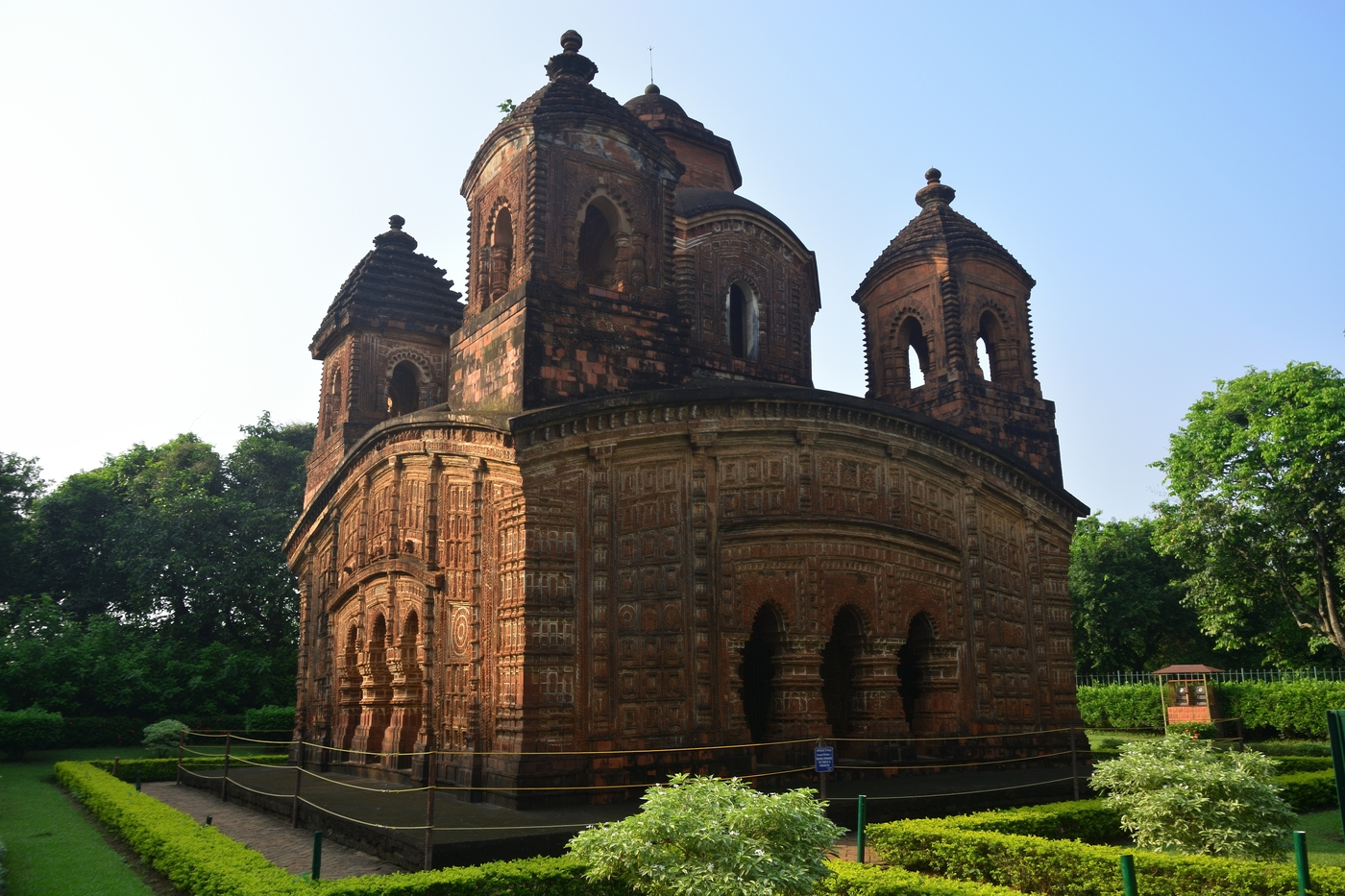
Whichever account of her mother is right, Hemalata grew up in a household that was, for its time, unusually learned and often on the move. Shrinivasa Acharya's own home was Jajigram. But the most famous turn of his life was the conversion of the bandit-king Vira Hambira. This gave him a second home in Vira Hambira's land of Vishnupura, today's Bishnupur in Bankura district. With the king's support, Vishnupura became a major center of Vaishnava worship, art, and architecture. At least one source describes a house of Hemalata's still standing in Vishnupura, next to a samadhi there said to be her father's. This suggests that she spent at least part of her adult life in that town, not only in Jajigram. By the time she reached adulthood, she could teach Vaishnava philosophy well enough for a following to gather around her. What she did with that learning is told in Guru by the Order of Mahaprabhu.
Not Counted Among Her Father's Own Disciples #
One clear and meaningful detail survives about how the tradition understood Hemalata's bond with her father. She was not formally counted among Shrinivasa Acharya's initiated disciples, because she was his own blood relation. In Gaudiya Vaishnavism, diksha, or formal initiation, is understood to create a special kind of bond between guru and disciple. The tradition treats a father's direct initiation of his own child as outside that pattern, whatever informal teaching may have passed between them at home. The sources we found do not record who gave Hemalata her own diksha. Her later work as a guru is where her own story truly begins.
Chapter 2
Guru by the Order of Mahaprabhu
How the daughter of Srinivasa Acharya came to give diksha, and the disciple whose poem preserves what little is known of her.
No source names the person who gave Hemalata her own diksha. The record is simply silent on this point; it is not avoiding the question. Chaitanya Mahaprabhu Himself gave the standard the tradition applies here: yare dekha, tare kaha 'krishna'-upadesha, amara ajnaya guru hana tara' ei desha, "Instruct everyone you meet to follow the orders of Lord Krishna... In this way become a spiritual master and try to liberate everyone in this land" (Chaitanya-charitamrita, Madhya-lila 7.128). Srila Prabhupada applied this same order directly to women: whoever understands Krishna consciousness perfectly may become guru, whatever their birth. Hemalata's own guruship is understood in the tradition to rest on that order, and on the recognition of the Vaishnavas around her, not on anything she claimed for herself. Every source agrees on what she became. She was a diksha-guru who gathered a real following, men and women alike, at a time when society gave almost no woman that role. The scholar Jagadananda Das has written a study of women in Gaudiya Vaishnava history. In it he calls her one of the very few women in the tradition whose standing as guru is confirmed by independent sources. He also compares her directly to Jahnava Mata, Nityananda Prabhu's widow. About a generation before Hemalata's own time, Jahnava Mata had become the accepted head of the whole Gaudiya Vaishnava movement.
| Detail | Description |
|---|---|
| Comparable figure | Jahnava Devi, Nityananda Prabhu's widow and accepted head of the movement after 1534 |
| Chief disciple | Yadunandana Dasa, a Vaidya-caste poet |
| Disciple's chief work | Karnananda, a devotional account of the life of Srinivasa Acharya |
| Disciple's shripata | Malihati, also called Meleti, north of Katwa |
| Where the disciple often stayed | Hemalata's own house at Budhaipara, on the western bank of the Bhagirathi |
| Miracle associated with her | Making an unlimited amount of cooked lentils appear from a Jajigram pond still called Daldhala |
Yadunandana Dasa and the Book Named Karnananda #
Hemalata's most celebrated disciple was Yadunandana Dasa, a poet of the Vaidya caste. One Gaudiya biographical source says he was born in Shaka 1459, close to 1537 CE. It says he was born in the village of Khalihati, on the western bank of the Bhagirathi river. His shripata, the place linked with his name, was at Malihati (Meleti), north of Katwa. He is remembered for often staying at Hemalata's own house in the village of Budhaipara. He is also remembered for naming her at the end of nearly every chapter of his great work, a devotional life of her father. By his own account, he wrote it with her lotus feet held fast within his heart. According to the sources gathered here, Hemalata was so moved on hearing the finished work that she herself gave it its title, Karnananda, meaning something like delight for the ear. Besides that life of her father, Yadunandana put other Gaudiya devotional works into Bengali verse, among them Vidagdha-madhava, Govinda-lilamrita, and Krishna-karnamrita. He also added verses to the devotional collection Padamrita-samudra. No source says anything of his marriage, his children, or the date of his own passing.
The Lentil Pond at Jajigram #
A separate tradition, kept alive by a modern account of Bengal's Vaishnava holy places, tells of a miracle linked to Hemalata at Jajigram. To feed a large gathering of guests, she is said to have made an endless supply of cooked lentils appear from a nearby pond. That pond is still called Daldhala, Bengali for lentils, and it can still be seen at Jajigram today. This story is told here just as the local tradition tells it. Devotional miracle stories like this are usually told in the same way, without claiming any outside proof.
A Legend of Four Arms #
A second legend is similar in form to the first. The Bengali scholar Haridas Das records it in his Gaudiya-Vaishnava Abhidhana, a standard reference for the tradition's history. It says that Hemalata once showed four arms instead of two, to catch a slipping cloth before it fell. In this she was like Jahnava Devi, and like Rami, the wife of Nityananda Prabhu's disciple Abhirama Thakura. Jagadananda Das has written about all three stories together. He points out that what matters is not their exact details but what they were meant to show. In his view, each story, within the tradition that tells it, confirms the standing of a woman serving as guru, in a society that gave her no other clear way to show it. This story is told here in that same spirit. It is a legend that the tradition uses to make a point about her standing, not a claim of plain history. What that standing meant when a rival teacher tested it directly is told in The Expulsion of Rupa Kaviraja.
Chapter 3
The Expulsion of Rupa Kaviraja
A householder's daughter upheld the accepted Gaudiya teaching against a teacher who taught that no householder could ever be a guru.
One episode of Hemalata's life is told in more detail than any other, and it is told independently in more than one source. It is her expulsion of a teacher named Rupa Kaviraja from the Gaudiya Vaishnava community. It is also the episode that shows most clearly what her authority as a guru meant in practice.
| Detail | Description |
|---|---|
| The teacher | Rupa Kaviraja, originally from the Surma valley, in present-day Assam |
| His diksha guru | Sri Krishna-charana Chakravarti |
| His Bhagavatam teacher | Sri Mukunda Dasa |
| Where he settled | Radha-kunda, Vrindavana |
| His disputed teaching | That no householder could serve as guru, alongside an unregulated, imitative approach to raga-marga later associated with the name Sauromya |
| His fate after expulsion | Branded an ativadi, "one who has gone too far," within the Gaudiya Vaishnava community |
A Teacher From the Surma Valley #
Rupa Kaviraja came to the Vaishnava communities of Bengal and Vrindavana from the Surma valley, in what is today Assam. He took diksha from a teacher named Sri Krishna-charana Chakravarti. He studied Srimad-Bhagavatam under Sri Mukunda Dasa, a respected Vaishnava of that time, and at last settled at Radha-kunda. According to the accounts gathered here, the Vaishnavas living nearby were at first truly glad to see him engaged in devotional life. Over time, though, Rupa Kaviraja formed and began teaching ideas that broke from standard Gaudiya practice in several clear ways. He rejected the worship of tulasi and shalagrama-shila, and he gave up ekadashi fasting. He also pushed an approach to spontaneous devotion, raga-marga, that set aside the careful, inward practice that mainstream Gaudiya Vaishnavism teaches. Instead, he urged devotees to copy the intimate moods of Krishna's friends in Vraja directly in their outward behavior.
A Doctrine That Denied Her Own Father #
One part of Rupa Kaviraja's teaching makes this whole episode especially serious. He held that a householder could never be fit to serve as a spiritual master. Hemalata's own father, Shrinivasa Acharya, was among the most celebrated householder-preachers in the whole Gaudiya tradition. All the accounts agree that Hemalata herself lived as a householder preacher, not as a renunciate. A teaching that denied householders any claim to guruship was not some distant philosophical dispute for her. Whatever Rupa Kaviraja meant by it, it directly challenged the rightful position of her own family and of the line of teaching she belonged to.
Tearing the Beads From His Neck #
The available sources describe what followed only briefly, but they agree. Srila Bhaktisiddhanta Sarasvati Thakura, writing centuries later in The Harmonist (Vol. 18, No. 18, 1922), stated plainly:
"Srinivasa Acarya's famous daughter, Srimati Hemalata Thakurani, rejected an envious disciple named Sri Rupa Kaviraja from the Vaisnava society."
Other sources describe the act in more physical terms. She tore the kanthi-mala, the strand of neck-beads marking a Vaishnava's initiation, from around Rupa Kaviraja's neck. After this act, he was formally no longer allowed to eat with other members of the Vaishnava community. Her own disciple Yadunandana Dasa recorded this event, and others like it, in Karnananda, the same work he wrote to glorify her father. After the expulsion, Rupa Kaviraja's own followers are said to have begun wearing only a single strand of tulasi beads. This was a quiet, lasting sign of what had happened to their teacher. Within the Gaudiya Vaishnava community, Rupa Kaviraja came to be counted as an ativadi, one who had gone too far.
A Second, Separate Confrontation #
A related but different episode should be mentioned here, because more than one modern retelling has mixed it up with Hemalata's own. According to the Narottama-vilasa, Rupa Kaviraja also clashed with a Vaishnavi named Krishnapriya. She was the daughter of Ganganarayan Chakravarti, who was himself the chief disciple of Narottama Dasa Thakura. Krishnapriya, a renunciate living at Radha-kunda, was challenged by Rupa Kaviraja over her presence at a public reading of Srimad-Bhagavatam. He asked how she, being a woman, could even listen to the reading. She is recorded as replying that it was idle talk, not her own presence, that made listening hard. The clash is said to have ended badly for Rupa Kaviraja, who was at last forced to leave Vrindavana altogether. We do not treat this Krishnapriya as the same person as Hemalata's own sister of the same name, who is recorded elsewhere. No source says they are the same, and the shared name may be only a coincidence.
A Contested Date #
Her father was likely born between about 1517 and 1530. One source dates her disciple Yadunandana Dasa to roughly 1537 CE. Both dates point to a life for Hemalata in the mid-to-late 16th or early 17th century. This dispute most probably belongs to that period, not to the early eighteenth century given by one modern account.
Closing
A Living Memory in Bengal #
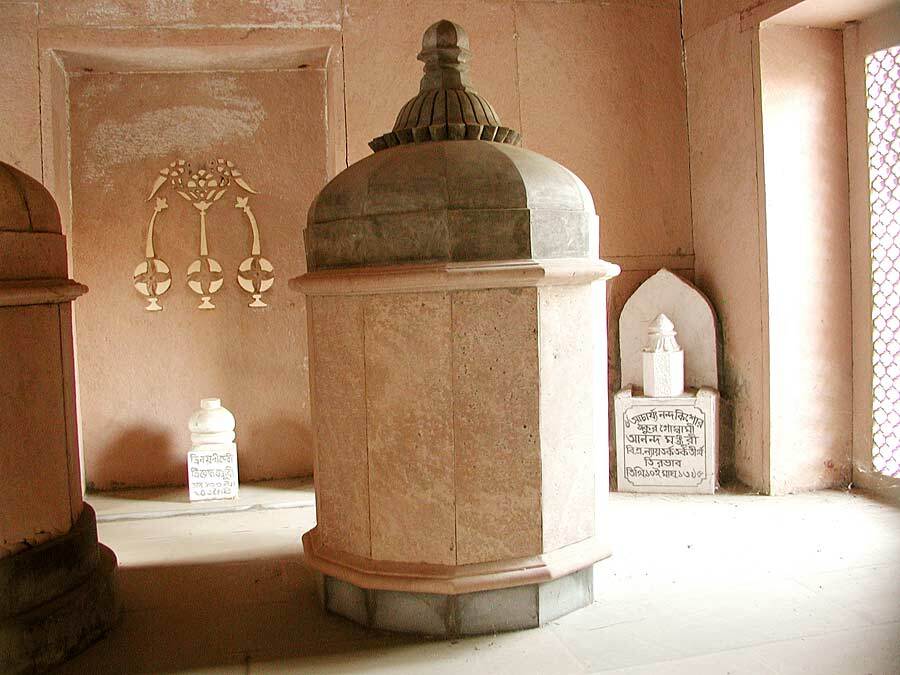
No year survives for Hemalata's birth or disappearance. She is remembered today in two places. One is Dhira Samira Kunja in Vrindavana, beside a samadhi said to be her father's. The other is a house of hers still standing in Vishnupura, Bengal. This double memory suits a woman who spent her life moving between Bengal and Vrindavana. The sources are silent about her final years, but the line of her descendants and disciples left its own lasting mark. Shrinivasa Acharya's own history records that her family settled in the villages of Maliati and Budhaipada in Murshidabad district. In the words used in that history, "her own preaching work left a lasting mark on Gaudiya Vaishnavism in that part of Bengal." Chaitanya Mahaprabhu taught that the only qualification for a guru is knowledge of Krishna and surrender to Him, nothing more:
"Whether one is a brahmana, a sannyasi, or a shudra, whoever knows the science of Krishna is a guru." (Chaitanya-charitamrita, Madhya-lila 8.128)
Hemalata's own life is one more example of that teaching being accepted exactly as it was given, not treated as an empty formality.
- Hemalata Thakurani - Gaudiya History
- Yadunandana Dasa - Gaudiya History
- Jagadananda Das, Women Saints in Gaudiya Vaishnavism (Part I)
- Ativadi Apa-sampradaya (quoting Srila Bhaktisiddhanta Sarasvati Thakura, The Harmonist, Vol. 18, No. 18, 1922)
- Bir Hambir and Srinivas Acharya - The Gaudiya Treasures of Bengal
- Sri Srinivasa Acharya's Sripat, Jajigram - The Gaudiya Treasures of Bengal
- Srila Shrinivasa Acharya
- Female Diksa Guru — ISKCON GBC
- Women Saints in Gaudiya Vaishnavism, Jan Brzezinski / Jagadananda Das (Vaishnavi Ministry)
