Read in English

The Sanoriya Vipra

The Meeting at Adi Keshava Temple

A brahmana's ecstatic dance in Mathura reveals an unexpected bond with Chaitanya Mahaprabhu's own guru.

Mathura, Uttar Pradesh, during Chaitanya Mahaprabhu's Vrindavana tour

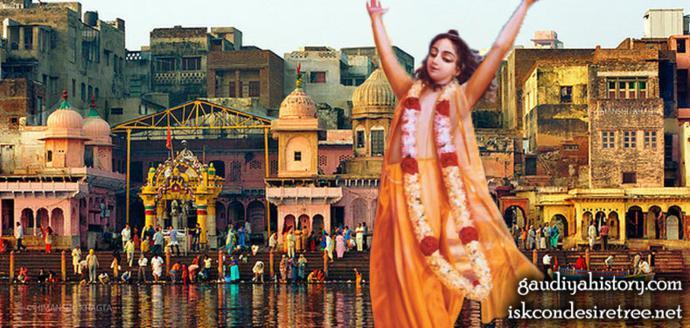
Devotional artwork of Chaitanya Mahaprabhu dancing in ecstasy at Vishrama Ghat, Mathura, before going on to the Adi Keshava temple.
Devotional artwork of Chaitanya Mahaprabhu dancing in ecstasy at Vishrama Ghat, Mathura, before going on to the Adi Keshava temple.gaudiyahistory.iskcondesiretree.com · ISKCON/BBT-affiliated devotional art, approved for use on this site

Arrival at Vishrama Ghat #

When Sri Chaitanya Mahaprabhu entered Mathura, He went first to Vishrama Ghat on the Yamuna and bathed there. From the ghat He went to see Krishna's birthplace and the Deity known as Keshavaji, or Adi Keshava. Standing before the Deity, Mahaprabhu began to chant and dance, overwhelmed with ecstatic love, and the sound He raised drew a crowd. People who had never seen anything like it stood watching, amazed.

One brahmana in that crowd did more than watch. He fell at Mahaprabhu's feet and then rose and began dancing beside Him. The two danced together, embracing, calling out the names Hari and Krishna, until the whole temple courtyard was in an uproar of chanting. The priest serving Lord Keshava came out and garlanded Mahaprabhu. Onlookers told each other that no ordinary person could inspire love like this - that Mahaprabhu must be Krishna Himself, come to deliver Mathura.

A Private Question #

After the dancing settled, Mahaprabhu took the brahmana aside to a quiet spot and questioned him directly: an elderly, sincere, spiritually advanced man - where had this transcendental ecstasy for Krishna come from? The brahmana's answer was simple. Years earlier, His Holiness Srila Madhavendra Puri had come touring through Mathura. He had visited this brahmana's own home, taken him as a disciple, and even accepted a meal cooked by his hand. Madhavendra Puri had gone on, the brahmana said, to install the Gopala Deity - the same Deity still being served at Govardhana Hill.

The moment he heard Madhavendra Puri's name, Mahaprabhu immediately fell at the brahmana's feet. Startled, even frightened, the brahmana fell back at Mahaprabhu's feet in turn, protesting that this was not right - Mahaprabhu was a sannyasi, and he only an ordinary brahmana. He guessed, correctly, that such extraordinary love for Krishna in a stranger could only mean some connection to Madhavendra Puri himself.

"You Are My Guru" #

Mahaprabhu's reply is one of the clearest statements anywhere in the Chaitanya-charitamrita on how a spiritual master's godbrothers are to be regarded. He told the brahmana plainly: "You are on the platform of My spiritual master, and I am your disciple. Since you are My spiritual master, it is not befitting that you offer Me obeisances." Ishvara Puri, Mahaprabhu's own diksha-guru, and Madhavendra Puri were godbrothers, disciples of the same guru - which meant, in Mahaprabhu's own reckoning, that this village brahmana stood in the position of a guru to Him.

Balabhadra Bhattacharya, who had been traveling with Mahaprabhu, explained the relationship in full, and the brahmana - pleased beyond measure - began to dance again. He took Mahaprabhu home and, entirely on his own initiative, began serving Him however he could.

Cooking Despite Caste, and a Verse from the Gita #

When the brahmana asked Balabhadra Bhattacharya to cook Mahaprabhu's lunch, Mahaprabhu stopped him with a smile: "Madhavendra Puri has already taken lunch at your place. Therefore you may cook and give Me the food. That is My instruction." He then quoted a verse everyone would have recognized, from the Bhagavad-gita: whatever a great man does, other men follow; whatever standard he sets, the world takes up.

The text does not soften what was at stake. This brahmana belonged to the Sanodiya community - priests who traditionally served goldsmiths and jewelers - and a sannyasi did not, as a rule, accept food cooked in a Sanodiya home. Madhavendra Puri had broken that rule once, seeing past caste to the man's Vaishnava character; Mahaprabhu now broke it again, deliberately, to make the same point unmistakable. Genuine bhakti, the episode says without needing to say it twice, outranks birth.

Word spread through Mathura fast. Hundreds of thousands are said to have come to see Mahaprabhu after this, so many that He had to come outside the brahmana's house simply to be seen. What began as one man's private ecstasy at a temple had turned, within days, into a citywide events - and had bound this otherwise unknown brahmana permanently into Mahaprabhu's story. What happened once the crowds grew too large to manage is told on Persuading the Lord to Leave Vrindavana.

इस लीला के शास्त्र प्रमाण

vipra kahe, — 'śrīpāda śrī-mādhavendra-purī / bhramite bhramite āilā mathurā-nagarī' / kṛpā kari' teṅho mora nilaye āilā / more śiṣya kari' mora hāte 'bhikṣā' kailā

शब्दार्थ

vipra kahe — the brahmana said; śrīpāda śrī-mādhavendra-purī — His Holiness Sri Madhavendra Puri; bhramite bhramite āilā mathurā-nagarī — came touring to the city of Mathura; kṛpā kari' — by his causeless mercy; teṅho mora nilaye āilā — he came to my home; more śiṣya kari' — accepting me as his disciple; mora hāte bhikṣā kailā — took a meal from my own hand.

The brahmana replied, "His Holiness Srila Madhavendra Puri came to the city of Mathura while he was on tour. While at Mathura, Sripada Madhavendra Puri visited my house and accepted me as a disciple. He even took lunch at my home."

Madhya 17.166-167 Chaitanya-charitamrita

The brahmana's own account of how he became Madhavendra Puri's disciple, the fact that makes him significant to Chaitanya Mahaprabhu at all.

prabhu kahe, — "tumi 'guru', āmi 'śiṣya'-prāya / 'guru' hañā 'śiṣye' namaskāra nā yuyaya"

शब्दार्थ

prabhu kahe — Sri Chaitanya Mahaprabhu said; tumi guru — you are My spiritual master; āmi śiṣya-prāya — I am like your disciple; guru hañā — being the spiritual master; śiṣye namaskāra nā yuyaya — it is not befitting to offer obeisances to the disciple.

Sri Chaitanya Mahaprabhu said, "You are on the platform of My spiritual master, and I am your disciple. Since you are My spiritual master, it is not befitting that you offer Me obeisances."

Madhya 17.170 Chaitanya-charitamrita

Mahaprabhu's direct statement of the guru-tattva principle that a spiritual master's godbrother is to be honored as a guru, applied here to a village brahmana of low social rank.

yad yad ācarati śreṣṭhas tat tad evetaro janaḥ / sa yat pramāṇaṁ kurute lokas tad anuvartate

शब्दार्थ

yat yat ācarati śreṣṭhaḥ — whatever the best man does; tat tat eva itaraḥ janaḥ — that very thing lesser men do; saḥ yat pramāṇaṁ kurute — whatever standard he sets by exemplary acts; lokaḥ tat anuvartate — the world follows.

"Whatever action a great man performs, common men follow. And whatever standards he sets by exemplary acts, all the world pursues."

तात्पर्य से: Purport excerpt: "This is a quotation from the Bhagavad-gita (3.21)."

3.21, quoted in Chaitanya-charitamrita, Madhya 17.178 Bhagavad-gita

Quoted by Chaitanya Mahaprabhu to justify accepting cooked food from the Sanodiya brahmana despite the caste restriction, since Madhavendra Puri had already set the precedent.

yadyapi 'sanoḍiyā' haya seita brāhmaṇa / sanoḍiyā-ghare sannyāsī nā kare bhojana / tathāpi purī dekhi' tāṅra 'vaiṣṇava'-ācāra / 'śiṣya' kari' tāṅra bhikṣā kaila aṅgīkāra

शब्दार्थ

yadyapi sanoḍiyā haya seita brāhmaṇa — although that brahmana belonged to the Sanodiya community; sanoḍiyā-ghare sannyāsī nā kare bhojana — a sannyasi does not accept food in the house of a Sanodiya; tathāpi purī dekhi' tāṅra vaiṣṇava-ācāra — still, Madhavendra Puri, seeing his Vaishnava behavior; śiṣya kari' tāṅra bhikṣā kaila aṅgīkāra — accepted him as a disciple and accepted food from him.

The brahmana belonged to the Sanodiya brahmana community, and a sannyasi does not accept food from such a brahmana. Although the brahmana belonged to the Sanodiya community, Srila Madhavendra Puri had seen that he behaved like a Vaishnava and had therefore accepted him as his disciple.

Madhya 17.179-180 Chaitanya-charitamrita

States plainly, in the text's own words, the caste restriction this brahmana's community carried and how Madhavendra Puri had already set it aside for him on the basis of Vaishnava character.
