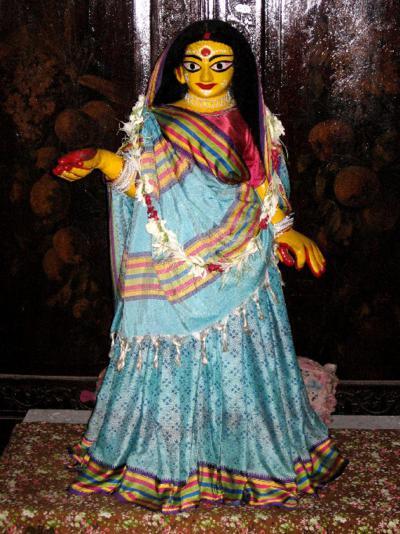
Jahnava was born into a Vaishnava family that was close to the movement even before Chaitanya Mahaprabhu had appeared. Her father, Suryadasa Sarakhela, lived at Shaligrama, a village a few miles from Navadwip. He worked as an accountant, or secretary, in the Muslim government of Gauda. The title Sarakhela means roughly "commander," and it shows the rank of that office. This post made him a wealthy man. By every account, he was also a devoted one.
| Detail | Description |
|---|---|
| Father | Suryadasa Sarakhela of Shaligrama |
| Occupation | Accountant to the Muslim government of Gauda |
| Brothers of Suryadasa | Gauridasa Pandita, Krishnadasa Sarakhela, and others named in different sources |
| Elder daughter | Vasudha, first wife of Nityananda Prabhu |
| Younger daughter | Jahnava, second wife of Nityananda Prabhu |
| Traditional identity | Identified, with Vasudha, as an expansion of Balarama's consort; some sources instead name her Ananga Manjari |
The Sarakhela Brothers of Shaligrama #
Suryadasa had several brothers. One, Gauridasa Pandita, is counted among the twelve gopalas and was one of the most fervent of all Nityananda Prabhu's followers. He later moved from Shaligrama to Ambika Kalna with his elder brother's blessing. Another, Krishnadasa Sarakhela, stands beside Suryadasa in the Chaitanya-charitamrita itself. There, Krishnadasa Kaviraja Goswami names the two brothers together as men of firm faith in Nityananda Prabhu, "a reservoir of love of Godhead." A few later collections list still more brothers, among them Damodara, Jagannatha and Nrisimha Chaitanya. But the sources do not agree closely enough on the full list for it to be taken as settled fact. They do agree on one thing. The family's devotion to Nityananda Prabhu was already long established by the time marriage was discussed. One source names Suryadasa's own mother as Kamala Devi and his wife, Jahnava's mother, as Bhadravati Devi.
Suryadasa had two daughters: Vasudha, the elder, and Jahnava, the younger. Both grew up in the same devotional household at Shaligrama. Both would go on to marry the same man.
An Honest Note on Dates #
No surviving source gives a firm, agreed year or place for Jahnava's birth. Among the Bengali devotional biographies, her story is preserved in the Bhakti-ratnakara of Narahari Chakravarti Thakura. This is the chief source for her life. It records her family, her marriage and her later work in close detail, but not a birth date. One modern compilation gives a specific date, 10 May 1509, and a birthplace of Ambika Kalna. But that source's own editors note that it relies on devotional literature and has not been checked independently. It also does not fit well with the family's own home at Shaligrama. That home is recorded both in the Bhakti-ratnakara and in the Chaitanya-charitamrita's own purport on her father. So the family home at Shaligrama is the more consistently recorded detail here, but the birth date itself is still not settled. The sources allow only a short, honest account of her early years.
Two Traditions of Her Spiritual Identity #
Every major associate of Chaitanya Mahaprabhu carries an eternal identity in Krishna's own pastimes in Vraja. Kavi Karnapura's Gaura-ganoddesha-dipika lists these identities in full. For Jahnava and Vasudha, it records two related but different traditions side by side, and it does not choose one over the other.
The first identifies the two sisters directly as expansions of Balarama's own consorts: Vasudha as Varuni, and Jahnava as Revati. In this tradition, their father Suryadasa is himself an incarnation of Kakudmi, who is Revati's father in the Puranic account. This is why the Gaura-ganoddesha-dipika describes him as "resplendent as the sun." The second tradition is recorded in the same text. It identifies one of the two sisters, most often Jahnava, with Ananga Manjari, the younger sister of Radharani among the gopis of Vraja. A few sources turn this around and apply it to Vasudha instead. Srila Prabhupada himself follows this second identification in his purport to Chaitanya-charitamrita, Adi-lila 11.21. He writes simply that "she is described in the Gaura-ganoddesha-dipika (66) as Ananga-manjari of Vrindavana." The Gaura-ganoddesha-dipika itself accepts both identities as true at the same time, in the same way that other associates of Mahaprabhu are given more than one identity at a time. Later in her life, at Vrindavana, the Deity of Gopinatha is said to have addressed Jahnava directly by this second name. That episode is told on Journeys to Vrindavana and Jahnava Radhika.
Whichever identity a given text emphasizes, they all agree on the same underlying point. Jahnava's later authority in the Gaudiya Vaishnava movement, described on Leading the Movement After 1534, was never an anomaly the tradition had to explain away. It was consistent with who she already was.
