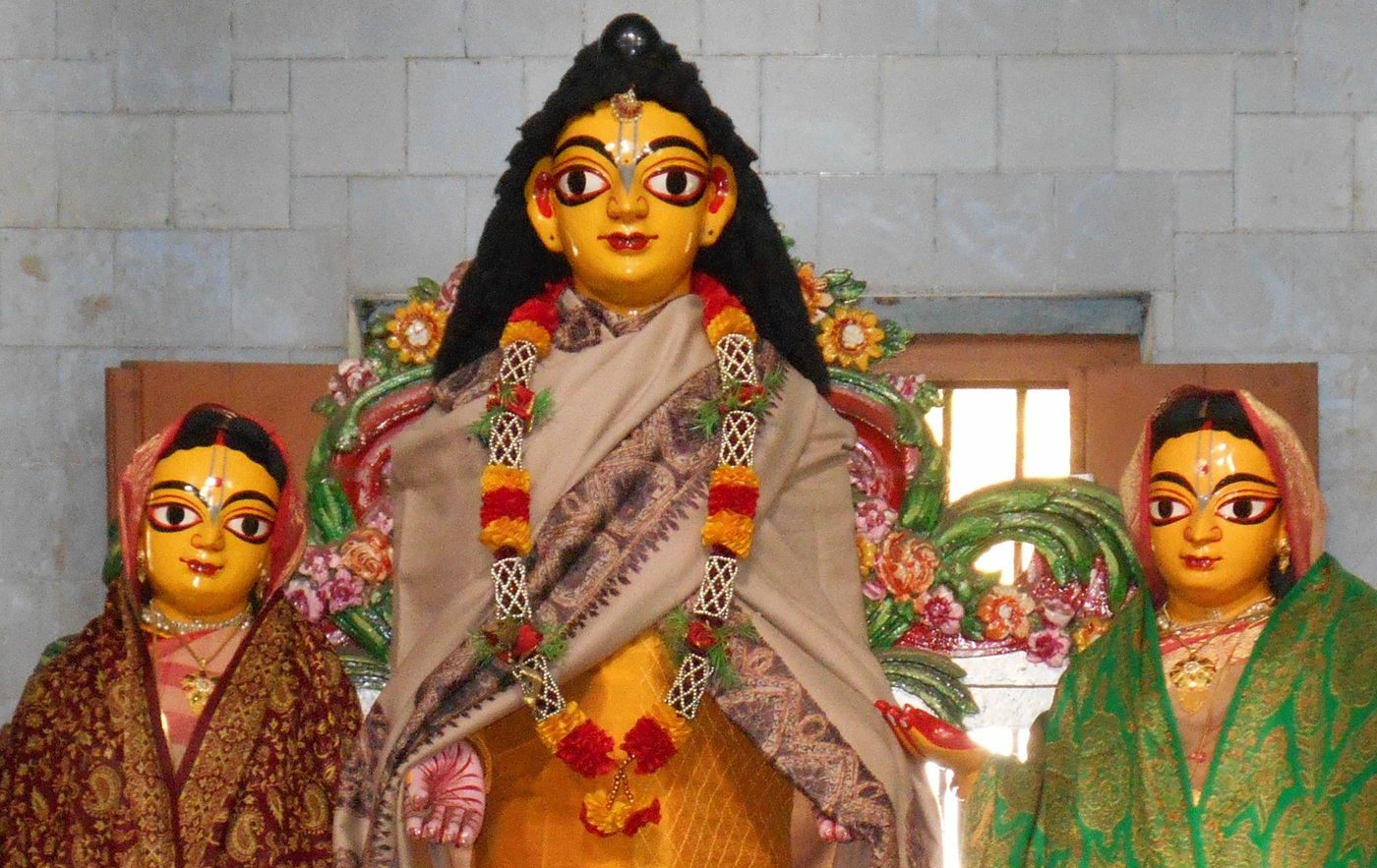
The sources do not give a firm year for Jahnava Devi's disappearance, and we do not make one up here. But they do give the day. The Bhakta-mala and the wider Bengali tradition place it on Shukla Navami, the ninth day of the bright fortnight, in the month of Vaishakha, at Vrindavana. One modern writer estimates the year as about 1594. But the old texts do not support this year in the way they support the day and place. So it is given here only as one writer's calculation, not as an established fact.
The Deity at Gopinatha's Left #
The tradition's account of how she left this world is closely connected with the Deity of Jahnava Radhika described on Journeys to Vrindavana and Jahnava Radhika. According to the Bhakta-mala, at the time of her disappearance Jahnava revealed her own transcendental form. She told the priests at the Gopinatha temple to install a Deity of herself in the Lord's own chamber. The priests are said to have hesitated to place any Deity directly beside Gopinatha's own. Then, the tradition says, Gopinatha spoke to them Himself. He called her "My beloved Ananga Manjari" and said that she should stand at His left, with Radhika at His right. Whatever a modern reader may think of the miracle in this story, its central claim is a living fact of temple worship. A Deity of Jahnava Devi still stands today beside Gopinatha at Vrindavana. The tradition's reason for this has never changed. It is her identity as Ananga Manjari, already discussed on Birth and Family.
Ekachakra and Bengal #
In Bengal her memory is kept even more directly. At Ekachakra, Nityananda Prabhu's birthplace, the temple of Banka Raya houses the Deity of Krishna that Nityananda Prabhu Himself is said to have established. The priests of that temple hold that Nityananda Prabhu entered into this very Deity at the time of His own disappearance. A Deity of Jahnava stands on Banka Raya's right side, and Radharani on His left. The temple's own priests explain the arrangement like this. Nityananda Prabhu had entered the Deity, and Jahnava's place was set beside Him. More widely, Jahnava is worshipped today with Nityananda Prabhu in temples throughout Bengal. This is so wherever the Nityananda-vamsa and the wider Gaudiya Vaishnava community have kept up the worship that her household at Khardaha first began. Devotional verse keeps her present too. In his Kalyana-kalpa-taru, Srila Bhaktivinoda Thakura wrote a prayer addressed directly to her. In it he calls her "Nityananda's energy," "devotion to Krishna," and "my guru," and asks for shelter at her feet. A bhajan by the mahajana Krishna Das is still sung by Vaishnavas today. Each verse ends by remembering "Jahnava's lotus feet" before the singer takes up the chanting of the holy names.
What Srila Prabhupada Said Her Example Proves #
Srila Prabhupada spoke about Jahnava Devi's example on at least two separate occasions, four years apart, when the subject of women and spiritual authority came up directly (discussed more fully on Leading the Movement After 1534). Once, in a 1972 room conversation in San Diego, he said she "was acharya" and "was controlling the whole Gaudiya Vaishnava community," and he spoke of her again in a 1976 interview in Toronto. In that interview he confirmed that a woman can indeed be guru "in the line of disciplic succession" and named her as his proof.
Gaudiya Vaishnavas do not usually present Jahnava Devi as a reformer, and nothing in the record suggests she thought of herself that way either. But the tradition has never quietly put aside what happened. Every founding figure of Gaudiya Vaishnavism had disappeared within a few years of one another. After that, for several decades in the middle of the sixteenth century, the movement's recognized head was a widow. She held no formal office, and there was no earlier example she could point to. After her, her stepson Virabhadra carried the Khardaha line forward. The hereditary Nityananda-vamsa that he founded has kept up temple worship in Bengal in the centuries since. But Bengal still remembers Jahnava Devi herself first, more than any of the households that came from her family. She is remembered whenever people speak of the Kheturi festival, the Gopinatha temple at Vrindavana, or the question of who held the Gaudiya Vaishnava movement together in its most difficult years.
