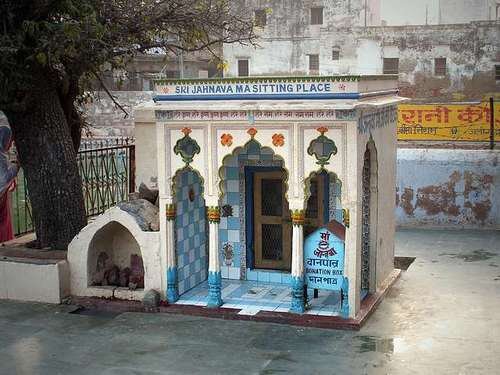
Jahnava traveled between Bengal and Vraja more than once in her life. On an earlier visit, Rupa Goswami himself explained scripture to her directly. Few Vaishnavas of any generation received such a mark of respect from him. The Bhakti-ratnakara describes one later journey in the most detail. She made that journey after the Kheturi festival described on Presiding at the Kheturi Festival.
The Road to Vraja #
Leaving Kheturi, Jahnava's party traveled toward Vraja along a route that passed through a prosperous village. There, the tradition records, she saved a number of hardened atheists and criminals and gave them Krishna-prema. The sources elsewhere describe her showing the same mercy to devotees of every class. When she reached Vrindavana, she visited the samadhi of her own uncle, Gauridasa Pandita, who is discussed on Birth and Family. She is said to have wept at the sight of it. The senior Goswamis of Vrindavana were already there to receive her. Among them were Jiva Goswami, Gopala Bhatta Goswami, Lokanatha Goswami and Bhugarbha Goswami. Madhu Pandita was also there. He was the priest of the Gopinatha Deity whose own temple would later carry Jahnava's name. With these leaders of the Vrindavana community, she visited the main temples of Vraja one by one: Madana-mohana, Govinda, and Gopinatha. Then she went on to Radha-kunda.
Radha-Kunda with Raghunatha Dasa Goswami #
At Radha-kunda she met Raghunatha Dasa Goswami. By then he lived in constant chanting of the holy names, and his body was thin from decades of austerity. Of the Six Goswamis, he was known as the most severe and the most withdrawn toward ordinary visitors. Still, he spent a great deal of time personally showing her the ground at Radha-kunda. She remained there three days doing bhajana. While sitting on the bank of the kunda, she heard the sound of Krishna's flute. She had a vision of Krishna Himself that overwhelmed her in waves of divine love. The ghat where this happened is still known today as Shri Jahnava Ghat. Afterward she joined a parikrama of the whole of Vraja-mandala with the Vaishnavas gathered around her. During this parikrama she heard Jiva Goswami himself speak on Sanatana Goswami's Brihad-Bhagavatamrita.
The Return Through Bengal #
Jahnava did not return directly to Khardaha. Her route home passed through many of the holy places of Gaudiya Bengal. She stopped again at Kheturi for three or four days. Then she went to Budhuri in Murshidabad district, the home of Ramachandra Kaviraja, and on to Ekachakra, Nityananda Prabhu's own birthplace. Next came Katwa, where Mahaprabhu had taken sannyasa, and where she met Yadunandana Acharya. After that she went to Jajigrama, Shrinivasa Acharya's home village, and then to Shrikhanda, home of Raghunandana Thakura. Then came Navadwip, Ambika, and Saptagram, where she visited the house of Uddharana Datta Thakura. Finally she returned to Khardaha. On this same journey, Parameshvara Dasa, a close associate of her stepson Virabhadra, told her about his own vision of Radha and Gopinatha united in Vrindavana. Jahnava was moved by what he reported. She instructed him to install the Deities of Radha-Gopinatha at Atapura, in Hooghly district. This episode is also recorded, in a slightly different way, on Leading the Movement After 1534.
The Deity of Radhika, and a Note on Which Side She Stands #
The best-known result of her time at the Gopinatha temple concerns the Deity of Radharani installed there. Jahnava saw the small Deity of Radhika beside Gopinatha, and she came to feel that the couple would look still more complete with a larger one. That same night, in a dream, Gopinatha is said to have asked her directly to arrange for a taller Radhika to stand beside Him. She had a new Deity made in Bengal and brought it to Vrindavana. Braj Ras is a Vrindavana devotional-literature site that records the temple's own account of its Deities. According to Braj Ras, this taller Radhika stands at Gopinatha's right. It also says that a separate Deity of Jahnava herself, installed only after her disappearance, stands at His left. That story is told in full on Legacy and Worship Today. Nityananda Prabhu's own page describes the arrangement the other way around, with the Radhika Deity on the left carrying Jahnava's name. The sources do not agree closely enough to settle which is correct. So we report the disagreement honestly instead of picking a side. Both accounts agree on the fact that matters most. A Deity connected to Jahnava by name and by tradition has stood in the Gopinatha temple's own inner shrine for centuries. That is why her name is still spoken today by pilgrims who may never have heard of Kheturi or Khardaha at all.
