Narottama Dasa Thakura's own page tells the full story of how the Kheturi Mahotsava came about: Narottama's homecoming, his cousin Santosh Datta's temple, and the six Deities installed there. It also tells how the festival drew two separated communities of Chaitanya Mahaprabhu's followers back into a single body. Read that page for the event in full. This page looks closely at one part of it: what Jahnava Devi herself is recorded as having done there. The Bhakti-ratnakara treats her role as the real center of the whole occasion.
Invited, Honored, and Asked to Take Charge #
Jahnava traveled to Kheturi from Khardaha with her own party. The Bhakti-ratnakara describes how the whole gathering greeted her arrival, in words usually used only for the most senior Vaishnavas of the age. It calls her "worshiped by the entire universe, expert in the distribution of the pearl of prema," and says her mere presence satisfied everyone who saw her. She was given the highest honor of the gathering. On the opening day she was asked not simply to attend the event as an honored guest, but to take charge of it as a whole and direct it.
The Morning She Cooked for Everyone #
The most exact single detail to survive from Kheturi is about ordinary household work, and for that reason it stands out all the more. On one of the festival mornings, the Bhakti-ratnakara records, "Jahnava Ishvari rose early... in great delight and took her bath and did her mantra meditation. Then she began to cook innumerable vegetable preparations with great enthusiasm." She supervised and personally took part in cooking the first offering to the newly installed Deities. She made that offering herself. Then, with her own hands, she served the prasadam to the assembled mahantas, the senior renunciants and heads of the gathered Vaishnava communities. Only after every guest had eaten did she take her own meal. Think for a moment about what this means. By then the entire Bengali Gaudiya Vaishnava world had accepted her as its acharya. Yet she spent one of the festival's central mornings at the cooking fire. The tradition does not remember this as a contradiction. It sees it as fully in keeping with everything else she did. In this tradition, real authority has never stood apart from service. The greater the Vaishnava, the more naturally the two go together.
Directing the Kirtana and the Colors #
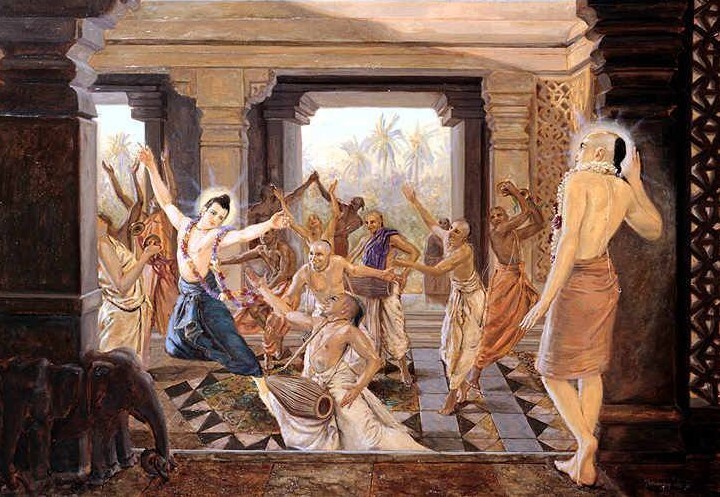
She directed the kirtana that ran through the festival's central days. Narottama Dasa Thakura's own singing made the assembled Vaishnavas feel that Chaitanya Mahaprabhu, Nityananda Prabhu and their eternal associates had appeared bodily within the sankirtana. Jahnava then explained to the gathering what had happened to them. She told them that Mahaprabhu appears wherever His holy name is sung together. Next, she had the whole assembly play with colored powder, in a mood recalling Holi, to mark the occasion. She instructed Shrinivasa Acharya, who performed the installation rites for the six Deities, to distribute garlands and sandalwood paste to the devotees. She accepted a share of the same offerings herself when it was returned to her. Shyamananda Prabhu had come to Kheturi from his own base in Odisha. For the several days the festival lasted, both he and Shrinivasa Acharya were, in every practical way, under her direction.
What Kheturi Confirmed #
Kheturi is rightly remembered as the event that reunited two communities of Chaitanya Mahaprabhu's followers. Over time these communities had moved toward different moods of devotion. Some had known Him personally in Navadwip. Others were followers of the Six Goswamis, who knew Him mainly through His years of renunciation at Puri. Her presiding role at Kheturi confirmed something more. It was something already settled in the years before Kheturi, as described on Leading the Movement After 1534. The recognized head of the whole reunited body was a woman. Narottama Dasa Thakura called the festival together, Shrinivasa Acharya performed its installation rites, and Shyamananda Prabhu was also there. None of them treated her position as needing any special explanation. From Kheturi she went on to travel again to Vraja, as told on Journeys to Vrindavana and Jahnava Radhika.
