Srila Jahnava Mata
Consort of Nityananda Prabhu Who Led Gaudiya Vaishnavism After 1534
The complete life, on one page: The main biography and every pastime page, in order, in one place
Introduction
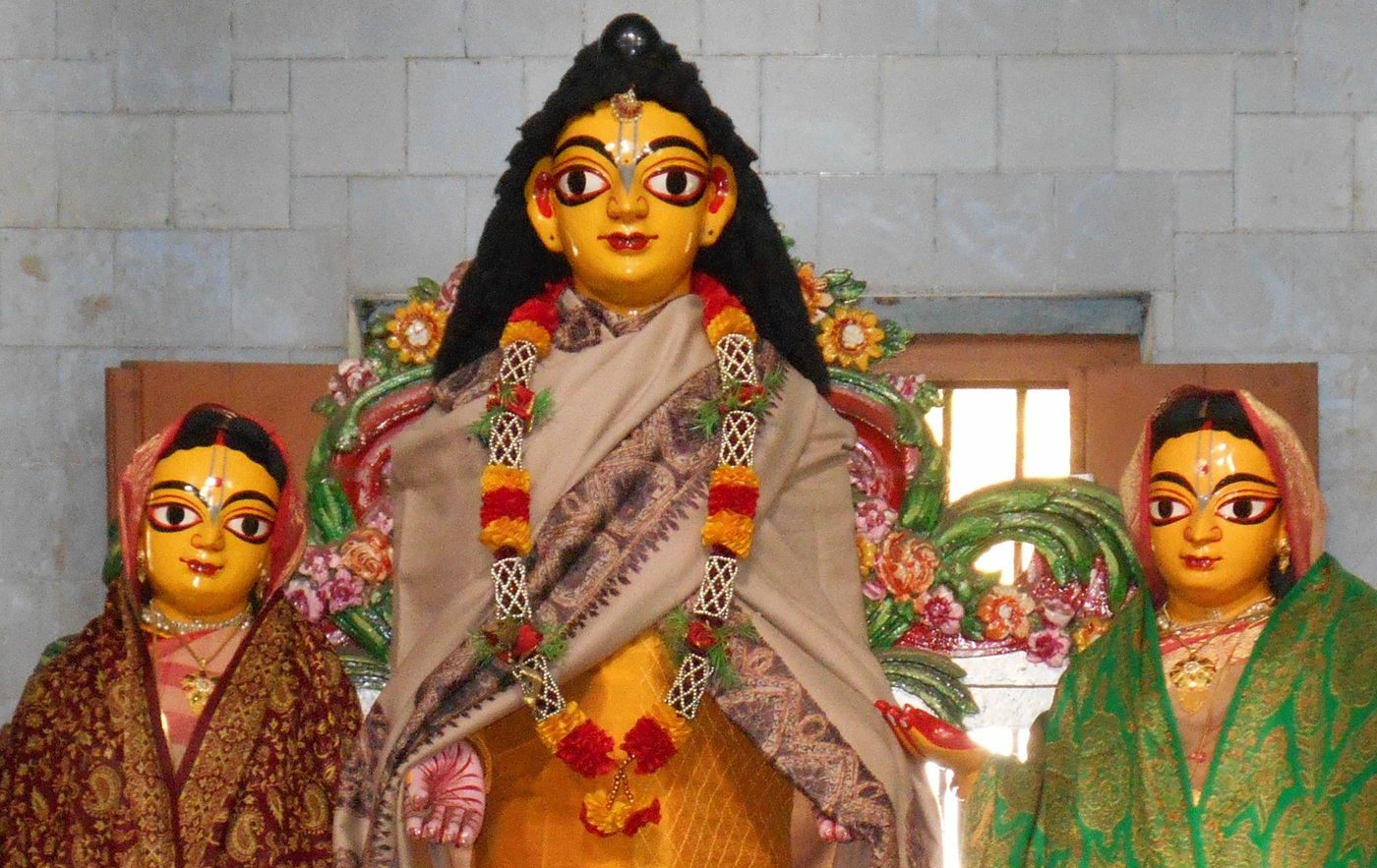
Srila Jahnava Mata, also known as Jahnava Devi, was the younger of the two wives of Nityananda Prabhu. In the decades after 1534, she became the acknowledged head of the entire Gaudiya Vaishnava movement. She held no formal post, and nobody in the society around her had held such a place before. Sixteenth-century Bengal did not expect a widow to lead anything, let alone a religious movement full of brahmana men. Yet she did lead it, as its acknowledged head, and no source shows that anyone at the time objected. Srila Prabhupada himself said of her, plainly, that she "was acharya" and that she was "controlling the whole Gaudiya Vaishnava community."
| Detail | Description |
|---|---|
| Father | Suryadasa Sarakhela, accountant to the ruler of Gauda, of Shaligrama |
| Husband | Nityananda Prabhu (married alongside her elder sister, Vasudha) |
| Identity | Ananga-manjari of Vrindavana (Gaura-ganoddesha-dipika 66; Chaitanya-charitamrita Adi 11.21 purport) |
| Home | Khardaha, on the Ganges north of present-day Calcutta |
| Stepson and disciple | Virabhadra Gosvami (Virachandra), son of Vasudha |
| Role after 1534 | Diksha-guru and acknowledged head of the Gaudiya Vaishnava movement |
| Accepted her as shiksha-guru | Narottama Dasa Thakura, Shrinivasa Acharya, Shyamananda Prabhu, each of whom had taken formal diksha elsewhere |
| Her own diksha-guru | Not named in any surviving source |
| Disappearance | Shukla Navami, month of Vaishakha, at Vrindavana (year not established) |
Scriptural evidence for the introduction (1)
केचित्श्रीवसुधादेवीं कलावपि विवृण्वते ।
अनङ्ग मञ्जरीं केचिज्जाह्नवीं च प्रचक्षते ।
उभयं तु समीचीनं पूर्व न्यायात्सतां मतम् ॥६६॥
kecit śrī-vasudhā-devīṁ kalāv api vivṛṇvate |
anaṅga mañjarīṁ kecij jāhnavīṁ ca pracakṣate |
ubhayaṁ tu samīcīnaṁ pūrva nyāyāt satāṁ matam ||66||
Some say that Srimati Vasudha-devi is the incarnation of Srimati Ananga-manjari, and others say that Srimati Jahnavi-devi is the incarnation of Srimati Ananga-manjari. In truth, both opinions are correct. They are both incarnations of Srimati Ananga-manjari.
Kavi Karnapura records that both Vasudha and Jahnava are held to be Ananga-manjari, and accepts both views; the verse just before (65) names them as Nityananda Prabhu's two wives, daughters of Suryadasa. Srila Prabhupada cites this verse in the purport to Chaitanya-charitamrita Adi 11.21 (listed separately). Sanskrit: diacritic edition of the Gaura-ganoddesha-dipika; English translation as published at bvmlu.org.
Chapter 1
Birth and Family
The Sarakhela family of Shaligrama, and the two identities the tradition gives Jahnava Devi.
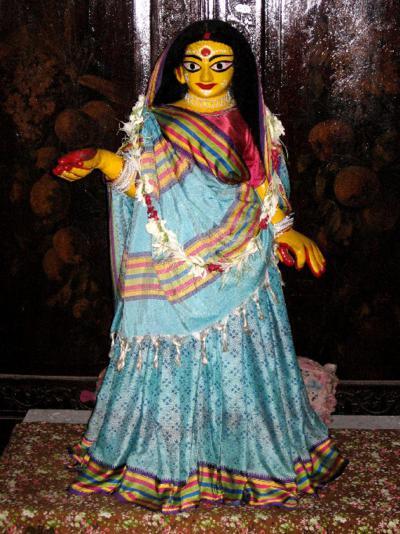
Jahnava was born into a Vaishnava family that was close to the movement even before Chaitanya Mahaprabhu had appeared. Her father, Suryadasa Sarakhela, lived at Shaligrama, a village a few miles from Navadwip. He worked as an accountant, or secretary, in the Muslim government of Gauda. The title Sarakhela means roughly "commander," and it shows the rank of that office. This post made him a wealthy man. By every account, he was also a devoted one.
| Detail | Description |
|---|---|
| Father | Suryadasa Sarakhela of Shaligrama |
| Occupation | Accountant to the Muslim government of Gauda |
| Brothers of Suryadasa | Gauridasa Pandita, Krishnadasa Sarakhela, and others named in different sources |
| Elder daughter | Vasudha, first wife of Nityananda Prabhu |
| Younger daughter | Jahnava, second wife of Nityananda Prabhu |
| Traditional identity | Identified, with Vasudha, as an expansion of Balarama's consort; some sources instead name her Ananga Manjari |
The Sarakhela Brothers of Shaligrama #
Suryadasa had several brothers. One, Gauridasa Pandita, is counted among the twelve gopalas and was one of the most fervent of all Nityananda Prabhu's followers. He later moved from Shaligrama to Ambika Kalna with his elder brother's blessing. Another, Krishnadasa Sarakhela, stands beside Suryadasa in the Chaitanya-charitamrita itself. There, Krishnadasa Kaviraja Goswami names the two brothers together as men of firm faith in Nityananda Prabhu, "a reservoir of love of Godhead." A few later collections list still more brothers, among them Damodara, Jagannatha and Nrisimha Chaitanya. But the sources do not agree closely enough on the full list for it to be taken as settled fact. They do agree on one thing. The family's devotion to Nityananda Prabhu was already long established by the time marriage was discussed. One source names Suryadasa's own mother as Kamala Devi and his wife, Jahnava's mother, as Bhadravati Devi.
Suryadasa had two daughters: Vasudha, the elder, and Jahnava, the younger. Both grew up in the same devotional household at Shaligrama. Both would go on to marry the same man.
An Honest Note on Dates #
No surviving source gives a firm, agreed year or place for Jahnava's birth. Among the Bengali devotional biographies, her story is preserved in the Bhakti-ratnakara of Narahari Chakravarti Thakura. This is the chief source for her life. It records her family, her marriage and her later work in close detail, but not a birth date. One modern compilation gives a specific date, 10 May 1509, and a birthplace of Ambika Kalna. But that source's own editors note that it relies on devotional literature and has not been checked independently. It also does not fit well with the family's own home at Shaligrama. That home is recorded both in the Bhakti-ratnakara and in the Chaitanya-charitamrita's own purport on her father. So the family home at Shaligrama is the more consistently recorded detail here, but the birth date itself is still not settled. The sources allow only a short, honest account of her early years.
Two Traditions of Her Spiritual Identity #
Every major associate of Chaitanya Mahaprabhu carries an eternal identity in Krishna's own pastimes in Vraja. Kavi Karnapura's Gaura-ganoddesha-dipika lists these identities in full. For Jahnava and Vasudha, it records two related but different traditions side by side, and it does not choose one over the other.
The first identifies the two sisters directly as expansions of Balarama's own consorts: Vasudha as Varuni, and Jahnava as Revati. In this tradition, their father Suryadasa is himself an incarnation of Kakudmi, who is Revati's father in the Puranic account. This is why the Gaura-ganoddesha-dipika describes him as "resplendent as the sun." The second tradition is recorded in the same text. It identifies one of the two sisters, most often Jahnava, with Ananga Manjari, the younger sister of Radharani among the gopis of Vraja. A few sources turn this around and apply it to Vasudha instead. Srila Prabhupada himself follows this second identification in his purport to Chaitanya-charitamrita, Adi-lila 11.21. He writes simply that "she is described in the Gaura-ganoddesha-dipika (66) as Ananga-manjari of Vrindavana." The Gaura-ganoddesha-dipika itself accepts both identities as true at the same time, in the same way that other associates of Mahaprabhu are given more than one identity at a time. Later in her life, at Vrindavana, the Deity of Gopinatha is said to have addressed Jahnava directly by this second name. That episode is told on Journeys to Vrindavana and Jahnava Radhika.
Whichever identity a given text emphasizes, they all agree on the same underlying point. Jahnava's later authority in the Gaudiya Vaishnava movement, described on Leading the Movement After 1534, was never an anomaly the tradition had to explain away. It was consistent with who she already was.
Scriptural evidence for this chapter (4)
সূর্যদাস সরখেল, তাঁর ভাই কৃষ্ণদাস ।
নিত্যানন্দে দৃঢ় বিশ্বাস, প্রেমের নিবাস ॥ ২৫ ॥
suryadasa sarakhela, tanra bhai krsnadasa
nityanande drdha visvasa, premera nivasa
Word for word
suryadasa sarakhela: Suryadasa Sarakhela; tanra bhai: his brother; krsnadasa: Krsnadasa; nityanande: unto Lord Nityananda; drdha visvasa: firm faith; premera nivasa: the reservoir of all love of Godhead.
Suryadasa Sarakhela and his younger brother Krsnadasa Sarakhela both possessed firm faith in Nityananda Prabhu. They were a reservoir of love of Godhead.
From the purport: Purport excerpt: "Suryadasa had four brothers, all of whom were pure Vaisnavas. Vasudha and Jahnava were two daughters of Suryadasa Sarakhela."
The Chaitanya-charitamrita's own textual basis for Jahnava's father, his brother, and the family home at Shaligrama.
নিত্যানন্দের গণ যত,—সব ব্রজসখা ।
শৃঙ্গ–বেত্র–গোপবেশ, শিরে শিখিপাখা ॥ ২১ ॥
nityanandera gana yata — saba vraja-sakha
srnga-vetra-gopavesa, sire sikhi-pakha
Word for word
nityanandera: of Lord Nityananda Prabhu; gana: followers; yata: all; saba: all; vraja-sakha: residents of Vrndavana; srnga: horn; vetra: cane stick; gopa-vesa: dressed like a cowherd boy; sire: on the head; sikhi-pakha: the plume of a peacock.
All the associates of Lord Nityananda were formerly cowherd boys in Vrajabhumi, symbolically represented by their horns, sticks, cowherd dress and peacock plumes.
From the purport: Purport excerpt: "Jahnava-mata is also within the list of Lord Nityananda's followers. She is described in the Gaura-ganoddesa-dipika (66) as Ananga-manjari of Vrndavana."
Srila Prabhupada's own textual basis for identifying Jahnava with Ananga Manjari, the tradition discussed at length here.
sri-varuni-revata-vamsa-sambhave
tasya priye dve vasudha ca jahnavi
sri-surya-dasasya mahatmanah sute
kakudma-rupasya ca surya-tejasah
ananga-manjarim kecij jahnavam ca pracaksate
ubhayam tu samicinam purva-nyayat satam matam
Vasudha and Jahnavi, the two beloveds of Nityananda Prabhu, took birth in the lineage of Varuni and Revati, as daughters of the great soul Sri Suryadasa, who was himself Kakudmi, radiant as the sun, in an earlier appearance. Some describe Jahnava as an incarnation of Ananga Manjari; both views are accepted as valid by the learned, by the same reasoning applied elsewhere to Mahaprabhu's other associates.
The traditional verse behind both identifications of Jahnava Devi discussed here: as an expansion of Revati, and as Ananga Manjari.
From the purport: Jahnava-mata is also within the list of Lord Nityananda's followers. She is described in the Gaura-ganoddesha-dipika (66) as Ananga-manjari of Vrindavana. All the devotees who are followers of Jahnava-mata are counted within the list of Sri Nityananda Prabhu's devotees.
Srila Prabhupada's own purport to CC Adi-lila 11.21, identifying Jahnava Devi's eternal identity in Krishna's Vraja pastimes, from the Gaura-ganoddesha-dipika (66), as Ananga-manjari of Vrindavana. This identification underlies the tradition's account of both her authority after 1534 and the Deity of her installed at the Gopinatha temple in Vrindavana.
Chapter 2
Marriage and the Two Wives of Nityananda Prabhu
How Jahnava and her sister Vasudha came to marry Nityananda Prabhu, and what became of their household at Khardaha.
The full story of how Nityananda Prabhu married Vasudha and Jahnava, the two daughters of Suryadasa Sarakhela, is told on Nityananda Prabhu's own account of the wedding. That page draws on the dramatic account given in the Bhakti-ratnakara and the Premavilasa. It covers the refusal, Vasudha's collapse, and how Nityananda restored her life on the condition that the marriage would go forward. It is the fuller and more reliable telling of the episode from Nityananda's side, so readers who want the complete story of how the marriage came about should read it first. What follows here is what happened around and after it, from Jahnava's own side.
A Vision Before the Wedding #
Some retellings of the Bhakti-ratnakara describe the marriage coming about more peacefully than in the dramatic account of the refusal and Vasudha's collapse. In this version, Suryadasa was thinking over the question of his daughters' marriage late one night. He is said to have fallen asleep and dreamed of Nityananda Prabhu as Balarama Himself, radiant beyond description. Suryadasa's own two daughters stood at Nityananda Prabhu's sides in their forms as Revati and Varuni. Waking in ecstasy, Suryadasa is said to have sent a Brahmin friend to Navadwip to place the proposal before Srivasa Thakura, at whose house Nityananda Prabhu was then staying. Through Srivasa Thakura, the friend carried it to Advaita Acharya as well, and both received the news with joy. The surviving texts do not let a reader be sure which is true. It may be this vision, or the more dramatic events already told on Nityananda Prabhu's own page, or some combination of both. But the different versions of the Bhakti-ratnakara agree on the outcome. Suryadasa gave both daughters to Nityananda Prabhu, and did so gladly.
The Wedding at Shaligrama #
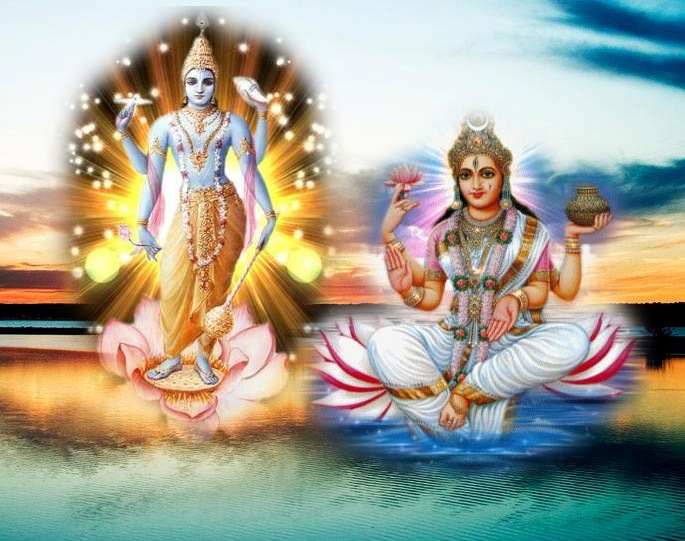
The preliminary adhivasa rites were performed at the house of Krishnadasa Sarakhela in Shaligrama, with the brahmanas of the surrounding villages in attendance. Suryadasa then gave his two daughters to Nityananda Prabhu according to the full religious rite. From Shaligrama the new household made the customary rounds any Bengali bridegroom's family would make. They went first to Sachi Devi at Nabadwip, who received both brides with open affection, then to Advaita Acharya's house at Shantipur, where Sita Thakurani took them into her lap and blessed them. Afterward Nityananda Prabhu settled the family at Khardaha, on the Ganges north of present-day Calcutta. It remained Jahnava's own home for the rest of her life, and it became the headquarters of the entire Bengal mission.
Vasudha's Children and Jahnava's Motherhood #
Vasudha bore Nityananda Prabhu eight sons and one daughter, but seven of the sons died in infancy. The two children who survived were the daughter, Ganga Devi, and the youngest son, Virabhadra, also called Virachandra. According to the Gaura-ganoddesha-dipika, these two children are themselves identified with Kshirodakashayi Vishnu and the river Ganges. The same text identifies Ganga Devi's own husband, Madhavacharya, with King Shantanu of the Mahabharata, husband of the river-goddess Ganga in that earlier age. Vasudha herself died not long after their birth. Jahnava bore no children of her own. She raised both of them, and the sources all agree that Virabhadra became her particular favorite. When he grew, Jahnava gave him initiation, not Vasudha, his own mother by birth, and not Nityananda Prabhu himself. Later, Virabhadra saw her in a four-armed form. It is said that after this experience he was sure in his own mind that she, and no one else, was to be his diksha-guru.
Virabhadra himself grew into one of the most important figures of the second generation. Chaitanya-charitamrita calls him the greatest branch of the movement after Nityananda Prabhu. Krishnadasa Kaviraja Goswami takes shelter of his feet before he even begins to write that work. But his story belongs more properly on Nityananda Prabhu's own page. What matters most here is a simple fact. Within a generation, a household built around two sisters married to one man produced two things. It produced the hereditary Nityananda-vamsa, which carried the family's worship forward in Bengal. It also produced the woman who would soon be recognized as the head of the entire movement to which that family belonged. Her rise to that recognition is the subject of Leading the Movement After 1534.
Chapter 3
Leading the Movement After 1534
How Nityananda Prabhu's widow became the acknowledged head of Gaudiya Vaishnavism, and what Srila Prabhupada said about it.
Chaitanya Mahaprabhu disappeared in 1534. Within a few years Nityananda Prabhu, Advaita Acharya and Srivasa Thakura had all followed him. In that short time, every figure the movement had been built around in its first generation was gone. The surviving sources describe what happened next. There was no fight over who should lead, no split, and no long period of confusion. Instead, something close to a quiet agreement came almost at once. Jahnava, Nityananda Prabhu's widow, was recognized as the movement's head.
Why Her, and Why So Little Recorded Dispute #
Nothing in sixteenth-century Bengal made this an obvious outcome. Jahnava had no formal office to inherit, and no source names who gave her own formal diksha. The sources simply do not say who her personal guru was. But she had a standing that no one seems to have questioned. She had a household at Khardaha that had already been the informal center of the Bengal mission for years. She had a stepson in Virabhadra, whom she had raised and personally initiated. And she had a traditional identity as Ananga Manjari, an eternal associate of Krishna in Vraja. Both the Gaura-ganoddesha-dipika and Srila Prabhupada's own purport to Chaitanya-charitamrita, Adi-lila 11.21 hold this, and it is discussed at length on Birth and Family. She initiated a large number of disciples beyond Virabhadra alone. When she later arranged Virabhadra's own marriage to two daughters of Yadunandana Acharya, named Shrimati and Narayani, both women themselves became her initiated disciples. Parameshvara Dasa was one of Nityananda Prabhu's own close associates and one of the twelve gopalas. Srila Prabhupada's purport to Chaitanya-charitamrita Adi 11.29 describes him as having "accompanied Srimati Jahnava-devi when she performed the festival at Khetari," in words quoted from Srila Bhaktisiddhanta Sarasvati Thakura. By her own order, Parameshvara Dasa installed Radha-Gopinatha in the temple at Atapura, in the district of Hooghly. Her authority to act this way rested not on anything she claimed for herself but on the order Sri Chaitanya Mahaprabhu gave to every one of His followers: yare dekha, tare kaha 'krishna'-upadesha, amara ajnaya guru hana tara' ei desha, "instruct everyone you meet to follow the orders of Lord Krishna... in this way become a spiritual master" (Chaitanya-charitamrita, Madhya-lila 7.128).
The clearest surviving explanation of what this authority really meant does not come from any sixteenth-century source. It comes from Srila Prabhupada himself, four centuries later, and he spoke about it twice. In a 1972 room conversation in San Diego, a disciple asked whether a woman's statement could be accepted as authoritative. Srila Prabhupada answered: "If a woman is perfect in Krishna consciousness... Just like Jahnava-devi, Lord Nityananda's wife, she was acharya. She was controlling the whole Vaishnava community," and when he was asked to confirm this, he added, "She was controlling the whole Gaudiya Vaishnava community." In the same conversation he also made an important clarification: "It is not that woman cannot be acharya. Generally, they do not become. In very special case. But Jahnava-devi was accepted as [acharya], but she did not declare." In other words, the recognition came from the community around her, not from any claim she made for herself. The next section gives the exact standard Srila Prabhupada applied to reach that conclusion.
The Standard Prabhupada Applied #
Four years later, in Toronto, a professor asked Srila Prabhupada directly whether a woman could be guru in the line of disciplic succession. Again he gave the same example: "Yes. Jahnava Devi was... Nityananda's wife. She became. If she is able to go to the highest perfection of life, why it is not possible to become guru?" He then quoted the verse that, as he understood it, settles the question for anyone who aspires to it, whatever his birth: yei krsna-tattva-vetta, sei guru haya, "whoever knows the science of Krishna, that person is guru" (Chaitanya-charitamrita, Madhya-lila 8.128). Chaitanya Mahaprabhu first spoke that verse to Ramananda Raya himself. Ramananda Raya was a governor, but he was born into a family that the caste system of the day ranked below a brahmana. Mahaprabhu spoke the verse to settle the very same question, only about a man instead of a woman. The purport to that verse makes the point clearly. Varnashrama-dharma assigns different social duties to different classes. But Krishna consciousness stands on a completely separate level. It is open to a brahmana, a sannyasi, a shudra, or a woman, as Srila Prabhupada's own later words about Jahnava Devi make clear. Nityananda Prabhu's own page uses this same principle to describe what Jahnava's leadership shows about the movement's own principles. Srila Prabhupada's point is limited and exact. He does not say that being a man or a woman makes no difference in any social arrangement. He says that the one qualification for guru is knowledge of Krishna, and that Jahnava Devi's own history proves this qualification was always real, never only a theory.
No one questioned her standing, and by then it was widely known throughout Bengal. This same standing brought her to Kheturi a short time later. She did not go as a guest of honor in the ordinary sense. She went as the person Narottama Dasa Thakura asked to preside over the entire festival. That event is the subject of Presiding at the Kheturi Festival.
Scriptural evidence for this chapter (5)
কিবা বিপ্র, কিবা ন্যাসী, শূদ্র কেনে নয়।
যেই কৃষ্ণতত্ত্ববেত্তা, সেই 'গুরু' হয়॥
kibā vipra, kibā nyāsī, śūdra kene naya
yei kṛṣṇa-tattva-vettā, sei 'guru' haya
Word for word
kibā: whether; vipra: a brāhmaṇa; kibā: whether; nyāsī: a sannyāsī; śūdra: a śūdra; kene: why; naya: not; yei: anyone who; kṛṣṇa-tattva-vettā: a knower of the science of Kṛṣṇa; sei: that person; guru: the spiritual master; haya: is.
Whether one is a brahmana, a sannyasi or a shudra, regardless of what he is, he can become a spiritual master if he knows the science of Krishna.
From the purport: Actually the brahmana is supposed to be the spiritual master of all other varnas, or classes, but as far as Krishna consciousness is concerned, everyone is capable of becoming a spiritual master because knowledge in Krishna consciousness is on the platform of the spirit soul.
Chaitanya Mahaprabhu spoke this verse to Ramananda Raya, a governor of shudra birth, to settle the question of who may become guru. Srila Prabhupada quoted this same verse (as 'yei krsna-tattva-vetta, sei guru haya') in a 1976 Toronto interview (transcript 760618i2tor) when asked directly whether a woman could be guru in the disciplic succession, naming Jahnava Devi as his proof.
পরমেশ্বরদাস—নিত্যানন্দৈক–শরণ ।
কৃষ্ণভক্তি পায়, তাঁরে যে করে স্মরণ ॥ ২৯ ॥
paramesvara-dasa — nityanandaika-sarana
krsna-bhakti paya, tanre ye kare smarana
Word for word
paramesvara-dasa: Paramesvara dasa; nityananda-eka-sarana: completely surrendered to the lotus feet of Nityananda; krsna-bhakti paya: gets love of Krsna; tanre: him; ye: anyone; kare: does; smarana: remembering.
Paramesvara dasa, the fifth gopala of krsna-lila, completely surrendered to the lotus feet of Nityananda. Anyone who remembers his name will easily get love of Krsna.
From the purport: Purport excerpt: "He accompanied Srimati Jahnava-devi when she performed the festival at Khetari. It is stated in the Bhakti-ratnakara that by the order of Srimati Jahnava-mata, he installed Radha-Gopinatha in the temple at Atapura, in the district of Hugli."
The Chaitanya-charitamrita's own confirmation that a Deity installation was carried out on Jahnava-mata's direct order, cited here as evidence of her practical authority after 1534.
From the purport: If a woman is perfect in Krishna consciousness... Just like Jahnava-devi, Lord Nityananda's wife, she was acharya. She was controlling the whole Vaishnava community... She was controlling the whole Gaudiya Vaishnava community... It is not that woman cannot be acharya. Generally, they do not become. In very special case. But Jahnava-devi was accepted as [acharya], but she did not declare.
Srila Prabhupada's direct answer, in conversation with disciple Atreya Rishi, to the question of whether a woman's statement could be accepted as authoritative. This is the primary source for the claim that Jahnava Devi was recognized as acharya and headed the Gaudiya Vaishnava community after 1534.
কিবা বিপ্র, কিবা ন্যাসী, শূদ্র কেনে নয় ।
যেই কৃষ্ণতত্ত্ববেত্তা, সেই ‘গুরু’ হয় ॥ ১২৮ ॥
kiba vipra, kiba nyasi, sudra kene naya
yei krsna-tattva-vetta, sei 'guru' haya
Word for word
kiba: whether; vipra: a brahmana; kiba: whether; nyasi: a sannyasi; sudra: a sudra; kene naya: why not; yei: anyone who; krsna-tattva-vetta: a knower of the science of Krsna; sei: that person; guru: the spiritual master; haya: is.
"Whether one is a brahmana, a sannyasi or a sudra -- regardless of what he is -- he can become a spiritual master if he knows the science of Krsna."
The verse Srila Prabhupada quoted verbatim, in his 1976 Toronto interview discussed here, as his own scriptural basis for saying Jahnava Devi could become guru.
From the purport: Is it possible, Swamiji, for a woman to be a guru in the line of disciplic succession? Prabhupada: Yes. Jahnava devi was... Nityananda's wife. She became. If she is able to go to the highest perfection of life, why it is not possible to become guru? But, not so many. Actually one who has attained the perfection, she can become guru.
Prof. O'Connell's direct question and Srila Prabhupada's answer, four years after the San Diego conversation, confirming a woman can be guru in the disciplic succession and naming Jahnava Devi as the proof. He follows this immediately with CC Madhya 8.128 in the same breath.
Chapter 4
Presiding at the Kheturi Festival
What Jahnava Devi did at the festival that brought together and strengthened the second generation of Gaudiya Vaishnavism.
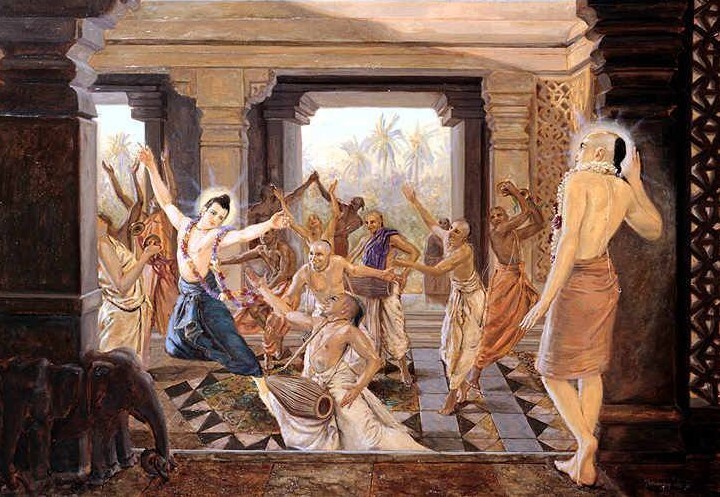
Narottama Dasa Thakura's own page tells the full story of how the Kheturi Mahotsava came about: Narottama's homecoming, his cousin Santosh Datta's temple, and the six Deities installed there. It also tells how the festival drew two separated communities of Chaitanya Mahaprabhu's followers back into a single body. Read that page for the event in full. This page looks closely at one part of it: what Jahnava Devi herself is recorded as having done there. The Bhakti-ratnakara treats her role as the real center of the whole occasion.
Invited, Honored, and Asked to Take Charge #
Jahnava traveled to Kheturi from Khardaha with her own party. The Bhakti-ratnakara describes how the whole gathering greeted her arrival, in words usually used only for the most senior Vaishnavas of the age. It calls her "worshiped by the entire universe, expert in the distribution of the pearl of prema," and says her mere presence satisfied everyone who saw her. She was given the highest honor of the gathering. On the opening day she was asked not simply to attend the event as an honored guest, but to take charge of it as a whole and direct it.
The Morning She Cooked for Everyone #
The most exact single detail to survive from Kheturi is about ordinary household work, and for that reason it stands out all the more. On one of the festival mornings, the Bhakti-ratnakara records, "Jahnava Ishvari rose early... in great delight and took her bath and did her mantra meditation. Then she began to cook innumerable vegetable preparations with great enthusiasm." She supervised and personally took part in cooking the first offering to the newly installed Deities. She made that offering herself. Then, with her own hands, she served the prasadam to the assembled mahantas, the senior renunciants and heads of the gathered Vaishnava communities. Only after every guest had eaten did she take her own meal. Think for a moment about what this means. By then the entire Bengali Gaudiya Vaishnava world had accepted her as its acharya. Yet she spent one of the festival's central mornings at the cooking fire. The tradition does not remember this as a contradiction. It sees it as fully in keeping with everything else she did. In this tradition, real authority has never stood apart from service. The greater the Vaishnava, the more naturally the two go together.
Directing the Kirtana and the Colors #
She directed the kirtana that ran through the festival's central days. Narottama Dasa Thakura's own singing made the assembled Vaishnavas feel that Chaitanya Mahaprabhu, Nityananda Prabhu and their eternal associates had appeared bodily within the sankirtana. Jahnava then explained to the gathering what had happened to them. She told them that Mahaprabhu appears wherever His holy name is sung together. Next, she had the whole assembly play with colored powder, in a mood recalling Holi, to mark the occasion. She instructed Shrinivasa Acharya, who performed the installation rites for the six Deities, to distribute garlands and sandalwood paste to the devotees. She accepted a share of the same offerings herself when it was returned to her. Shyamananda Prabhu had come to Kheturi from his own base in Odisha. For the several days the festival lasted, both he and Shrinivasa Acharya were, in every practical way, under her direction.
What Kheturi Confirmed #
Kheturi is rightly remembered as the event that reunited two communities of Chaitanya Mahaprabhu's followers. Over time these communities had moved toward different moods of devotion. Some had known Him personally in Navadwip. Others were followers of the Six Goswamis, who knew Him mainly through His years of renunciation at Puri. Her presiding role at Kheturi confirmed something more. It was something already settled in the years before Kheturi, as described on Leading the Movement After 1534. The recognized head of the whole reunited body was a woman. Narottama Dasa Thakura called the festival together, Shrinivasa Acharya performed its installation rites, and Shyamananda Prabhu was also there. None of them treated her position as needing any special explanation. From Kheturi she went on to travel again to Vraja, as told on Journeys to Vrindavana and Jahnava Radhika.
Scriptural evidence for this chapter (2)
Jahnava Devi, the daughter of Surya Pandit and wife of Nityananda Prabhu, worshiped by the entire universe, expert in the distribution of the pearl of prema, was delighted to hear his name. Her joy increased when she observed his uncommon love for Krishna and his renunciation. Out of her mercy, she came to Kheturi, satisfying everyone by being present there and giving her darshan to all.
Narahari Chakravarti's own description, in the Bhakti-ratnakara, of the honor in which Jahnava Devi was held by the time she arrived at the Kheturi festival; cited here via a secondary translation, since the Bhakti-ratnakara has no standalone English corpus on vedabase.
Jahnava Ishvari rose early that morning in great delight and took her bath and did her mantra meditation. Then she began to cook innumerable vegetable preparations with great enthusiasm.
The specific verse behind the account of Jahnava Devi personally cooking the first offering at Kheturi; cited via a secondary translation for the same reason as the citation above.
Chapter 5
Journeys to Vrindavana and Jahnava Radhika
Her pilgrimage from Bengal to Vraja, her welcome among the Six Goswamis, and the Deity that still carries her name.
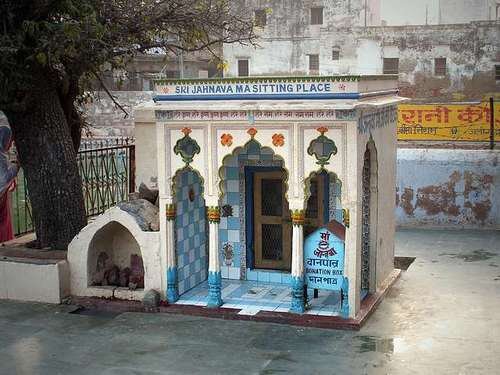
Jahnava traveled between Bengal and Vraja more than once in her life. On an earlier visit, Rupa Goswami himself explained scripture to her directly. Few Vaishnavas of any generation received such a mark of respect from him. The Bhakti-ratnakara describes one later journey in the most detail. She made that journey after the Kheturi festival described on Presiding at the Kheturi Festival.
The Road to Vraja #
Leaving Kheturi, Jahnava's party traveled toward Vraja along a route that passed through a prosperous village. There, the tradition records, she saved a number of hardened atheists and criminals and gave them Krishna-prema. The sources elsewhere describe her showing the same mercy to devotees of every class. When she reached Vrindavana, she visited the samadhi of her own uncle, Gauridasa Pandita, who is discussed on Birth and Family. She is said to have wept at the sight of it. The senior Goswamis of Vrindavana were already there to receive her. Among them were Jiva Goswami, Gopala Bhatta Goswami, Lokanatha Goswami and Bhugarbha Goswami. Madhu Pandita was also there. He was the priest of the Gopinatha Deity whose own temple would later carry Jahnava's name. With these leaders of the Vrindavana community, she visited the main temples of Vraja one by one: Madana-mohana, Govinda, and Gopinatha. Then she went on to Radha-kunda.
Radha-Kunda with Raghunatha Dasa Goswami #
At Radha-kunda she met Raghunatha Dasa Goswami. By then he lived in constant chanting of the holy names, and his body was thin from decades of austerity. Of the Six Goswamis, he was known as the most severe and the most withdrawn toward ordinary visitors. Still, he spent a great deal of time personally showing her the ground at Radha-kunda. She remained there three days doing bhajana. While sitting on the bank of the kunda, she heard the sound of Krishna's flute. She had a vision of Krishna Himself that overwhelmed her in waves of divine love. The ghat where this happened is still known today as Shri Jahnava Ghat. Afterward she joined a parikrama of the whole of Vraja-mandala with the Vaishnavas gathered around her. During this parikrama she heard Jiva Goswami himself speak on Sanatana Goswami's Brihad-Bhagavatamrita.
The Return Through Bengal #
Jahnava did not return directly to Khardaha. Her route home passed through many of the holy places of Gaudiya Bengal. She stopped again at Kheturi for three or four days. Then she went to Budhuri in Murshidabad district, the home of Ramachandra Kaviraja, and on to Ekachakra, Nityananda Prabhu's own birthplace. Next came Katwa, where Mahaprabhu had taken sannyasa, and where she met Yadunandana Acharya. After that she went to Jajigrama, Shrinivasa Acharya's home village, and then to Shrikhanda, home of Raghunandana Thakura. Then came Navadwip, Ambika, and Saptagram, where she visited the house of Uddharana Datta Thakura. Finally she returned to Khardaha. On this same journey, Parameshvara Dasa, a close associate of her stepson Virabhadra, told her about his own vision of Radha and Gopinatha united in Vrindavana. Jahnava was moved by what he reported. She instructed him to install the Deities of Radha-Gopinatha at Atapura, in Hooghly district. This episode is also recorded, in a slightly different way, on Leading the Movement After 1534.
The Deity of Radhika, and a Note on Which Side She Stands #
The best-known result of her time at the Gopinatha temple concerns the Deity of Radharani installed there. Jahnava saw the small Deity of Radhika beside Gopinatha, and she came to feel that the couple would look still more complete with a larger one. That same night, in a dream, Gopinatha is said to have asked her directly to arrange for a taller Radhika to stand beside Him. She had a new Deity made in Bengal and brought it to Vrindavana. Braj Ras is a Vrindavana devotional-literature site that records the temple's own account of its Deities. According to Braj Ras, this taller Radhika stands at Gopinatha's right. It also says that a separate Deity of Jahnava herself, installed only after her disappearance, stands at His left. That story is told in full on Legacy and Worship Today. Nityananda Prabhu's own page describes the arrangement the other way around, with the Radhika Deity on the left carrying Jahnava's name. The sources do not agree closely enough to settle which is correct. So we report the disagreement honestly instead of picking a side. Both accounts agree on the fact that matters most. A Deity connected to Jahnava by name and by tradition has stood in the Gopinatha temple's own inner shrine for centuries. That is why her name is still spoken today by pilgrims who may never have heard of Kheturi or Khardaha at all.
Scriptural evidence for this chapter (1)
Jahnava Devi's travels from Kheturi to Vraja, her reception by the Goswamis at Vrindavana, her time at Radha-kunda, and her return through Bengal are described in the eleventh Taranga (chapter) of the Bhakti-ratnakara.
The general textual source, in Narahari Chakravarti's Bhakti-ratnakara, for the account of Jahnava Devi's journey; no complete English translation of this Taranga is available on vedabase, so the secondary summary at the source linked here is relied on instead.
Chapter 6
Legacy and Worship Today
Her disappearance, her ongoing worship in Bengal and Vraja, and what Srila Prabhupada said her example proves.
The sources do not give a firm year for Jahnava Devi's disappearance, and we do not make one up here. But they do give the day. The Bhakta-mala and the wider Bengali tradition place it on Shukla Navami, the ninth day of the bright fortnight, in the month of Vaishakha, at Vrindavana. One modern writer estimates the year as about 1594. But the old texts do not support this year in the way they support the day and place. So it is given here only as one writer's calculation, not as an established fact.
The Deity at Gopinatha's Left #
The tradition's account of how she left this world is closely connected with the Deity of Jahnava Radhika described on Journeys to Vrindavana and Jahnava Radhika. According to the Bhakta-mala, at the time of her disappearance Jahnava revealed her own transcendental form. She told the priests at the Gopinatha temple to install a Deity of herself in the Lord's own chamber. The priests are said to have hesitated to place any Deity directly beside Gopinatha's own. Then, the tradition says, Gopinatha spoke to them Himself. He called her "My beloved Ananga Manjari" and said that she should stand at His left, with Radhika at His right. Whatever a modern reader may think of the miracle in this story, its central claim is a living fact of temple worship. A Deity of Jahnava Devi still stands today beside Gopinatha at Vrindavana. The tradition's reason for this has never changed. It is her identity as Ananga Manjari, already discussed on Birth and Family.
Ekachakra and Bengal #
In Bengal her memory is kept even more directly. At Ekachakra, Nityananda Prabhu's birthplace, the temple of Banka Raya houses the Deity of Krishna that Nityananda Prabhu Himself is said to have established. The priests of that temple hold that Nityananda Prabhu entered into this very Deity at the time of His own disappearance. A Deity of Jahnava stands on Banka Raya's right side, and Radharani on His left. The temple's own priests explain the arrangement like this. Nityananda Prabhu had entered the Deity, and Jahnava's place was set beside Him. More widely, Jahnava is worshipped today with Nityananda Prabhu in temples throughout Bengal. This is so wherever the Nityananda-vamsa and the wider Gaudiya Vaishnava community have kept up the worship that her household at Khardaha first began. Devotional verse keeps her present too. In his Kalyana-kalpa-taru, Srila Bhaktivinoda Thakura wrote a prayer addressed directly to her. In it he calls her "Nityananda's energy," "devotion to Krishna," and "my guru," and asks for shelter at her feet. A bhajan by the mahajana Krishna Das is still sung by Vaishnavas today. Each verse ends by remembering "Jahnava's lotus feet" before the singer takes up the chanting of the holy names.
What Srila Prabhupada Said Her Example Proves #
Srila Prabhupada spoke about Jahnava Devi's example on at least two separate occasions, four years apart, when the subject of women and spiritual authority came up directly (discussed more fully on Leading the Movement After 1534). Once, in a 1972 room conversation in San Diego, he said she "was acharya" and "was controlling the whole Gaudiya Vaishnava community," and he spoke of her again in a 1976 interview in Toronto. In that interview he confirmed that a woman can indeed be guru "in the line of disciplic succession" and named her as his proof.
Gaudiya Vaishnavas do not usually present Jahnava Devi as a reformer, and nothing in the record suggests she thought of herself that way either. But the tradition has never quietly put aside what happened. Every founding figure of Gaudiya Vaishnavism had disappeared within a few years of one another. After that, for several decades in the middle of the sixteenth century, the movement's recognized head was a widow. She held no formal office, and there was no earlier example she could point to. After her, her stepson Virabhadra carried the Khardaha line forward. The hereditary Nityananda-vamsa that he founded has kept up temple worship in Bengal in the centuries since. But Bengal still remembers Jahnava Devi herself first, more than any of the households that came from her family. She is remembered whenever people speak of the Kheturi festival, the Gopinatha temple at Vrindavana, or the question of who held the Gaudiya Vaishnava movement together in its most difficult years.
Scriptural evidence for this chapter (1)
রাঢ়দেশে জন্মিলা ঠাকুর নিত্যানন্দ ।
গঙ্গাদাস পণ্ডিত, গুপ্ত মুরারি, মুকুন্দ ॥ ৬১ ॥
radha-dese janmila thakura nityananda
gangadasa pandita, gupta murari, mukunda
Word for word
radha-dese: in the part of Bengal where the Ganges is not visible; janmila: took birth; thakura nityananda: Nityananda Prabhu; gangadasa pandita: Gangadasa Pandita; gupta murari: Murari Gupta; mukunda: Mukunda.
In Radhadesa, the part of Bengal where the Ganges is not visible, Nityananda Prabhu, Gangadasa Pandita, Murari Gupta and Mukunda took birth.
From the purport: Purport excerpt: "On Bankima Raya's right side is a deity of Jahnava, and on His left side is Srimati Radharani... the deity of Jahnava-mata was therefore later placed on the right side of Bankima Raya."
Srila Prabhupada's own description of the Ekachakra temple arrangement cited here, confirming Jahnava's continuing worship beside the Deity Nityananda Prabhu established there.
- Sri Chaitanya-charitamrita, Adi-lila 11.21-40 (with Bhaktisiddhanta Sarasvati's Anubhasya)
- Sri Chaitanya-charitamrita, Adi-lila 13.61
- Jahnava Mata (Gaudiya History biography index)
- Jahnava Mata - Biography (excerpted from Shri Chaitanya: His Life & Associates, Bhakti Ballabh Tirtha Maharaj)
- Jahnava Mata (Dandavats, 20 May 2021)
- Radha Gopinath Temple, Vrindavan (Braj Ras)
- Room Conversation, 29 June 1972, San Diego
- Interview with Professors O'Connell, Motilal and Shivaram, 18 June 1976, Toronto
- Marriage to Vasudha and Jahnava (this site, Nityananda Prabhu)
- The Kheturi Festival (this site, Narottama Dasa Thakura)
- Sri Chaitanya-charitamrita, Adi-lila 11.8 (Bhaktisiddhanta Sarasvati's Anubhasya: "Virabhadra Gosani ... a disciple of Jahnava Devi")
- Female Diksa Guru — ISKCON GBC (historical examples, with Bhakti-ratnakara ch. 13 and Prema-vilasa vilasas 15 & 20)
