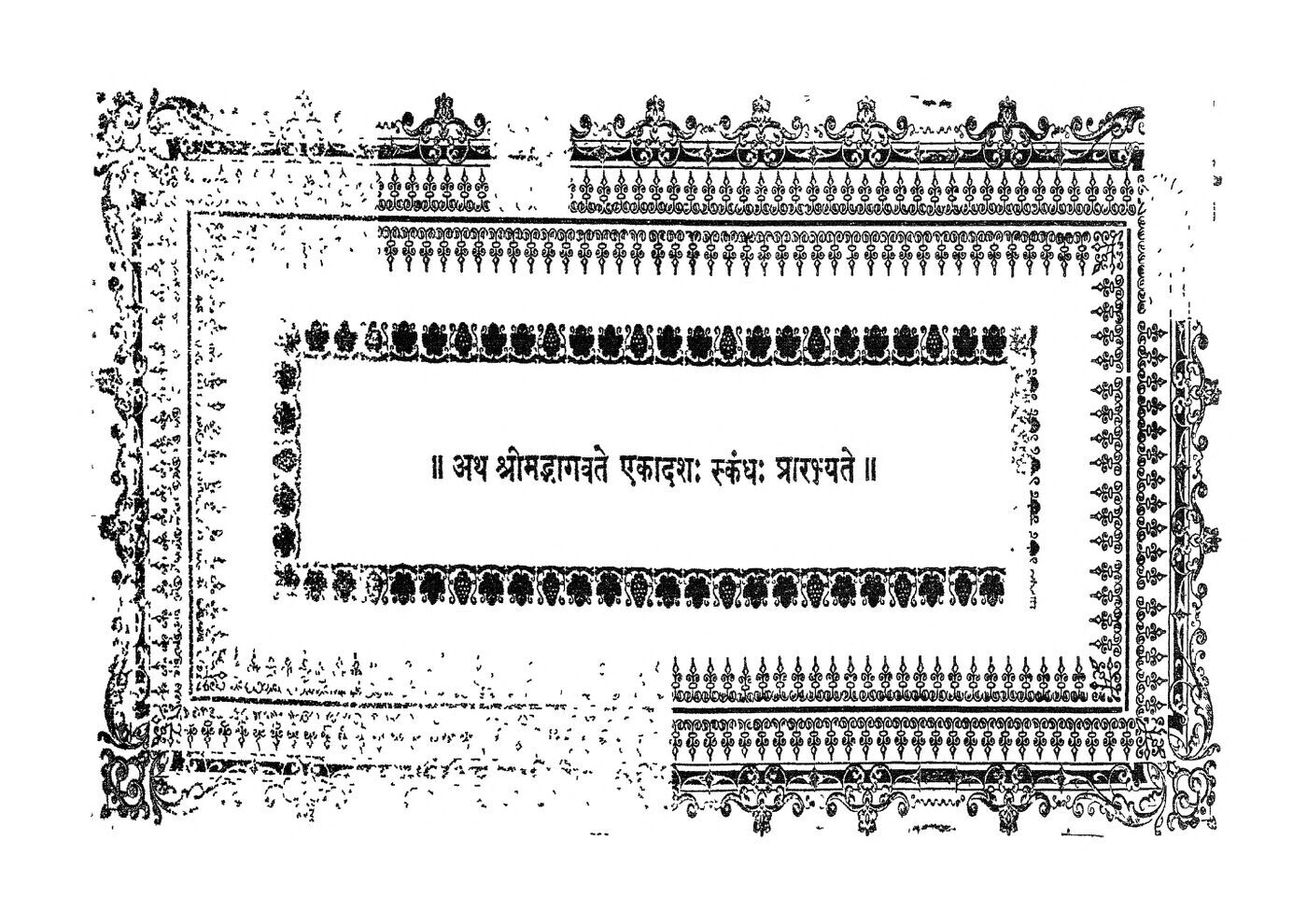
There is confusion about this acharya's guru, but every source agrees on what he wrote. The Padaratnavali is a complete, verse-by-verse Dvaita commentary on Srimad-Bhagavatam. Some Gaudiya-tradition sources call it Bhakti-ratnavali, and it is popularly known simply as Vijayadhvajeeyam. It is not a minor or forgotten work. Madhva-sampradaya scholars still treat it as a standard reference, and a full printed edition (Srimad-Bhagavatam with Padaratnavali-tika, from Gopal Narayan and Co., 1892) has been in circulation for well over a century.
Building on Madhvacharya's Own Digest #
Before this acharya wrote, Madhvacharya himself had already written a Bhagavata-tatparya-nirnaya. But that work is a digest, or short summary, of Madhvacharya's own understanding of the Bhagavatam's overall meaning. It is not a verse-by-verse commentary. The Padaratnavali is what turns that short digest into something closer to a full commentary. It goes through the Bhagavatam mostly verse by verse. To support dualist explanations, it relies heavily on grammar, word meanings, and references from other puranic and smriti texts. Sometimes it does this by explaining the origin of words in unusual or unexpected ways. Scholars who study Bhagavatam commentaries also say that the Padaratnavali records an unusually large number of variant readings of the Bhagavatam text itself. These are differences between manuscripts in the order, or even the number, of verses, especially in the Tenth Canto. This gives it real value for studying the text of the Bhagavatam, apart from its philosophical content.
A Commentary in Conversation With Sridhara Swami #
The Padaratnavali often responds to Srila Sridhara Swami's earlier Bhavartha-dipika. This is the oldest surviving complete Bhagavatam commentary, and every later commentator, Dvaita and Gaudiya alike, had to answer to it. One Gaudiya-tradition source describes how this acharya worked with Sridhara Swami's commentary. It says he tried to draw out and state clearly the "dualist's point of view" that Sridhara Swami's own language, read carefully, already carried. Here the same source follows Srila Jiva Goswami's own explanation in the Tattva-sandarbha. It describes Sridhara Swami's language as sounding Advaita on the surface on purpose, while carrying real devotional content underneath. It is "meat on the end of a hook," as Srila Baladeva Vidyabhusana later put it. The sources at hand cannot tell us whether this acharya wrote his commentary for exactly that kind of clarification. He may simply have written an independent Dvaita reading that happens to discuss the same earlier text. But the record clearly shows that the two commentaries respond to each other. They were written a century apart, by two different schools of Vedanta, on the same book. Readers interested in Sridhara Swami's own commentary and its complicated relationship to both Advaita and Vaishnava readers can see Writing the Bhavartha-dipika.
Praised by a Gaudiya Acharya, in His Own Words #
The clearest sign of this commentary's importance, and one that anyone can check independently, comes from Srila Jiva Goswami himself. In the Tattva-sandarbha, Jiva Goswami explains where he took some of his quotations from Madhvacharya's work. There he names this acharya directly among Madhvacharya's disciples and grand-disciples. He describes him and Vyasa Tirtha as scholars who had become "very famous in the South" and were "most eminent scholars of the Vedic literature and its interpretation." This is very rare in this whole part of the guru-parampara list. Here a major Gaudiya acharya, whose works are already published, praises him by name in a specific passage that anyone can find. He is not only a name in a list.
A Closing Prayer #
Gaudiya devotional tradition preserves a closing prayer that is said to conclude the Padaratnavali. In it, the author asks Krishna for three boons in return for having written the commentary out of love. He asks that he remain a poor man through this life and any future life. He asks that he always have the opportunity to study Madhvacharya's own devotional works. And he asks that by this service he may always remain Krishna's servant. This prayer has not been checked here against a scholarly critical edition of the Padaratnavali. So it is offered as tradition, not as an independently confirmed quotation. But if it is genuine, it is a fitting closing note from this Dvaita scholar. His entire surviving legacy is a single book, written, by every account, out of devotion and not ambition.
