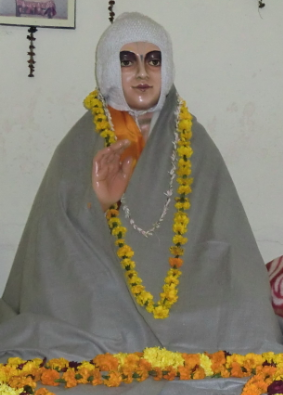
Sources disagree, sometimes sharply, about exactly when Jiva Goswami left this world. The most commonly cited traditional date is 1608, and it is the date used elsewhere on these pages for consistency. But other reputable sources place his disappearance as early as 1598, and Wikimedia's own catalogue entry for a photograph of his samadhi statue also lists 1598.
Another devotional account gives the same 1598 figure, and its dates agree with each other. It says Jiva Goswami was born around 1513, the same figure given in the Detail table below. It also says plainly that "Jiva Gosvami lived for eighty-five years" before his disappearance in 1598, and this span of years fits exactly with its own birth year. Not every source here is this consistent. A widely circulated Gaudiya History biographical sketch gives a birth year of 1533 and a disappearance at age eighty-five. That would actually work out to 1618, not the 1540 that the same page states. We point out this mistake here instead of quietly correcting it. Academic researcher Jan Brzezinski, writing in the Journal of Vaishnava Studies, has proposed a still wider range, from roughly 1516 to 1608.
Both 1608 and 1598 rest on sources that are treated as reliable, so both are reported here side by side, without settling the question. What can be said with confidence is only that Jiva Goswami lived to an old age. He outlived both his uncles by several decades, and he spent the greater part of a century in Vrindavana.
| Detail | Description |
|---|---|
| Disappearance (traditional) | 1608 |
| Other cited dates | 1598 (per another devotional account, consistent with its own stated birth year of 1513 and an 85-year lifespan); occasionally as early as the 1540s in inconsistent sources |
| Place | Radha-Damodara temple, Vrindavana |
| Samadhi | Stands within the Radha-Damodara temple compound |
| Later resident of same temple | Srila Prabhupada, 1962-1965 |
A Long Stewardship's Quiet End #
Dramatic final pastimes are recorded for some of the other Goswamis. But for Jiva Goswami, no detailed story of his final illness or last words survives in the available sources. What the record does keep is where he stayed until the end. It was the Radha-Damodara temple, which he had built up around the deity that his uncle Rupa Goswami had placed in his care decades earlier. By every account, he continued there to receive visiting Vaishnavas, guide the growing Gaudiya community, and keep up the worship he had begun as a young disciple. His samadhi stands within that same temple compound to this day. Beside it is the samadhi of Rupa Goswami himself and, tradition says, at least a portion of the remains of his student Krishnadasa Kaviraja Goswami.
Pilgrims visiting the Radha-Damodara temple today can still see a statue of Jiva Goswami placed within his own samadhi shrine. It is a simple, quiet memorial for one whose writings shaped the philosophy of an entire tradition. Some of the other Goswamis' resting places lie somewhat apart from Vrindavana's main pilgrimage routes. But Radha-Damodara has remained an active temple and residence without a break, from Jiva's own lifetime to the present day.
A Final Generation Prepared for Bengal #
In his last years, Jiva Goswami's attention turned above all to preparing the next generation to carry the Goswamis' work forward. Bhaktisiddhanta Sarasvati Thakura's Anubhashya records that he personally trained Shrinivasa, Narottama Dasa Thakura and Dukhi Krishnadasa in the teachings of Vaishnava faith. He gave them the titles Acharya, Thakura and Shyamananda respectively. Then he sent them back to Bengal and Orissa with the Goswamis' own writings, and with instructions to preach the holy names and love of Krishna there. This same period, and the fuller story of the journey the three of them made, is told at greater length in Leading the Vrindavana Goswamis. It is mentioned here only briefly. The story of how and why Duhkhi Krishnadasa came to be named Shyamananda is told on his own page. Krishnadasa Kaviraja Goswami completed Sri Chaitanya-charitamrita itself while Jiva Goswami was still living. Not long after that, Jiva received Shrinivasa, Narottama and Dukhi Krishnadasa at Vrindavana and began this final chapter of his preaching mission.
The Measure Srila Prabhupada Gave Him #
No one associated with the modern spread of Gaudiya Vaishnavism praised Jiva Goswami's legacy more consistently than Srila Prabhupada. The philosopher Pramathanath Tarkabhusan once told him there was "no comparison with Jiva Goswami and any other philosophers of the world," as Prabhupada described in one letter. In a 1971 lecture in London, Prabhupada was explaining a Bhagavatam verse that cited Jiva's Krishna-sandarbha. There he declared that "throughout the whole world there is not a single philosopher who can defy these Jiva Gosvami's six sandarbhas." Elsewhere he called Jiva Goswami simply the greatest scholar and philosopher in the world. This was not a passing compliment. It was his settled judgment, repeated across decades of lectures, letters and conversations.
The Temple That Sheltered a Later Mission #
The closing detail of Jiva Goswami's life belongs, in a way, to a much later chapter of Gaudiya Vaishnava history. In his own purport to Chaitanya-charitamrita, Srila Prabhupada records that he himself lived at the Radha-Damodara temple that Jiva Goswami established. Srila Prabhupada stayed there from 1962 until 1965, after his own retirement from active family life. In those very years he worked on his English translation of Srimad-Bhagavatam, before leaving for the United States to begin the mission that became ISKCON. This temple was built by the youngest of the Six Goswamis four hundred years earlier. It then became the place where Krishna consciousness was prepared for its journey to the West. None of the sources treat this connection as a coincidence. They consistently present it as the direct fruit of the systematic philosophical foundation that Jiva Goswami spent his life laying down. The full account of that foundation, the Sat-sandarbha itself, is told in Writing the Sat-sandarbha. The wider story of his life, from a grieving child in Bengal to the recognized philosopher of an entire tradition, begins at Birth and Early Education.
