Jiva Goswami was born into a family already marked for renunciation. His father, Anupama, also known as Vallabha, was the youngest of three brothers who served together in the Bengal court. Later all three were drawn to Sri Chaitanya Mahaprabhu. The elder two, Rupa and Sanatana, would go on to lead the rediscovery of Vrindavana. Anupama himself never reached that mission's end. While traveling through Bengal toward Puri, he died on the bank of the Ganges. His household was left without its head while Jiva was still a boy. Sources do not agree on exactly where Jiva was born. Even careful modern researchers treat the question of his birth village as unresolved, so no attempt is made here to settle it.
| Detail | Description |
|---|---|
| Father | Anupama (Vallabha), youngest brother of Rupa and Sanatana Goswami |
| Mother | Name not recorded in the surviving sources |
| Early gifts | Sanskrit grammar, poetry and logic, mastered as a boy |
| First pilgrimage | Navadwipa, age roughly ten to thirteen |
| Guide at Navadwipa | Nityananda Prabhu, Srivasa Pandita, Saci Mata |
| Advanced study | Varanasi, Vedanta under Madhusudana Vachaspati |
A Household Without Its Father #
Even as a small child, Jiva was remembered as unusually serious about his devotions. He kept a private worship of Krishna and Balarama. He decorated the images himself and offered them food. By the account preserved at gaudiyahistory.iskcondesiretree.com, he also embraced them at bedtime. His parents took this for a child's play, but the village around them recognized it as something more. At school he moved quickly through Sanskrit grammar, poetry and logic, and his teachers are said to have predicted early on that he would become a serious renunciant. The Bhakti-ratnakara records that, as Jiva grew older, he gradually developed the bodily marks tradition associates with a mahapurusha, a great soul: elongated, lotus-like eyes, a high nose and forehead, broad shoulders and chest, arms reaching to his knees, and a complexion said to shine like molten gold.
All of this unfolded under the shadow of his father's death. After Anupama's passing, Jiva remained with his mother in the family's ancestral house at Fatehabad, the only child left to comfort her, even as his own heart was already pulling him toward Sri Chaitanya Mahaprabhu's associates. Whenever he called to mind his father, his uncles, or the lotus feet of Sri Gaurasundara, he is said to have lost all outward composure and fallen to the ground, unable to bear the separation.
The Journey to Navadwipa #
One night Jiva dreamed that his household Deities, Sri Rama and Krishna, had taken the forms of Nitai-Gauranga, dancing before him and giving him the dust of Their lotus feet before disappearing (Bhakti-ratnakara 1.732). Not long afterward, someone suggested he travel to Navadwipa and bathe in the coolness of Nityananda Prabhu's lotus feet, and Jiva resolved to go. His mother was reluctant to lose a second family member to the renounced life. By most accounts Jiva was somewhere between the ages of ten and thirteen when he finally set out. He is said to have told her only that he wished to visit the family's ancestral home at Fatehabad. Quietly, he arranged for the boatman to carry him to Navadwipa instead.
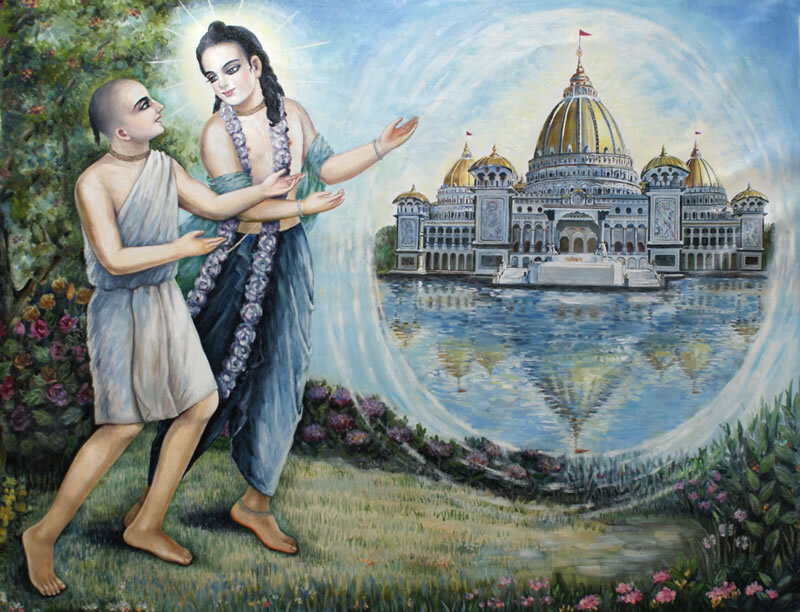
Arriving at Navadwipa, Jiva first offered his dandavats to Mother Ganges, then learned that Nityananda Prabhu, who happened to be there at the same time, was staying at the home of Srivasa Pandita. He hurried there and fell at the door to offer his obeisances. Nityananda Prabhu came out with Srivasa Pandita, lifted the boy up, embraced him, and asked, "Are you the nephew of Sri Rupa and Sri Sanatana?" Jiva, who had worshiped Krishna and Balarama since boyhood, recognized in Nityananda Prabhu the very form of Balarama Himself: "You are the form of the universe. You are Balaram... I therefore pray for Your merciful glance." Nityananda Prabhu brought him inside, asked after the family at Fatehabad, introduced him to the devotees gathered there, and gave him the remnants of his own prasadam.
The following day Nityananda Prabhu took Jiva to the home of Saci Mata, the mother of Sri Chaitanya Mahaprabhu. Seeing Nityananda Prabhu arrive, Saci Mata covered her head with the end of her sari and had her attendant Isana wash his feet; Nityananda in turn offered her his namaskara and introduced young Jiva. Saci Mata placed her hand on the boy's head in blessing and had the two of them honor prasadam that Sri Vishnupriya had secretly cooked for Sri Gaurachandra. Afterward Vamsivadana, Saci Mata's own attendant, guided Jiva through all nine islands of Navadwipa, showing him the birthplace of Sri Chaitanya Mahaprabhu, Srivasa Pandita's house, and the home of Jagannatha Mishra. For a boy who had spent his short life absorbed in the Bhagavatam, walking through the actual ground of the Lord's earthly pastimes in the company of Balarama's own incarnation left a permanent mark.
Sent On to Varanasi #
Nityananda Prabhu did not keep Jiva in Navadwipa. He advised him to continue his education first, at Varanasi (Kashi), which was then one of India's main centers of Sanskrit learning. There Jiva studied Vedanta under Madhusudana Vachaspati. Gaudiya sources remember Madhusudana as a disciple of Sarvabhauma Bhattacharya. This was the same Sarvabhauma who had received his own understanding of Vedanta, in the light of the Bhagavatam, directly from Sri Chaitanya Mahaprabhu at Jagannatha Puri. If that chain of teaching is accurately preserved, Jiva's formal Vedanta training reached back, teacher to teacher, to Mahaprabhu Himself, even though the two had never personally met. Earlier, at Navadwipa, when Jiva formally asked Nityananda Prabhu's permission to continue on toward Mathura, Nityananda had placed his own feet on Jiva's head, embraced him, and told him, "Yes, go soon to Vrindavana. That place has been awarded to your family, to your father and uncles, by Sri Caitanya Mahaprabhu, and therefore you must go there immediately," and he also directed Jiva to travel by way of Benares and to take instruction there from Madhusudana Vachaspati before going on.
Whatever the exact line of teaching, Jiva left Varanasi with a reputation as a serious philosopher, well before he had settled anywhere as a teacher. Tradition also tells of Sri Chaitanya Mahaprabhu's own long instruction to Sanatana Goswami in this same city of Varanasi, some years before Jiva arrived there as a student. That story is told at greater length on Sanatana Goswami's own page. By the time his mother, too, had passed away, Jiva was about twenty years old. He then set out from Varanasi for Vrindavana.
A Scholar Ready for Vrindavana #
By 1535, the date most commonly given for his arrival, Jiva Goswami had completed the two halves of a Gaudiya Vaishnava education, devotion and formal Sanskrit scholarship. His uncles Rupa and Sanatana had also been learned Sanskrit scholars at the Bengal court, long before they gave up everything to serve Mahaprabhu. Jiva too arrived already carrying both. He came to Vrindavana not as a raw student who still had to be taught the basics, but as a young scholar. His only unfinished task was to place his great learning at the feet of his two uncles. In the years before, they had been rediscovering Krishna's lost pastime places and writing the first scriptures of the tradition he was about to join. What happened when he arrived is the subject of Arrival in Vrindavana. That chapter also tells how firmly he insisted on beginning as the most junior servant in Rupa Goswami's household, in spite of all his learning.
