Srila Jiva Goswami
Systematic Philosopher of the Six Goswamis of Vrindavana
The complete life, on one page: The main biography and every pastime page, in order, in one place
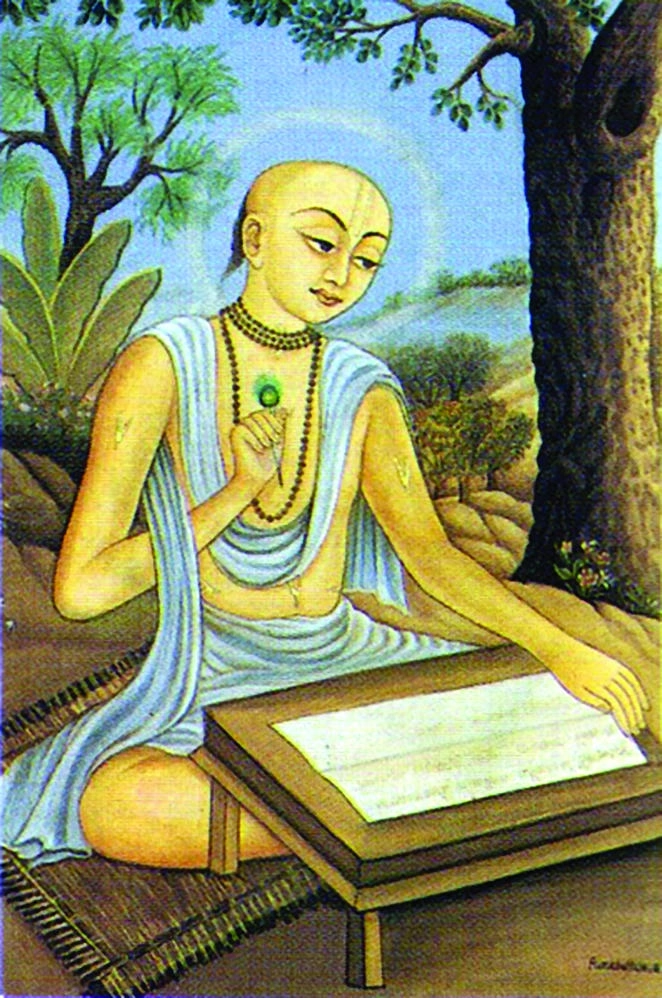
Introduction
śrī-rūpa-caraṇa-dvandva-rāgiṇaṁ vrajavāsinaṁ śrī-jīvaṁ satataṁ vande manda-svānanda-dāyinam
"I offer my repeated obeisances unto Srila Jiva Gosvami, whose heart is constantly attracted to the lotus feet of Srila Rupa Gosvami. He is the crest jewel of all the residents of Vraja, and by his causeless mercy he bestows unimaginable joy even upon the dull and unphilosophical."
Bhakti-ratnakara 4.289
(Another devotional account of Srila Jiva Gosvami's life that we have used does not open with a pranama-mantra. It begins instead with Srila Prabhupada's own praise of him, quoted just below.)
According to Sri Gaura-ganoddesha-dipika (verse 195), Srila Jiva Gosvami is identified as Vilasa Manjari in Krishna's eternal pastimes in Vraja. Few Vaishnava philosophers have been praised by Srila Prabhupada as highly: he wrote that "the Vaishnavas are by far the greatest philosophers in the world, and the greatest among them was Jiva Gosvami Prabhu." In a letter written from Bombay on 3 November 1970, Srila Prabhupada recalled a meeting in Calcutta. At that meeting the learned Sanskrit scholar Pramathanath Tarkabhusan had said of Jiva Gosvami that "there was no comparison with Jiva Gosvami and any other philosophers of the world," and the scholar also said that "Gaudiya Vaishnavism is very much proud of having such a great acharya as Jiva Gosvami."
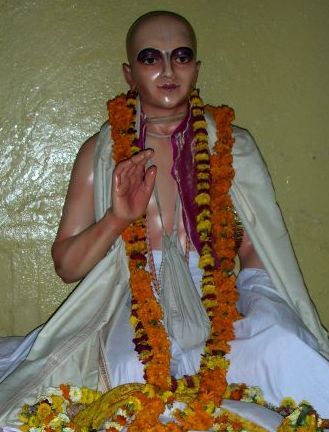
Srila Jiva Goswami was the youngest of the Six Goswamis of Vrindavana. In the estimate of Srila Prabhupada and generations of Gaudiya Vaishnava scholars since, he was the most systematic philosopher among them. His father was Anupama, the youngest of three brothers who served together in the court of Bengal. Jiva never knew the settled family life that his uncles Srila Rupa Gosvami and Srila Sanatana Gosvami had renounced before him. His father died on the road while Jiva was still a child, and Jiva grew up among scholars and pilgrims, not courtiers. Later he reached Vrindavana as a young man, already trained in Sanskrit philosophy at Navadwipa and Varanasi. By then his uncles had spent years rediscovering the lost holy places of Vraja and writing the tradition's first scriptures. Jiva's task was to take everything Rupa and Sanatana had lived and written, and join it into one single philosophical system that could be defended in debate.
| Detail | Description |
|---|---|
| Birth | c. 1513 (disputed; see below) |
| Family | Son of Anupama (Vallabha), youngest brother of Rupa and Sanatana Goswami |
| Identity | In Krishna-lila: Vilasa-manjari, a maidservant of Sri Radha (Gaura-ganoddesha-dipika 195, 204; Chaitanya-charitamrita Adi 10.85 purport) |
| Education | Navadwipa, then Varanasi under Madhusudana Vachaspati |
| Diksha-guru | Rupa Goswami |
| Chief work | Sat-sandarbha (six-part systematic theology of Gaudiya Vaishnavism) |
| Temple established | Radha-Damodara, Vrindavana (deity given by Rupa Goswami, ordinarily dated 1542) |
| Disappearance | Traditionally 1608, Radha-Damodara temple (another devotional account instead gives 1598, matching its own stated birth year of 1513 and an 85-year lifespan; see Final Days and Disappearance) |
Scriptural evidence for the introduction (2)
তাঁর মধ্যে রূপ–সনাতন—বড় শাখা ।
অনুপম, জীব, রাজেন্দ্রাদি উপশাখা ॥
tāṅra madhye rūpa-sanātana — baḍa śākhā
anupama, jīva, rājendrādi upaśākhā
Word for word
tāṅra: within that; madhye: in the midst of; rūpa-sanātana: the branch known as Rupa-Sanatana; baḍa śākhā: the big branch; anupama: Anupama; jīva: Jiva; rājendra-ādi: and Rajendra and others; upaśākhā: their subbranches.
Among these branches, Rupa and Sanatana were principal. Anupama, Jiva Gosvami and others, headed by Rajendra, were their subbranches.
From the purport: "After the disappearance of Srila Rupa Gosvami and Sanatana Gosvami in Vrndavana, Srila Jiva Gosvami became the acarya of all the Vaisnavas in Bengal, Orissa and the rest of the world, and it is he who used to guide them in their devotional service."
The genealogical verse in Krishnadasa Kaviraja Goswami's list of Sri Chaitanya Mahaprabhu's followers that names Jiva Goswami as a subbranch under Rupa and Sanatana; Srila Prabhupada's purport gives the fullest single biographical summary of Jiva Goswami's life and works.
कर्पूरमञ्जरी श्याममञ्जरी श्वेतमञ्जरी ।
विलासमञ्जरी कामलेखा च मौनमञ्जरी ॥१९५॥
गौरेण तत्प्रियैः सार्धं धृतपुरुषविग्रहः ।
खेलन्ति स्म स्वभावानुसारात्ताः क्रमशो यथा ॥१९८॥
सुशीलः पण्डितः श्रीमान्जीवः श्रीवल्लभात्मजः ।
वाणीनाथद्विजश्चम्पहट्टवासी प्रभोः प्रियः ॥२०४॥
karpūra-mañjarī śyāma-mañjarī śveta-mañjarī
vilāsa-mañjarī kāmalekhā ca mauna-mañjarī
gaureṇa tat-priyaiḥ sārdhaṁ dhṛta-puruṣa-vigrahaḥ
khelanti sma svabhāvānusārāt tāḥ kramaśo yathā
suśīlaḥ paṇḍitaḥ śrīmān jīvaḥ śrī-vallabhātmajaḥ
vāṇīnātha-dvijaś campahaṭṭa-vāsī prabhoḥ priyaḥ
Karpura-manjari, Syama-manjari, Sveta-manjari, Vilasa-manjari, ... were among the maidservants of Srimati Radharani. Assuming male forms they appeared among Lord Caitanya's associates, and each displayed his particular kind of ecstatic love for the Lord. These gopis became ... Sriman Jiva Pandita (who was the saintly son of Sri Vallabha) ...
From the purport: In the Gaura-gaṇoddeśa-dīpikā (195) it is said that Śrīla Jīva Gosvāmī was formerly Vilāsa-mañjarī gopī. (Srila Prabhupada, Chaitanya-charitamrita Adi 10.85 purport)
Verse 195 lists Vilasa-manjari among Srimati Radharani's maidservants; verse 198 says they appeared in the same order (kramasah) as Sri Chaitanya's associates; verse 204 gives the twelfth associate as 'Jiva, son of Sri Vallabha', the twelfth name matching Vilasa-manjari. Jiva Gosvami's father Anupama was formerly named Vallabha (CC Adi 10.84 purport). Not to be confused with Jiva Pandita, son of Ratnagarbha (GGD 169, Indira). Sanskrit: diacritic edition of the Gaura-ganoddesha-dipika; English translation as published at bvmlu.org.
Chapter 1
Birth and Early Education
A scholar's childhood cut short by grief, and the long road through Navadwipa and Varanasi to Vrindavana
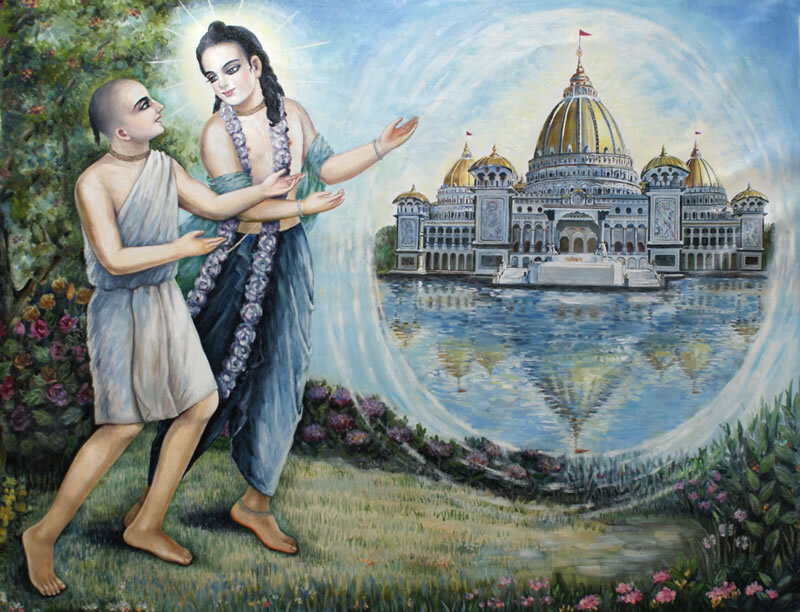
Jiva Goswami was born into a family already marked for renunciation. His father, Anupama, also known as Vallabha, was the youngest of three brothers who served together in the Bengal court. Later all three were drawn to Sri Chaitanya Mahaprabhu. The elder two, Rupa and Sanatana, would go on to lead the rediscovery of Vrindavana. Anupama himself never reached that mission's end. While traveling through Bengal toward Puri, he died on the bank of the Ganges. His household was left without its head while Jiva was still a boy. Sources do not agree on exactly where Jiva was born. Even careful modern researchers treat the question of his birth village as unresolved, so no attempt is made here to settle it.
| Detail | Description |
|---|---|
| Father | Anupama (Vallabha), youngest brother of Rupa and Sanatana Goswami |
| Mother | Name not recorded in the surviving sources |
| Early gifts | Sanskrit grammar, poetry and logic, mastered as a boy |
| First pilgrimage | Navadwipa, age roughly ten to thirteen |
| Guide at Navadwipa | Nityananda Prabhu, Srivasa Pandita, Saci Mata |
| Advanced study | Varanasi, Vedanta under Madhusudana Vachaspati |
A Household Without Its Father #
Even as a small child, Jiva was remembered as unusually serious about his devotions. He kept a private worship of Krishna and Balarama. He decorated the images himself and offered them food. By the account preserved at gaudiyahistory.iskcondesiretree.com, he also embraced them at bedtime. His parents took this for a child's play, but the village around them recognized it as something more. At school he moved quickly through Sanskrit grammar, poetry and logic, and his teachers are said to have predicted early on that he would become a serious renunciant. The Bhakti-ratnakara records that, as Jiva grew older, he gradually developed the bodily marks tradition associates with a mahapurusha, a great soul: elongated, lotus-like eyes, a high nose and forehead, broad shoulders and chest, arms reaching to his knees, and a complexion said to shine like molten gold.
All of this unfolded under the shadow of his father's death. After Anupama's passing, Jiva remained with his mother in the family's ancestral house at Fatehabad, the only child left to comfort her, even as his own heart was already pulling him toward Sri Chaitanya Mahaprabhu's associates. Whenever he called to mind his father, his uncles, or the lotus feet of Sri Gaurasundara, he is said to have lost all outward composure and fallen to the ground, unable to bear the separation.
The Journey to Navadwipa #
One night Jiva dreamed that his household Deities, Sri Rama and Krishna, had taken the forms of Nitai-Gauranga, dancing before him and giving him the dust of Their lotus feet before disappearing (Bhakti-ratnakara 1.732). Not long afterward, someone suggested he travel to Navadwipa and bathe in the coolness of Nityananda Prabhu's lotus feet, and Jiva resolved to go. His mother was reluctant to lose a second family member to the renounced life. By most accounts Jiva was somewhere between the ages of ten and thirteen when he finally set out. He is said to have told her only that he wished to visit the family's ancestral home at Fatehabad. Quietly, he arranged for the boatman to carry him to Navadwipa instead.
Arriving at Navadwipa, Jiva first offered his dandavats to Mother Ganges, then learned that Nityananda Prabhu, who happened to be there at the same time, was staying at the home of Srivasa Pandita. He hurried there and fell at the door to offer his obeisances. Nityananda Prabhu came out with Srivasa Pandita, lifted the boy up, embraced him, and asked, "Are you the nephew of Sri Rupa and Sri Sanatana?" Jiva, who had worshiped Krishna and Balarama since boyhood, recognized in Nityananda Prabhu the very form of Balarama Himself: "You are the form of the universe. You are Balaram... I therefore pray for Your merciful glance." Nityananda Prabhu brought him inside, asked after the family at Fatehabad, introduced him to the devotees gathered there, and gave him the remnants of his own prasadam.
The following day Nityananda Prabhu took Jiva to the home of Saci Mata, the mother of Sri Chaitanya Mahaprabhu. Seeing Nityananda Prabhu arrive, Saci Mata covered her head with the end of her sari and had her attendant Isana wash his feet; Nityananda in turn offered her his namaskara and introduced young Jiva. Saci Mata placed her hand on the boy's head in blessing and had the two of them honor prasadam that Sri Vishnupriya had secretly cooked for Sri Gaurachandra. Afterward Vamsivadana, Saci Mata's own attendant, guided Jiva through all nine islands of Navadwipa, showing him the birthplace of Sri Chaitanya Mahaprabhu, Srivasa Pandita's house, and the home of Jagannatha Mishra. For a boy who had spent his short life absorbed in the Bhagavatam, walking through the actual ground of the Lord's earthly pastimes in the company of Balarama's own incarnation left a permanent mark.
Sent On to Varanasi #
Nityananda Prabhu did not keep Jiva in Navadwipa. He advised him to continue his education first, at Varanasi (Kashi), which was then one of India's main centers of Sanskrit learning. There Jiva studied Vedanta under Madhusudana Vachaspati. Gaudiya sources remember Madhusudana as a disciple of Sarvabhauma Bhattacharya. This was the same Sarvabhauma who had received his own understanding of Vedanta, in the light of the Bhagavatam, directly from Sri Chaitanya Mahaprabhu at Jagannatha Puri. If that chain of teaching is accurately preserved, Jiva's formal Vedanta training reached back, teacher to teacher, to Mahaprabhu Himself, even though the two had never personally met. Earlier, at Navadwipa, when Jiva formally asked Nityananda Prabhu's permission to continue on toward Mathura, Nityananda had placed his own feet on Jiva's head, embraced him, and told him, "Yes, go soon to Vrindavana. That place has been awarded to your family, to your father and uncles, by Sri Caitanya Mahaprabhu, and therefore you must go there immediately," and he also directed Jiva to travel by way of Benares and to take instruction there from Madhusudana Vachaspati before going on.
Whatever the exact line of teaching, Jiva left Varanasi with a reputation as a serious philosopher, well before he had settled anywhere as a teacher. Tradition also tells of Sri Chaitanya Mahaprabhu's own long instruction to Sanatana Goswami in this same city of Varanasi, some years before Jiva arrived there as a student. That story is told at greater length on Sanatana Goswami's own page. By the time his mother, too, had passed away, Jiva was about twenty years old. He then set out from Varanasi for Vrindavana.
A Scholar Ready for Vrindavana #
By 1535, the date most commonly given for his arrival, Jiva Goswami had completed the two halves of a Gaudiya Vaishnava education, devotion and formal Sanskrit scholarship. His uncles Rupa and Sanatana had also been learned Sanskrit scholars at the Bengal court, long before they gave up everything to serve Mahaprabhu. Jiva too arrived already carrying both. He came to Vrindavana not as a raw student who still had to be taught the basics, but as a young scholar. His only unfinished task was to place his great learning at the feet of his two uncles. In the years before, they had been rediscovering Krishna's lost pastime places and writing the first scriptures of the tradition he was about to join. What happened when he arrived is the subject of Arrival in Vrindavana. That chapter also tells how firmly he insisted on beginning as the most junior servant in Rupa Goswami's household, in spite of all his learning.
Chapter 2
Arrival in Vrindavana
Joining Rupa and Sanatana Goswami, and beginning again as the lowest servant in the household
When Jiva Goswami reached Vrindavana, his uncles Srila Rupa Gosvami and Srila Sanatana Gosvami were already busy with the work Sri Chaitanya Mahaprabhu had personally given them. They were recovering Krishna's lost pastime places and writing the tradition's first systematic scriptures. Rupa had been instructed at Prayag and Sanatana at Varanasi years earlier, long before Jiva himself had left Bengal. That earlier meeting and instruction are told on their own pages. This page tells what happened when the nephew arrived. Jiva was already a trained Sanskrit scholar, yet he came to place himself under two uncles who had chosen to live as beggars in the forest.
| Detail | Description |
|---|---|
| Arrival in Vrindavana | Traditionally dated 1535 |
| Welcomed by | Prabodhananda Saraswati, Kashishvara Pandit, Krishnadasa Kaviraja Goswami |
| First service | Washing Rupa Goswami's feet, copying and proofreading his manuscripts |
| Diksha-guru | Rupa Goswami |
| Deity received | Sri Sri Radha-Damodara, carved by Rupa Goswami, traditionally dated 1542 |
| Early editorial work | Proofread Bhakti-rasamrita-sindhu and Sanatana's Bhagavatam commentary |
Arriving Among Friends #
Reaching Vrindavana, Jiva found devotees already gathered there who received him with love and friendship: Prabodhananda Saraswati, Kashishvara Pandit, and Krishnadasa Kaviraja Goswami among them. Rupa and Sanatana themselves were overjoyed to see their nephew, who was already known as a scholar, taking his place among the Vrindavana devotees.
Choosing to Begin at the Bottom #
Jiva did not arrive in Vrindavana expecting people to treat him specially because of his own education. All the surviving accounts say that instead he took up the humblest services in Rupa Goswami's household. He washed his uncle's feet, prepared the palm-leaf manuscripts his uncle wrote on, and proofread finished work before it went further. When Jiva first approached his eldest uncle, Sanatana, for initiation, Sanatana out of humility passed the responsibility on to Rupa. Before agreeing, Rupa tested him. He had Jiva prepare articles for Deity worship, beg alms, cook, research texts, massage his feet, and prepare the very palm leaves Rupa wrote his own books on. Jiva also regularly brought water for his uncles' bath and cleaned their asrama. Rupa was highly pleased with Jiva's selfless spirit. Only after this period of direct, personal service did Rupa formally accept him as a disciple and initiate him into the Vaishnavism of Sri Chaitanya Mahaprabhu. So, of the two uncles, it was Rupa Goswami who became Jiva's diksha-guru, the spiritual master who gave him mantra initiation. Sanatana stayed just as close to Jiva throughout these same years, guiding him with instruction.
Proofreading the Bhakti-rasamrita-sindhu #
Once Jiva was accepted as a disciple, he was given exactly the kind of work his training had prepared him for. He reviewed and proofread Rupa Goswami's own writing, including the verses of the Bhakti-rasamrita-sindhu. This systematic study of devotional rasa is still one of Rupa's central works. Jiva did much more with this text than simply proofread it. He later wrote his own full commentary on it, the Durgama-sangamani, discussed further in Other Literary Works. He also proofread Sanatana Goswami's own commentary on the Tenth Canto of the Bhagavatam. Following Sanatana's instruction, he produced a condensed version of his own. Jiva worked this closely on both his uncles' books, not just through formal study. This gave him the working knowledge he would later draw on for his own systematic work, the Sat-sandarbha. That story is told in full at Writing the Sat-sandarbha.
The Gift of Radha-Damodara #
According to the early-seventeenth-century Sadhana-dipika, Rupa Goswami was skilled enough to carve and draw deities with his own hands. The Sadhana-dipika was written by Radha-Krishna Goswami, who was then head of the Govindaji temple. Tradition says that Rupa Goswami carved a small black-marble deity of Damodara with his own hands and gave Him into Jiva's care. This is usually dated to 1542. But Jiva did not buy the land around it at Seva Kunja until 1558, so the exact order of events is not clear. No source fully explains this difference, so we report it here instead of hiding it. Jiva worshiped this same deity, known today as Sri Sri Radha-Damodara, for the rest of his life. The temple that later grew up around this worship became one of the most important places in Vrindavana connected with the Six Goswamis, and it still is today.
A Household Under Two Uncles #
Throughout these years Jiva lived and worked in close daily contact with both Rupa and Sanatana. He took in not only their conclusions but also their way of working. They always checked their statements against the Bhagavatam and other scripture. They insisted on quoting authority instead of stating their own opinion. And they were eager to defend the tradition's main claims about Krishna, even against far more senior and famous scholars. At this time Vrindavana was still a forest of scattered bhajana-kutiras, not a settled town. The Goswamis who lived there, with Jiva among the youngest of them, followed a discipline of very little eating and very little sleep. They spent almost all their time in study of scripture and in chanting. Jiva came from a background of formal Sanskrit education. By the time he arrived, his uncles had already practiced austerities for years. So Jiva had to learn this discipline directly, by living inside it, not by reading about it.
Jiva had a trained scholar's confidence, but the household he lived in valued restraint and respect above all else. These two things did not always fit easily together. From this same training Jiva had picked up an early habit of defending his gurus' arguments with more force than caution. This habit would soon place him at the center of one of the more debated episodes in early Gaudiya Vaishnava history. It is told in Defending His Gurus' Honor.
Chapter 3
Writing the Sat-sandarbha
Six connected works that turned Sri Chaitanya Mahaprabhu's teaching into formal philosophy
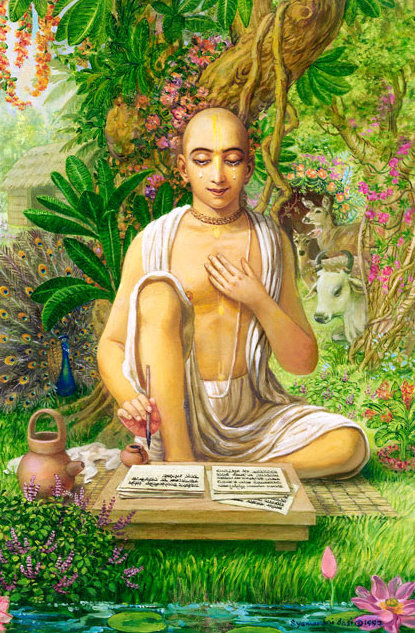
By the time Jiva reached full maturity as a scholar, Rupa and Sanatana Goswami had already given the Gaudiya Vaishnava tradition its devotional practice, its recovered holy places, and its first compiled scriptures. But the tradition still needed a single work that could answer, argument by argument, the trained Vedantists, Naiyayikas and rival Vaishnava schools of sixteenth-century India. It needed a systematic philosophical case, built from scriptural evidence alone, for who Krishna is and what devotion to Him means. Jiva Goswami wrote exactly this in the Sat-sandarbha. It is made of six works, written one after another and later gathered under the single title Bhagavata-sandarbha. It is still the closest thing Gaudiya Vaishnavism has to a formal system of theology.
| Detail | Description |
|---|---|
| Full title | Sat-sandarbha (also called Bhagavata-sandarbha), six parts |
| The six parts | Tattva, Bhagavat, Paramatma, Krishna, Bhakti and Priti Sandarbha |
| Sometimes counted as a seventh | Krama-sandarbha, a running commentary on Srimad-Bhagavatam |
| Method | Argument built almost entirely from Bhagavatam verses and other scripture |
| Auto-commentary | Sarva-samvadini, Jiva's own explanatory notes on the Sandarbhas |
| Described in | Sri Chaitanya-charitamrita, Madhya-lila 1.43 |
Tattva-sandarbha: Which Scripture to Trust #
Before any doctrine could be argued, Jiva first had to settle a question of method: which scriptures actually count as reliable evidence for spiritual truth. The Tattva-sandarbha takes up this question directly and concludes that Srimad-Bhagavatam is the single most authoritative source for understanding the Absolute Truth, clearing the ground on which every later argument in the series would stand.
Bhagavat-sandarbha and Paramatma-sandarbha: Mapping the Divine #
The second Sandarbha turns to the nature of Godhead itself. It distinguishes the impersonal Brahman effulgence from the Supreme Personality's own potencies, energies and pure spiritual qualities. It also describes the transcendental position of shuddha-sattva. This is the pure goodness, beyond the material modes, in which the Lord and His pastimes exist. The third narrows the focus further, to Paramatma, the Lord's presence as the Supersoul within every living being and within the cosmos. It explains how a single divine presence can live within millions of souls at the same time and still remain one. It also explains how the universe itself unfolds from that presence.
Krishna-sandarbha: The Argument for Supremacy #
The fourth Sandarbha is, by most measures, the most important. It is devoted to a single claim: that Krishna, not any other form of Godhead, is svayam bhagavan, the original Personality from whom Vishnu, Narayana and every other divine expansion and incarnation come. To make the case, Jiva brings together scripture after scripture in support and backs up earlier commentators, including Sridhara Svami. He works through Krishna's pastimes, His expansions, and the eternal nature of Goloka and Vrindavana, including Srimati Radharani's own topmost position among the gopis. As Krishnadasa Kaviraja Goswami himself later summarized in Sri Chaitanya-charitamrita, "In Sri Bhagavata-sandarbha, Srila Jiva Gosvami has written conclusively about the ultimate end of devotional service," and this fourth volume is the part that most directly establishes Krishna's own position.
Bhakti-sandarbha and Priti-sandarbha: From Doctrine to Practice #
After establishing what Krishna is, Jiva turns in the last two Sandarbhas to what a devotee should do about it. Bhakti-sandarbha lays out devotional service itself as a practice. It describes its stages, who is qualified for it, and the rules for hearing, chanting and remembering. It shows that unmotivated service is higher than the ritual duties of the varnashrama system. It explains the path of raganuga-bhakti, which follows the spontaneous devotion of Vraja's own residents. It also shows the difference between an ordinary devotee and one who has grown into deep realization. Priti-sandarbha, the final volume, is about prema, love of Godhead. It presents prema as the real goal toward which all of this practice moves, and it ranks prema above every form of liberation. It describes the direct, personal experience of meeting the Supreme Personality of Godhead face to face as the highest fruit of devotional service.
A "Seventh" Sandarbha #
Jiva Goswami's commentary on all twelve cantos of Srimad-Bhagavatam is sometimes counted as a "seventh" Sandarbha, under the name Krama-sandarbha. This way of counting is found in listings that go back to a separate devotional account and similar sources. But the Sat-sandarbha proper is always described as six works. Other sources used for this page describe a commentary with a similar name in a different way. They say it covers only the Bhagavatam's Tenth Canto, and they treat it as a condensed version of Sanatana Goswami's own larger commentary. The available sources are not fully consistent on this point. So both descriptions are given here, without assuming that they refer to the same work. Either way, the purpose behind it was the same as the purpose behind the Sat-sandarbha itself. It was to base every philosophical claim directly on the verses of Srimad-Bhagavatam, not on argument alone.
A System, Not Just a Collection #
The Sat-sandarbha is different from Rupa's and Sanatana's earlier books less in its content than in its structure. Its content is not so new, since Jiva was working from conclusions his uncles had already lived and taught. Its structure is what stands out. It has six volumes, each building formally on the last. They move a reader from questions of evidence, to questions of God's nature, to questions of practice, and finally to the goal of practice itself. Jiva later wrote his own commentary on the Sandarbhas, the Sarva-samvadini. In it he pointed out links between passages and answered objections, across at least the first several Sandarbhas. Centuries later, Srila Prabhupada would say of the finished work that there was no philosopher in the world who could successfully argue against Jiva Goswami's six Sandarbhas. This claim is examined in Other Literary Works, along with the rest of Jiva's literary output, including the full list of roughly twenty-five works credited to him. Even in Jiva's own lifetime, his work did not go unchallenged, as the next chapter shows.
Scriptural evidence for this chapter (1)
Quoted in the text above:
- Madhya 1.43 Sri Chaitanya-charitamrita
Chapter 4
Defending His Gurus' Honor
A public debate, a private exile, and two later slanders Srila Prabhupada personally refuted
No figure among the Six Goswamis attracted quite as many conflicting stories after his death as Jiva Goswami. Sri Chaitanya-charitamrita itself records one debated episode from his own lifetime. In Srila Prabhupada's purport to that same verse, he goes on to name two further accusations that circulated among later, less careful followers, and he directly disproves them. Together these form the closest thing to a controversy in Jiva Goswami's story. The sources for each part of it are not equally solid, and this page keeps that difference clear instead of smoothing it over.
The Scholar Who Wanted a Second Certificate #
Sri Chaitanya-charitamrita (Adi-lila 10.85) records that a self-important Sanskrit scholar once approached Rupa and Sanatana Goswami separately, demanding a public debate over the revealed scriptures. The man was mainly interested in his own reputation. Neither uncle wanted to spend time proving a point to him, so both simply signed a written statement admitting defeat and let him go. With those two signatures, the scholar then asked the young Jiva for the same certificate. He naturally expected that the nephew would follow the same humble example. Jiva refused. He argued the scriptures with the man directly and, in the Charitamrita's own account, defeated him outright. Other retellings say the exchange stretched across several days on the bank of the Yamuna before the scholar's defeat was generally accepted.
Word reached Rupa Goswami that his nephew and disciple had done what he and Sanatana had chosen not to do. As Srila Prabhupada records, Rupa outwardly showed mild displeasure. Why had Jiva bothered, when the man might simply have gone away with his paper? Some followers took this as proof that Jiva had been rightly corrected for pride. Srila Prabhupada does not accept this view in his purport. He explains that humility applies to insults against oneself. It does not apply to blasphemy against one's guru or against Vaishnavas generally. He notes that the same principle moved Sri Chaitanya Mahaprabhu Himself to fierce anger when Nityananda Prabhu was struck by Jagai and Madhai. This was so even though the Lord's own teaching in the Shikshashtaka calls a devotee to feel lower than a blade of grass. In other words, defending one's own honor may be a failure of humility, but defending a guru's honor is not.
Another Account: Rupanarayana Saraswati and the "Jiva-doya" Pun #
A version of this same debate is preserved in another devotional account, with its own set of specific details. It is given here alongside the account above, not quietly merged with it. In this telling, the traveling scholar is named directly: Rupanarayana Saraswati. He is described as a digvijayi, "one who had conquered all directions," who made a habit of demanding a jayapatra, a written certificate of victory, from everyone he debated. Rupa and Sanatana signed his jayapatra without a contest. Then Rupanarayana, blinded by his own vanity, sought out their young nephew next. He showed his letter as proof that he had already defeated the uncles. Jiva was angry for his gurus' sake. He accepted the challenge his uncles had avoided and spent seven days on the bank of the Yamuna defending their good name. After that, Rupanarayana left in shame and was never seen in Vrindavana again.
In this account, Jiva was eager to share his victory with Rupa. This did not earn him only mild displeasure, as in the first account. Instead it brought him severe punishment, for Rupa banished him from Vrindavana outright. Jiva went to nearby Mathura, where he lived in the hollow of a tree, ate once a day, and kept a vow of silence for a full year. In the end it was Sanatana Goswami who shortened the exile. He told Rupa that by banishing Jiva he was neglecting Sri Chaitanya Mahaprabhu's own teaching of "jiva doya", kindness (doya) to all living beings (jiva). The phrase was also a pun on Jiva Goswami's own name. Rupa understood the play on words, laughed heartily and cancelled the banishment. Srila Prabhupada's defense of Jiva, cited above, is aimed at critics who call this episode a lapse in humility. It answers this version of the story just as directly as it answers the milder one recorded in Sri Chaitanya-charitamrita.
Exile at Nanda Ghat #
A separate tradition tells a different story with a similar pattern. It is less firmly documented. It is preserved mainly in the later Bhakti-ratnakara and repeated on gaudiyahistory.iskcondesiretree.com and elsewhere. This story involves neither Rupanarayana Saraswati nor the Yamuna debate. In this account, an elder Vaishnava scholar was reviewing Rupa Goswami's draft verses for the Bhakti-rasamrita-sindhu, and he offered some suggestions for changes. Afterward Jiva pressed the visiting scholar and argued successfully against each proposed change. When Rupa Goswami heard of it, he judged that his nephew had answered a kindly meant offer with more eagerness than courtesy. He told Jiva to leave Vrindavana until his mind was steadier. Jiva is said to have lived for a time across the river at Nanda Ghat, eating almost nothing. Some tellings say he lived in an abandoned crocodile hole, and others say a simple straw hut. At last, the story says, Sanatana Goswami found him, spoke to Rupa on his behalf, and brought him home.
This story does not appear in Sri Chaitanya-charitamrita or in Srila Prabhupada's purports. The sources are not even consistent about who the visiting scholar was. Some name him Vallabha Bhatta, a Vaishnava contemporary of the Goswamis. Others name the far more famous Vallabhacharya, founder of the separate Pushti Marg tradition. These are two different people, and we cannot say with confidence which one the original story intended. We also cannot say whether this Nanda Ghat tradition and the Rupanarayana/Mathura tradition above describe one incident remembered two ways, or two genuinely separate episodes of banishment and reconciliation. Both are reported here as tradition, not as settled fact.
Two Slanders Answered Directly #
Srila Prabhupada's purport to Chaitanya-charitamrita Adi-lila 10.85 goes further. It names two additional stories that, he says, were made up by careless followers to defame Jiva Goswami. The first claimed that when Krishnadasa Kaviraja Goswami brought Jiva the completed manuscript of Sri Chaitanya-charitamrita, Jiva threw it into a well out of jealousy for his own reputation, and that Krishnadasa died of the shock. Srila Prabhupada calls this story outright fabrication and blasphemy against both a guru and a Vaishnava. He notes that it should never be accepted as authoritative. The second accused Jiva of rejecting the Gaudiya Vaishnava understanding of Radha and Krishna's parakiya, or secret-lover, relationship in favor of a svakiya, or married, framing. Srila Prabhupada explains that Jiva favored the svakiya framing deliberately, for the protection of his followers. Jiva foresaw that dishonest sahajiyas, "cheap imitators," would misuse parakiya theology by imitating it, and this has in fact happened. Jiva did not do this because he disagreed with the doctrine itself. He had studied and accepted it from Srila Rupa Gosvami and Sanatana Goswami, and he strictly continued to follow it.
Taken together, the debate, the two exile traditions and the two later slanders describe a consistent pattern. They show a scholar who would not let his gurus' honor go undefended. Sometimes the very uncles he was defending judged that his eagerness went too far. And after his own disappearance, his reputation was attacked by followers who understood neither his arguments nor his motives. Once the debate and the exile were behind him, Jiva became the senior-most authority left in Vrindavana. His actual role in those years is the subject of Leading the Vrindavana Goswamis.
Scriptural evidence for this chapter (1)
তাঁর মধ্যে রূপ–সনাতন—বড় শাখা ।
অনুপম, জীব, রাজেন্দ্রাদি উপশাখা ॥
tāṅra madhye rūpa-sanātana — baḍa śākhā
anupama, jīva, rājendrādi upaśākhā
Word for word
tāṅra: within that; madhye: in the midst of; rūpa-sanātana: the branch known as Rupa-Sanatana; baḍa śākhā: the big branch; anupama: Anupama; jīva: Jiva; rājendra-ādi: and Rajendra and others; upaśākhā: their subbranches.
Among these branches, Rupa and Sanatana were principal. Anupama, Jiva Gosvami and others, headed by Rajendra, were their subbranches.
From the purport: "Another story fabricated to defame Srila Jiva Gosvami states that when Srila Krsnadasa Kaviraja Gosvami showed him the newly-completed manuscript of Sri Caitanya-caritamrta, Jiva Gosvami thought it would hamper his reputation as a big scholar and therefore threw it into a well... Such a story should never be accepted as authoritative."
Srila Prabhupada's purport to this same verse names and directly refutes the sahajiya accusations later leveled against Jiva Goswami, including the Rupa Narayana debate, the fabricated story about the Chaitanya-charitamrita manuscript, and the parakiya-svakiya rasa controversy.
Chapter 5
Leading the Vrindavana Goswamis
Acharya of the Gaudiya Vaishnavas after Rupa and Sanatana, and teacher to the scholars who carried their books to Bengal
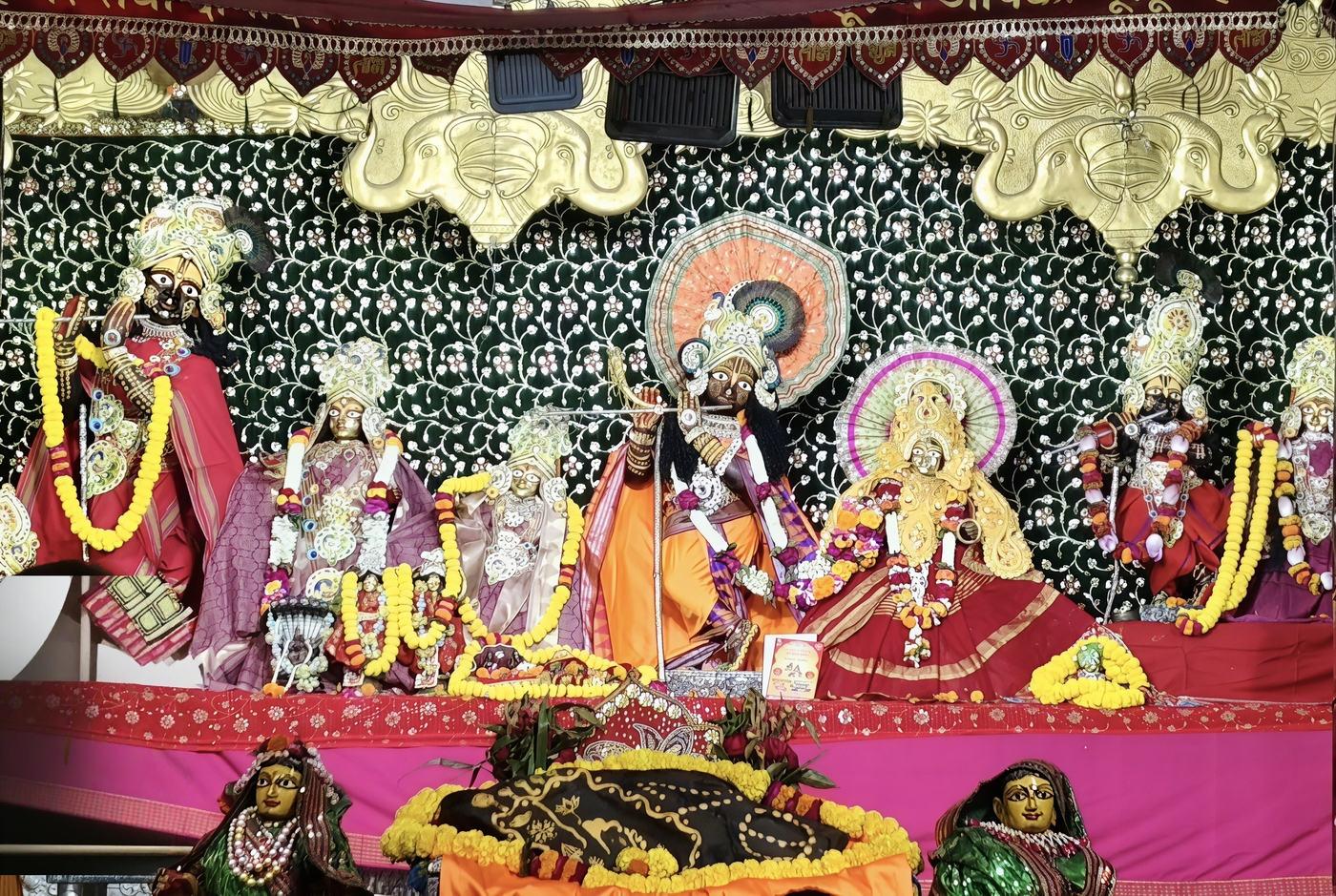
By the most commonly cited date, Sanatana Goswami disappeared in 1558, and Rupa Goswami some years after. Tradition holds that by the time of Rupa's own disappearance, he had already handed Jiva his manuscripts and the task of writing commentaries on them. From that point forward, as Srila Prabhupada states plainly in his purport to Chaitanya-charitamrita, "Srila Jiva Gosvami became the acharya of all the Vaishnavas in Bengal, Orissa and the rest of the world, and it is he who used to guide them in their devotional service." Bhaktisiddhanta Sarasvati Thakura's own Anubhashya commentary describes the same period in similar terms. It says that after Rupa and Sanatana's disappearance, Jiva was established as the topmost teacher of doctrine in the sampradaya. He engaged everyone in the worship of Krishna through the truths Mahaprabhu himself had given. He occasionally joined the devotees on the parikrama of Vraja Dham, and at times he visited Vitthaladeva in Mathura. The youngest of the Six Goswamis would in time be the last of them left. The whole weight of leading a scattered movement that was still taking shape fell on him.
| Detail | Description |
|---|---|
| Became acharya | After the disappearances of Sanatana (c. 1558) and Rupa Goswami |
| Land purchased | Seva Kunja area, 1558, from Ali Kant Chaudhari, Emperor Akbar's local landlord, for 30 rupees |
| Key students sent to Bengal | Srinivasa Acharya, Narottama Dasa Thakura, Shyamananda Pandit |
| Instructing student | Krishnadasa Kaviraja Goswami, author of Sri Chaitanya-charitamrita |
| Met | Emperor Akbar, traditionally dated 1570 |
| Radha-kunda excavation | Managed by Jiva Goswami on Raghunatha Dasa Goswami's behalf, 1542 |
Purchasing the Ground at Seva Kunja #
A surviving deed, kept today at the Vrindavan Research Institute, records a purchase made in 1558. In it Jiva Goswami bought land around Seva Kunja from Ali Kant Chaudhari, Emperor Akbar's local landlord, for the price of thirty rupees. Seva Kunja was the site where Rupa Goswami had based himself. It is also where the rasa-lila pastimes of Krishna and the gopis are held to have taken place. The land included Seva Kunja itself along with Dan Gulli, Imli Tala, Sringhar Sthali and Rasa Sthali, marked out by four boundary trees. Around this land, and around the deity of Radha-Damodara that Rupa Goswami had earlier placed in his care, Jiva built the temple and community that would carry the Goswamis' work forward. Another devotional account instead dates the start of Radha-Damodara worship itself to 1542. It names the seller of the land as a wealthy servant of Akbar called Alisha Chaudhari, not Ali Kant Chaudhari. These may be two names for the same person. The account may be confusing the deity's founding with the later 1558 land deed. Or these may be two separate transactions. The available sources do not settle this, so both accounts are reported here instead of quietly picking one.
Host to Every Bengali Pilgrim #
Despite his position as the senior-most authority in Vrindavana, Jiva Goswami is remembered as always humble in his daily conduct. Whenever Bengali Vaishnavas made the journey to Vrindavana, he received them personally, arranged their food and lodging, and guided them on parikrama around the sacred sites his uncles had spent years recovering. Jiva was the unquestioned authority on doctrine, yet he was willing to act as an ordinary host. Gaudiya sources repeatedly hold this up as the true measure of his character.
Krishnadasa Kaviraja and the Scholars of the Next Generation #
Krishnadasa Kaviraja Goswami would go on to write Sri Chaitanya-charitamrita itself. He names Jiva Goswami directly as one of his six instructing spiritual masters, alongside Rupa, Sanatana, Raghunatha Bhatta, Gopala Bhatta and Raghunatha dasa Goswami. Jiva is also remembered as having given Krishnadasa the title Kaviraja, "king of poets," for his poetic work Govinda-lilamrita. Later generations sometimes assumed the title was given for the Charitamrita itself, but the more exact sources connect it with this earlier work. Three other students held an especially close place in Jiva's circle: Srinivasa Acharya, Narottama Dasa Thakura, and Shyamananda. Shyamananda had arrived at Vrindavana as Duhkhi Krishnadasa, to study in the theological school for advanced students that Jiva had newly established there, and Jiva gave him his new name. Jiva personally trained the three in grammar, poetry, logic and the tradition's own literature. When he judged them ready, he gave them the titles Acharya, Thakura and Shyamananda respectively. He then organized what became one of the most important journeys in early Gaudiya history.
Sending the Manuscripts to Bengal #
The Goswamis' original writings existed only as handwritten manuscripts. These were the works of Rupa, Sanatana, Gopala Bhatta, Raghunatha Dasa and Jiva himself, and the community in Bengal and Orissa had no direct access to them. Jiva arranged for Srinivasa, Narottama and Shyamananda to carry the collected books east. He supplied a cart, bullocks and armed guards, and obtained a passport from the king of Jaipur for their protection along the way. Srila Prabhupada's own purport to Chaitanya-charitamrita confirms the most dramatic detail of the journey. The manuscripts were plundered near Vishnupura in Bengal. Jiva received word of the loss, and later learned that the books had been recovered. Once safely in Bengal, the three scholars translated and preached from these texts extensively, helping to establish the sampradaya across the region for generations to come. Krishnadasa Kaviraja Goswami wrote Sri Chaitanya-charitamrita itself while Jiva was still living.
Meeting the Emperor at Radha-Damodara #
Jiva Goswami's reputation reached well beyond Vrindavana's own community of Vaishnavas. Once, on a visit to Agra, he debated a group of Rajput scholars about which river is more glorious, the Yamuna or the Ganga. He established that the Yamuna is the more glorious of the two rivers, because the Ganga flows from Krishna's own lotus feet, while the Yamuna is His eternal consort. The Mughal emperor was satisfied with the argument and wished to reward him. In that age paper itself was scarce and costly, and Jiva asked only for a supply of blank paper.
Word of Jiva's learning eventually reached Emperor Akbar himself. In 1570 Raja Man Singh, the king of Jaipur and a disciple of Raghunatha Bhatta Goswami, brought Akbar to meet Jiva Goswami at the Radha-Damodara Mandira in Vrindavana. Akbar was impressed enough to provide funds for a small library, a granth-bhandara, to keep the Goswamis' manuscripts safely. He also granted Raja Man Singh permission to build large temples at Vrindavana, among them Madana-mohana, Govindaji, Gopinathaji and Jugal-Kishorji. For their construction he donated high-quality red sandstone, which until then had been reserved for Mughal forts and palaces. The historian F. S. Growse described Akbar being led blindfolded into the garden known as Nidhivan. According to Growse, Akbar was so moved by what he saw there that he gave his full support to the Goswamis' building projects. Akbar's visit is remembered as playing a central role in the development of Vrindavana as a whole, because it led to the building of what became its four original great temples.
The Granth-bhandara and the Grantha-Samadhi #
Jiva supervised the building of the Radha-Damodara Mandir around the deities Rupa Goswami had given him. Rooms in its courtyard have traditionally been rented to holy men. Srila Prabhupada lived in a room on the eastern side of this same courtyard for six years before sailing for the United States in 1965. There he produced the first three volumes of his Bhagavatam translation. Rupa Goswami's own tomb stands in the same courtyard. Tradition holds that the Six Goswamis met at Radha-Damodara to plan the spreading of Krishna consciousness. With men provided by Akbar, Jiva built a granth-bhandara to store handwritten copies of the Goswamis' books. His own Sankalpa-patra, his last will and testament, records that he worked on this with great personal eagerness. Within that same temple compound stands a unique Grantha-Samadhi containing the sacred books of the Six Goswamis. These include confidential palm-leaf writings on the intimate pastimes of Krishna and the gopis. It is said to be the only grantha-samadhi of its kind anywhere in the world.
Managing the Excavation of Radha-kunda #
Jiva Goswami was also given responsibility, on behalf of his uncles Rupa and Sanatana, for the well-being of Raghunatha Dasa Goswami. Raghunatha Dasa lived at Radha-kunda in a small bhajana-kutira, and Jiva visited him there to perform bhajana whenever he could. It was Raghunatha Dasa who first thought of excavating the two sacred kundas there, and he remained central to their basic planning. But he was too deeply absorbed in his own bhajana to manage the day-to-day work, so it fell to Jiva to see the project through. Once Raghunatha Dasa began worrying about how the excavation would be funded. He stopped himself and gave up the thought, disgusted at his own anxiety. Around that same time, far away, a wealthy merchant named Samarpana had been planning to donate money to Lord Badri-Narayana at Badrinatha. He had a dream in which Badri-Narayana himself told him to give the donation instead to Raghunatha Dasa at Radha-kunda. The merchant did exactly this, and Raghunatha Dasa in turn called Jiva Goswami to Radha-kunda to manage the work. In 1542 Jiva purchased the two paddy fields where the sacred kundas were situated, and arranged laborers and materials for building their ghatas.
Meeting the Emperor Again #
Tradition also holds that Akbar later invited Jiva to his palace for further discussion, and that Jiva declined because of a personal vow never to leave Vrindavana. The emperor is said to have responded by sending a carriage and horses, with an assurance that Jiva would be returned before nightfall, and Jiva is said to have accepted this promise once. This episode is less securely documented than the land deed, the Agra debate and the Radha-Damodara meeting. But however it is weighed against them, it points to the same fact. By the last decades of his life, Jiva Goswami's authority reached well beyond the community of Vaishnavas he had been born into. How that long period of leadership finally came to a close is told in Final Days and Disappearance.
Scriptural evidence for this chapter (2)
শ্রীরূপ, সনাতন, ভট্ট–রঘুনাথ ।
শ্রীজীব, গোপালভট্ট, দাস–রঘুনাথ ॥
śrī-rūpa, sanātana, bhaṭṭa-raghunātha
śrī-jīva, gopāla-bhaṭṭa, dāsa-raghunātha
Word for word
śrī-rūpa: Srila Rupa Gosvami; sanātana: Sanatana Gosvami; bhaṭṭa-raghunātha: Raghunatha Bhatta Gosvami; śrī-jīva: Srila Jiva Gosvami; gopāla-bhaṭṭa: Gopala Bhatta Gosvami; dāsa-raghunātha: Srila Raghunatha dasa Gosvami.
My instructing spiritual masters are Sri Rupa Gosvami, Sri Sanatana Gosvami, Sri Bhatta Raghunatha, Sri Jiva Gosvami, Sri Gopala Bhatta Gosvami and Srila Raghunatha dasa Gosvami.
Krishnadasa Kaviraja Goswami names Jiva Goswami directly as one of his six instructing spiritual masters (siksa-gurus), the clearest scriptural evidence of the relationship between the two.
এই ছয় গুরু—শিক্ষাগুরু যে আমার ।
তাঁ’ সবার পাদপদ্মে কোটি নমস্কার ॥
ei chaya guru — śikṣā-guru ye āmāra
tāṅ'-sabāra pāda-padme koṭi namaskāra
Word for word
ei: these; chaya: six; guru: spiritual masters; śikṣā-guru: instructing spiritual masters; ye: who are; āmāra: my; tāṅ'-sabāra: of all of them; pāda-padme: unto the lotus feet; koṭi: ten million; namaskāra: respectful obeisances.
These six are my instructing spiritual masters, and therefore I offer millions of respectful obeisances unto their lotus feet.
From the purport: "By accepting the six Gosvamis as his instructing spiritual masters, the author specifically makes it clear that one should not be recognized as a Gaudiya Vaisnava if he is not obedient to them."
The companion verse to Adi 1.36, in which Krishnadasa Kaviraja Goswami offers obeisances to Jiva Goswami and the other five instructing gurus by name.
Chapter 6
Other Literary Works
A grammar built from Krishna's names, commentaries on his uncles' books, and roughly two dozen further titles
The Sat-sandarbha was Jiva Goswami's central achievement, but by no means his only one. Tradition credits him with at least twenty-five separate works, including commentaries, grammar, poetry and ritual manuals. Several devotional sources repeat a claim that he wrote half a million Sanskrit verses on palm leaves without any correction. This claim cannot be confirmed from any independent source. Even so, the works that survive are so many and so varied that they make Jiva Goswami one of the most productive Sanskrit authors the Gaudiya Vaishnava tradition has produced.
| Detail | Description |
|---|---|
| Total works credited | At least twenty-five |
| Grammar | Hari-namamrita-vyakarana, built from Krishna's names |
| Commentary on Rupa Goswami | Durgama-sangamani (on Bhakti-rasamrita-sindhu, also called Bhakti-rasamrita-sesha in another devotional account) and Locana-rocani (on Ujjvala-nilamani) |
| Commentary on the Bhagavatam | Krama-sandarbha, also known in some sources as Laghu-toshani |
| Devotional narrative | Gopala-champu, in two parts (purva, 33 chapters; uttara, 37 chapters) |
| Self-commentary | Sarva-samvadini, on the Sat-sandarbha |
A Grammar Made of Holy Names #
Among Jiva Goswami's most distinctive works is the Hari-namamrita-vyakarana, a full Sanskrit grammar. Ordinary grammar books use plain, everyday examples to show how nouns and verbs change their forms. In this book, every example sentence that explains such a rule is taken from Krishna's names and pastimes. In this way it was a grammar textbook and a devotional work at the same time. Srila Prabhupada himself wrote of it, in the Introduction to Srimad-Bhagavatam, that "this grammar is still current, known as Hari-namamrita-vyakarana, and is prescribed in the syllabus of schools in Bengal," and the account preserved at gaudiyahistory.iskcondesiretree.com agrees with this.
Commentaries on His Uncles' Books #
A large share of Jiva's writing was spent explaining and defending the works of Rupa and Sanatana Goswami. Two examples are:
- Durgama-sangamani: his full commentary on Rupa's Bhakti-rasamrita-sindhu. This is the systematic book on devotional rasa that Jiva had proofread as a young disciple. Another devotional account calls this same commentary Bhakti-rasamrita-sesha. This is one of several places where the available sources use different titles for what appears to be the same work.
- Locana-rocani: does the same service for Rupa's Ujjvala-nilamani, the companion book on the specific rasa of romantic love between Radha and Krishna.
On the Bhagavatam itself, Jiva wrote a commentary on its Tenth Canto. Lists that follow Srila Prabhupada's own purport to Chaitanya-charitamrita most often call it the Krama-sandarbha. Other biographical sketches give the name Laghu Vaishnava-toshani to what appears to be the same work, or a closely related one. They describe it as a shorter version of Sanatana Goswami's own larger Bhagavatam commentary, written at Sanatana's instruction. Another devotional account describes a Krama-sandarbha that covers all twelve cantos of the Bhagavatam, not only the Tenth. The sources do not fully agree whether these names describe one text or several. So all of these names and descriptions are reported here, without choosing one.
Gopala-champu and the Sarva-samvadini #
The Gopala-champu, composed in the champu style that mixes prose and verse, retells the pastimes of Krishna in two parts: a purva-bhaga of thirty-three chapters covering Krishna's activities in Vrindavana, and an uttara-bhaga of thirty-seven chapters covering the Lord's later activities in Mathura and Dvaraka. The purva-bhaga was completed in Shakabda 1510 (1588 A.D.), a decade before Jiva Goswami's own disappearance. One surviving passage describes Govardhana Hill itself rising up in a towering form to devour the offerings the Vrajavasis had brought, calling out for more even as it emptied the ponds around the hill. Alongside his six Sandarbhas, Jiva also wrote the Sarva-samvadini, a commentary on his own work that explains his arguments and links them to one another. One modern academic source says it covers at least the first four Sandarbhas in detail. But the work is generally treated as a companion to the whole six-part series.
The Full List of Twenty-Five Works #
Another devotional account gives a numbered list of the works composed and edited by Jiva Goswami. It is given here in full, together with the titles already discussed above:
- Hari-namamrita-vyakarana
- Sutra-malika
- Dhatu-sangraha
- Krishnarcha-dipika (called Radha-Krishnarcana-candrika in some other sources, a work giving details of worshiping Radha and Krishna together)
- Gopala-virudavali
- Rasamrita-shesha
- Sri Madhava-mahotsava
- Sri Sankalpa-kalpavriksha
- Bhavartha-sucaka-campu
- Gopala-tapani-tika, a commentary on the Gopala-tapani Upanishad
- Brahma-samhita-tika, also called Dikdarshani
- Bhakti-rasamrita-sesha, the commentary on Bhakti-rasamrita-sindhu discussed above as the Durgama-sangamani
- Locana-rocani, the commentary on Ujjvala-nilamani
- Yogasara-stava-tika, a commentary on a hymn from the Padma Purana
- Gayatri-bhashya, an explanation of the Gayatri mantra following the Agni Purana
- A description of Krishna's lotus feet drawn from the Padma Purana
- A companion description of Srimati Radharani's lotus feet
- The two parts of Gopala-champu
- The seven works making up and accompanying the Sat-sandarbha: Krama, Tattva, Bhagavat, Paramatma, Krishna, Bhakti and Priti Sandarbha
Outside this list, Jiva Goswami is also credited elsewhere with the Sutra-malika and Dhatu-sangraha on grammar, both named above. Other available sources add a commentary on the Brahma-samhita, which they treat as separate from the work named Dikdarshani. They also add the Radha-Krishnarcana-candrika on deity worship. Here it is treated as probably the same work as the Krishnarcha-dipika in the numbered list, not as another separate title. Several of these shorter works are less like independent books and more like reference tools for other Vaishnavas, such as a verse-index or a ritual handbook. This suggests that Jiva thought of his writing as building a complete working library for the young Gaudiya Vaishnava community, not simply as adding to his own name as an author.
A Body of Work Meant to Be Used #
All this large and varied writing is held together less by any single argument than by one steady purpose. In sixteenth-century India, a serious institution of Sanskrit learning was expected to have its own grammar, its own commentaries on its own basic texts, its own ritual manuals, and its own systematic philosophy. Jiva gave all of these to the Gaudiya Vaishnava tradition, and all of them could be traced back to scriptural evidence, not borrowed wholesale from other schools. Later Gaudiya acharyas continued to write commentaries directly on Jiva's own texts. Baladeva Vidyabhushana, for instance, composed his own commentary on the Tattva-sandarbha itself, alongside Jiva's Sarva-samvadini. For him the Sandarbhas were not curiosities from history. They were living arguments, still worth studying generations later. This may be the clearest sign that Jiva succeeded in what he set out to do. Like the Sat-sandarbha itself, all this writing, whether grammar, commentary, ritual manual or devotional narrative, gave the young Gaudiya Vaishnava community every tool that a serious Sanskrit scholar of that time would expect a complete tradition to have. What became of that community, and of Jiva himself, in his final years is told in Final Days and Disappearance.
Chapter 7
Final Days and Disappearance
A disputed date, a lasting temple, and a legacy that reached all the way to Srila Prabhupada's own mission
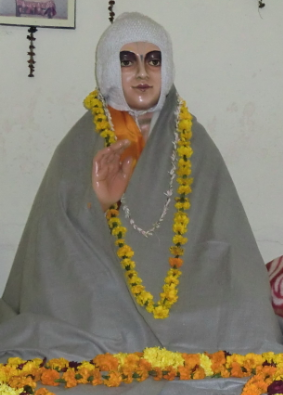
Sources disagree, sometimes sharply, about exactly when Jiva Goswami left this world. The most commonly cited traditional date is 1608, and it is the date used elsewhere on these pages for consistency. But other reputable sources place his disappearance as early as 1598, and Wikimedia's own catalogue entry for a photograph of his samadhi statue also lists 1598.
Another devotional account gives the same 1598 figure, and its dates agree with each other. It says Jiva Goswami was born around 1513, the same figure given in the Detail table below. It also says plainly that "Jiva Gosvami lived for eighty-five years" before his disappearance in 1598, and this span of years fits exactly with its own birth year. Not every source here is this consistent. A widely circulated Gaudiya History biographical sketch gives a birth year of 1533 and a disappearance at age eighty-five. That would actually work out to 1618, not the 1540 that the same page states. We point out this mistake here instead of quietly correcting it. Academic researcher Jan Brzezinski, writing in the Journal of Vaishnava Studies, has proposed a still wider range, from roughly 1516 to 1608.
Both 1608 and 1598 rest on sources that are treated as reliable, so both are reported here side by side, without settling the question. What can be said with confidence is only that Jiva Goswami lived to an old age. He outlived both his uncles by several decades, and he spent the greater part of a century in Vrindavana.
| Detail | Description |
|---|---|
| Disappearance (traditional) | 1608 |
| Other cited dates | 1598 (per another devotional account, consistent with its own stated birth year of 1513 and an 85-year lifespan); occasionally as early as the 1540s in inconsistent sources |
| Place | Radha-Damodara temple, Vrindavana |
| Samadhi | Stands within the Radha-Damodara temple compound |
| Later resident of same temple | Srila Prabhupada, 1962-1965 |
A Long Stewardship's Quiet End #
Dramatic final pastimes are recorded for some of the other Goswamis. But for Jiva Goswami, no detailed story of his final illness or last words survives in the available sources. What the record does keep is where he stayed until the end. It was the Radha-Damodara temple, which he had built up around the deity that his uncle Rupa Goswami had placed in his care decades earlier. By every account, he continued there to receive visiting Vaishnavas, guide the growing Gaudiya community, and keep up the worship he had begun as a young disciple. His samadhi stands within that same temple compound to this day. Beside it is the samadhi of Rupa Goswami himself and, tradition says, at least a portion of the remains of his student Krishnadasa Kaviraja Goswami.
Pilgrims visiting the Radha-Damodara temple today can still see a statue of Jiva Goswami placed within his own samadhi shrine. It is a simple, quiet memorial for one whose writings shaped the philosophy of an entire tradition. Some of the other Goswamis' resting places lie somewhat apart from Vrindavana's main pilgrimage routes. But Radha-Damodara has remained an active temple and residence without a break, from Jiva's own lifetime to the present day.
A Final Generation Prepared for Bengal #
In his last years, Jiva Goswami's attention turned above all to preparing the next generation to carry the Goswamis' work forward. Bhaktisiddhanta Sarasvati Thakura's Anubhashya records that he personally trained Shrinivasa, Narottama Dasa Thakura and Dukhi Krishnadasa in the teachings of Vaishnava faith. He gave them the titles Acharya, Thakura and Shyamananda respectively. Then he sent them back to Bengal and Orissa with the Goswamis' own writings, and with instructions to preach the holy names and love of Krishna there. This same period, and the fuller story of the journey the three of them made, is told at greater length in Leading the Vrindavana Goswamis. It is mentioned here only briefly. The story of how and why Duhkhi Krishnadasa came to be named Shyamananda is told on his own page. Krishnadasa Kaviraja Goswami completed Sri Chaitanya-charitamrita itself while Jiva Goswami was still living. Not long after that, Jiva received Shrinivasa, Narottama and Dukhi Krishnadasa at Vrindavana and began this final chapter of his preaching mission.
The Measure Srila Prabhupada Gave Him #
No one associated with the modern spread of Gaudiya Vaishnavism praised Jiva Goswami's legacy more consistently than Srila Prabhupada. The philosopher Pramathanath Tarkabhusan once told him there was "no comparison with Jiva Goswami and any other philosophers of the world," as Prabhupada described in one letter. In a 1971 lecture in London, Prabhupada was explaining a Bhagavatam verse that cited Jiva's Krishna-sandarbha. There he declared that "throughout the whole world there is not a single philosopher who can defy these Jiva Gosvami's six sandarbhas." Elsewhere he called Jiva Goswami simply the greatest scholar and philosopher in the world. This was not a passing compliment. It was his settled judgment, repeated across decades of lectures, letters and conversations.
The Temple That Sheltered a Later Mission #
The closing detail of Jiva Goswami's life belongs, in a way, to a much later chapter of Gaudiya Vaishnava history. In his own purport to Chaitanya-charitamrita, Srila Prabhupada records that he himself lived at the Radha-Damodara temple that Jiva Goswami established. Srila Prabhupada stayed there from 1962 until 1965, after his own retirement from active family life. In those very years he worked on his English translation of Srimad-Bhagavatam, before leaving for the United States to begin the mission that became ISKCON. This temple was built by the youngest of the Six Goswamis four hundred years earlier. It then became the place where Krishna consciousness was prepared for its journey to the West. None of the sources treat this connection as a coincidence. They consistently present it as the direct fruit of the systematic philosophical foundation that Jiva Goswami spent his life laying down. The full account of that foundation, the Sat-sandarbha itself, is told in Writing the Sat-sandarbha. The wider story of his life, from a grieving child in Bengal to the recognized philosopher of an entire tradition, begins at Birth and Early Education.
- Sri Chaitanya-charitamrita, Adi-lila 10.85 (Bhaktivedanta VedaBase)
- Sri Chaitanya-charitamrita, Adi-lila 1.36-37 (Bhaktivedanta VedaBase)
- Jiva Goswami - Gaudiya History
- Jiva Goswami - Biography - Gaudiya History
- Srila Jiva Goswami: The Greatest Scholar and Philosopher, by Mayapur-shashi Dasa - Back to Godhead
- Srila Jiva Goswami Samadhi - Vrindaban Forest
