By the most commonly cited date, Sanatana Goswami disappeared in 1558, and Rupa Goswami some years after. Tradition holds that by the time of Rupa's own disappearance, he had already handed Jiva his manuscripts and the task of writing commentaries on them. From that point forward, as Srila Prabhupada states plainly in his purport to Chaitanya-charitamrita, "Srila Jiva Gosvami became the acharya of all the Vaishnavas in Bengal, Orissa and the rest of the world, and it is he who used to guide them in their devotional service." Bhaktisiddhanta Sarasvati Thakura's own Anubhashya commentary describes the same period in similar terms. It says that after Rupa and Sanatana's disappearance, Jiva was established as the topmost teacher of doctrine in the sampradaya. He engaged everyone in the worship of Krishna through the truths Mahaprabhu himself had given. He occasionally joined the devotees on the parikrama of Vraja Dham, and at times he visited Vitthaladeva in Mathura. The youngest of the Six Goswamis would in time be the last of them left. The whole weight of leading a scattered movement that was still taking shape fell on him.
| Detail | Description |
|---|---|
| Became acharya | After the disappearances of Sanatana (c. 1558) and Rupa Goswami |
| Land purchased | Seva Kunja area, 1558, from Ali Kant Chaudhari, Emperor Akbar's local landlord, for 30 rupees |
| Key students sent to Bengal | Srinivasa Acharya, Narottama Dasa Thakura, Shyamananda Pandit |
| Instructing student | Krishnadasa Kaviraja Goswami, author of Sri Chaitanya-charitamrita |
| Met | Emperor Akbar, traditionally dated 1570 |
| Radha-kunda excavation | Managed by Jiva Goswami on Raghunatha Dasa Goswami's behalf, 1542 |
Purchasing the Ground at Seva Kunja #
A surviving deed, kept today at the Vrindavan Research Institute, records a purchase made in 1558. In it Jiva Goswami bought land around Seva Kunja from Ali Kant Chaudhari, Emperor Akbar's local landlord, for the price of thirty rupees. Seva Kunja was the site where Rupa Goswami had based himself. It is also where the rasa-lila pastimes of Krishna and the gopis are held to have taken place. The land included Seva Kunja itself along with Dan Gulli, Imli Tala, Sringhar Sthali and Rasa Sthali, marked out by four boundary trees. Around this land, and around the deity of Radha-Damodara that Rupa Goswami had earlier placed in his care, Jiva built the temple and community that would carry the Goswamis' work forward. Another devotional account instead dates the start of Radha-Damodara worship itself to 1542. It names the seller of the land as a wealthy servant of Akbar called Alisha Chaudhari, not Ali Kant Chaudhari. These may be two names for the same person. The account may be confusing the deity's founding with the later 1558 land deed. Or these may be two separate transactions. The available sources do not settle this, so both accounts are reported here instead of quietly picking one.
Host to Every Bengali Pilgrim #
Despite his position as the senior-most authority in Vrindavana, Jiva Goswami is remembered as always humble in his daily conduct. Whenever Bengali Vaishnavas made the journey to Vrindavana, he received them personally, arranged their food and lodging, and guided them on parikrama around the sacred sites his uncles had spent years recovering. Jiva was the unquestioned authority on doctrine, yet he was willing to act as an ordinary host. Gaudiya sources repeatedly hold this up as the true measure of his character.
Krishnadasa Kaviraja and the Scholars of the Next Generation #
Krishnadasa Kaviraja Goswami would go on to write Sri Chaitanya-charitamrita itself. He names Jiva Goswami directly as one of his six instructing spiritual masters, alongside Rupa, Sanatana, Raghunatha Bhatta, Gopala Bhatta and Raghunatha dasa Goswami. Jiva is also remembered as having given Krishnadasa the title Kaviraja, "king of poets," for his poetic work Govinda-lilamrita. Later generations sometimes assumed the title was given for the Charitamrita itself, but the more exact sources connect it with this earlier work. Three other students held an especially close place in Jiva's circle: Srinivasa Acharya, Narottama Dasa Thakura, and Shyamananda. Shyamananda had arrived at Vrindavana as Duhkhi Krishnadasa, to study in the theological school for advanced students that Jiva had newly established there, and Jiva gave him his new name. Jiva personally trained the three in grammar, poetry, logic and the tradition's own literature. When he judged them ready, he gave them the titles Acharya, Thakura and Shyamananda respectively. He then organized what became one of the most important journeys in early Gaudiya history.
Sending the Manuscripts to Bengal #
The Goswamis' original writings existed only as handwritten manuscripts. These were the works of Rupa, Sanatana, Gopala Bhatta, Raghunatha Dasa and Jiva himself, and the community in Bengal and Orissa had no direct access to them. Jiva arranged for Srinivasa, Narottama and Shyamananda to carry the collected books east. He supplied a cart, bullocks and armed guards, and obtained a passport from the king of Jaipur for their protection along the way. Srila Prabhupada's own purport to Chaitanya-charitamrita confirms the most dramatic detail of the journey. The manuscripts were plundered near Vishnupura in Bengal. Jiva received word of the loss, and later learned that the books had been recovered. Once safely in Bengal, the three scholars translated and preached from these texts extensively, helping to establish the sampradaya across the region for generations to come. Krishnadasa Kaviraja Goswami wrote Sri Chaitanya-charitamrita itself while Jiva was still living.
Meeting the Emperor at Radha-Damodara #
Jiva Goswami's reputation reached well beyond Vrindavana's own community of Vaishnavas. Once, on a visit to Agra, he debated a group of Rajput scholars about which river is more glorious, the Yamuna or the Ganga. He established that the Yamuna is the more glorious of the two rivers, because the Ganga flows from Krishna's own lotus feet, while the Yamuna is His eternal consort. The Mughal emperor was satisfied with the argument and wished to reward him. In that age paper itself was scarce and costly, and Jiva asked only for a supply of blank paper.
Word of Jiva's learning eventually reached Emperor Akbar himself. In 1570 Raja Man Singh, the king of Jaipur and a disciple of Raghunatha Bhatta Goswami, brought Akbar to meet Jiva Goswami at the Radha-Damodara Mandira in Vrindavana. Akbar was impressed enough to provide funds for a small library, a granth-bhandara, to keep the Goswamis' manuscripts safely. He also granted Raja Man Singh permission to build large temples at Vrindavana, among them Madana-mohana, Govindaji, Gopinathaji and Jugal-Kishorji. For their construction he donated high-quality red sandstone, which until then had been reserved for Mughal forts and palaces. The historian F. S. Growse described Akbar being led blindfolded into the garden known as Nidhivan. According to Growse, Akbar was so moved by what he saw there that he gave his full support to the Goswamis' building projects. Akbar's visit is remembered as playing a central role in the development of Vrindavana as a whole, because it led to the building of what became its four original great temples.
The Granth-bhandara and the Grantha-Samadhi #
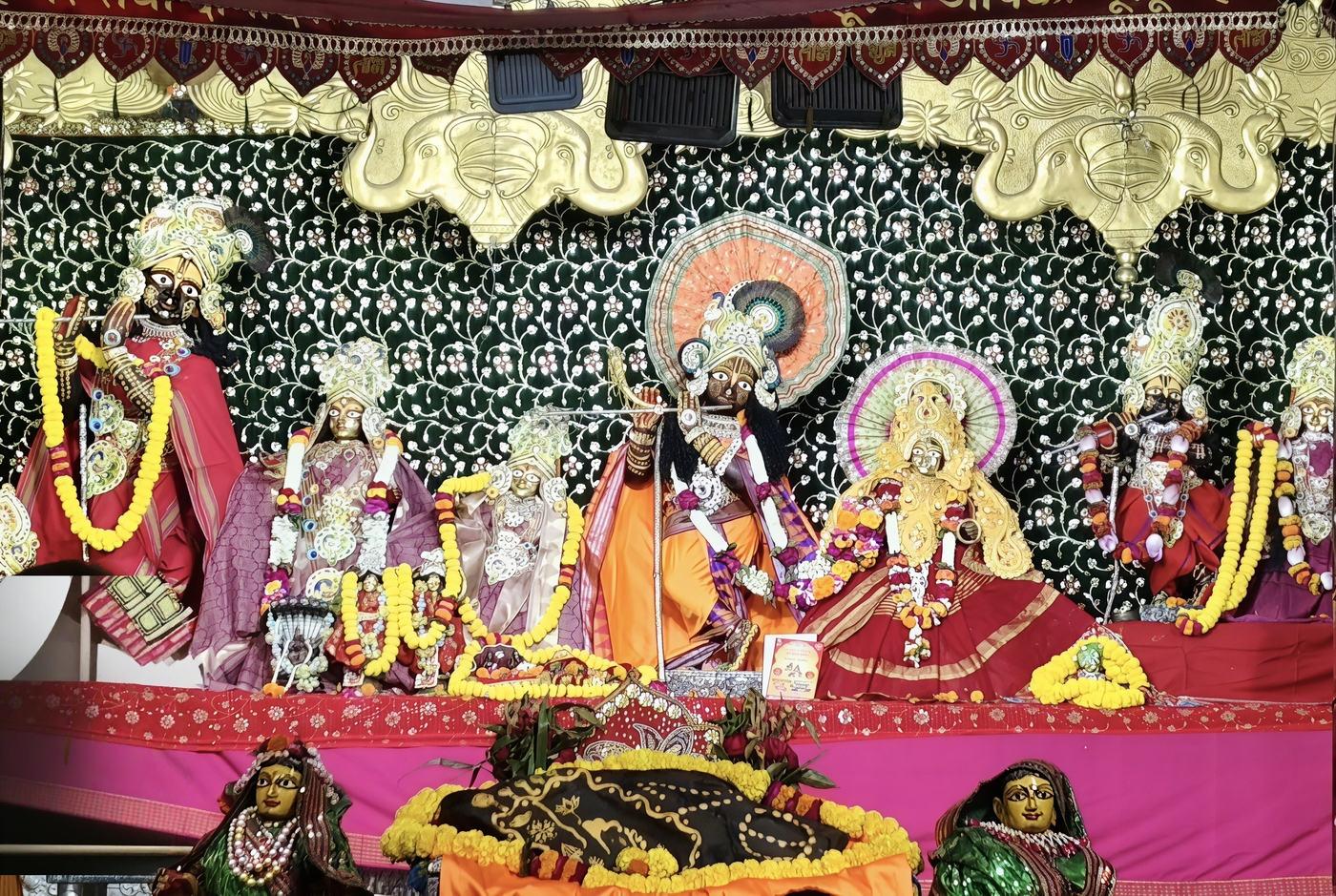
Jiva supervised the building of the Radha-Damodara Mandir around the deities Rupa Goswami had given him. Rooms in its courtyard have traditionally been rented to holy men. Srila Prabhupada lived in a room on the eastern side of this same courtyard for six years before sailing for the United States in 1965. There he produced the first three volumes of his Bhagavatam translation. Rupa Goswami's own tomb stands in the same courtyard. Tradition holds that the Six Goswamis met at Radha-Damodara to plan the spreading of Krishna consciousness. With men provided by Akbar, Jiva built a granth-bhandara to store handwritten copies of the Goswamis' books. His own Sankalpa-patra, his last will and testament, records that he worked on this with great personal eagerness. Within that same temple compound stands a unique Grantha-Samadhi containing the sacred books of the Six Goswamis. These include confidential palm-leaf writings on the intimate pastimes of Krishna and the gopis. It is said to be the only grantha-samadhi of its kind anywhere in the world.
Managing the Excavation of Radha-kunda #
Jiva Goswami was also given responsibility, on behalf of his uncles Rupa and Sanatana, for the well-being of Raghunatha Dasa Goswami. Raghunatha Dasa lived at Radha-kunda in a small bhajana-kutira, and Jiva visited him there to perform bhajana whenever he could. It was Raghunatha Dasa who first thought of excavating the two sacred kundas there, and he remained central to their basic planning. But he was too deeply absorbed in his own bhajana to manage the day-to-day work, so it fell to Jiva to see the project through. Once Raghunatha Dasa began worrying about how the excavation would be funded. He stopped himself and gave up the thought, disgusted at his own anxiety. Around that same time, far away, a wealthy merchant named Samarpana had been planning to donate money to Lord Badri-Narayana at Badrinatha. He had a dream in which Badri-Narayana himself told him to give the donation instead to Raghunatha Dasa at Radha-kunda. The merchant did exactly this, and Raghunatha Dasa in turn called Jiva Goswami to Radha-kunda to manage the work. In 1542 Jiva purchased the two paddy fields where the sacred kundas were situated, and arranged laborers and materials for building their ghatas.
Meeting the Emperor Again #
Tradition also holds that Akbar later invited Jiva to his palace for further discussion, and that Jiva declined because of a personal vow never to leave Vrindavana. The emperor is said to have responded by sending a carriage and horses, with an assurance that Jiva would be returned before nightfall, and Jiva is said to have accepted this promise once. This episode is less securely documented than the land deed, the Agra debate and the Radha-Damodara meeting. But however it is weighed against them, it points to the same fact. By the last decades of his life, Jiva Goswami's authority reached well beyond the community of Vaishnavas he had been born into. How that long period of leadership finally came to a close is told in Final Days and Disappearance.
