Shivananda Sena's own story already gives the short version of his youngest son's tale: a name chosen in advance, a toe placed in an infant's mouth, a verse recited at age seven. This page follows Sri Chaitanya-charitamrita's own account of those events in full, verse by verse. It also shows carefully which details come directly from Krishnadasa Kaviraja Goswami's text and which come from later retellings.
| Detail | Description |
|---|---|
| Birth name | Paramananda dasa (also written Paramananda Sena) |
| Nickname from Mahaprabhu | Puri dasa |
| Exact primary source | Sri Chaitanya-charitamrita, Antya-lila, Chapter 12, verses 44-51 (naming and blessing) and Chapter 16, verses 68-76 (the verse and title) |
| Where the birth actually happened | At Shivananda Sena's home, most likely near Kumarahatta in Bengal, not at Jagannatha Puri, despite some short summaries |
| Age at the famous verse | Seven, "with no education," per Chaitanya-charitamrita 16.75 |
A Name Chosen Before The Child Existed #
Sri Chaitanya-charitamrita's account of this story begins with a promise, not with a birth. On an earlier visit, Mahaprabhu had told Shivananda Sena, "When this son is born, give him the name Puri dasa" (Antya-lila 12.46-47). The next verse, 12.48, says: "The son was in the womb of Shivananda's wife, and when Shivananda returned home the son was born." Read plainly, this places the birth at the family's own home after Shivananda returned from Puri, not at Jagannatha Puri itself. That home was almost certainly in Kumarahatta in Bengal, the village named elsewhere as Shivananda Sena's real native place. This is a small correction, but it should be made carefully, because more than one short summary of this story says that the boy was born at Puri during the pilgrimage. Chaitanya-charitamrita's own text does not actually say that.
Named By The Lord's Own Order #
The next verse settles the name itself: "The child was named Paramananda dasa in accordance with the Lord's order, and the Lord jokingly called him Puri dasa" (Antya 12.49). So the boy had two names from the very start. One was a formal name, which his father gave him by Mahaprabhu's own instruction. The other was a playful pet name from the Lord Himself. This pet name stayed with him, and it was used again later, in Antya-lila Chapter 16, when Mahaprabhu addresses the seven-year-old boy directly as "Puri dasa."
The Toe In The Infant's Mouth #
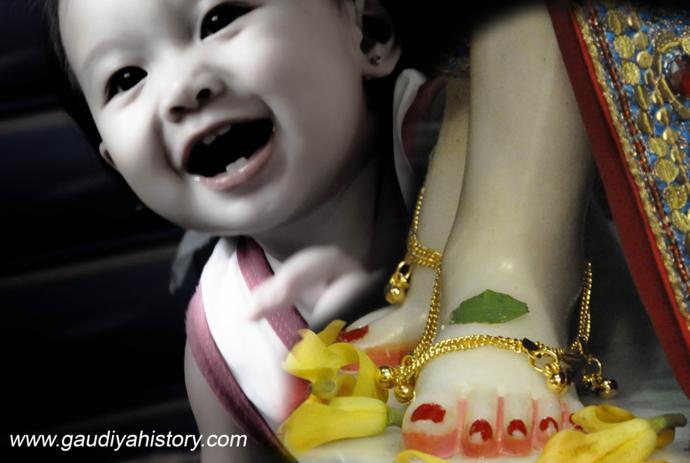
Next comes the most quoted detail in this whole story. It should be stated exactly, because popular versions sometimes add to it: "When Shivananda Sena introduced the child to Sri Chaitanya Mahaprabhu, the Lord put His toe in the child's mouth" (Antya 12.50). That is the entire verse. There is no elaborate scene and no dialogue, only this one surprising act of loving closeness. Krishnadasa Kaviraja Goswami does not record such an act for any other child anywhere else in his very long biography of Mahaprabhu. The very next line explains what the act meant for the whole family: "No one can cross over the ocean of Shivananda Sena's good fortune, for the Lord considered Shivananda's whole family His own" (Antya 12.51). Later Vaishnava writers connect this act directly to the boy's later gift for poetry. These writers include the compilers of the traditional biographical literature used by Gaudiya History and Back to Godhead. They treat the toe placed in his infant mouth as the literal seed of everything he would go on to write. This explanation comes from tradition. Chaitanya-charitamrita does not state it outright, and we report it here as tradition.
A Boy Who Would Not Chant Aloud #
Some years later, the boy was old enough to be brought before Mahaprabhu on his own, not carried. He then became the subject of a second, very different episode, recorded in Antya-lila, Chapter 16. Sri Chaitanya-charitamrita says Shivananda Sena "tried with much endeavor to get his boy to speak Krishna's holy name," and the boy simply would not. Mahaprabhu Himself remarked on it directly: "I have induced the whole world to take to the holy name of Krishna. I have induced even the trees and immovable plants to chant the holy name... But I could not induce this boy to chant the holy name of Krishna." Svarupa Damodara Goswami, who was standing nearby, gave the explanation. The boy had already been initiated and given the mantra. A disciple does not repeat his own guru-given mantra aloud in front of others. Following this rule, the boy "chants the mantra within his mind but does not say it aloud." It is a small moment, but it tells us something important. It shows that, even before the boy had spoken a single verse of his own, something unusual was already at work in him.
A Verse At Seven Years Old #
The proof came directly afterward. "Another day," the text says, Mahaprabhu simply asked him to recite, "Recite, My dear Puri dasa," and the boy, without any preparation, composed and spoke aloud an original Sanskrit verse: "Lord Sri Krishna is just like a bluish lotus flower for the ears; He is ointment for the eyes, a necklace of indranila gems for the chest, and universal ornaments for the gopi damsels of Vrindavana. Let that Lord Sri Hari, Krishna, be glorified." Chaitanya-charitamrita stresses how extraordinary this was: "Although the boy was only seven years old and still had no education, he composed such a nice verse. Everyone was struck with wonder" (Antya 16.75). Krishnadasa Kaviraja Goswami then closes the episode with his own reflection. He gives the credit entirely to "the glory of Sri Chaitanya Mahaprabhu's causeless mercy, which even the demigods, headed by Lord Brahma, cannot estimate" (Antya 16.76).
Where The Name "Kavi-Karnapura" Actually Comes From #
Here we must be careful to separate two things. Sri Chaitanya-charitamrita's own surviving verses end this scene at "everyone was struck with wonder." In the text as it survives on vedabase.io, they do not show Svarupa Damodara Goswami giving the title "Kavi-karnapura" on the spot. A widely repeated detail says that Svarupa Damodara remarked the verse had "satiated the ears of the devotees." So he named the boy Karnapura, from karna, "ears," plus pura, "filling" or "satiation." This specific detail comes from later traditional accounts. It is repeated in the same way in Gaudiya History's biography, in the Back to Godhead article on his life, and in a secondary collection of Bhakti-ratnakara material. Several separate Gaudiya sources agree on it. So we report it here as the accepted traditional explanation for the name, not as an invented detail. But we also say clearly that it comes from that later part of the tradition, not directly from Krishnadasa Kaviraja Goswami's own verses. What Chaitanya-charitamrita itself makes certain is that the boy had exactly this kind of poetic gift, and that Mahaprabhu's own closest associates saw it and marveled at it. The rest of this story tells what he went on to build with that gift, starting with Sri Chaitanya-chandrodaya-nataka.
