Srila Madhava Ghosh
The Singer of Vrindavana
The complete life, on one page: The main biography and every pastime page, in order, in one place
Introduction
Madhava Ghosh was one of three brothers, with Govinda Ghosh and Vasudeva Ghosh, whose kirtan made Sri Chaitanya Mahaprabhu and Nityananda Prabhu dance in Navadvipa. Srila Krishnadasa Kaviraja Goswami names all three brothers separately in Sri Chaitanya-charitamrita, and Srila Prabhupada's purport picks Madhava out with a title that has stayed with his name for five hundred years: "known as the singer of Vrindavana." Most of what we know about Madhava is tied up with the story of his brothers. Where the old texts do speak of him alone, we give what they say plainly. Where they are silent, we leave the silence just as it is.
| Detail | Description |
|---|---|
| Also known as | Madhava Ghosa, Sri Madhava Ghosh, Madhava Ghosh Thakura |
| Family | Kayastha family of northern Rarh, Bengal; brother of Govinda Ghosh and Vasudeva Ghosh |
| Birthplace | Kulai village on the Ajay river near Katwa (one tradition); Baduna or Burangi grama in Sri Hatta (another) |
| Role | Kirtan singer among the associates of Sri Chaitanya Mahaprabhu and Nityananda Prabhu |
| Traditional epithet | "The singer of Vrindavana" |
| Identity | Rasollasa, a gopi of Vraja who sang the songs composed by Vishakha (Gaura-ganoddesha-dipika 188; Chaitanya-charitamrita Adi 10.115 purport) |
| Later shripata | Dainhat, near Katwa, Bengal |
Scriptural evidence for the introduction (2)
govinda, mādhava, vāsudeva — tina bhāi
yāṅ-sabāra kīrtane nāce caitanya-nitāi
Word for word
govinda: Govinda; mādhava: Mādhava; vāsudeva: Vāsudeva; tina bhāi: three brothers; yāṅ-sabāra: all of whom; kīrtane: in the performance of saṅkīrtana; nāce: dance; caitanya-nitāi: Lord Caitanya and Nityānanda Prabhu.
The three brothers Govinda, Madhava and Vasudeva were the eighty-second, eighty-third and eighty-fourth branches of the tree. Lord Chaitanya and Nityananda used to dance in their kirtana performances.
From the purport: Purport excerpt: "Madhava Ghosh was expert in performing kirtana. No one within this world could compete with him. He was known as the singer of Vrindavana and was very dear to Sri Nityananda Prabhu."
The one purport that names Madhava individually among the three brothers and records his eternal identity as the gopi Rasollasa per Gaura-ganoddesha-dipika 188.
कलावती रसोल्लासा गुणतुङ्गा व्रजे स्थिता ।
श्री विशाखा कृतं गीतं गायन्ति स्माद्य ता मताः ।
गोविन्द माधवानन्दवासुदेवा यथाक्रमम् ॥१८८॥
kalāvatī rasollāsā guṇatuṅgā vraje sthitā
śrī viśākhā kṛtaṁ gītaṁ gāyanti smādya tā matāḥ
govinda mādhavānanda-vāsudevā yathākramam
The vraja-gopis Kalavati-devi, Rasollasa-devi, and Gunatunga-devi, who sang the songs composed by Visakha-devi, later appeared as Govinda, Madhavananda, and Vasudeva respectively.
From the purport: According to the Gaura-gaṇoddeśa-dīpikā (188), the three brothers were formerly Kalāvatī, Rasollāsā and Guṇatuṅgā, who recited the songs composed by Śrī Viśākhā-gopī. (Srila Prabhupada, Chaitanya-charitamrita Adi 10.115 purport)
Kavi Karnapura's verse naming the three Ghosh brothers, in order, as the Vraja gopis Kalavati, Rasollasa and Gunatunga; Madhava (Madhavananda), named second, is Rasollasa. Sanskrit: diacritic edition of the Gaura-ganoddesha-dipika; English translation as published at bvmlu.org.
Chapter 1
Birth and the Ghosh Brothers of Navadvipa
Two traditions of a family's origins, and the journey that brought three brothers into Sri Chaitanya Mahaprabhu's sankirtana
Madhava Ghosh, Govinda Ghosh and Vasudeva Ghosh were three brothers born into a kayastha family from northern Rarh, the old name for the part of Bengal west of the Ganges. Every source agrees on that much. But there are two different answers to the question of where they were actually born. We keep both here side by side, instead of choosing one over the other.
| Detail | Description |
|---|---|
| Family | Govinda, Madhava and Vasudeva Ghosh, kayastha family of northern Rarh |
| Tradition one | Born in Kulai village, on the Ajay river, about 20 km west of Katwa |
| Tradition two | Ancestral home in Baduna or Burangi grama, Sri Hatta; father resided at Kumarhatta |
| Era | Contemporaries of Sri Chaitanya Mahaprabhu, early 16th century |
| Eventual home | Navadvipa, where their kirtan joined Mahaprabhu's sankirtana circle |
Two Traditions of One Birthplace #
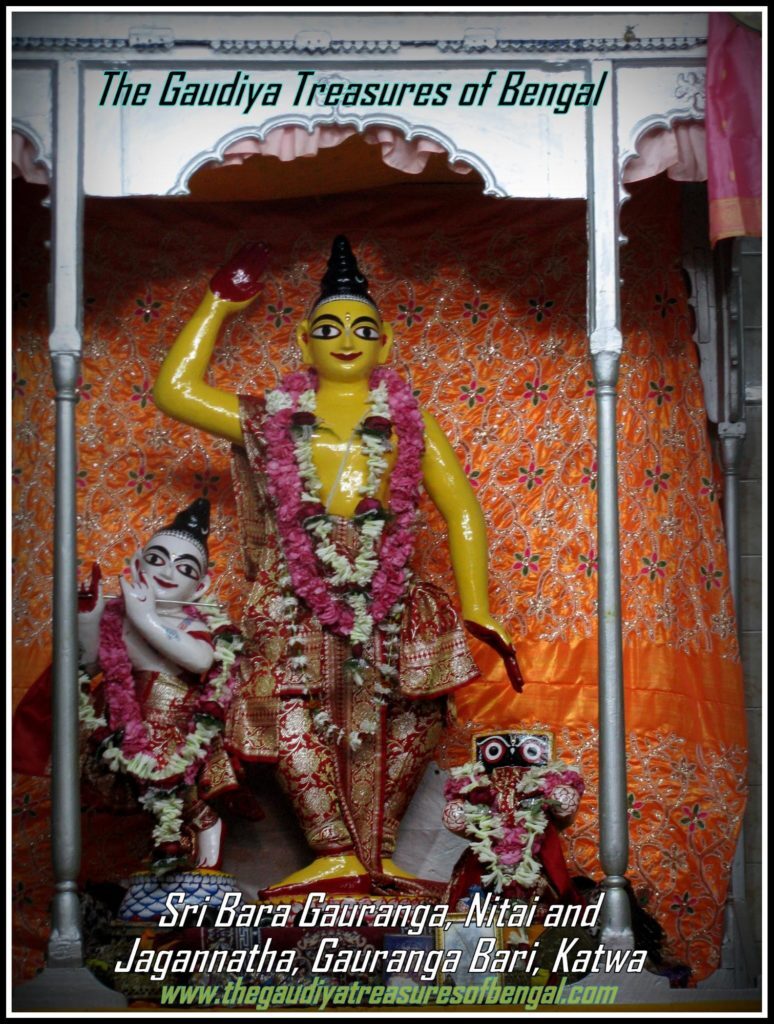
Several modern Gaudiya pilgrimage writers, and the Vaishnava Song Book, say all three brothers were born in Kulai, a village on the bank of the Ajay river about twenty kilometers west of Katwa. People there still tell a vivid story about the brothers' childhood home. A neem tree is said to have stood by their house. Sri Narahari Sarkar Thakura is remembered to have carved its wood into three deities of Chaitanya Mahaprabhu in His ecstatic, dancing form. The tallest of the three deities is worshiped today at Sri Gauranga Bari in Katwa. The shortest stays at Narahari Sarkar's own home in Srikhandha. It is a beautiful story, but only one source tells it this way. Other accounts of the same three deities describe their carving without mentioning this tree at all. So it is shared here as a local tradition worth knowing, not a settled fact.
An older tradition tells a different story. According to it, the family's true ancestral home lay far to the east, in Sri Hatta, in a village called Baduna or Burangi grama, and the brothers' father lived at Kumarhatta, closer to Navadvipa. Only after his death, this tradition says, did Govinda, Madhava and Vasudeva leave their father's home and settle in Navadvipa dhama itself. The two versions cannot simply be merged into one. A village near Katwa on the Ajay river and a village in Sri Hatta are not the same place, and nothing available here settles which is right. But one thing is certain. However it happened, the three brothers arrived in Navadvipa, and it was there that their singing was first recorded.
Three Voices, One Sankirtana #
Once in Navadvipa, Govinda, Madhava and Vasudeva Ghosh became regular members of the sankirtana around Sri Chaitanya Mahaprabhu in His last years as a householder and in the early years of His sannyasa. Sri Chaitanya-charitamrita counts all three among the "branches" of Mahaprabhu's associates, with one line for each brother. Srila Prabhupada's purport at that verse already describes Madhava on his own: "known as the singer of Vrindavana," and "very dear to Sri Nityananda Prabhu." Their kayastha background mattered to no one in this circle. What mattered, from the very first mention of them in the text, was their voices.
Their name as singers rests on specific pastimes: the beda-kirtana processions, the Ratha-yatra festival at Jagannatha Puri, and Madhava's own place among Nityananda Prabhu's associates. These are told in Singing for Sri Chaitanya Mahaprabhu. What tradition remembers of Madhava's later life, his shripata at Dainhat, and his one surviving song are gathered in Legacy and Disappearance.
Scriptural evidence for this chapter (1)
The meritorious Madhava Ghosh devoted himself to kirtan. There was no singer on earth who was his equal. It was said of him that he was a singer from Vrindavan. He was most dear to Nityananda Prabhu. The three brothers, Govinda, Madhava and Vasudeva began to sing while Lord Nityananda danced.
Cited via a secondary compilation, not a direct Chaitanya-bhagavata translation, since no standalone Chaitanya-bhagavata corpus is available to verify the Bengali original directly.
Chapter 2
Singing for Sri Chaitanya Mahaprabhu
The kirtan verses, the Bengal mission with Nityananda Prabhu, and the Ratha-yatra party that named Madhava Ghosh individually
Wherever Sri Chaitanya-charitamrita describes Mahaprabhu's sankirtana at length, the three Ghosh brothers tend to appear in it. In two of its clearest scenes, Madhava Ghosh's own part in the singing is recorded apart from his brothers'.
| Detail | Description |
|---|---|
| Setting | Navadvipa's beda-kirtana pastimes; the Ratha-yatra festival, Jagannatha Puri |
| Individual verse | Adi-lila 11.18: Madhava as "principal performer of kirtana," Nityananda dancing to his song |
| Bengal mission | Sent with Vasudeva Ghosh and Ramadasa under Nityananda Prabhu, by Mahaprabhu's own order |
| Ratha-yatra role | Responsive singer, with Vasudeva, in Govinda Ghosh's kirtan party; Vakreshvara Pandita danced |
| Distinguishing fact | Counted among both Chaitanya's and Nityananda's associates at once, unlike Govinda |
The Verse That Names Him Alone #
Most mentions of the Ghosh brothers in Sri Chaitanya-charitamrita name all three together in a single line, and for good reason: their kirtan is remembered as one shared, combined sound. One chapter breaks that pattern. In the eleventh chapter of the Adi-lila, which lists the associates and expansions of Nityananda Prabhu, Madhava Ghosh gets a verse of his own: "Sri Madhava Ghosh was a principal performer of kirtana. While he sang, Nityananda Prabhu danced." The very next verse gives Vasudeva Ghosh an equally personal line, that his kirtan could make "even wood and stone" melt. Placed one after the other, these two verses show that even within a family famous as a trio, tradition still remembered each brother's own voice: Madhava's, in particular, for its power to set Nityananda Prabhu dancing.
Chaitanya-bhagavata, quoted by later writers on the brothers' history, adds a bigger claim about Madhava alone: that no kirtan singer on earth equaled him, and that of the three brothers, Nityananda Prabhu held him most dear.
Sent to Bengal with Nityananda Prabhu #
The clearest moment that separates Madhava from Govinda came when Sri Chaitanya Mahaprabhu told Nityananda Prabhu to leave Jagannatha Puri and return to Bengal to preach. Sri Chaitanya-charitamrita names three companions who went with Him: Ramadasa, Madhava Ghosh and Vasudeva Ghosh. Govinda Ghosh, by contrast, stayed behind at Puri with Mahaprabhu, "feeling great satisfaction." A few verses later, Srila Krishnadasa Kaviraja Goswami explains what this meant. Madhava and Vasudeva had gone with Nityananda under the Lord's own order. So they came to be counted among both circles of devotees, sometimes listed with Mahaprabhu's own associates and sometimes with Nityananda's. Govinda, who stayed in Puri, belonged only to the first circle.
This is more than a small detail. For a period of his life, Madhava Ghosh served the preaching mission in Bengal through his kirtan. He did this at Nityananda Prabhu's side, not in Mahaprabhu's immediate company. The old texts give this personal role to Madhava, but not to Govinda.
The Ratha Yatra Kirtan Party #
Sri Chaitanya-charitamrita's account of the Ratha-yatra festival at Jagannatha Puri gives the fullest picture of how the three brothers actually sang together. Organizing the sankirtana singers into groups, Mahaprabhu made Govinda Ghosh the lead singer of one party, with the younger Haridasa, Vishnudasa and Raghava Pandita as the responding voices. Madhava Ghosh and Vasudeva Ghosh joined this same party as extra responsive singers, while Vakreshvara Pandita danced for the group. Elsewhere the text simply says, of all three brothers together, that "their sankirtana... pleases the Lord very much." It is a small line, but it fits everything else recorded about them: wherever Mahaprabhu's own sankirtana is described in detail, the Ghosh voices are part of it.
Taken together, these passages give Madhava Ghosh a role that is truly his own, even inside a family of singers. He is not simply "the third of the Ghosh brothers," but a singer with a verse of his own. That verse credits him with making Nityananda Prabhu dance. For a time, his own path through Mahaprabhu's mission also ran through Bengal, not Puri. What tradition remembers of his life after this, and the one song that survives in his own name, are gathered in Legacy and Disappearance.
Scriptural evidence for this chapter (6)
Quoted in the text above:
- Adi 11.18 Sri Chaitanya-charitamrta
Further verses:
vāsudeva gīte kare prabhura varṇane
kāṣṭha-pāṣāṇa drave yāhāra śravaṇe
Word for word
vāsudeva: Vāsudeva Ghoṣa; gīte: in song; kare: does; prabhura varṇane: describing the Lord; kāṣṭha-pāṣāṇa: wood and stone; drave: melt; yāhāra śravaṇe: by hearing which.
When Vasudeva Ghosh described Lord Chaitanya and Nityananda while performing kirtana, even wood and stone would melt.
The companion verse to Adi 11.18, giving Vasudeva Ghosh his own individual line immediately after Madhava's: cited here to show the pattern of the two brothers each receiving a distinct verse.
prabhura ājñāya nityānanda gauḍe calilā
tāṅra saṅge tina-jana prabhu-ājñāya āilā
rāmadāsa, mādhava, āra vāsudeva ghoṣa
prabhu-saṅge rahe govinda pāiyā santoṣa
Word for word
prabhura ājñāya: under the order of Lord Caitanya Mahāprabhu; nityānanda: Lord Nityānanda; gauḍe: to Bengal; calilā: went back; tāṅra saṅge: in His company; tina-jana: three men; rāmadāsa, mādhava, āra vāsudeva ghoṣa: Rāmadāsa, Mādhava and Vāsudeva Ghoṣa; prabhu-saṅge rahe govinda: Govinda remained with the Lord; pāiyā santoṣa: feeling great satisfaction.
By the order of Sri Chaitanya Mahaprabhu, three devotees accompanied Lord Nityananda Prabhu when He returned to Bengal to preach. These three were Ramadasa, Madhava Ghosh and Vasudeva Ghosh. Govinda Ghosh, however, remained with Sri Chaitanya Mahaprabhu at Jagannatha Puri and thus felt great satisfaction.
The verse that separates Madhava from Govinda specifically: he was sent to Bengal with Nityananda Prabhu while Govinda stayed at Puri with Mahaprabhu.
nityānande ājñā dila yabe gauḍe yāite
mahāprabhu ei dui dilā tāṅra sāthe
ataeva dui-gaṇe duṅhāra gaṇana
mādhava-vāsudeva ghoṣerao ei vivaraṇa
Word for word
nityānande ājñā dila: gave the order to Nityānanda; yabe gauḍe yāite: when to go to Bengal; mahāprabhu ei dui dilā tāṅra sāthe: Mahāprabhu gave these two to go with Him; ataeva dui-gaṇe duṅhāra gaṇana: therefore the two are counted in both parties; mādhava-vāsudeva ghoṣerao ei vivaraṇa: this is the same description for Mādhava and Vāsudeva Ghoṣa.
When Nityananda Prabhu was ordered to go to Bengal to preach, these two devotees [Sri Ramadasa and Gadadhara dasa] were ordered to go with Him. Thus they are sometimes counted among the devotees of Lord Chaitanya and sometimes among the devotees of Lord Nityananda. Similarly, Madhava Ghosh and Vasudeva Ghosh belonged to both groups of devotees simultaneously.
States directly that Madhava Ghosh, unlike Govinda, was counted among both Chaitanya Mahaprabhu's and Nityananda Prabhu's circles of associates.
govinda, mādhava ghoṣa, ei vāsu-ghoṣa
tina bhāira kīrtane prabhu pāyena santoṣa
Word for word
govinda: Govinda Ghoṣa; mādhava ghoṣa: Mādhava Ghoṣa; ei vāsu-ghoṣa: this Vāsudeva Ghoṣa; tina bhāira: of the three brothers; kīrtane: in the saṅkīrtana; prabhu pāyena santoṣa: the Lord gets very much pleasure.
Here also are Govinda Ghosh, Madhava Ghosh and Vasudeva Ghosh. They are three brothers, and their sankirtana, congregational chanting, pleases the Lord very much.
From the purport: Purport excerpt: "As far as Vasudeva Ghosh is concerned, he composed many nice songs about Lord Sri Chaitanya Mahaprabhu, and these are all authorized Vaishnava songs."
Places the three brothers together among the singers of Mahaprabhu's beda-kirtana pastimes.
govinda-ghoṣa — pradhāna kaila āra sampradāya
haridāsa, viṣṇudāsa, rāghava, yāhāṅ gāya
mādhava, vāsudeva-ghoṣa, — dui sahodara
nṛtya karena tāhāṅ paṇḍita-vakreśvara
Word for word
govinda-ghoṣa: Govinda Ghoṣa; pradhāna kaila āra sampradāya: formed another group as its chief; haridāsa, viṣṇudāsa, rāghava, yāhāṅ gāya: where the younger Haridāsa, Viṣṇudāsa and Rāghava sing; mādhava, vāsudeva-ghoṣa: Mādhava and Vāsudeva Ghoṣa; dui sahodara: two brothers; nṛtya karena tāhāṅ paṇḍita-vakreśvara: Vakreśvara Paṇḍita dances there.
The Lord formed another group, appointing Govinda Ghosh as leader. In this group the younger Haridasa, Vishnudasa and Raghava were the responding singers. Two brothers named Madhava Ghosh and Vasudeva Ghosh also joined this group as responsive singers. Vakreshvara Pandita was the dancer.
Describes exactly how the three brothers were positioned in the kirtan party at the Ratha-yatra festival: Govinda as leader, Madhava and Vasudeva as responsive singers.
Chapter 3
Legacy and Disappearance
His eternal identity as Rasollasa, a shripata at Dainhat, and the one surviving song under his own name
Very little is written about how Madhava Ghosh's life ended, and we leave that gap as it is instead of filling it with guesses. What does survive is gathered here: an eternal spiritual identity from the Gaura-ganoddesha-dipika, a seat of worship at Dainhat, and a single Bengali song under his own signature.
| Detail | Description |
|---|---|
| Spiritual identity | Rasollasa, a gopi of Vraja who sings the songs of Vishakha-gopi (Gaura-ganoddesha-dipika 188) |
| Rasa | Madhurya-rasa, with Sri Radhika as ultimate shelter, per Srila Bhaktisiddhanta Sarasvati Thakura |
| Shripata | Dainhat, near Katwa, Bengal |
| Surviving composition | "Nace Pahum Abadhuta Gora," one gaura-candrika song, preserved under his own bhanita |
| Disappearance | No date or narrative recorded, unlike Govinda Ghosh or Vasudeva Ghosh |
An Eternal Identity as Rasollasa #
Srila Prabhupada's purport to Sri Chaitanya-charitamrita, Adi-lila 10.115, tells us something that later writers on the Ghosh brothers have repeated ever since. According to the Gaura-ganoddesha-dipika, verse 188, Govinda, Madhava and Vasudeva were three gopis in their eternal life in Krishna's Vraja-lila. These gopis are Kalavati, Rasollasa and Gunatunga, and they sing the songs composed by Vishakha-gopi. In order, Madhava is Rasollasa. Srila Bhaktisiddhanta Sarasvati Thakura placed all three brothers in madhurya-rasa, the devotional mood of a lover. He counted them among those who take Srimati Radharani as their final shelter. This description fits naturally with their place among Vishakha's own singing companions.
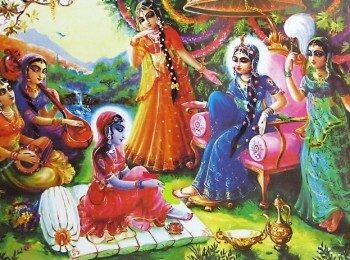
This is the one place where a source gives Madhava his own eternal identity, apart from his brothers, instead of simply counting him third in the trio. We must be careful here for exactly that reason, because it comes from a single text. Every later writer has repeated it, but no other source has confirmed it on its own. So it is presented here as what that one source says, not as a fact confirmed by many different traditions.
A Shripata at Dainhat #
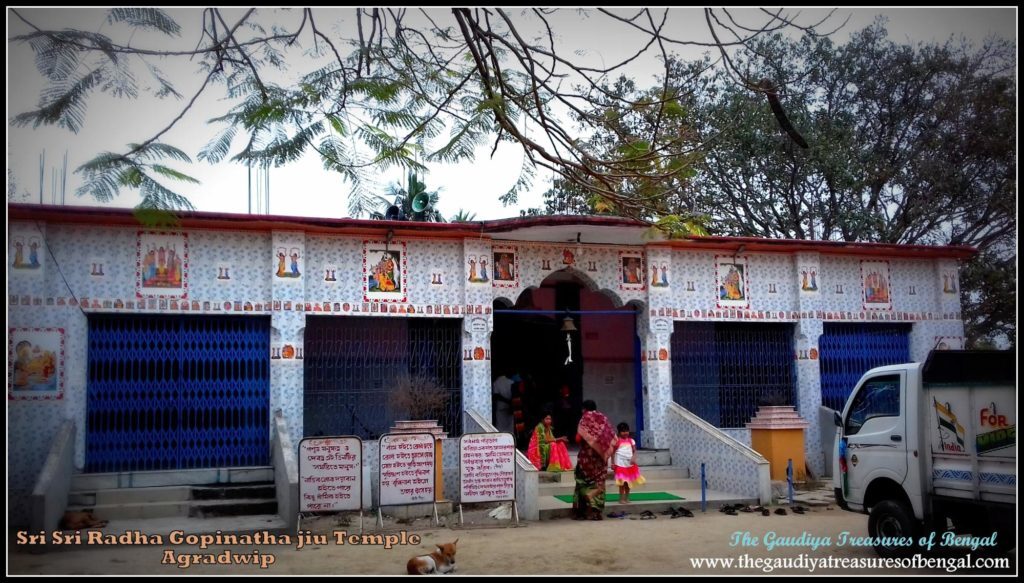
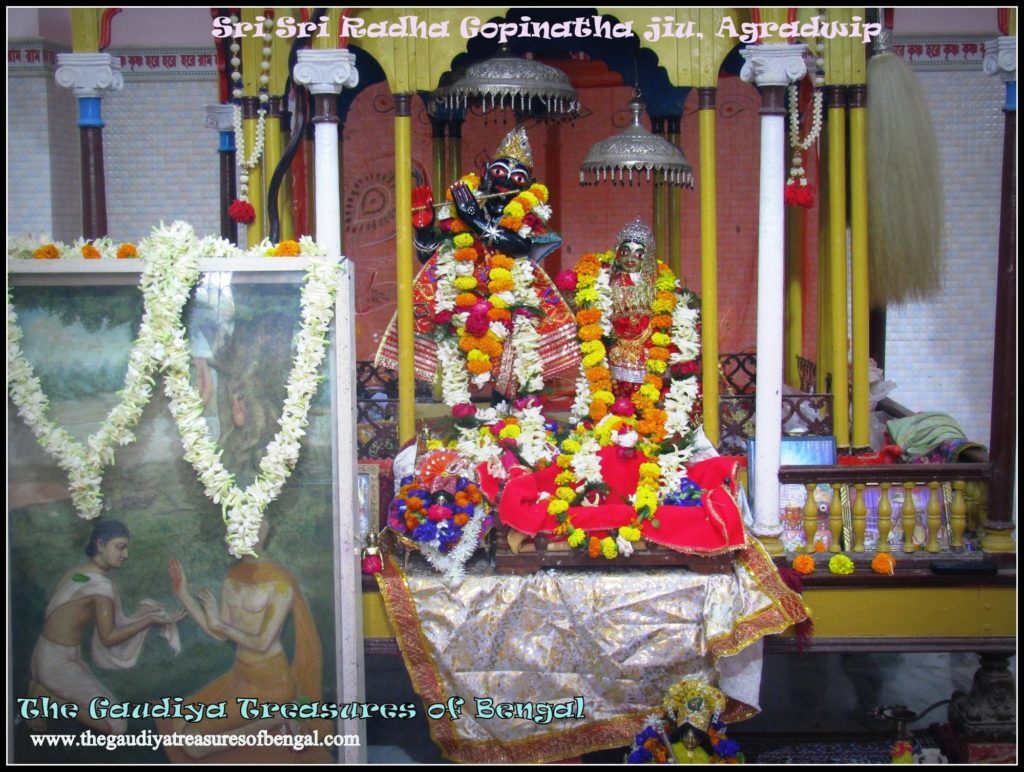
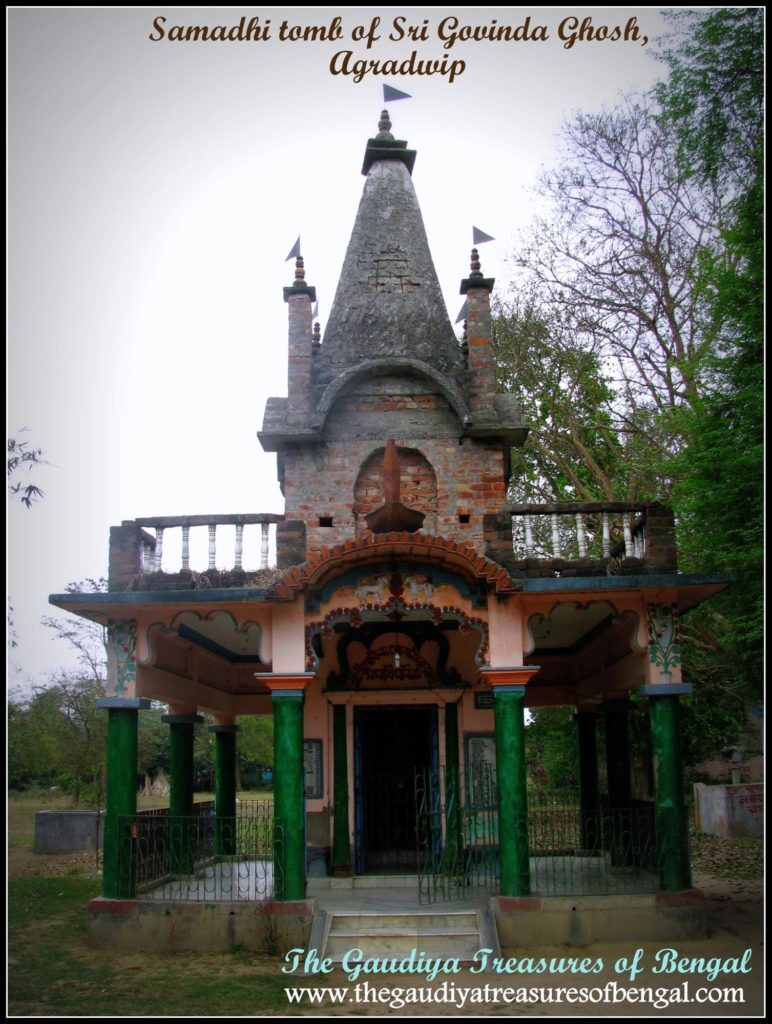
Later Gaudiya tradition places each of the three brothers at his own shripata, a seat of worship, once their traveling years were behind them. It places Govinda Ghosh at Agradvipa, where the Gopinatha deity he served is still worshiped. It places Vasudeva Ghosh at Tamluk, at the spot where Chaitanya Mahaprabhu is remembered to have once stopped on His way to Puri. And it places Madhava Ghosh at Dainhat, near Katwa. Beyond naming the place, the old texts do not keep any specific story about Madhava's own years there. There is no dated festival and no story of a deity speaking to him. There is nothing like the detailed funeral-rites story told of Govinda Ghosh, or the samadhi-pit story told of Vasudeva Ghosh. Whatever happened at Dainhat in Madhava Ghosh's later life has simply not come down to us.
The same silence covers his disappearance itself. No date is recorded for it, unlike Govinda Ghosh's tirobhava on Krishna Trayodashi of the month of Chaitra, or Vasudeva Ghosh's on the second day of the waxing moon of Karttika. When the record is thin, an honest account must be thin too. This does not mean that nothing was ever written. It only means that on this one point, nothing has come down to us.
One Song in His Own Voice #
Among everything gathered under Madhava Ghosh's name, one thing is clearly his own: a single Bengali gaura-candrika song, "Nace Pahum Abadhuta Gora" ("The Avadhuta Lord Gaura Dances"), closed with his own bhanita, his signature line. The song pictures Gauranga not as a child or a king, but as a wanderer who has given up the world, lost in the dance of kirtan. This fits a singer who is remembered above all for the kirtan that made Nityananda Prabhu dance. Its last line turns from describing the Lord to a personal prayer: "In his heart, Madhava Ghosha yearns to attain Lord Gaura's company." It is the one line in this whole record where Madhava Ghosh speaks for himself instead of being spoken about. His life is remembered mostly through a family of three. Fittingly, this line asks for nothing more than to remain in his Lord's company.
For the fuller story of the brothers' shared beginnings and their kirtan before Sri Chaitanya Mahaprabhu, see Birth and the Ghosh Brothers of Navadvipa and Singing for Sri Chaitanya Mahaprabhu.
Scriptural evidence for this chapter (1)
kalāvatī rasollāsā guṇatuṅgā vraje sthitāḥ
śrī-viśākhā-kṛtaṁ gītaṁ gāyanti sma adya tā matāḥ
govinda-mādhavānanda-vāsudeva yathā-kramam
Govinda, Madhava and Vasudeva were three gopis in Vraja — Kalavati, Rasollasa and Gunatunga — who used to sing the songs composed by Vishakha-gopi.
The traditional source for Madhava Ghosh's own eternal identity as the gopi Rasollasa, quoted in Srila Prabhupada's purport to Adi 10.115 and repeated by later compilers of the brothers' history.
Closing
Three Brothers, One Kirtan #
Sri Chaitanya-charitamrita counts Govinda, Madhava and Vasudeva as the eighty-second, eighty-third and eighty-fourth branches of the "Chaitanya tree," Krishnadasa Kaviraja's picture of the associates who carried Mahaprabhu's sankirtana out into the world. Srila Prabhupada's purport at this verse gives Madhava his own line among the three: "Madhava Ghosh was expert in performing kirtana. No one within this world could compete with him. He was known as the singer of Vrindavana and was very dear to Sri Nityananda Prabhu." The same purport also tells us the brothers' eternal identity, from the Gaura-ganoddesha-dipika: in their eternal life in Vraja, they were three gopis, Kalavati, Rasollasa and Gunatunga, who sing the songs composed by Vishakha-gopi. Madhava is Rasollasa.
Kavi Karnapura's verse itself (Gaura-ganoddesha-dipika 188) lists the three gopis and then the three brothers in the same order. This is how we know that Madhava is Rasollasa:
kalāvatī rasollāsā guṇatuṅgā vraje sthitā
śrī viśākhā kṛtaṁ gītaṁ gāyanti smādya tā matāḥ
govinda mādhavānanda-vāsudevā yathākramam
"The vraja-gopis Kalavati-devi, Rasollasa-devi, and Gunatunga-devi, who sang the songs composed by Visakha-devi, later appeared as Govinda, Madhavananda, and Vasudeva respectively." (Gaura-ganoddesha-dipika 188)
Sri Chaitanya-charitamrita speaks of the three brothers again in its account of Mahaprabhu's beda-kirtana pastimes, saying simply that "their sankirtana... pleases the Lord very much." It is a small verse, but it fits a pattern seen again and again in the text: wherever Chaitanya Mahaprabhu's sankirtana is described at length, the Ghosh brothers tend to be there.
Known as the Singer of Vrindavana #
Chapter eleven of the Adi-lila, which lists the associates and expansions of Nityananda Prabhu, gives Madhava a verse of his own, not shared with his brothers: "Sri Madhava Ghosh was a principal performer of kirtana. While he sang, Nityananda Prabhu danced." The very next verse gives Vasudeva an equally personal line, that his kirtan could melt "even wood and stone." So even inside a family known together for sweet singing, tradition still remembered something special about each brother's voice. Chaitanya-bhagavata, quoted by later writers, adds a matching description of Madhava. It says that no singer on earth equaled him, and that he was especially dear to Nityananda Prabhu, even more than he was to Mahaprabhu.
This closeness to Nityananda Prabhu was not a small thing. It shaped the next part of Madhava's life, and it is why his own verse appears in a chapter about Nityananda's associates rather than Mahaprabhu's.
Songs in the Vaishnava Song Book #
The Vaishnava Song Book carries 1 song by Srila Madhava Ghosh: see the full author page here.
- Sri Chaitanya-caritamrta, Adi-lila 10.115 (Bhaktivedanta VedaBase)
- Sri Chaitanya-caritamrta, Adi-lila 11.18 (Bhaktivedanta VedaBase)
- Sri Chaitanya-caritamrta, Adi-lila 11.14-15 (Bhaktivedanta VedaBase)
- Sri Chaitanya-caritamrta, Adi-lila 10.117-118 (Bhaktivedanta VedaBase)
- Sri Chaitanya-caritamrta, Madhya-lila 11.88 (Bhaktivedanta VedaBase)
- Ghosh Brothers, Vedic Library by ISVARA.org (Gaura-ganoddesha-dipika 188 and Chaitanya-bhagavata citations)
- Sri Govinda, Vasudeva and Madhava Ghosh, ISKCON Bangalore Blog
- Vasudeva Ghosh, Govinda Ghosh, and Madhava Ghosh, Stephen Knapp
- The Ghosh Brothers, Shyam Das Baba
- Govinda Ghosh - Life and Pastimes, The Gaudiya Treasures of Bengal
- Vasudeva Ghosh, Gaudiya History
