Chaitanya-charitamrita describes Murari Gupta's calling in a single couplet. As a physician, he cured his patients' bodily disease and, by his mercy, their spiritual disease as well. On at least two recorded occasions, Sri Chaitanya Mahaprabhu Himself directly received both kinds of this care.
Called In to Treat the Lord's Indigestion #
Chaitanya-bhagavata records that a devotee once fed Mahaprabhu food cooked with too much ghee. In some tellings this devotee is named as Sivananda Sena. The following day the Lord fell sick. This time the usual order between Lord and devotee was strikingly reversed, and the Lord Himself went to Murari Gupta's own house seeking treatment. Murari's solution was simple and fitting for his profession. He gave the Lord water from his own household jug, the ordinary remedy for indigestion, and Mahaprabhu was cured at once. Srila Prabhupada's purport to Chaitanya-charitamrita states the episode plainly: "Lord Caitanya accepted some water from the waterpot of Murari Gupta, and thus He was cured... since Murari Gupta was a physician, he gave the Lord some drinking water and cured Him." Years later, on a morning walk in Denver, Prabhupada returned to the same idea in passing conversation. A disciple observed that Murari Gupta had been "a doctor in both ways," treating body and soul alike, and Prabhupada agreed.
The Boar Incarnation Dances in His Courtyard #
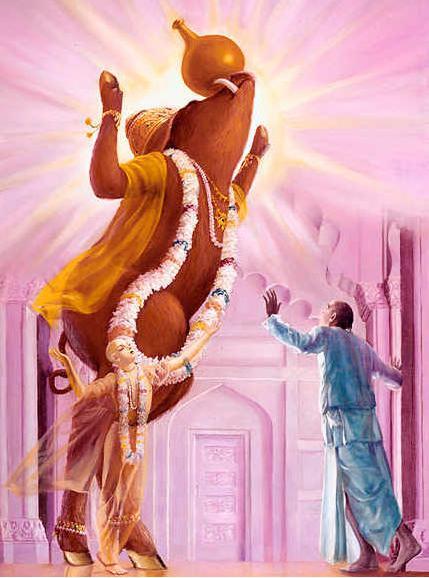
On another occasion, Mahaprabhu arrived at Murari's house absorbed in the ecstatic mood of Varaha, the boar incarnation of Krishna who once lifted the earth from the cosmic ocean. Chaitanya-charitamrita records the scene in a single line: "varaha-avesa haila murari-bhavane / tanra skandhe cadi' prabhu nacila angane". This means that the ecstasy of becoming Varahadeva arose in Murari's house, and the Lord climbed onto Murari's shoulders and danced there in his own courtyard. Fuller retellings add that the Lord roared and lifted a household waterpot in His teeth. In this way He acted out Varaha's rescue of the earth on a small scale. Murari was astonished. When he was asked to sing the Lord's praises on the spot, he could only confess that he was not fit to glorify a Lord whose glories even the thousand-headed Ananta Shesha cannot fully describe.
The Discipline of Etiquette #
Even though Murari was close to the Lord, he was still corrected. Once Murari came to Srivasa Thakura's courtyard, where Mahaprabhu sat beside Nityananda Prabhu. Murari offered his obeisances to the Lord first and to Nityananda Prabhu second. This was reasonable etiquette, since he took Mahaprabhu to be the senior one. But Nityananda Prabhu was in fact the elder of the two. Mahaprabhu told him simply that he had made a mistake, without explaining further. That night, Murari dreamed of Nityananda Prabhu as Balarama Himself, fanning the Lord with a chamara. From the next day on, he reversed the order of his obeisances. Srila Bhaktisiddhanta Sarasvati Thakura explained the wider point of this episode in his Gaudiya-bhashya. To worship the Supreme Lord without first honoring guru and the jagad-guru is a mistake in the order of worship. Since then, Gaudiya Vaishnava tradition has treated this small correction as a lesson meant for every reader, not only for Murari.
Betel Nut and a Warning to the Mayavadis #
Mahaprabhu's affection for Murari reached even to ordinary courtesies. He would give Murari His own chewed pan, or betel nut. Murari accepted it with clear delight, and afterward wiped his hand on his own head instead of washing it as custom required. On one such occasion, tradition records, the Lord's mood suddenly changed into open anger. He was angry at the Mayavadi explanation of the scriptures then current in Kashi under the sannyasi Prakashananda Sarasvati. Grinding His teeth, the Lord declared that anyone who denied His personal form was heading for ruin. He said that He had already caused Prakashananda's own body to suffer for the offense. It is a startling scene to find inside an otherwise homely memory of sharing pan. It is given here as the older Bengali sources give it. Beyond that secondary tradition, no independent scripture confirms the detail about Prakashananda.
A Devotee Who Wished to Die Before His Lord #
Murari's love for Mahaprabhu also brought him a private anxiety. Murari reasoned that every incarnation of God eventually leaves His closest associates behind. Ramachandra abandoned Sita after Ravana's death, and Krishna arranged the destruction of His own Yadu dynasty. So Murari concluded that Mahaprabhu's own departure could not be avoided. He privately resolved that he would rather die in the Lord's presence than witness it. He made a knife and hid it in his house. Chaitanya-charitamrita insists that Mahaprabhu knew everything. The Lord came straight to Murari's home, asked for the knife, and told him plainly that He still had pastimes left to complete in Murari's company. This moment of reassurance ends this part of their story with the same theme that runs through all of it. The Lord would not let His most anxious devotee out of His sight.
