Srila Murari Gupta
Physician-Devotee and Author of the Earliest Life of Sri Chaitanya Mahaprabhu
The complete life, on one page: The main biography and every pastime page, in order, in one place
Introduction
Srila Murari Gupta was special in two ways among the many devotees who surrounded Sri Chaitanya Mahaprabhu in Navadvipa. He was a working physician, and he is remembered for treating the Lord Himself on more than one occasion. He was also the first person known to have sat down and written Mahaprabhu's life story while Mahaprabhu was still living it. His Sanskrit account of Chaitanya Mahaprabhu's early years is usually called his Kadaca, or diary. It is the earliest biography of the Lord that the Gaudiya Vaishnava tradition has. It is older than Vrindavana Dasa Thakura's Chaitanya-bhagavata, and older still than Krishnadasa Kaviraja Goswami's Sri Chaitanya-charitamrita. Chaitanya-charitamrita, at least, drew on it directly.
| Detail | Description |
|---|---|
| Family | A vaidya (Ayurvedic physician) family from Srihatta (Sylhet, in present-day Bangladesh); moved to Navadvipa while Murari was young |
| Born | Not recorded; sources agree only that he was some years older than Sri Chaitanya Mahaprabhu (b. 1486) |
| Given name later | Ramadasa, a name Mahaprabhu is said to have written on his forehead |
| Chief work | Sri Krishna-Chaitanya-Caritamrita, his Kadaca - the earliest known biography of Sri Chaitanya Mahaprabhu |
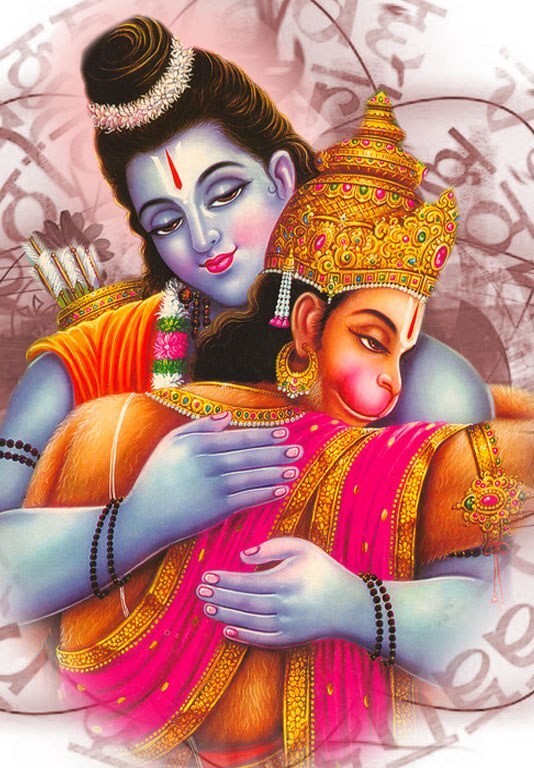
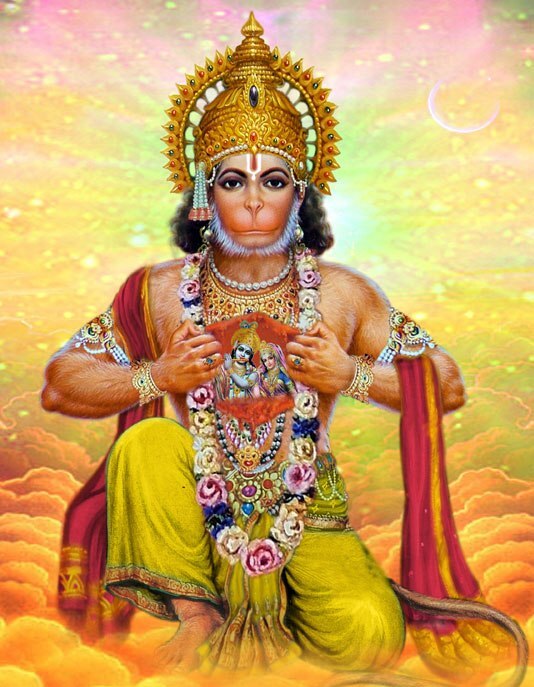
| Identity | Hanuman, the eternal servant of Lord Ramachandra (Gaura-ganoddesha-dipika 91; Chaitanya-charitamrita Madhya 15.156) |
| Disappeared | Year not recorded; tradition places the day on Sharad Purnima, the autumn rasa-lila full-moon |
| Sripat/samadhi | Near Ballal Dighi, east of the Yogapitha, Sri Mayapur - still maintained today |
Scriptural evidence for the introduction (5)
শ্ৰীমুরারি গুপ্ত শাখা—প্রেমের ভাণ্ডার। প্রভুর হৃদয় দ্রবে শুনি' দৈন্য যাঁর॥
sri-murari gupta sakha - premera bhandara
prabhura hrdaya drave suni' dainya yanra
Word for word
sri-murari gupta sakha - Sri Murari Gupta, the branch; premera bhandara - a storehouse of love of Godhead; prabhura hrdaya - the Lord's heart; drave - melts; suni' - hearing; dainya - humility; yanra - of whom
Murari Gupta, the twenty-first branch of the tree of Sri Chaitanya Mahaprabhu, was a storehouse of love of Godhead. His great humility and meekness melted the heart of Lord Chaitanya.
From the purport: Purport excerpt: "He belonged to a vaidya physician family of Srihatta, the paternal home of Lord Caitanya, and later became a resident of Navadvipa. He was among the elders of Sri Caitanya Mahaprabhu."
Names Murari Gupta as one of the principal branches of Mahaprabhu's own devotional tree and states his family origin in Srihatta.
রঘুনাথের পায় মুঞি বেচিয়াছোঁ মাথা। কাঢ়িতে না পারি মাথা, মনে পাই ব্যথা॥
raghunathera paya muni veciyachon matha
kadhite na pari matha, mane pai vyatha
Word for word
raghunathera paya - unto the lotus feet of Lord Raghunatha (Ramachandra); muni - I; veciyachon matha - have sold my head; kadhite na pari matha - I cannot take my head back; mane pai vyatha - my mind feels pain
It is not possible for me to give up the service of Raghunatha's lotus feet. At the same time, if I do not do so I shall break Your order. What can I do?
Murari Gupta's own words when Mahaprabhu tested whether he could be persuaded to shift his exclusive devotion from Ramachandra to Krishna; the basis for the pull-quote used here.
গোসাঞি কহেন, — "এইমত মুরারি-গুপ্ত। পূর্বে আমি পরীক্ষিলুঁ তার এই রীত॥
gosani kahena, - "ei-mata murari-gupta
purve ami pariksilun tara ei rita
Word for word
gosani kahena - Sri Chaitanya Mahaprabhu replied; ei-mata murari-gupta - there was a similar incident concerning Murari Gupta; purve ami pariksilun - formerly I examined him; tara ei rita - his determination was of this same kind
Sri Chaitanya Mahaprabhu said, "There was a similar incident concerning Murari Gupta. Formerly I examined him, and his determination was similar.
Mahaprabhu Himself, years later, cites His earlier test of Murari Gupta's exclusive devotion as the standard He held up for Jiva Goswami's father Anupama.
मुरारि गुप्तो हनुमानङ्गदः श्रीपुरन्दरः ।
यः श्रीसुग्रीवनामासीद्गोविन्दानन्द एव सः ॥९१॥
murāri gupto hanumān aṅgadaḥ śrī-purandaraḥ
yaḥ śrī-sugrīva-nāmāsīd govindānanda eva saḥ
The devotee named Murari Gupta in Lord Caitanya's pastimes had previously been Hanuman.
Kavi Karnapura's verse identifying Murari Gupta as Hanuman (the same verse names Purandara as Angada and Govindananda as Sugriva). Sanskrit: diacritic edition of the Gaura-ganoddesha-dipika; English translation as published at bvmlu.org.
sākṣāt hanumān tumi śrī-rāma-kiṅkara
tumi kene chāḍibe tāṅra caraṇa-kamala
“In this way, I congratulated Murāri Gupta, saying, ‘Indeed, you are the incarnation of Hanumān. Consequently you are the eternal servant of Lord Rāmacandra. Why should you give up the worship of Lord Rāmacandra and His lotus feet?’ ”
Sri Chaitanya Mahaprabhu's own words, spoken before the devotees, calling Murari Gupta the incarnation of Hanuman and the eternal servant of Lord Ramachandra.
Chapter 1
Birth and Training as a Physician
A Srihatta vaidya family, a move to Navadvipa, and the medical trade Murari Gupta practiced his whole life.
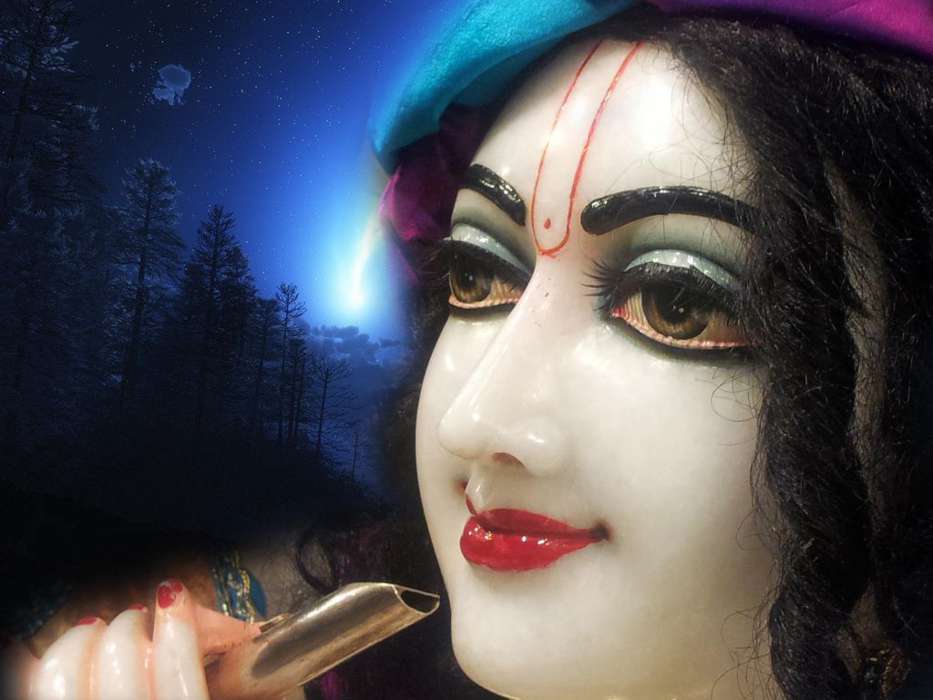
Everything the tradition remembers about Murari Gupta's early life starts from a single fact. He was born into a vaidya family, a lineage of Ayurvedic physicians, in the district of Srihatta on Bengal's eastern edge. This district was important beyond his own household. It was also the ancestral home of Jagannatha Mishra, the father of the boy who would become Sri Chaitanya Mahaprabhu. Chaitanya-bhagavata also names other Srihatta families that produced well-known Vaishnavas, such as the family of Srivasa Thakura, alongside Murari's own.
| Detail | Description |
|---|---|
| Family trade | Vaidya - Ayurvedic physician |
| Native district | Srihatta (Sylhet, present-day Bangladesh) |
| Later residence | Navadvipa, near the house of Jagannatha Mishra |
| Age relative to Mahaprabhu | Some years older |
| Parents | Names not recorded in any source |
| Family Deities | Sri Sita, Rama, Lakshmana and Hanuman |
No Names, No Dates, Only a Trade #
No source gives Murari's parents' names or a year of his birth. What we have instead is a trade and a place. Chaitanya-bhagavata gives its own list of associates who appeared in Srihatta before Mahaprabhu's incarnation. It names Murari in this list, alongside Advaita Acharya, Sivananda Sena, Jagannatha Mishra himself, and Nilambara Chakravarti. Later his own family moved to Navadvipa. They settled so close to Jagannatha Mishra's household that Murari grew up as a near neighbor of the child who would become Sri Chaitanya Mahaprabhu. This is one of the reasons later biographers give so much weight to his eyewitness account of the Lord's Nadia years. That subject is taken up fully in Writing the Earliest Biography of Mahaprabhu.
Chaitanya-bhagavata gives one more detail that should be kept. It reads his very name, "Gupta," as meaning hidden. Murari is one of Krishna's own names. So Chaitanya-bhagavata takes the name as a sign that Murari had quietly come to live in this physician's heart. This was well before anyone in Nadia recognized what stood in front of them.
A Physician Trained to Heal Two Diseases #
Chaitanya-charitamrita is unusually direct about what kind of physician Murari Gupta was. Two verses, one after the other, explain it. He never accepted charity or money from anyone. He maintained his household strictly by his own earnings as a vaidya. And in treating his patients, he relieved both their bodily disease and what the text calls bhava-roga, the deeper disease of material existence. Srila Prabhupada's purport to this second verse makes the comparison clear. He holds Murari up as a model for physicians of any age: "The physicians of the modern day should learn from Murari Gupta... there are no such hospitals to cure the material disease of the spirit soul." The texts show Murari keeping these same principles in his later service to Mahaprabhu, as described in Serving as the Lord's Physician.
A Detail from Srila Prabhupada's Own Lectures #
Decades later, in more than one lecture, Srila Prabhupada added a detail about Murari's working life that does not appear in the classical Bengali biographies. He said that Murari served for a time as physician to a local Muslim Nawab. Speaking in San Francisco in March 1967, Prabhupada told it this way: "His name was Murari Gupta. He was physician to the then Nawab, Muslim Nawab... they were sitting on the back of the elephant. In the meantime, that Murari Gupta saw one peacock, and as soon as he saw the peacock, the feather, he at once remembered Krishna and at once fainted and fall down." Prabhupada used the story to illustrate alambana. This is the technical term in bhakti-rasa theology for a devotee's mind being carried at once to Krishna by even a chance reminder. He told the same story again, almost unchanged, in a 1975 initiation talk in San Francisco. Neither the classical Bengali sources nor any other available research confirms the detail about the Nawab independently. So it is given here as Srila Prabhupada's own telling. We report it honestly and do not mix it quietly into the older material.
What Training Could Not Explain #
Every source agrees that, for all his professional skill, Murari's learning could not keep up with that of the boy who lived nearby. A trained, older physician was outmatched again and again by a child in ordinary debate. In Gaudiya Vaishnava memory, this contrast became one of the clearest early signs of who that child really was. The well-loved episodes built around it are told in Boyhood Friendship with Nimai Pandita.
Scriptural evidence for this chapter (1)
চিকিৎসা করেন যারে হইয়া সদয়। দেহরোগ ভবরোগ,—দুই তার ক্ষয়॥
cikitsa karena yare ha-iya sadaya
deha-roga bhava-roga, - dui tara ksaya
Word for word
cikitsa karena - gave medical treatment; yare - upon whom; ha-iya sadaya - becoming merciful; deha-roga - the disease of the body; bhava-roga - the disease of material existence; dui tara ksaya - both of his diminished
As Murari Gupta treated his patients, by his mercy both their bodily and spiritual diseases subsided.
From the purport: Purport excerpt: "The physicians of the modern day should learn from Murari Gupta... there are no such hospitals to cure the material disease of the spirit soul."
States directly that Murari Gupta's medical practice addressed both bodily and spiritual disease, the guiding idea behind his service as a physician.
Chapter 2
Boyhood Friendship with Nimai Pandita
A senior student who could never win an argument with a child, and the prank that finally taught him why.
Long before anyone in Navadvipa suspected who their neighbor's son really was, Murari Gupta saw His childhood from very close. He was a fellow student who kept losing to Him, and on at least one occasion he was the target of one of His pranks.
Beaten Every Time at Ganga Das Pandit's School #
Murari studied at the tol, or school, run by Ganga Das Pandit in Navadvipa. The young Sri Chaitanya Mahaprabhu, known then as Nimai Pandita, was also a student there, though He was much younger than Murari. Being older did not give Murari any advantage. Chaitanya-bhagavata records that however many times the older student tried to defeat Nimai in debates over grammar and logic, he could not do it. Nimai, for His part, could out-argue every student in the school at once. At last the child's extraordinary sharpness pushed Murari and his companions past their patience. They began shoving, and finally there was a full fight in the Ganges itself. The text says it stirred up so much mud that the local women could not fill their water pots and the brahmanas could not properly bathe.
"You Are a Doctor - Go Heal the Sick" #
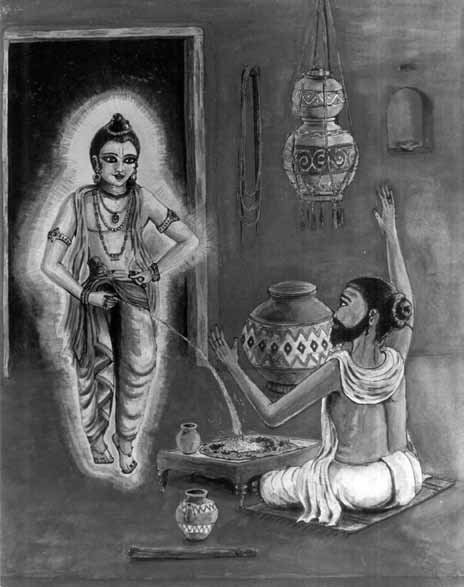
Tradition holds that around this same period Nimai teased Murari directly. He joked that Murari's profession and his hopes as a scholar did not match. Nimai had just watched Murari fail again to hold his ground in an argument. So He told him plainly that he was a vaidya, and grammar had nothing to offer him that would help with mucus, bile, or indigestion. His real business, Nimai said, was collecting leaves and roots to heal the sick. Murari was stung, but he did not show his anger outwardly. He simply watched Nimai in silence. The tradition says he was struck by how a child's touch alone was enough to fill him with unexpected ecstasy. He also began to suspect, more and more, that no ordinary boy could reason as this one did.
A Prank at the Lunch Table #
A related and more detailed telling of Nimai's teasing survives in Lochana Dasa Thakura's Chaitanya-mangala. In this version, Murari was by now regarded as a serious young scholar. One day he was speaking at length to an admiring circle of classmates on the value of jnana-yoga, the path of philosophical knowledge. Then Nimai began openly copying his gestures from a distance, mocking him in front of them as "the great future doctor of Nadia." At last Murari was provoked. He snapped back publicly that this troublesome son of Jagannatha Mishra brought nothing but complaints wherever He went, and that even His very name was a poor joke. Nimai warned him he would regret this by lunchtime, and He kept His word. While Murari was sitting down to eat, Nimai arrived at his house dressed in full ornaments. Without a word of warning, the Lord walked up to his plate and urinated on his food in front of him. Then, laughing, Nimai told him directly to abandon the paths of jnana and karma entirely. He told Murari to give his mind wholly to krishna-bhajan, devotional service to Krishna, the true source of every art, every charm and all bliss.
What the Prank Left Behind #
Murari, the text says, was left speechless. His hair stood on end, and he was uncertain whether the ordinary neighborhood boy in front of him could really be who he suddenly suspected. First he ran to Nimai's own house. There he found Sachi Mata and Jagannatha Mishra still fondly quarreling over whose lap their son would sit in. Then he went to Advaita Acharya and poured out everything he had just witnessed. On hearing it, Advaita Acharya wept aloud in open joy. He embraced Murari as though a long-held prayer had finally been answered. Chaitanya-bhagavata's account of the school-days teasing gives no exact date, and neither does Lochana Dasa Thakura's fuller telling of the lunch-table prank. We do not try here to decide whether they describe one incident remembered two ways or two separate occasions. But both agree on the pattern. A physician who could out-argue no one was humbled again and again by a child whose touch alone left him in tears he did not yet understand. Years later this pattern was confirmed most fully and publicly, when Mahaprabhu revealed Himself directly and made Murari His own physician in turn. That story is told in Serving as the Lord's Physician.
Chapter 3
Serving as the Lord's Physician
Water for an upset stomach, a dance as the boar incarnation, and a devotee corrected, fed, and reassured in turn.
Chaitanya-charitamrita describes Murari Gupta's calling in a single couplet. As a physician, he cured his patients' bodily disease and, by his mercy, their spiritual disease as well. On at least two recorded occasions, Sri Chaitanya Mahaprabhu Himself directly received both kinds of this care.
Called In to Treat the Lord's Indigestion #
Chaitanya-bhagavata records that a devotee once fed Mahaprabhu food cooked with too much ghee. In some tellings this devotee is named as Sivananda Sena. The following day the Lord fell sick. This time the usual order between Lord and devotee was strikingly reversed, and the Lord Himself went to Murari Gupta's own house seeking treatment. Murari's solution was simple and fitting for his profession. He gave the Lord water from his own household jug, the ordinary remedy for indigestion, and Mahaprabhu was cured at once. Srila Prabhupada's purport to Chaitanya-charitamrita states the episode plainly: "Lord Caitanya accepted some water from the waterpot of Murari Gupta, and thus He was cured... since Murari Gupta was a physician, he gave the Lord some drinking water and cured Him." Years later, on a morning walk in Denver, Prabhupada returned to the same idea in passing conversation. A disciple observed that Murari Gupta had been "a doctor in both ways," treating body and soul alike, and Prabhupada agreed.
The Boar Incarnation Dances in His Courtyard #
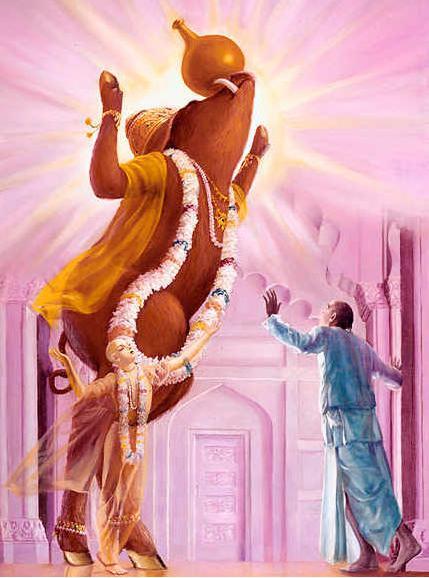
On another occasion, Mahaprabhu arrived at Murari's house absorbed in the ecstatic mood of Varaha, the boar incarnation of Krishna who once lifted the earth from the cosmic ocean. Chaitanya-charitamrita records the scene in a single line: "varaha-avesa haila murari-bhavane / tanra skandhe cadi' prabhu nacila angane". This means that the ecstasy of becoming Varahadeva arose in Murari's house, and the Lord climbed onto Murari's shoulders and danced there in his own courtyard. Fuller retellings add that the Lord roared and lifted a household waterpot in His teeth. In this way He acted out Varaha's rescue of the earth on a small scale. Murari was astonished. When he was asked to sing the Lord's praises on the spot, he could only confess that he was not fit to glorify a Lord whose glories even the thousand-headed Ananta Shesha cannot fully describe.
The Discipline of Etiquette #
Even though Murari was close to the Lord, he was still corrected. Once Murari came to Srivasa Thakura's courtyard, where Mahaprabhu sat beside Nityananda Prabhu. Murari offered his obeisances to the Lord first and to Nityananda Prabhu second. This was reasonable etiquette, since he took Mahaprabhu to be the senior one. But Nityananda Prabhu was in fact the elder of the two. Mahaprabhu told him simply that he had made a mistake, without explaining further. That night, Murari dreamed of Nityananda Prabhu as Balarama Himself, fanning the Lord with a chamara. From the next day on, he reversed the order of his obeisances. Srila Bhaktisiddhanta Sarasvati Thakura explained the wider point of this episode in his Gaudiya-bhashya. To worship the Supreme Lord without first honoring guru and the jagad-guru is a mistake in the order of worship. Since then, Gaudiya Vaishnava tradition has treated this small correction as a lesson meant for every reader, not only for Murari.
Betel Nut and a Warning to the Mayavadis #
Mahaprabhu's affection for Murari reached even to ordinary courtesies. He would give Murari His own chewed pan, or betel nut. Murari accepted it with clear delight, and afterward wiped his hand on his own head instead of washing it as custom required. On one such occasion, tradition records, the Lord's mood suddenly changed into open anger. He was angry at the Mayavadi explanation of the scriptures then current in Kashi under the sannyasi Prakashananda Sarasvati. Grinding His teeth, the Lord declared that anyone who denied His personal form was heading for ruin. He said that He had already caused Prakashananda's own body to suffer for the offense. It is a startling scene to find inside an otherwise homely memory of sharing pan. It is given here as the older Bengali sources give it. Beyond that secondary tradition, no independent scripture confirms the detail about Prakashananda.
A Devotee Who Wished to Die Before His Lord #
Murari's love for Mahaprabhu also brought him a private anxiety. Murari reasoned that every incarnation of God eventually leaves His closest associates behind. Ramachandra abandoned Sita after Ravana's death, and Krishna arranged the destruction of His own Yadu dynasty. So Murari concluded that Mahaprabhu's own departure could not be avoided. He privately resolved that he would rather die in the Lord's presence than witness it. He made a knife and hid it in his house. Chaitanya-charitamrita insists that Mahaprabhu knew everything. The Lord came straight to Murari's home, asked for the knife, and told him plainly that He still had pastimes left to complete in Murari's company. This moment of reassurance ends this part of their story with the same theme that runs through all of it. The Lord would not let His most anxious devotee out of His sight.
Scriptural evidence for this chapter (1)
Quoted in the text above:
- Adi 17.19 Sri Chaitanya-charitamrita
Chapter 4
Writing the Earliest Biography of Mahaprabhu
What Murari Gupta's Kadaca actually is, what later biographers owed to it, and what remains genuinely unsettled about its title and structure.
Gaudiya Vaishnavas remember Murari Gupta most of all for something that has nothing to do with medicine. While Sri Chaitanya Mahaprabhu was still alive, or not long afterward, Murari set down in Sanskrit verse what he had seen. By then he had been an eyewitness to the Lord's Nadia pastimes for decades. The result is generally treated as the earliest biography of Mahaprabhu that exists.
A Diary Turned Into a Poem #
Sources agree on very little about this work, except that it came first. It is most often called Murari Gupta's Kadaca, and kadaca simply means diary or notebook. Its more formal Sanskrit title is given differently almost everywhere it is mentioned. The page on Krishnadasa Kaviraja Goswami calls it "Sri-krishna-chaitanya-charanamrita," matching the title Wikipedia gives (Sri Krsna Caitanya Caranamrita, also called murari-gupta-kaccha) and dating its composition to 1513. Banglapedia instead calls the finished work "Sri Krishna Chaitanyacharitamrita," popularly known as Murari Gupter Kadcha. It describes the work as written in verse across several cantos. Other retellings, drawing on ISKCON-affiliated biographical sources, call it Sri-Krishna-Chaitanya-carita-mahakavya, "the great poem of Sri Krishna Chaitanya's life." We do not try here to force these three titles into one. They most likely all point to the same Sanskrit work, remembered and translated slightly differently by different writers over five centuries. But readers should know that the name is truly unsettled, and should not treat any single version as the only correct one.
There is also a related, smaller uncertainty that we should be honest about. At least one source, The Gaudiya Treasures of Bengal, draws on Gaudiya Math tradition at Mayapur. It describes Murari's "karcha," or diary, as the raw record he kept of Mahaprabhu's Nadia pastimes. It treats his finished Sanskrit poem, the Carita-mahakavya, as a separate, more polished work built from that diary. The available sources do not settle whether the "Kadaca" and the finished verse biography are strictly the same text or two stages of the same project.
What the Work Covers #
Whatever it is called, most sources agree that Murari's account tells of Mahaprabhu's childhood and boyhood pastimes in Navadvipa in particular detail. This is exactly the period Murari himself had lived through at close range, as a neighbor and fellow student. That is why later writers valued it. Unlike every biography that came after it, Murari's was written by someone who did not need anyone else's report of Mahaprabhu's early years. He had been present for them himself.
The Debt Later Biographers Owed Him #
Because Murari was an eyewitness, his work became the foundation for the far larger biographies that followed. The page on Krishnadasa Kaviraja Goswami states directly that when its author composed Sri Chaitanya-charitamrita generations later, he "drew on Murari Gupta's Kadaca... for chronology," because Murari's "eyewitness status made it foundational for every later biographer." Banglapedia goes further. It lists Kavikarnapura, Lochana Dasa Thakura, Krishnadasa Kaviraja, and Narahari Chakravarti (author of Bhakti-ratnakara) as writers who borrowed from Murari's account for their own works. Vrindavana Dasa Thakura's own Chaitanya-bhagavata was composed after Murari's account but before Chaitanya-charitamrita. Banglapedia's list does not name it directly as borrowing from Murari. Still, its story of Mahaprabhu's Nadia years covers much of the same ground that Murari's Kadaca is said to have recorded first.
A Fragment That Does Survive #
More than one later retelling quotes a passage said to be Murari's own composition. It is a set of verses praising Ramachandra, which Mahaprabhu once asked him to recite aloud. "I worship the blessed Lord and master of the three worlds, Sri Ramachandra," the verses run in translation, "who wears a brilliant crown covered with a strand of jewels whose shining lights up all directions... whose well-shaped nose attracts everyone, and whose wonderful smile embarrasses the moonlight." Mahaprabhu is said to have been so pleased on hearing it that He placed His own feet on Murari's head and wrote the name Ramadasa on his forehead. The sources that preserve these lines do not say clearly whether they come from the Kadaca itself or from a separate hymn of Murari's. But they are the closest thing to Murari's own voice, in his own words, that we could find.
An Honest Gap in the Record #
We cannot quote the Kadaca itself at length here. Nor can we trace exactly which lines of the later biographies came from it word for word. No available source reproduces long passages of Murari's own Sanskrit beyond the fragment above. The popular biographical accounts used here also do not explain which manuscripts these claims of direct borrowing are based on. But we can honestly describe what the sources broadly agree on. A physician who had watched Mahaprabhu grow up wrote down what he remembered. He wrote it early enough that Mahaprabhu Himself may still have been alive to hear of it. And one source or another says that every major biographer of Sri Chaitanya Mahaprabhu who came after him consulted the text he left behind.
Chapter 5
Disappearance and Legacy
An undated disappearance on a well-remembered day, a guru who must not be confused with another devotee of the same name, and a physician Srila Prabhupada never stopped quoting.
No source gives a year for Murari Gupta's disappearance, and we report this gap instead of guessing. What tradition does preserve is the day itself, and the honor his memory has received ever since.
An Undated Day, Long Remembered #
Shyam Das Baba's account draws on Bhakti Ballabh Tirtha Maharaj's Sri Chaitanya: His Life and Associates. It states that Murari Gupta disappeared "on the same full-moon day as the autumn rasa-lila festival". This is Sharad Purnima, the same night on which Krishna is remembered as performing His rasa dance with the gopis of Vraja. Gaudiya Vaishnava temples still observe a disappearance day for Murari Gupta on this lunar date each year. But no source that we could find records the year of the original event.
A Guru Named, and a Name Worth Clarifying #
More than one biographical source names Murari's guru as a devotee called Chandrashekhara Acharya, who is also known in Chaitanya-charitamrita as Acharyaratna. He was a householder devotee of Navadvipa. He is a different person from Chandrashekhara Acharya the physician of Varanasi, who hosted Sri Chaitanya Mahaprabhu during His later travels and who has his own separate page. In a recorded conversation with Srila Bhakti Raksaka Sridhara Maharaja, Srila Prabhupada himself clearly separated the two men, confirming that they were not the same person. We follow the same distinction here. The available sources describe the relationship between Murari Gupta and the Navadvipa Chandrashekhara Acharya consistently enough for us to state it plainly. But it rests on second-hand biographical retellings, not on an exact chapter-and-verse reference that could be confirmed independently. Readers should keep this in mind when weighing it.
Where His Memory Is Kept #
Murari Gupta's residence in Navadvipa stands today near Ballal Dighi, east of the Yogapitha, under the care of the Chaitanya Math. It is a short walk from Srivasa Thakura's own courtyard, and barely a kilometer from the present-day ISKCON temple at Sri Mayapur. Deities of Sri Sita, Rama, Lakshmana and Hanuman are still worshipped there daily. In this way, the worship of the Deity Murari served in his own lifetime continues directly. A separate memorial temple was also built nearby by the Gaudiya Math, in his honor.
Remembered in Srila Prabhupada's Own Words #
Srila Prabhupada spoke about Murari Gupta on more than one occasion in his own preaching, in the years after founding the Krishna consciousness movement in the West. He cited him as an example of an ideal householder physician who "maintained his family with his earnings" while never compromising his devotion. He also told the story of Murari fainting at the mere sight of a peacock feather at least twice. He told it in a 1967 Bhagavatam lecture in San Francisco, and again in a 1975 initiation talk in the same city. In Prabhupada's own words, the story was proof that "this is the first-class stage of Krishna consciousness." On a Denver morning walk that same year, a disciple repeated this teaching back to him. Prabhupada then summed up the whole of Murari's life in five words: Murari Gupta was "a doctor in both ways."
Named in the Songs of Others #
Narahari Chakravarti's Bhakti-ratnakara, a later compilation of Gaudiya Vaishnava history, returns to Murari Gupta's own pastimes more than once. One of them is the Garuda episode. Murari answered Mahaprabhu's call and took on the form of the king of birds, so that the Lord could climb, in ecstasy, onto his shoulders. Another is the hidden-knife episode told in Serving as the Lord's Physician. Narahari was writing generations after Murari's own lifetime, yet he still found Murari's pastimes worth retelling in detail. This itself is a small sign of how firmly Murari had settled into the tradition's memory. He was not only a source that other authors drew from. He was also a character that other authors still wanted to tell stories about.
His Place in the Larger Story #
Most of all, though, Murari Gupta's legacy lies in what he wrote. As detailed in Writing the Earliest Biography of Mahaprabhu, his own Kadaca stands as the earliest life of Sri Chaitanya Mahaprabhu that the Gaudiya Vaishnava tradition has. It is a record made by someone who did not need to be told what Mahaprabhu's childhood was like, because he had grown up watching it happen next door. Everything written since about Mahaprabhu's Nadia years rests in some real part on this physician-scholar. This is true from Vrindavana Dasa Thakura's Chaitanya-bhagavata to Krishnadasa Kaviraja Goswami's Sri Chaitanya-charitamrita. He lost every argument to a child he did not yet know was God. Then he spent the rest of his life making sure that no one who came after him would have to wonder what that childhood had actually looked like.
Closing
Revealed as Hanuman #
From childhood, Murari's own worship belonged to Sri Sita-Rama, not to Krishna. In the Gaura-ganoddesha-dipika, Gaudiya Vaishnava tradition directly identifies him as Hanuman, Lord Ramachandra's eternal servant, now present in Mahaprabhu's Nadia pastimes. Tradition holds that this identity was confirmed during Mahaprabhu's mahaprakasha at Srivasa Thakura's courtyard. This was a display of the Lord's divinity in ecstasy that lasted twenty-one hours. During it, the Lord showed Murari a vision of Himself as Ramachandra, bow in hand, with Sita and Lakshmana at His side and an army of monkeys singing His praise. When he saw himself among those monkeys, Murari fainted at once. In his purport to this part of Chaitanya-charitamrita, Srila Prabhupada clearly confirms the episode: "When Sri Caitanya Mahaprabhu exhibited His maha-prakasa form, He appeared before Murari Gupta as Lord Ramacandra."
The verse of Kavi Karnapura's Gaura-ganoddesha-dipika (verse 91) reads:
murāri gupto hanumān aṅgadaḥ śrī-purandaraḥ
"The devotee named Murari Gupta in Lord Caitanya's pastimes had previously been Hanuman." (Gaura-ganoddesha-dipika 91)
Mahaprabhu Himself says the same in Chaitanya-charitamrita. Before all the devotees at Puri, He recalls how He once tested Murari's loyalty to Lord Ramachandra and then praised him: "Indeed, you are the incarnation of Hanumān. Consequently you are the eternal servant of Lord Rāmacandra." (Chaitanya-charitamrita Madhya 15.156)
Devotion Tested and Confirmed #
Murari's own worship belonged to Ramachandra. So Mahaprabhu is said to have tested him directly. More than once He urged Murari to turn his devotion to Krishna instead, since Krishna is the source from whom Rama and every other incarnation appears. Murari could not do what the Lord asked, but he would not disobey Him either. He spent a sleepless night in anguish. In the morning he came before the Lord, ready to give up his life rather than choose between them. "I have sold my very head to the lotus feet of Raghunatha," he told Mahaprabhu, by his own account preserved in Chaitanya-charitamrita, "I cannot take it back, and my mind aches with the pain of it." The Lord was not displeased at all. He praised this very refusal as the mark of real devotion. Later, in Chaitanya-charitamrita's Antya-lila, He spoke of His past test of Murari Gupta and held it up as the standard for Jiva Goswami's father Anupama. Sanatana Goswami once described Anupama in almost identical terms.
- Banglapedia: Murari Gupta
- Gaudiya History: Murari Gupta - Biography
- Gaudiya History: Murari Gupta - Biography (2)
- Gaudiya History: Murari Gupta (disciple of Chandrashekhara Acharya)
- Shyam Das Baba: Sri Murari Gupta (from Sri Chaitanya: His Life & Associates, Bhakti Ballabh Tirtha Maharaj)
- The Gaudiya Treasures of Bengal: Murari Gupta - Life and Pastimes
- ISKCON Desire Tree: Srila Murari Gupta - Disappearance (Prabhupada purports, CC Adi 10.49-51)
- ISKCON Bangalore: Sri Murari Gupta
- Sri Chaitanya-charitamrita, Adi-lila 10.49-51 (Bhaktivedanta VedaBase)
- Sri Chaitanya-charitamrita, Antya-lila 4.44-46 (Bhaktivedanta VedaBase)
- Srila Prabhupada lecture, Srimad-Bhagavatam 7.7.32-35, San Francisco, March 17 1967 (Bhaktivedanta VedaBase)
- Nandgram Dham: Srila Krishnadasa Kaviraja Goswami - Composing Sri Chaitanya-charitamrita
- Nandgram Dham: Srila Chandrashekhara Acharya (Varanasi physician - a distinct figure)
