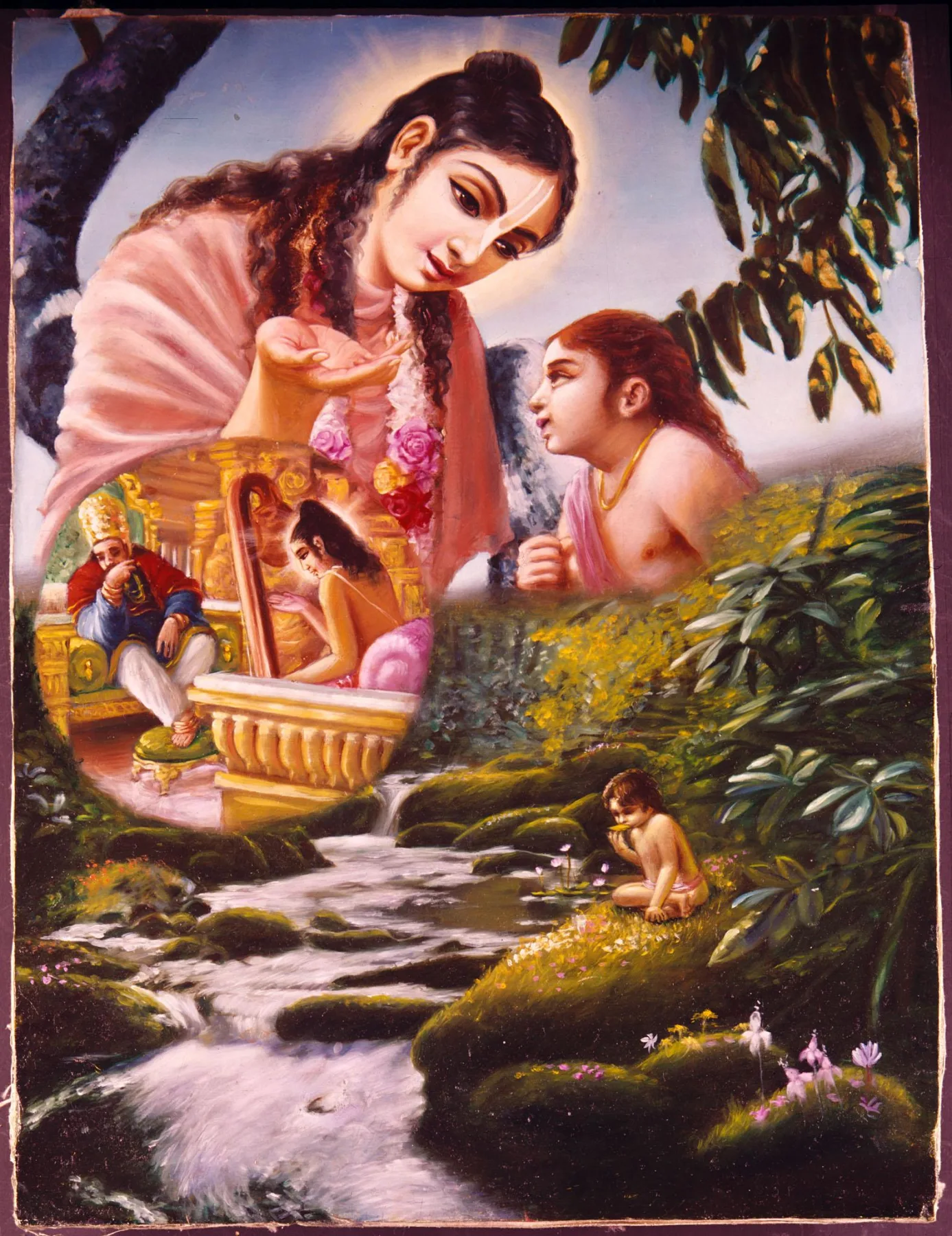
Insulted at His Father's Knee #
Dhruva Maharaja was a small child, about five years old, when his stepmother Suruci humiliated him in front of the royal court. He had tried to climb onto his father King Uttanapada's lap, where his half-brother Uttama was already sitting. Suruci told him bluntly that he had not been born from her womb, and so had no right to the king's lap, or, by extension, to the throne. If he wanted that place, she said, he would have to perform austerities severe enough to win Lord Narayana's favour and take his next birth from her womb instead. Dhruva's own father said nothing to defend him. The boy left the palace in tears and went to his mother, Suniti. Rather than comfort him with soft words, she confirmed that Suruci had spoken the truth. She told him that taking shelter of the Supreme Personality of Godhead was the only real answer to the insult.
Narada's Attempt to Dissuade Him #
News of this reached Narada Muni, who came to see the boy for himself. He was struck with wonder that a mere child could be so affected by a few harsh words. He touched Dhruva's head and gently tried to talk him out of his resolve. He warned him that the mystic austerities his mother had recommended were difficult even for adult yogis who had practised for lifetimes, and that a boy still attached to sport and play had no business undertaking them. He suggested, kindly, that Dhruva simply go home and wait until he was grown.
Dhruva refused. He told Narada that his heart had been pierced by Suruci's words in a way no philosophy could soothe. He said he meant to reach a position higher than his father or grandfather had ever reached. Narada was a worthy son of Lord Brahma who travelled the universe with his vina for everyone's welfare. So Dhruva asked him to show him an honest path toward that goal.
The Mantra and the Path to Madhuvana #
Moved by the boy's sincerity, Narada gave way and gave him exactly what he had refused a moment earlier: full instruction in devotional practice. He told Dhruva to go to Madhuvana forest on the bank of the river Yamuna, bathe three times daily in its waters, and sit in meditation on the four-armed form of Lord Vishnu. He described that form to him in detail, from its peaceful, smiling face down to the jewelled anklets on its lotus feet. He then gave Dhruva the same twelve-syllable Vasudeva mantra that Vaishnava devotees still chant in worship of the Lord today. He told him that a sincere chanter of this mantra could begin to see remarkable results within seven nights. And he taught him a simple kind of worship that a renounced devotee alone in the wilderness could actually perform. It used flowers, fruit, tulasi leaves, and even a Deity form made only of forest earth and water.
The Form Narada Told Him to See #
Narada gave clear instructions for meditation. He described the Lord's form to the five-year-old boy in real physical detail. The Lord's face is always beautiful and never displeased. His eyebrows and raised nose are set in a broad forehead, and His eyes and lips are pink like the rising sun. His four arms hold a conch, wheel, club, and lotus. The mark of Srivatsa is on His chest, and He wears a jewelled helmet and the Kaustubha gem at His throat. He is dressed in yellow silk garments. Small golden bells at His waist and ankles chime as He stands, always smiling, on the lotus-like centre of a devotee's heart. It is a strangely tender detail. A wandering sage took the time to paint such a complete and gentle picture for a child. Until a few minutes earlier, that child had simply been a hurt little boy determined to prove a point to his stepmother.
The Result #
Dhruva followed every instruction to the letter. The austerities that followed from this one meeting were so intense that they are said to have shaken the heavenly planets. Srimad-Bhagavatam describes them across the chapters that come after this one, and they end with Dhruva Maharaja's own direct vision of the Lord. It had all begun because Narada Muni overheard the news of one hurt boy and came to see him for himself.
