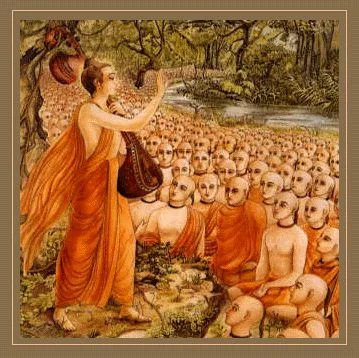
This episode is often the first one Vaishnava teachers reach for when asked why Narada Muni is always shown in motion, never settled anywhere for long. Srimad-Bhagavatam answers the question directly, and the answer involves a father's grief, a very deliberate riddle, and a curse that turned out to be a blessing.
Ten Thousand Sons Sent to Multiply #
Prajapati Daksha was one of the great forefathers given the duty of filling the universe with living beings. He fathered ten thousand sons known as the Haryashvas and ordered them to marry and have children of their own. Dutifully, the boys travelled to a sacred lake called Narayana-sarovara to purify themselves with austerities before beginning their assigned task. But the water itself, and the company of the realised souls who lived there, changed them. They acted on the boys exactly as such things once acted on the young Narada during his own previous life. With every bath, their hearts grew less and less interested in what their father had sent them to do.
A Riddle Instead of a Sermon #
Seeing them perform such fine austerities for a purely material goal, Narada Muni approached. Rather than simply telling them to renounce family life, he spoke to them in riddles. He described a strange, distant kingdom: a single man living there with an unchaste woman who constantly changes her dress; a river that flows in two directions at once; a house built of twenty-five different materials; a singing swan; and a wheel of blades and thunderbolts that turns on its own, without end. You have not even seen these things, he told them, so how do you imagine you understand your father's actual order well enough to carry it out?
The Haryashvas worked out the riddle themselves, without any further explanation, because their hearts were already prepared for it. The one man was the Supreme Personality of Godhead, complete in Himself and dependent on no one. The unchaste woman was the restless material intelligence that keeps changing its appearance to hold the soul's attention. The two-way river was material nature's endless cycle of creation and destruction. The house of twenty-five elements was the body itself. The swan was the discriminating soul who separates matter from spirit. And the self-turning wheel of blades was time, which cuts down every living being's plans without asking permission. Once they understood this, they saw Narada's real point. A person's real father is scripture, not a father's household ambitions, because scripture alone gives him his second birth. Every one of the ten thousand sons walked away from the assignment for good.
A Second Batch, and a Father's Fury #
When Daksha learned that Narada had cost him ten thousand sons in a single stroke, he grieved bitterly, but Brahma consoled him. Daksha then fathered a second group of a thousand sons, the Shabalashvas, and sent them to the very same lake with the very same instructions. Narada found them there too, and this time he barely needed the riddle at all: he simply reminded the younger brothers how devoted they were to their elder brothers, the Haryashvas, and suggested they follow the path those brothers had already taken. They did, immediately and completely.
This was too much for Daksha. He faced Narada directly and made three charges against him. He accused him of destroying two entire generations of sons while pretending to be a saint. He accused him of forcing renunciation on innocent boys who had not yet even paid their debts to their elders. And he accused him of betraying the trust every father places in a guest who enters his household. Then Daksha pronounced the curse. Since Narada was so fond of travelling the universe, from that moment he would never again be able to stay in any one residence. Srimad-Bhagavatam records his exact words: "You may travel all over the universe, but I curse you to have no residence anywhere" (Srimad-Bhagavatam 6.5.43).
A Curse Accepted as a Blessing #
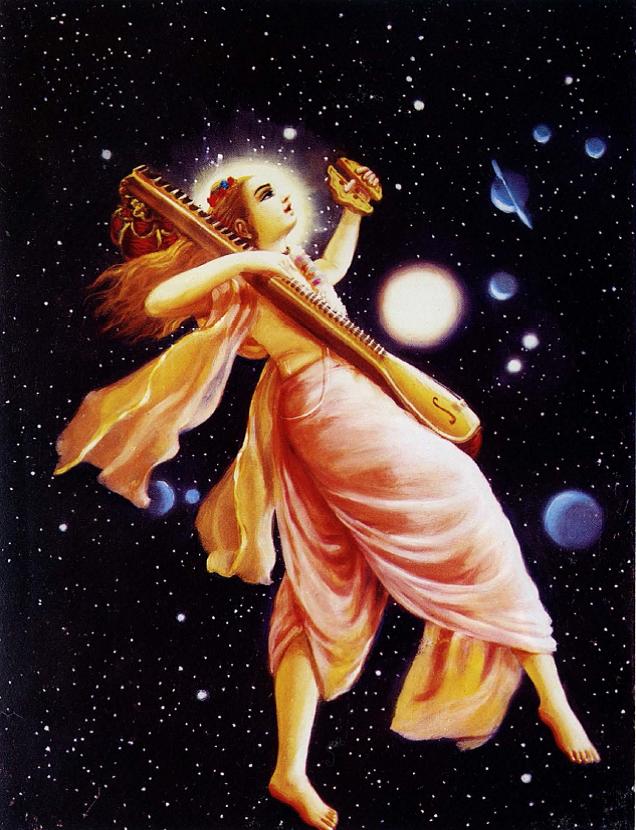
Narada's reply was two words, *tad badham*: so be it, what you have said is good, I accept. Srila Prabhupada's purport to this exchange makes the point clear. Daksha was a devoted householder himself, so he imagined that a life with no fixed home would be the worst possible punishment for anyone. But in fact, the purport says, such a life is exactly the qualification of a parivrajakacharya. This is a wandering teacher who travels constantly for the benefit of people who might otherwise never hear of Krishna at all. In the purport's words: "A preacher is known as parivrajakacharya, an acharya, or teacher, who always travels for the benefit of human society" (Srimad-Bhagavatam 6.5.43, purport). So what Daksha meant as a punishment became the very pattern of Narada's life's work. This same life of wandering, playing the vina and chanting without stopping later carried him to Dhruva Maharaja, to Kayadhu's rescue, to the forest robber who became Valmiki, and to Vyasadeva on the bank of the Sarasvati.
