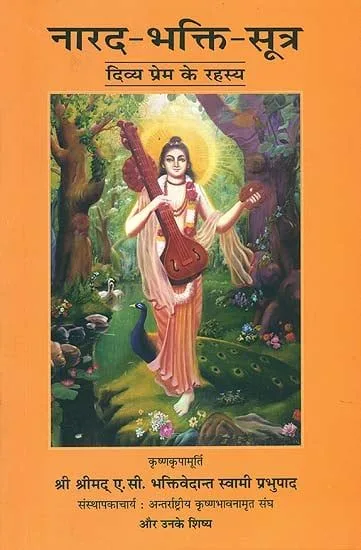
Eighty-Four Sutras on the Nature of Bhakti #
The Vedic tradition has many short Sanskrit texts called sutras, made up of brief, packed statements. One of them, the Narada-bhakti-sutra, is traditionally credited to Narada Muni himself. This short work of about eighty-four statements explains what bhakti really is. It shows how bhakti differs from ordinary religious duty and from the search for liberation, what obstacles block it, and how a sincere devotee can recognise real progress in it. Over the centuries Vaishnava commentators have written at length on these short sutras, just as later commentators explained Vyasadeva's own Vedanta-sutra.
As with many such texts, scholars disagree about exactly when it was written and by whom. The belief that Narada himself wrote it comes from tradition. It cannot be checked by any independent evidence. But its teaching fits well with the devotional teaching of this whole disciplic line, and Srila Prabhupada accepted it as authoritative whenever he referred to it directly. Students of Vedanta sometimes discuss it together with a second, similar work, the Shandilya-bhakti-sutra, which tradition credits to the sage Shandilya. The two texts are usually seen as companion works from two different lines of the tradition. Both try to define bhakti in short, exact statements, with the same care that Vyasadeva himself brought to Vedanta philosophy.
What Bhakti Actually Is #
One definition from this line of teaching became especially well known in Gaudiya Vaishnavism. It says that bhakti means engaging the senses in the service of Hrishikesha, the master of the senses, once a soul has become free of every material designation. Srila Prabhupada introduced this exact definition as coming from the Narada-bhakti-sutra when he spoke at Andhra University in 1972. The same verse also appears, in almost the same words, in Srila Rupa Gosvami's Bhakti-rasamrita-sindhu. But there the verse is credited to a different text, the Narada-pancharatra, which is related but separate. Both the printed edition and the purport in Sri Chaitanya-charitamrita that quotes the verse say this. Chaitanya Mahaprabhu himself quotes it this way while instructing Rupa Gosvami at Prayag: "Bhakti, or devotional service, means engaging all our senses in the service of the Lord, the Supreme Personality of Godhead, the master of all the senses" (Sri Chaitanya-charitamrita, Madhya 19.170). So the sources name different books for this verse. We do not try to settle this small difference here, because both texts clearly come from the same basic teaching about what bhakti means at its root.
A second theme runs through almost everything that Vaishnava tradition links with Narada's teaching on bhakti. Bhakti is *ahaituki*, causeless, and *apratihata*, unstoppable. This is exactly how Srimad-Bhagavatam itself defines the supreme occupation of humanity: "The supreme occupation [dharma] for all humanity is that by which men can attain to loving devotional service unto the transcendent Lord. Such devotional service must be unmotivated and uninterrupted to completely satisfy the self" (Srimad-Bhagavatam 1.2.6). It is open to absolutely anyone, whatever their birth, learning or qualification, and once it begins nothing can stop it. It is no coincidence that this is exactly the kind of devotion Narada himself received in his previous life. He was then a poor and uneducated servant boy with no formal qualification. Later he gave the same devotion, without hesitation, to a queen in captivity, a grieving five-year-old prince and a highway robber.
A Book Srila Prabhupada Set Aside #
Letters from Srila Prabhupada's first years in America show that he began an English translation of the Narada-bhakti-sutra almost as soon as he started writing to his first disciples. In February 1967 he sent Satsvarupa dasa Goswami the first installment of what he called simply "Narada Bhakti Sutras," and asked for feedback before continuing. A month later, though, he decided to finish Teachings of Lord Chaitanya first. He explained to the same disciple that the subject matter of the Narada-bhakti-sutra was already covered in that other book. As far as the surviving record shows, he never went back to it. He did not finish it himself. Later, the Bhaktivedanta Book Trust published it as a separate volume, begun by Srila Prabhupada and completed by his disciple Satsvarupa dasa Goswami. It is a small gap in his very large body of finished books. It also shows once more how carefully Srila Prabhupada, like Narada himself, always considered which project would best serve Krishna consciousness in the time he had.
