Narada Muni
Celestial Sage and Travelling Teacher of Bhakti, Guru of Vyasadeva and Dhruva Maharaja
The complete life, on one page: The main biography and every pastime page, in order, in one place
Introduction
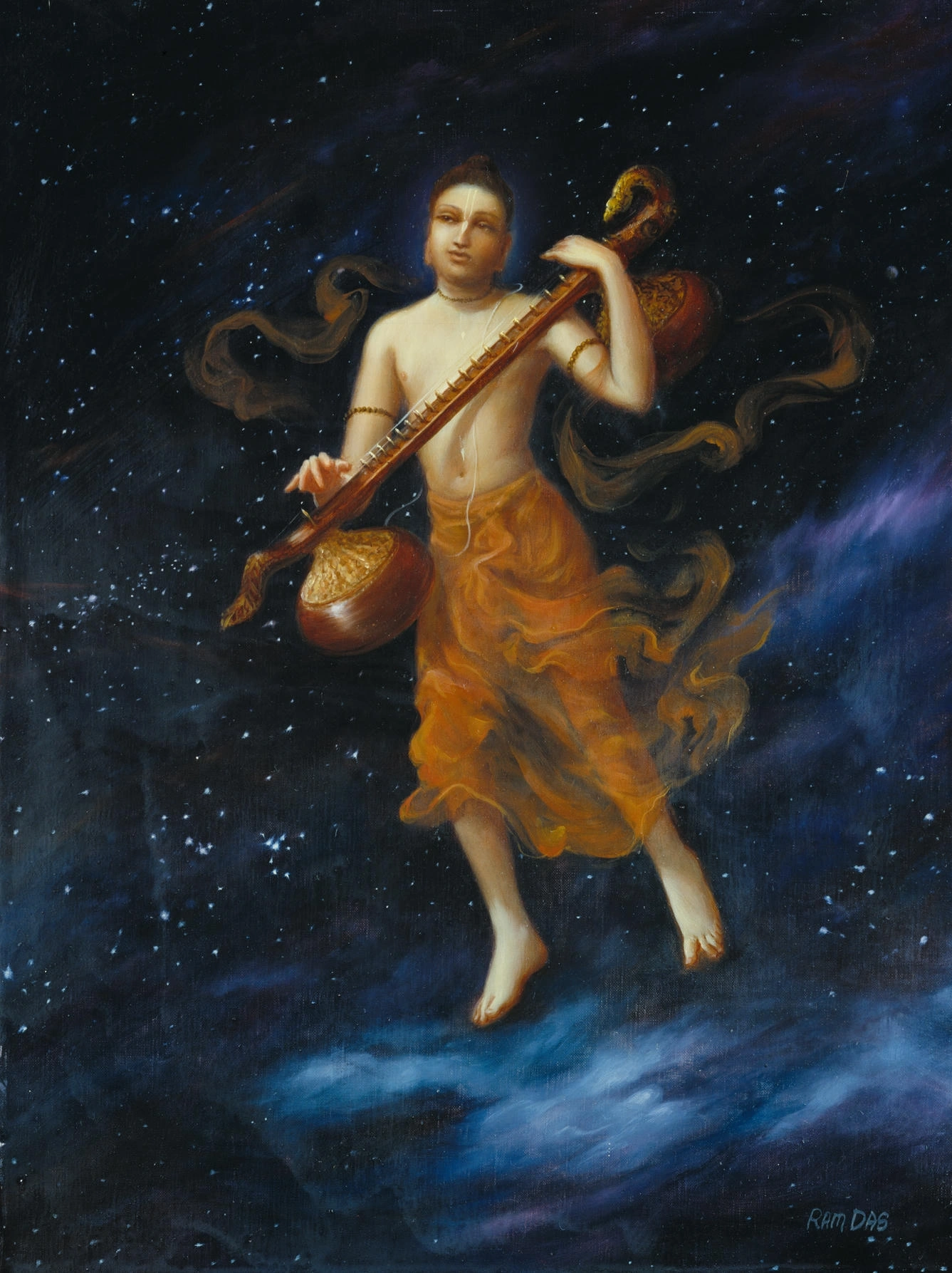
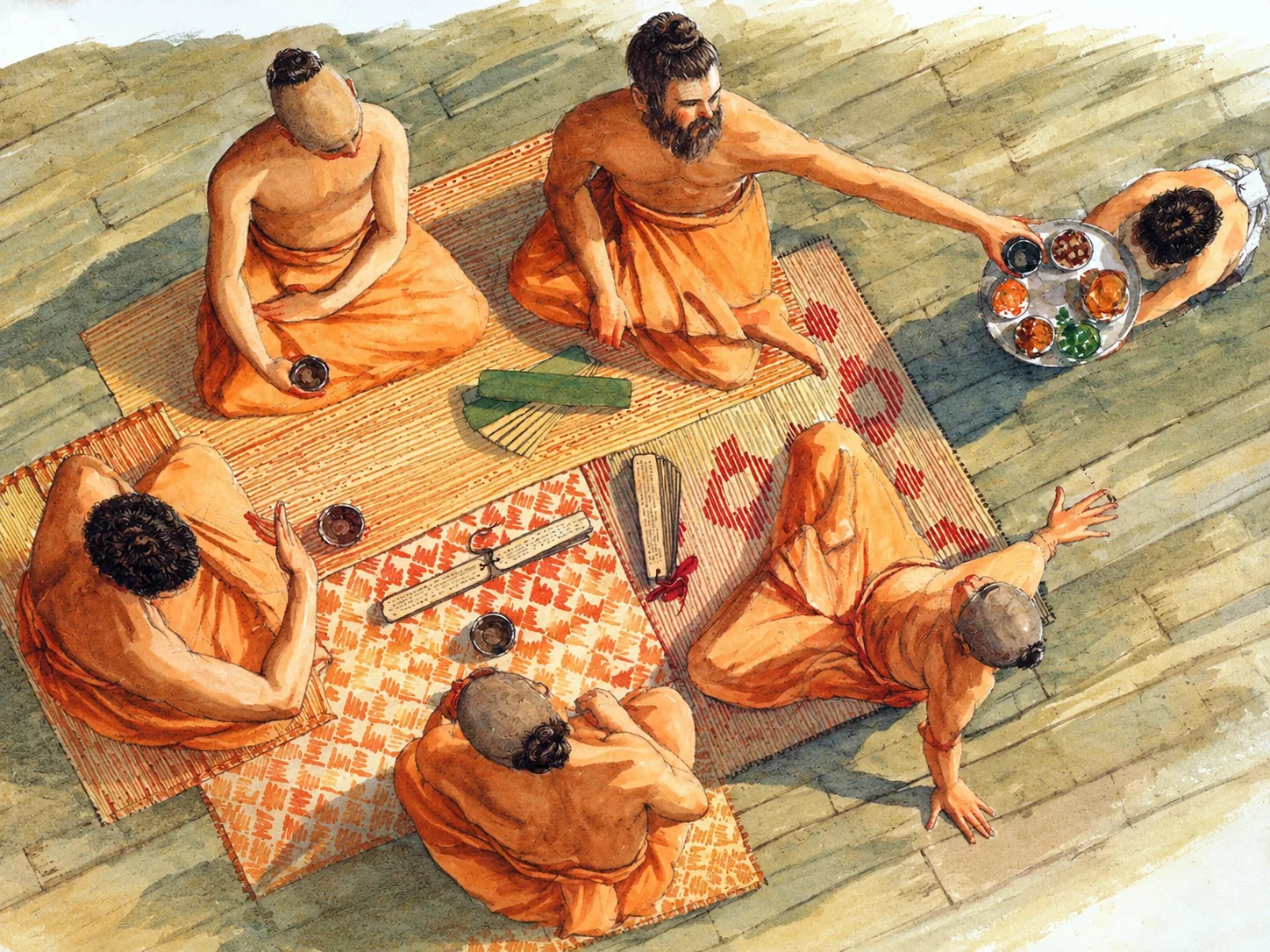
Narada Muni is one of the most widely travelled figures in the whole of Vedic literature. He is a celestial sage who moves freely through both the material universe and the spiritual sky, carrying nothing but a vina and the chanting of Krishna's names wherever he goes. Gaudiya Vaishnavas honour him as the second acharya of the Brahma-sampradaya. This disciplic line comes down from Lord Brahma through Narada to Vyasadeva. Many generations later it reaches Srila Prabhupada. He is remembered above all for one act. He persuaded Vyasadeva to write Srimad-Bhagavatam, though Vyasadeva had already compiled the Vedas and written the Mahabharata. Srimad-Bhagavatam is the ripened fruit of all Vedic knowledge, as the scripture itself says in its opening verses: "relish Srimad-Bhagavatam, the mature fruit of the desire tree of Vedic literatures" (Srimad-Bhagavatam 1.1.3).
| Detail | Description |
|---|---|
| Position | Second acharya of the Brahma-sampradaya; a mind-born son of Lord Brahma |
| Guru | Lord Brahma, in his present birth; unnamed wandering Vaishnava sannyasis, in a previous life |
| Instrument | A vina traditionally said, in the Linga Purana, to have been given to him by Lord Krishna |
| Best-known act | Instructing Vyasadeva to write Srimad-Bhagavatam (Srimad-Bhagavatam 1.5) |
| Famous disciples | Dhruva Maharaja, Prahlada Maharaja, Vyasadeva, and Valmiki, among many others |
| Attributed work | The Narada-bhakti-sutra |
| Principal sources | Srimad-Bhagavatam, Sri Chaitanya-charitamrita, and the purports and recorded talks of Srila Prabhupada |
Scriptural evidence for the introduction (1)
निगमकल्पतरोर्गलितं फलं
शुकमुखादमृतद्रवसंयुतम् ।
पिबत भागवतं रसमालयं
मुहुरहो रसिका भुवि भावुका: ॥ ३ ॥
nigama-kalpa-taror galitaṁ phalaṁ
śuka-mukhād amṛta-drava-saṁyutam
pibata bhāgavataṁ rasam ālayam
muhur aho rasikā bhuvi bhāvukāḥ
Word for word
nigama: the Vedic literatures; kalpa-taroḥ: the desire tree; galitam: fully matured; phalam: fruit; śuka: Śrīla Śukadeva Gosvāmī, the original speaker of Śrīmad-Bhāgavatam; mukhāt: from the lips of; amṛta: nectar; drava: semisolid and soft and therefore easily swallowable; saṁyutam: perfect in all respects; pibata: do relish it; bhāgavatam: the book dealing in the science of the eternal relation with the Lord; rasam: juice (that which is relishable); ālayam: until liberation, or even in a liberated condition; muhuḥ: always; aho: O; rasikāḥ: those who are full in the knowledge of mellows; bhuvi: on the earth; bhāvukāḥ: expert and thoughtful.
O expert and thoughtful men, relish Srimad-Bhagavatam, the mature fruit of the desire tree of Vedic literatures. It emanated from the lips of Sri Sukadeva Gosvami. Therefore this fruit has become even more tasteful, although its nectarean juice was already relishable for all, including liberated souls.
From the purport: "In the two previous slokas it has been definitely proved that the Srimad-Bhagavatam is the sublime literature which surpasses all other Vedic literatures."
Narada is the one who told Vyasadeva to write this scripture. The Bhagavatam's own opening chapter calls the resulting book the ripened fruit of the entire Vedic tree, which is why Narada's biography opens by naming that act as his single most important contribution to the disciplic line.
Chapter 1
The Previous Life of a Maidservant's Son
As a poor boy serving wandering sages through one rainy season, he tasted their kindness, and it changed everything that followed.
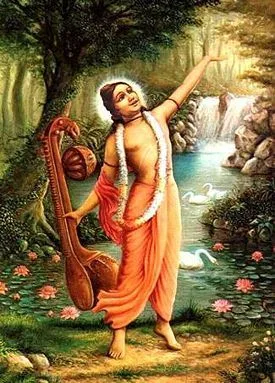
Long before he became a son of Brahma, Narada Muni lived an entirely different, human life. He describes this earlier life, not his current one, as the true beginning of his devotion. He tells the whole story himself, to Vyasadeva, late in the First Canto of Srimad-Bhagavatam.
A Maidservant's Only Son #
Narada explains that in a previous age he was born as the son of a poor maidservant. His mother worked in the house of great sages, learned brahmanas who followed the path of Vedanta. By the time he was five years old, he had no one else to look after him and no experience of the wider world. What set him apart, he says, was simply this: he was not a restless or naughty child. He kept close to his mother's work, spoke only when necessary, and had no taste for the games boys his age usually enjoy.
The Mercy of the Rainy Season #
Once, a group of these Vedantist sages stayed at that house through the four months of the rainy season. This is the traditional period when wandering sannyasis stop their travels and stay in one place. The boy was given the duty of serving them personally. Such sages are famously impartial toward everyone, but they showed their mercy to him anyway. With their permission he once ate the remnants of their food. He says plainly that this single act burned away his past sins and purified his heart at once: "Once only, by their permission, I took the remnants of their food, and by so doing all my sins were at once eradicated" (Srimad-Bhagavatam 1.5.25). Sitting near them through those months, he heard them describe the activities of Krishna, again and again. Each time he heard a little more, his taste for hearing about the Lord grew sharper. By the time the rains gave way to autumn, he had spent two full seasons absorbed only in the chanting and discussion of Krishna's glories, among men who cared for nothing else themselves.
Instructed, Then Left Alone #
When the season ended and the sages prepared to move on, they gave the boy a parting gift: confidential instruction in devotional knowledge. He says this is the same knowledge that the Lord imparts personally to those he favours. Soon afterward, tragedy struck. His mother went out one night to milk a cow, was bitten by a snake, and died. Surprisingly, Narada took this as the Lord's mercy, not as a disaster. He was a boy with no other family or attachment left, so it freed him to walk north alone, searching for nothing but Krishna consciousness.
Narada adds one detail about his mother that is easy to miss. She loved him deeply, but she herself depended on others and had no means, so she could do little to protect or provide for him. He describes the situation with a striking picture of his own. Everyone in this world is like a wooden doll in the hands of a puppeteer, moved about by a will far greater than their own love or wishes. He does not say this bitterly. In fact, here it is almost a relief. His mother's love could not shield him from what happened next, so what happened was not her failure. There was nothing left for him to do but keep walking.
One Glimpse, and a Lifetime of Longing #
Walking alone and without a plan, the boy passed through rich cities, quiet villages and cattle pastures. He passed mines glittering with gold, silver, and copper, and lakes crowded with lotus flowers and singing birds. Then the country became wilder and wilder, with bamboo thickets and tangles of reed and thorn. At last he came into dark, dangerous forests where owls, jackals, and snakes were the only company. Tired, hungry, and thirsty, he finally stopped to drink and bathe at a river. There, resting in the shade of a banyan tree, he began to meditate as the sages had taught him. As he fixed his mind on the Lord within his heart, Krishna actually appeared before him. The boy was so overwhelmed with ecstasy that he could not properly see either himself or the form in front of him. Just as suddenly, the vision withdrew. He tried desperately to see it again, but no matter how he tried, he could not. Then the Lord spoke to him directly. He explained that Narada would not see that form again in this lifetime. The single glimpse was meant only to sharpen his hunger for it, since a devotee whose longing keeps growing is a devotee who cannot fall away.
Comforted by this, Narada spent the rest of that life wandering the earth and chanting the Lord's names, until death came for him. He describes it arriving as suddenly and painlessly as a flash of lightning. What happened next belongs to the story of his birth as Brahma's son. The boy had served a handful of sages for four months of one rainy season. Now he was carried through the dissolution and re-creation of the entire universe into a very different kind of life.
Scriptural evidence for this chapter (2)
Quoted in the text above:
- SB 1.5.25 Srimad-Bhagavatam
Further verses:
अहं पुरातीतभवेऽभवं मुने दास्यास्तु कस्याश्चन वेदवादिनाम् ।
निरूपितो बालक एव योगिनां शुश्रूषणे प्रावृषि निर्विविक्षताम् ॥
ahaṁ purātīta-bhave 'bhavaṁ mune
dāsyās tu kasyāścana veda-vādinām
nirūpito bālaka eva yogināṁ
śuśrūṣaṇe prāvṛṣi nirvivikṣatām
Word for word
aham: I; purā: formerly; atīta-bhave: in the previous millennium; abhavam: became; mune: O muni; dāsyāḥ: of the maidservant; tu: but; kasyāścana: certain; veda-vādinām: of the followers of Vedanta; nirūpitaḥ: engaged; bālakaḥ: boy servant; eva: only; yogināṁ: of the devotees; śuśrūṣaṇe: in the service of; prāvṛṣi: during the four months of the rainy season; nirvivikṣatām: living together.
O Muni, in the last millennium I was born as the son of a certain maidservant engaged in the service of brahmanas who were following the principles of Vedanta. When they were living together during the four months of the rainy season, I was engaged in their personal service.
From the purport: Purport excerpt: "He was the son of the most insignificant parentage. He was not properly educated. Still, because his complete energy was engaged in the service of the Lord, he became..."
Narada's own account of the single act of service that began his devotional life, spoken directly to Vyasadeva.
Chapter 2
Birth as Brahma's Son and His Vina
Carried into a new universe through the breath of Brahma, and handed a vina filled with the sound of Krishna's own glory.
Entering the Universe Through Brahma's Breath #
Narada tells Vyasadeva that after his single death as the maidservant's son, his devotion carried him somewhere unusual. At the end of that millennium, Lord Narayana lay down in the water of universal devastation. Then Brahma began to merge into the Lord along with every element of creation. Narada merged along with him. In his own words, he entered through the Lord's breathing. For 4,300,000,000 solar years he remained in that dissolved state. When Brahma awoke to create the universe again, the Lord's transcendental body produced the great rishis, among them Marichi, Angira, and Atri. Narada appeared among them as one more of Brahma's mind-born sons.
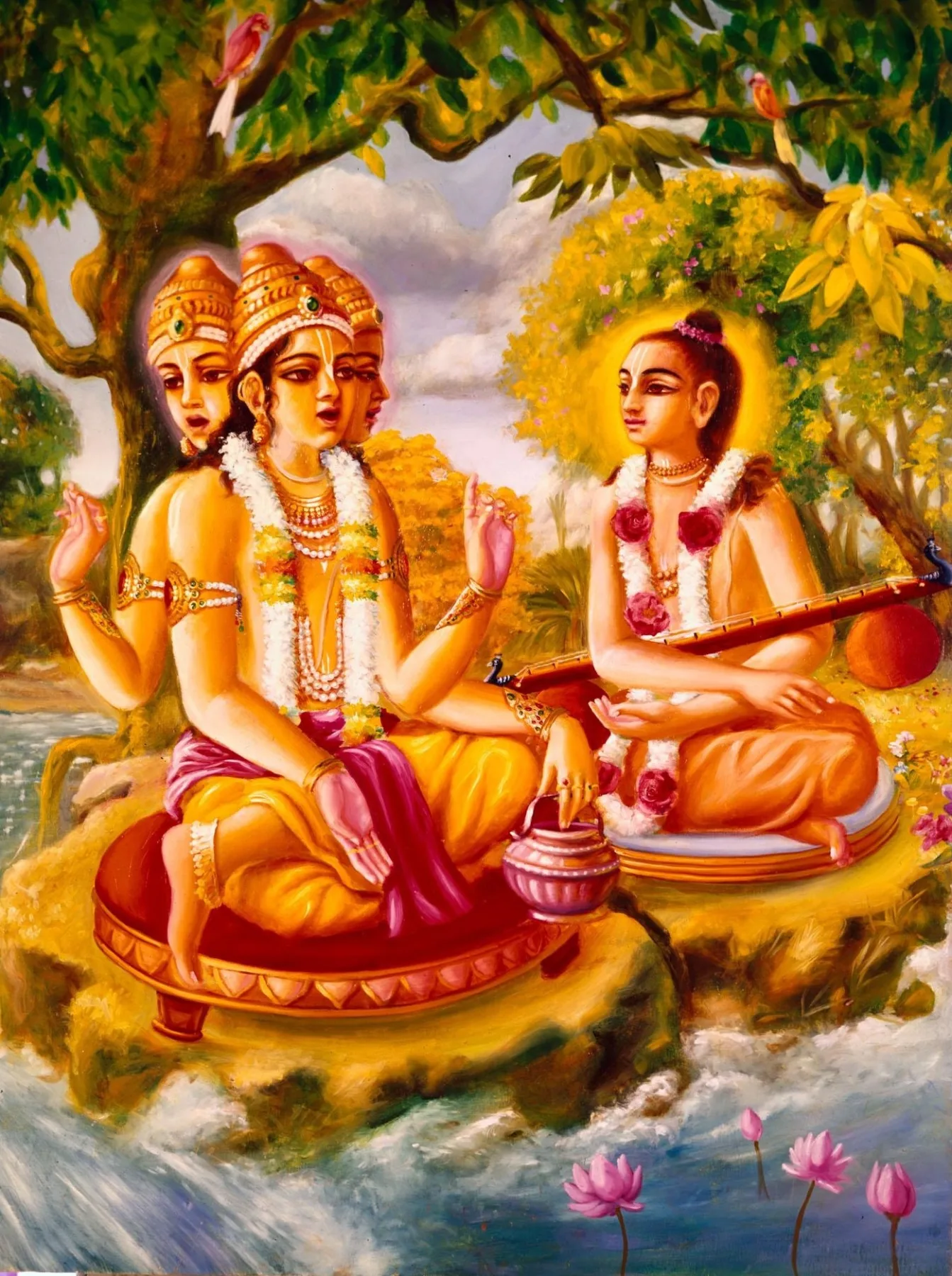
This is why Vyasadeva, throughout their conversation, addresses him simply as "son of Brahma." It is also why Lord Brahma is remembered in this tradition as both Narada's father and his first teacher in the present creation. Even so, as Narada's own account makes clear, the devotion he carried into that birth had already been earned across an entire previous age, in the life described here.
A Devotee Given Permission to Travel Anywhere #
Narada's position is truly unusual, even among liberated souls, because of what he says happened next. From that point on, by the grace of Lord Vishnu, he has travelled without restriction through both the material universe and the spiritual sky. The three modes of nature, which limit every other embodied being, do not bind him. Srila Prabhupada's purport explains how great this freedom really is. Vedic cosmology divides the material spheres into three regions: the topmost planetary systems, the middle systems, and the lower ones. Beyond even the topmost of these, above Brahmaloka itself, lies the covering of the universe. Beyond that again is an unlimited spiritual sky filled with self-illuminated Vaikuntha planets. An ordinary rishi, however advanced, cannot cross from the material universe into that spiritual sky. But Narada can, and he does so freely, exactly as he himself tells Vyasadeva: "Since then, by the grace of the almighty Vishnu, I travel everywhere without restriction both in the transcendental world and in the three divisions of the material world. This is because I am fixed in unbroken devotional service of the Lord" (Srimad-Bhagavatam 1.6.31). That is why Prabhupada describes him as a liberated being who is free to go anywhere at all. In his purport to this same verse, Prabhupada cites a statement of the Narasimha Purana. It says that sages like Marichi are authorities within fruitive ritual, and sages like Sanaka and Sanatana within philosophical speculation. But Narada alone is the chief authority for bhakti, devotional service itself. Every serious devotee in the material world follows, directly or indirectly, the path that his own Narada-bhakti-sutra lays down.
The Vina Named for Its Giver #
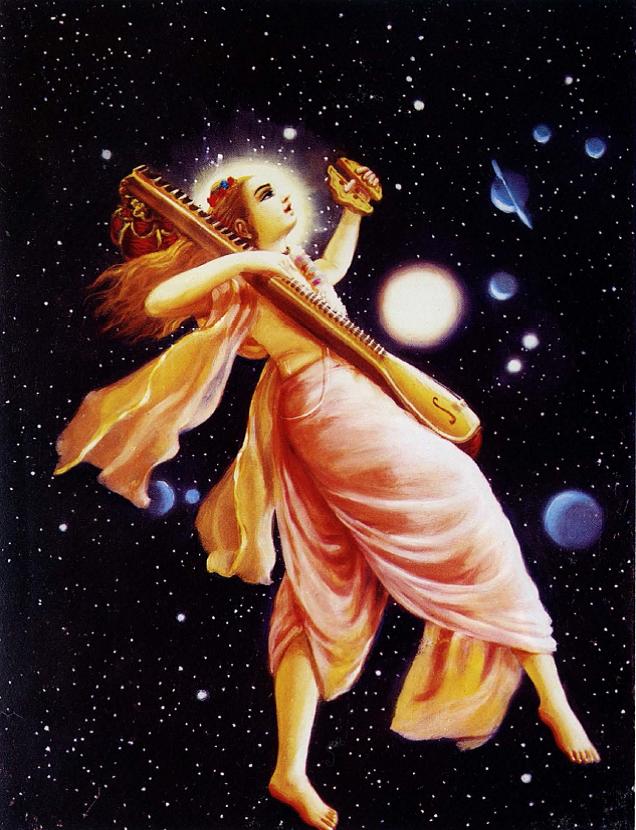
Narada's other constant companion is his vina, and Srimad-Bhagavatam is clear about where it came from. Narada says the instrument was given to him by Lord Krishna himself. Srila Prabhupada's purport cites the Linga Purana and Srila Jiva Gosvami on this point. Because the vina came directly from Krishna, it belongs to the same transcendental category as Krishna and Narada both. This means the sound it produces is never ordinary material vibration. Narada plays it with every step he takes, and every note carries the same glorification of the Lord that fills his conversation. Traditional Vaishnava art always shows him this way: walking, vina carried over one shoulder, chanting as he goes.
In Sri Chaitanya-charitamrita, Chaitanya Mahaprabhu himself includes Narada in a short list of shaktyavesha-avataras. These are souls specially empowered by the Lord with a particular opulence. He explains to Sanatana Gosvami that the Lord gave the special power of devotional service to Narada, exactly as He gave Brahma the power to create, and gave Ananta Shesha the power to support every planet. Vaishnava teachers say this same empowerment let a boy who once served sages for four rainy months become the guru of some of the greatest devotees in Vedic history. That story is the subject of the pages that follow.
Scriptural evidence for this chapter (2)
Quoted in the text above:
- SB 1.6.31 Srimad-Bhagavatam
Further verses:
देवदत्तामिमां वीणां स्वरब्रह्मविभूषिताम् ।
मूर्च्छयित्वा हरिकथां गायमानश्चराम्यहम् ॥
deva-dattām imāṁ vīṇāṁ
svara-brahma-vibhūṣitām
mūrcchayitvā hari-kathāṁ
gāyamānaś carāmy aham
Word for word
deva-dattām: gifted by the Supreme Personality of Godhead (Sri Krishna); imām: this; vīṇām: a musical stringed instrument; svara-brahma-vibhūṣitām: decorated with transcendental singing meter; mūrcchayitvā: vibrating; hari-kathāṁ: the transcendental message; gāyamānaḥ: singing constantly; carāmi: do move; aham: I.
And thus I travel, constantly singing the transcendental message of the glories of the Lord, vibrating this instrument called a vina, which is charged with transcendental sound and which was given to me by Lord Krishna.
From the purport: Purport excerpt: "The musical stringed instrument called the vina, which was handed to Narada by Lord Sri Krishna, is described in the Linga Purana, and this is confirmed by Srila Jiva Gosvami."
The scriptural basis for the vina's origin, cited here.
Chapter 3
Cursed by Daksha to Wander Forever
Twice he led Prajapati Daksha's sons to give up family life instead of becoming fathers, and the curse Daksha finally threw at him is the reason Narada has never stopped travelling since.
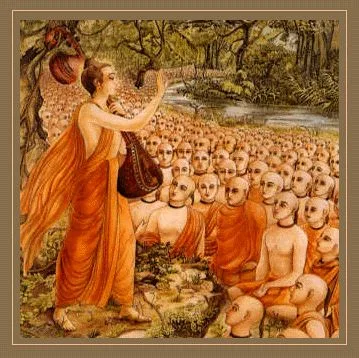
This episode is often the first one Vaishnava teachers reach for when asked why Narada Muni is always shown in motion, never settled anywhere for long. Srimad-Bhagavatam answers the question directly, and the answer involves a father's grief, a very deliberate riddle, and a curse that turned out to be a blessing.
Ten Thousand Sons Sent to Multiply #
Prajapati Daksha was one of the great forefathers given the duty of filling the universe with living beings. He fathered ten thousand sons known as the Haryashvas and ordered them to marry and have children of their own. Dutifully, the boys travelled to a sacred lake called Narayana-sarovara to purify themselves with austerities before beginning their assigned task. But the water itself, and the company of the realised souls who lived there, changed them. They acted on the boys exactly as such things once acted on the young Narada during his own previous life. With every bath, their hearts grew less and less interested in what their father had sent them to do.
A Riddle Instead of a Sermon #
Seeing them perform such fine austerities for a purely material goal, Narada Muni approached. Rather than simply telling them to renounce family life, he spoke to them in riddles. He described a strange, distant kingdom: a single man living there with an unchaste woman who constantly changes her dress; a river that flows in two directions at once; a house built of twenty-five different materials; a singing swan; and a wheel of blades and thunderbolts that turns on its own, without end. You have not even seen these things, he told them, so how do you imagine you understand your father's actual order well enough to carry it out?
The Haryashvas worked out the riddle themselves, without any further explanation, because their hearts were already prepared for it. The one man was the Supreme Personality of Godhead, complete in Himself and dependent on no one. The unchaste woman was the restless material intelligence that keeps changing its appearance to hold the soul's attention. The two-way river was material nature's endless cycle of creation and destruction. The house of twenty-five elements was the body itself. The swan was the discriminating soul who separates matter from spirit. And the self-turning wheel of blades was time, which cuts down every living being's plans without asking permission. Once they understood this, they saw Narada's real point. A person's real father is scripture, not a father's household ambitions, because scripture alone gives him his second birth. Every one of the ten thousand sons walked away from the assignment for good.
A Second Batch, and a Father's Fury #
When Daksha learned that Narada had cost him ten thousand sons in a single stroke, he grieved bitterly, but Brahma consoled him. Daksha then fathered a second group of a thousand sons, the Shabalashvas, and sent them to the very same lake with the very same instructions. Narada found them there too, and this time he barely needed the riddle at all: he simply reminded the younger brothers how devoted they were to their elder brothers, the Haryashvas, and suggested they follow the path those brothers had already taken. They did, immediately and completely.
This was too much for Daksha. He faced Narada directly and made three charges against him. He accused him of destroying two entire generations of sons while pretending to be a saint. He accused him of forcing renunciation on innocent boys who had not yet even paid their debts to their elders. And he accused him of betraying the trust every father places in a guest who enters his household. Then Daksha pronounced the curse. Since Narada was so fond of travelling the universe, from that moment he would never again be able to stay in any one residence. Srimad-Bhagavatam records his exact words: "You may travel all over the universe, but I curse you to have no residence anywhere" (Srimad-Bhagavatam 6.5.43).
A Curse Accepted as a Blessing #
Narada's reply was two words, *tad badham*: so be it, what you have said is good, I accept. Srila Prabhupada's purport to this exchange makes the point clear. Daksha was a devoted householder himself, so he imagined that a life with no fixed home would be the worst possible punishment for anyone. But in fact, the purport says, such a life is exactly the qualification of a parivrajakacharya. This is a wandering teacher who travels constantly for the benefit of people who might otherwise never hear of Krishna at all. In the purport's words: "A preacher is known as parivrajakacharya, an acharya, or teacher, who always travels for the benefit of human society" (Srimad-Bhagavatam 6.5.43, purport). So what Daksha meant as a punishment became the very pattern of Narada's life's work. This same life of wandering, playing the vina and chanting without stopping later carried him to Dhruva Maharaja, to Kayadhu's rescue, to the forest robber who became Valmiki, and to Vyasadeva on the bank of the Sarasvati.
Scriptural evidence for this chapter (2)
तन्तुकृन्तन यन्नस्त्वमभद्रमचर: पुन: ।
तस्माल्लोकेषु ते मूढ न भवेद्भ्रमत: पदम् ॥
tantu-kṛntana yan nas tvam
abhadram acaraḥ punaḥ
tasmāl lokeṣu te mūḍha
na bhaved bhramataḥ padam
Word for word
tantu-kṛntana: O mischief-monger who have mercilessly separated my sons from me; yat: which; naḥ: unto us; tvam: you; abhadram: an inauspicious thing; acaraḥ: have done; punaḥ: again; tasmāt: therefore; lokeṣu: in all the planetary systems; te: of you; mūḍha: O rascal; na: not; bhavet: there may be; bhramataḥ: who are wandering; padam: an abode.
You have made me lose my sons once, and now you have again done the same inauspicious thing. Therefore you are a rascal who does not know how to behave toward others. You may travel all over the universe, but I curse you to have no residence anywhere.
From the purport: "Because Prajapati Daksa was a grhamedhi who wanted to remain in household life, he thought that if Narada Muni could not remain in one place, but had to travel all over the world, that would be a great punishment for him. Actually, however, such a punishment is a boon for a preacher. A preacher is known as parivrajakacarya, an acarya, or teacher, who always travels for the benefit of human society."
Daksha's actual curse, and Prabhupada's purport explaining why what Daksha meant as a punishment is in fact the qualification of a parivrajakacharya. Prabhupada notes in the same purport that he considers himself cursed the same way, through the guru-parampara from Narada.
श्रीशुक उवाच प्रतिजग्राह तद्बाढं नारद: साधुसम्मत: ।
एतावान्साधुवादो हि तितिक्षेतेश्वर: स्वयम् ॥
śrī-śuka uvāca
pratijagrāha tad bāḍhaṁ
nāradaḥ sādhu-sammataḥ
etāvān sādhu-vādo hi
titikṣeteśvaraḥ svayam
Word for word
śrī-śukaḥ uvāca: Sri Sukadeva Gosvami said; pratijagrāha: accepted; tat: that; bāḍham: so be it; nāradaḥ: Narada Muni; sādhu-sammataḥ: who is an approved sadhu; etāvān: this much; sādhu-vādaḥ: appropriate for a saintly person; hi: indeed; titikṣeta: he may tolerate; īśvaraḥ: although able to curse Daksha himself; svayam: himself.
Sri Sukadeva Gosvami continued: My dear King, since Narada Muni is an approved saintly person, when cursed by Prajapati Daksha he replied, "tad badham: Yes, what you have said is good. I accept this curse." He could have cursed Prajapati Daksha in return, but because he is a tolerant and merciful sadhu, he took no action.
Narada's calm, two-word acceptance of the curse that shaped the rest of his travelling life.
Chapter 4
Delivering Dhruva Maharaja
When a five-year-old boy resolved to outdo his own father, Narada first tried to talk him out of it, then gave him the very mantra that made it possible.
Insulted at His Father's Knee #
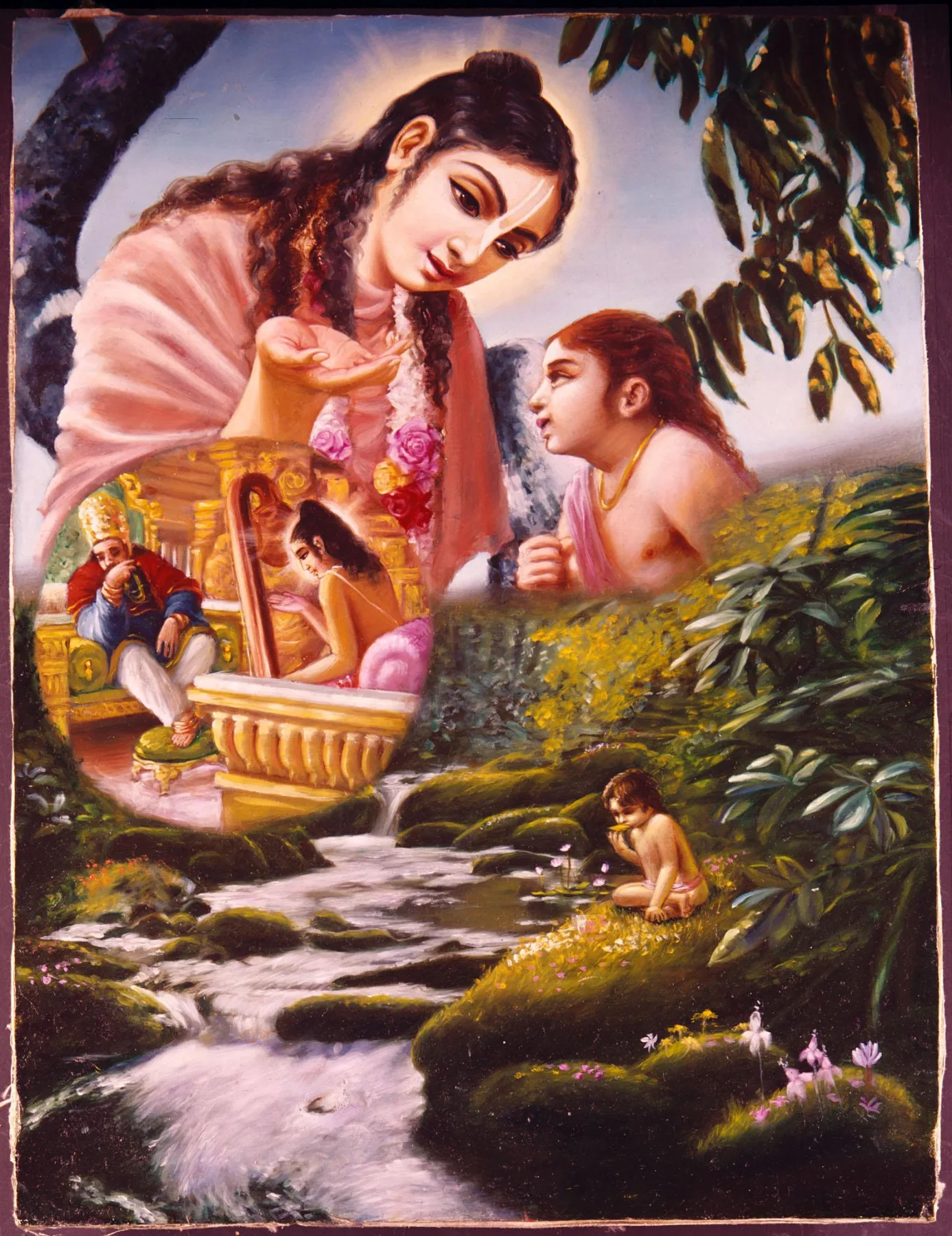
Dhruva Maharaja was a small child, about five years old, when his stepmother Suruci humiliated him in front of the royal court. He had tried to climb onto his father King Uttanapada's lap, where his half-brother Uttama was already sitting. Suruci told him bluntly that he had not been born from her womb, and so had no right to the king's lap, or, by extension, to the throne. If he wanted that place, she said, he would have to perform austerities severe enough to win Lord Narayana's favour and take his next birth from her womb instead. Dhruva's own father said nothing to defend him. The boy left the palace in tears and went to his mother, Suniti. Rather than comfort him with soft words, she confirmed that Suruci had spoken the truth. She told him that taking shelter of the Supreme Personality of Godhead was the only real answer to the insult.
Narada's Attempt to Dissuade Him #
News of this reached Narada Muni, who came to see the boy for himself. He was struck with wonder that a mere child could be so affected by a few harsh words. He touched Dhruva's head and gently tried to talk him out of his resolve. He warned him that the mystic austerities his mother had recommended were difficult even for adult yogis who had practised for lifetimes, and that a boy still attached to sport and play had no business undertaking them. He suggested, kindly, that Dhruva simply go home and wait until he was grown.
Dhruva refused. He told Narada that his heart had been pierced by Suruci's words in a way no philosophy could soothe. He said he meant to reach a position higher than his father or grandfather had ever reached. Narada was a worthy son of Lord Brahma who travelled the universe with his vina for everyone's welfare. So Dhruva asked him to show him an honest path toward that goal.
The Mantra and the Path to Madhuvana #
Moved by the boy's sincerity, Narada gave way and gave him exactly what he had refused a moment earlier: full instruction in devotional practice. He told Dhruva to go to Madhuvana forest on the bank of the river Yamuna, bathe three times daily in its waters, and sit in meditation on the four-armed form of Lord Vishnu. He described that form to him in detail, from its peaceful, smiling face down to the jewelled anklets on its lotus feet. He then gave Dhruva the same twelve-syllable Vasudeva mantra that Vaishnava devotees still chant in worship of the Lord today. He told him that a sincere chanter of this mantra could begin to see remarkable results within seven nights. And he taught him a simple kind of worship that a renounced devotee alone in the wilderness could actually perform. It used flowers, fruit, tulasi leaves, and even a Deity form made only of forest earth and water.
The Form Narada Told Him to See #
Narada gave clear instructions for meditation. He described the Lord's form to the five-year-old boy in real physical detail. The Lord's face is always beautiful and never displeased. His eyebrows and raised nose are set in a broad forehead, and His eyes and lips are pink like the rising sun. His four arms hold a conch, wheel, club, and lotus. The mark of Srivatsa is on His chest, and He wears a jewelled helmet and the Kaustubha gem at His throat. He is dressed in yellow silk garments. Small golden bells at His waist and ankles chime as He stands, always smiling, on the lotus-like centre of a devotee's heart. It is a strangely tender detail. A wandering sage took the time to paint such a complete and gentle picture for a child. Until a few minutes earlier, that child had simply been a hurt little boy determined to prove a point to his stepmother.
The Result #
Dhruva followed every instruction to the letter. The austerities that followed from this one meeting were so intense that they are said to have shaken the heavenly planets. Srimad-Bhagavatam describes them across the chapters that come after this one, and they end with Dhruva Maharaja's own direct vision of the Lord. It had all begun because Narada Muni overheard the news of one hurt boy and came to see him for himself.
Scriptural evidence for this chapter (1)
ॐ नमो भगवते वासुदेवाय ।
मन्त्रेणानेन देवस्य कुर्याद् द्रव्यमयीं बुध: ।
सपर्यां विविधैर्द्रव्यैर्देशकालविभागवित् ॥
oṁ namo bhagavate vāsudevāya
mantreṇānena devasya
kuryād dravyamayīṁ budhaḥ
saparyāṁ vividhair dravyair
deśa-kāla-vibhāgavit
Word for word
om: O my Lord; namaḥ: I offer my respectful obeisances; bhagavate: unto the Supreme Personality of Godhead; vāsudevāya: unto Lord Vasudeva; mantreṇa anena: by this mantra; devasya: of the Lord; kuryāt: one should do; dravyamayīm: physical; budhaḥ: one who is learned; saparyāṁ: worship; vividhaiḥ dravyaiḥ: with varieties of paraphernalia; deśa-kāla-vibhāga-vit: one who knows the divisions of country and time.
Om namo bhagavate vasudevaya. This is the twelve-syllable mantra for worshiping Lord Krishna. One should install the physical forms of the Lord, and with the chanting of the mantra one should offer flowers and fruits and other varieties of foodstuffs exactly according to the rules and regulations prescribed by authorities.
The mantra Narada Muni personally gave to the boy Dhruva Maharaja, still chanted by Vaishnava devotees today.
Chapter 5
Instructing Prahlada in the Womb
While the demon king Hiranyakashipu was away, Narada rescued his pregnant queen, and used the months of her captivity to instruct the child she carried.
A Question at a Sacrifice #
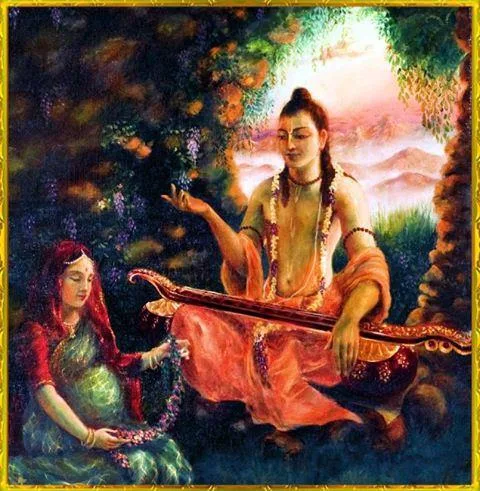
The story reaches us second-hand. Long afterward, at Maharaja Yudhishthira's Rajasuya sacrifice, the king watched the lifelong enemy of God, Shishupala, die at Krishna's hand and merge directly into the Lord's own body. Yudhishthira thought this ending was far too merciful for so hateful an enemy. He asked the sage seated nearby to explain it. Narada Muni answered him by narrating the entire history of Prahlada Maharaja. Narada explained how such mercy could reach even an enemy like Shishupala. Yudhishthira could understand it, he said, only by first understanding how completely the Lord protects and raises up His devotees. Prahlada Maharaja himself later retold part of that same history to his own demon classmates. It is in that retelling that we learn what Narada had done for him before he was even born.
Rescuing Kayadhu #
When the demon king Hiranyakashipu left his kingdom to perform severe austerities on Mandaracala Mountain, the demigods under Indra saw their chance and attacked the undefended capital. Hiranyakashipu's pregnant queen, Kayadhu, was taken captive. Indra assumed that her child would grow into another demon. So he intended to hold her until the child was born, so that it could be killed at birth. As Indra's forces dragged her away, crying out like a bird seized by a hawk, Narada Muni happened to be passing. He stepped in immediately, telling Indra that the woman was sinless and had to be released. Indra objected that the seed of a great demon lay within her. But Narada answered with something Indra had not expected. He said the child in her womb was faultless, a great devotee of the Lord, and no one would be able to kill him. Respecting Narada's word, Indra released her at once.
Instruction Given, and Received, in the Womb #
Narada then brought Kayadhu to his own ashrama and kept her under his protection for the months until Hiranyakashipu's return. She served him there with devotion. Prahlada says that Narada, moved by his natural compassion for fallen souls, gave her long instruction in bhagavata-dharma, transcendental knowledge untouched by material contamination. Prahlada gently admits that Kayadhu herself forgot almost all of it in the years that followed. But the child in her womb did not. Prahlada Maharaja states plainly that Narada's mercy had blessed him directly, so he remembered every word. This instruction, received before he was born, made him the unshakeable devotee history remembers, from his infancy onward. It was not anything he later learned in his father's demon-run household.
What Narada Actually Taught #
Years later, Prahlada Maharaja retold the instruction to his demon classmates, giving its main points and not every word. In short, he said that the spirit soul is never the same thing as the material body it happens to live in. A body is born, grows, matures, produces by-products, wastes away, and dies. Every material object goes through these six changes. But the soul within goes through none of them, because it is spiritual and self-illuminated. It is the knower of the body, not the body itself. Prahlada compared finding this soul within the body to the work of a skilled geologist. Where an untrained eye sees only rock, such a person can see gold buried in the stone. The method, he said, is a careful, patient process of setting aside everything that is not the self, "this is not it, this is not it," until only the spiritual particle remains. Srimad-Bhagavatam teaches this exact method clearly: "One must find the soul by analysis, saying, 'This is not it. This is not it.' Thus one must separate spirit from matter" (Srimad-Bhagavatam 7.7.23). Prahlada Maharaja became one of the most celebrated philosophers of the soul in Vedic literature. Yet he was taught to think this way, quite literally, before he had ever taken a single breath outside his mother's body.
So the same sage who delivered Dhruva Maharaja delivered Prahlada Maharaja too, in a real sense, before Prahlada had even drawn a single breath.
Scriptural evidence for this chapter (2)
देहस्तु सर्वसङ्घातो जगत्तस्थुरिति द्विधा ।
अत्रैव मृग्य: पुरुषो नेति नेतीत्यतत्त्यजन् ॥ २३ ॥
dehas tu sarva-saṅghāto
jagat tasthur iti dvidhā
atraiva mṛgyaḥ puruṣo
neti netīty atat tyajan
Word for word
dehaḥ: the body; tu: but; sarva-saṅghātaḥ: the combination of all the twenty-four elements; jagat: seen to be moving; tasthuḥ: and standing in one place; iti: thus; dvidhā: two kinds; atra eva: in this matter; mṛgyaḥ: to be searched for; puruṣaḥ: the living entity, the soul; na iti, na iti: thus, thus not; atat: what is not spirit; tyajan: giving up.
There are two kinds of bodies for every individual soul, a gross body made of five gross elements and a subtle body made of three subtle elements. Within these bodies, however, is the spirit soul. One must find the soul by analysis, saying, "This is not it. This is not it." Thus one must separate spirit from matter.
From the purport: "An expert in the study of soil can find out where gold is and then dig there... Similarly, one must analyze the whole body to find within the body the spirit soul."
This is the verse behind Prahlada's own retelling of Narada's womb-instruction: the neti-neti analysis and the gold-in-ore comparison both come from Prabhupada's purport here.
श्रीनारद उवाच अयं निष्किल्बिष: साक्षान्महाभागवतो महान् ।
त्वया न प्राप्स्यते संस्थामनन्तानुचरो बली ॥
śrī-nārada uvāca
ayaṁ niṣkilbiṣaḥ sākṣān
mahā-bhāgavato mahān
tvayā na prāpsyate saṁsthām
anantānucaro balī
Word for word
śrī-nāradaḥ uvāca: the great saint Narada Muni said; ayam: this (child within the womb); niṣkilbiṣaḥ: completely sinless; sākṣāt: directly; mahā-bhāgavataḥ mahān: a great saintly devotee; tvayā: by you; na prāpsyate: will not obtain; saṁsthām: his death; ananta-anucaraḥ: a servant of the Supreme Personality of Godhead; balī: extremely powerful.
Narada Muni replied: The child within this woman's womb is faultless and sinless. Indeed, he is a great devotee, a powerful servant of the Supreme Personality of Godhead. Therefore you will not be able to kill him.
From the purport: Purport excerpt: "There have been many instances in which demons or nondevotees have attempted to kill a devotee, but they have never been able to destroy a great devotee of the Supreme Personality of Godhead."
Narada's declaration to Indra that saved Kayadhu and the unborn Prahlada Maharaja.
Chapter 6
Transforming the Hunter Into Valmiki
Before he became the sage who composed the Ramayana, Valmiki was a robber, until Narada asked him one uncomfortable question.
A Question His Own Family Would Not Answer #
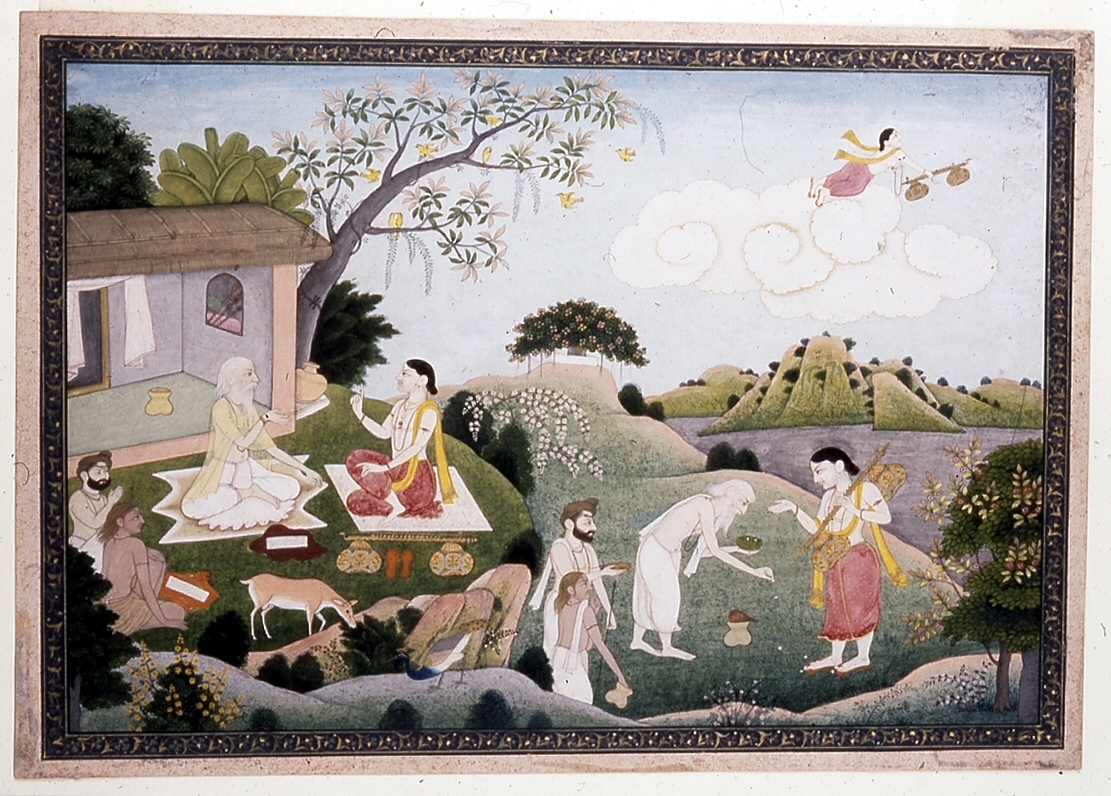
Vaishnava tradition holds that the sage later known as Valmiki began his life as a highway robber named Ratnakara. He fed his family by robbing travellers passing through the forest. This is recorded, among other places, in the retellings of how the Ramayana itself came to be written. One day he tried to rob Narada Muni. Narada did not resist. He offered to give him everything he wanted, on one condition. Go home, he said, and ask your family a single question: are they willing to share the sin of the crimes that feed them, the way they share the food and money those crimes buy? Trusting they would say yes, Ratnakara went home and asked.
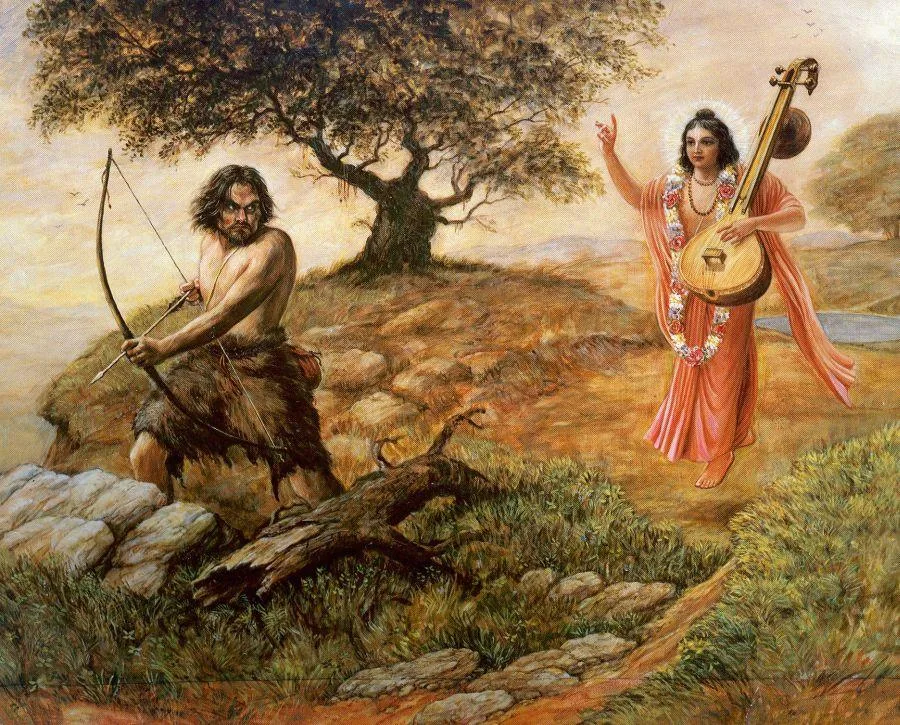
They refused outright. His wife and children told him they were glad to eat what he brought them, but the sin of getting it was his alone to carry. They wanted no part of it. Ratnakara returned to Narada in disgust. This refusal, more than any sermon, broke his attachment to the life he had been living.
The Word Hidden Inside a Name #
Narada then told him to give up that life and gave him a word to repeat instead: the word *mara*, meaning "death." It was meant to shock him into seeing how short the life he had spent robbing others really was. Ratnakara sat down and repeated it without pause, mara, mara, mara. He did this for so long that, without realising it, he was also repeating the reversed syllables of Rama's own name. He remained in that meditation so long that an anthill, a *valmika*, grew up around his motionless body. When he finally came out of it, transformed, the name Valmiki was the one that stayed with him.
Prabhupada on Valmiki #
Srila Prabhupada returned to this story often. He did so because it shows something he wanted every disciple to understand about how devotional association really works. A single meeting with a genuine devotee, even a meeting the person did not want, can reform even a lifelong criminal. In a 1966 lecture on Chaitanya-charitamrita he held Valmiki up as living proof that Narada's mercy reaches even a dacoit. Two years later, in Montreal, a student asked him how Krishna consciousness first came to this earth. In his answer he named Valmiki together with Dhruva Maharaja, Prahlada Maharaja, and Vyasadeva. These were four completely different men, in four completely different situations, delivered by the same guru.
Two Sages, Two Separate Gifts #
Vaishnava tradition gives two different sages two different roles in this story, and it is important not to mix them up. Narada Muni changed Ratnakara's character. He is the one who turned a robber's heart around and gave him a mantra to meditate on. The actual order to write the Ramayana itself came later, and from a different source entirely. Tradition holds that Lord Brahma personally visited the now-purified sage in his forest ashrama and instructed him to compose Lord Ramachandra's history. Brahma promised that everything he needed to know about Rama, Sita, Lakshmana, and every other figure in that history would become known to him, even though he had not seen it with his own eyes. Narada made Valmiki a sage; Brahma made him a poet. Through these two sages, Vedic literature gained one of its two great itihasas.
Valmiki went on to compose the Ramayana itself, twenty-four thousand Sanskrit verses telling the life of Lord Ramachandra. Later Gaudiya Vaishnavas study this work for its own devotional value. According to this tradition's own account, the Ramayana exists only because a forest robber once tried to rob Narada Muni.
Chapter 7
Instructing Vyasadeva to Write Srimad-Bhagavatam
Vyasadeva had already compiled the Vedas and written the Mahabharata, yet Narada found him still unsatisfied, and told him exactly why.
A Dissatisfaction Vyasadeva Could Not Name #
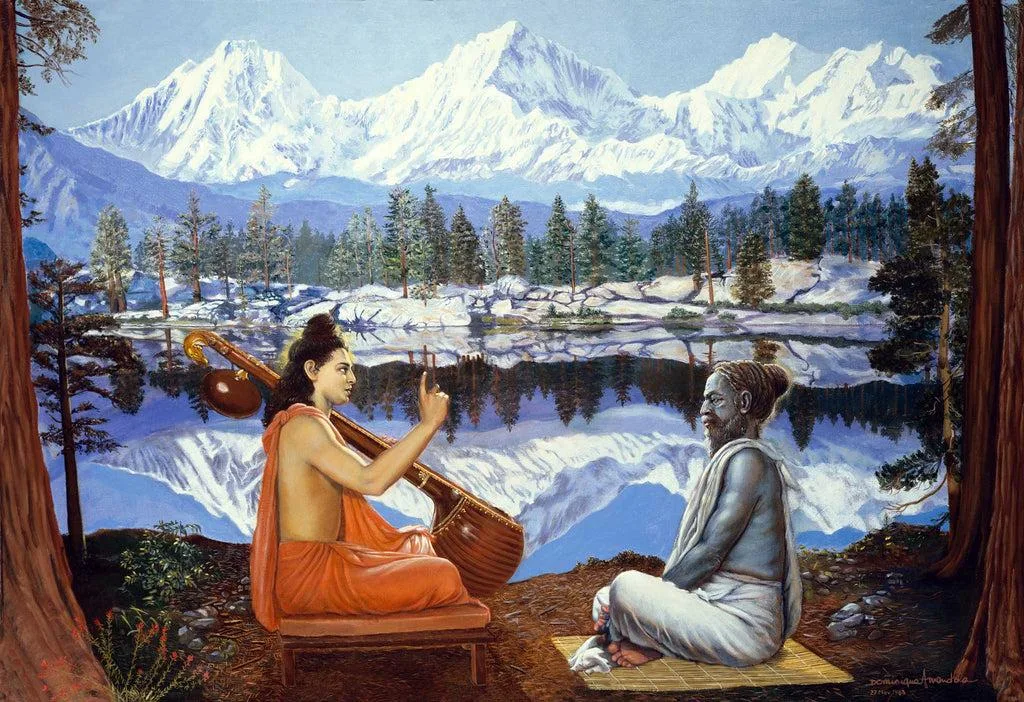
Srimad-Bhagavatam's own account of its origin opens with Vyasadeva sitting alone on the bank of the Sarasvati. He was deeply unhappy, even though he had an almost unimaginable amount of finished work behind him. He had arranged the Vedas into their four divisions, compiled the Puranas, and completed the Mahabharata, the vast epic meant to bring Vedic knowledge within reach of ordinary people. None of it had brought him peace. At this low point, his own guru, Narada Muni, arrived. Smiling, Narada asked Vyasadeva directly whether he was really satisfied identifying himself with his body and mind as the field of self-realisation. Whatever his answer might be, it was clear that Vyasadeva was not at peace.
Narada's Diagnosis #
Vyasadeva admitted Narada was right. Something was missing, and he could not say what. Narada told him plainly. Vyasadeva had described religious duty, economic development, and the other goals of life at great length. But he had not properly described the glories of the Supreme Personality of Godhead himself. Any literature that fails to describe the Lord directly is like a place of pilgrimage for crows, however learned it may be. It is of no real use to a soul who is truly seeking the spiritual goal. But literature that does describe the Lord's names, forms, qualities, and pastimes is different. Even if it is not perfectly composed, every honest, purified person hears it, sings it, and treasures it. This is because only such literature brings about real change in a world that has gone the wrong way.
Instruction Confirmed by His Own Experience #
Narada did not stop at pointing out the problem. He told Vyasadeva that Vyasadeva himself was perfectly qualified to write exactly this kind of literature. His vision was pure, his vows were firm, and he could sit in trance and see the Lord's pastimes directly. Then Narada told Vyasadeva something remarkable about Narada's own life. In a previous birth, Krishna himself had given Narada this same knowledge and devotional service. This is the story Narada tells at length elsewhere. This personal experience was exactly why Narada could speak with such confidence about what Vyasadeva was missing. Any writing not centred on the Lord, he warned, disturbs the mind the way wind tosses a boat that has nowhere to anchor. But writing that describes the Lord in trance gives the writer's own mind somewhere real to rest.
Narada also answered an objection Vyasadeva had not even raised yet. Someone might say that describing devotional life could lead people into activities that might not always succeed. Narada's answer was that a devotee who takes up the Lord's service and stumbles is still far ahead of someone who does their ordinary material duties perfectly. This is because a soul that has once tasted devotional life cannot help but return to it. But perfect material work simply produces more material bondage. Srimad-Bhagavatam preserves Narada's own words to Vyasadeva on this exact point: "One who has forsaken his material occupations to engage in the devotional service of the Lord may sometimes fall down while in an immature stage, yet there is no danger of his being unsuccessful. On the other hand, a nondevotee, though fully engaged in occupational duties, does not gain anything" (Srimad-Bhagavatam 1.5.17). He even gave Vyasadeva a kind of reasoning taken from medicine for the whole project. An activity that binds a person to matter can, when turned toward the Lord's service, become the very thing that cuts that bondage away. In effect, he said that the same fire that causes a disease can be turned into its cure.
The Result #
Vyasadeva accepted the instruction completely. Sitting in meditation on the bank of the same river, he began to see the Supreme Personality of Godhead and His energies exactly as Narada had described. From that vision he composed Srimad-Bhagavatam. This entire disciplic line, all the way down to Srila Prabhupada and this movement, holds it as its single most important text. In some sense, every acharya in this tradition who ever wrote a word about Krishna's pastimes owes his work to this one conversation between a guru and his disciple on the bank of the Sarasvati.
Chapter 8
The Narada-bhakti-sutra
A short Sanskrit text of brief sayings (sutras) on bhakti, traditionally credited to Narada himself, and a book Srila Prabhupada once began, then set aside.
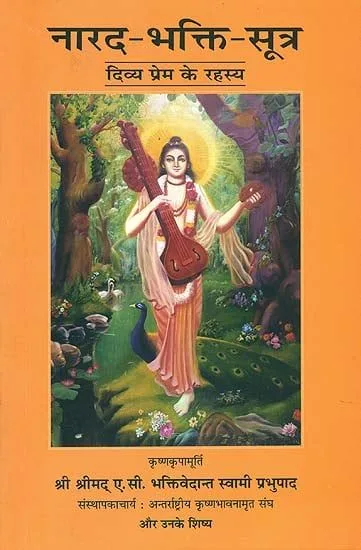
Eighty-Four Sutras on the Nature of Bhakti #
The Vedic tradition has many short Sanskrit texts called sutras, made up of brief, packed statements. One of them, the Narada-bhakti-sutra, is traditionally credited to Narada Muni himself. This short work of about eighty-four statements explains what bhakti really is. It shows how bhakti differs from ordinary religious duty and from the search for liberation, what obstacles block it, and how a sincere devotee can recognise real progress in it. Over the centuries Vaishnava commentators have written at length on these short sutras, just as later commentators explained Vyasadeva's own Vedanta-sutra.
As with many such texts, scholars disagree about exactly when it was written and by whom. The belief that Narada himself wrote it comes from tradition. It cannot be checked by any independent evidence. But its teaching fits well with the devotional teaching of this whole disciplic line, and Srila Prabhupada accepted it as authoritative whenever he referred to it directly. Students of Vedanta sometimes discuss it together with a second, similar work, the Shandilya-bhakti-sutra, which tradition credits to the sage Shandilya. The two texts are usually seen as companion works from two different lines of the tradition. Both try to define bhakti in short, exact statements, with the same care that Vyasadeva himself brought to Vedanta philosophy.
What Bhakti Actually Is #
One definition from this line of teaching became especially well known in Gaudiya Vaishnavism. It says that bhakti means engaging the senses in the service of Hrishikesha, the master of the senses, once a soul has become free of every material designation. Srila Prabhupada introduced this exact definition as coming from the Narada-bhakti-sutra when he spoke at Andhra University in 1972. The same verse also appears, in almost the same words, in Srila Rupa Gosvami's Bhakti-rasamrita-sindhu. But there the verse is credited to a different text, the Narada-pancharatra, which is related but separate. Both the printed edition and the purport in Sri Chaitanya-charitamrita that quotes the verse say this. Chaitanya Mahaprabhu himself quotes it this way while instructing Rupa Gosvami at Prayag: "Bhakti, or devotional service, means engaging all our senses in the service of the Lord, the Supreme Personality of Godhead, the master of all the senses" (Sri Chaitanya-charitamrita, Madhya 19.170). So the sources name different books for this verse. We do not try to settle this small difference here, because both texts clearly come from the same basic teaching about what bhakti means at its root.
A second theme runs through almost everything that Vaishnava tradition links with Narada's teaching on bhakti. Bhakti is *ahaituki*, causeless, and *apratihata*, unstoppable. This is exactly how Srimad-Bhagavatam itself defines the supreme occupation of humanity: "The supreme occupation [dharma] for all humanity is that by which men can attain to loving devotional service unto the transcendent Lord. Such devotional service must be unmotivated and uninterrupted to completely satisfy the self" (Srimad-Bhagavatam 1.2.6). It is open to absolutely anyone, whatever their birth, learning or qualification, and once it begins nothing can stop it. It is no coincidence that this is exactly the kind of devotion Narada himself received in his previous life. He was then a poor and uneducated servant boy with no formal qualification. Later he gave the same devotion, without hesitation, to a queen in captivity, a grieving five-year-old prince and a highway robber.
A Book Srila Prabhupada Set Aside #
Letters from Srila Prabhupada's first years in America show that he began an English translation of the Narada-bhakti-sutra almost as soon as he started writing to his first disciples. In February 1967 he sent Satsvarupa dasa Goswami the first installment of what he called simply "Narada Bhakti Sutras," and asked for feedback before continuing. A month later, though, he decided to finish Teachings of Lord Chaitanya first. He explained to the same disciple that the subject matter of the Narada-bhakti-sutra was already covered in that other book. As far as the surviving record shows, he never went back to it. He did not finish it himself. Later, the Bhaktivedanta Book Trust published it as a separate volume, begun by Srila Prabhupada and completed by his disciple Satsvarupa dasa Goswami. It is a small gap in his very large body of finished books. It also shows once more how carefully Srila Prabhupada, like Narada himself, always considered which project would best serve Krishna consciousness in the time he had.
Scriptural evidence for this chapter (3)
Quoted in the text above:
- CC Madhya 19.170 Sri Chaitanya-charitamrita
- SB 1.2.6 Srimad-Bhagavatam
- CC Madhya 19.170 Narada-pancharatra (quoted in Bhakti-rasamrita-sindhu 1.1.12 and Sri Chaitanya-charitamrita, Madhya-lila 19.170)
Chapter 9
Legacy as the Travelling Teacher of Bhakti
Present since the dawn of this universe, still travelling without restriction, and still making devotees wherever he goes.
"Unlimited" Disciples #
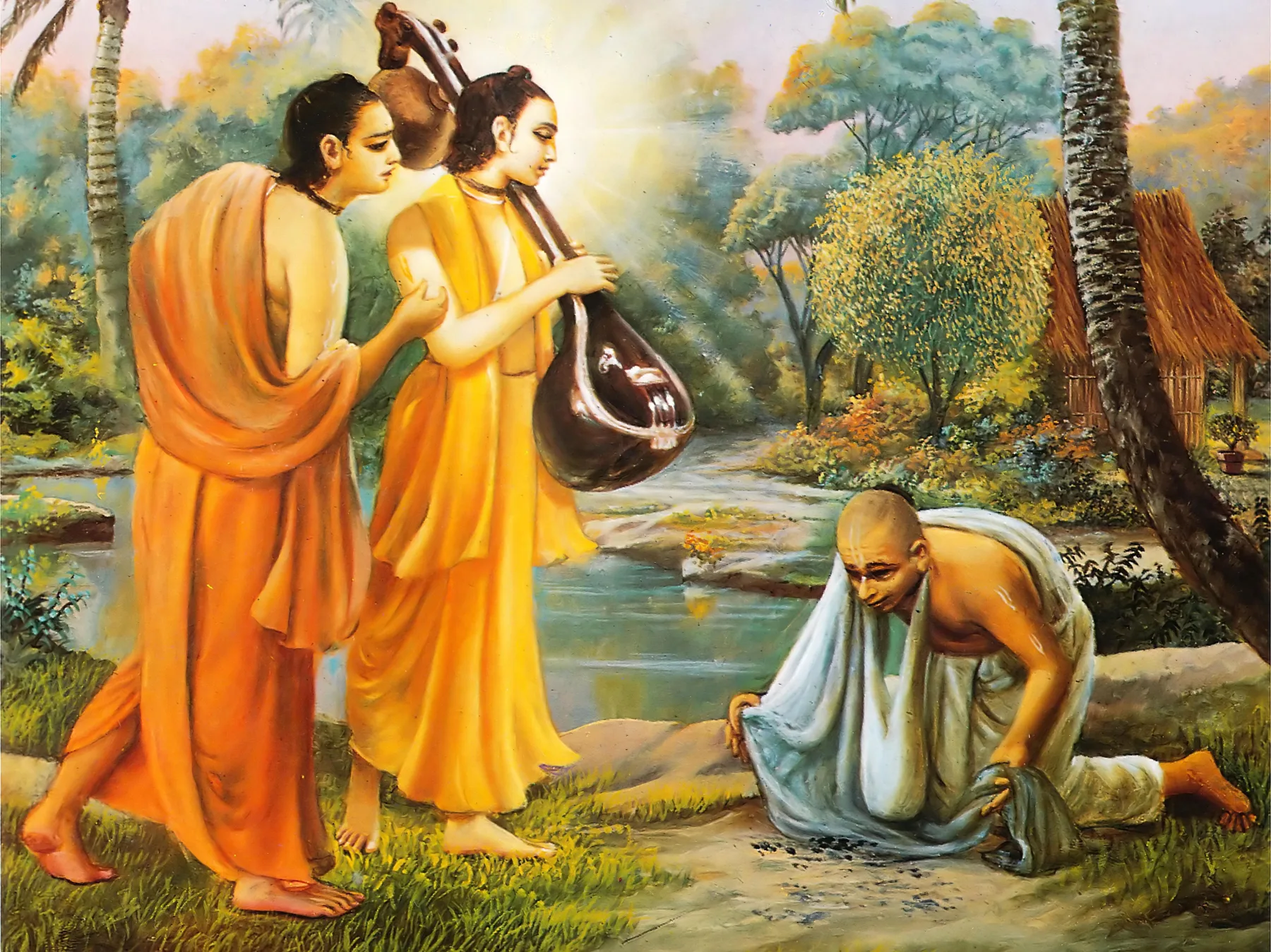
In 1968, a young devotee in Montreal asked Srila Prabhupada a striking question: had Narada Muni actually brought the chanting of the Hare Krishna mantra to this earth, and if so, how long ago? Prabhupada's answer shows something important about Narada's place in this tradition. Such a thing cannot really be calculated, he said, because Narada has been present since the time of creation, as one of the sons of Brahma. And nearly every great devotee described in Vedic literature is, in one way or another, his disciple. He then named them: Prahlada Maharaja, Dhruva Maharaja, Vyasadeva, Valmiki. He summed up Narada's entire mission in a single thought. Narada was extremely skilled at making disciples, and in the end their true number was simply too great to count.
Named by Chaitanya Mahaprabhu Himself #
Sri Chaitanya Mahaprabhu makes much the same point in his own teaching, as recorded in Sri Chaitanya-charitamrita. Mahaprabhu explains to Sanatana Gosvami the different kinds of empowered incarnations the Lord sends into the world. He names Narada, alongside the four Kumaras, Maharaja Prithu, and Lord Parashurama, as one of the principal shaktyavesha-avataras: souls invested with a specific opulence of the Supreme Personality of Godhead. Brahma carries the power to create, and Ananta Shesha carries the power to support every planet in existence. In the same way, Narada carries the power of devotional service itself. He can awaken bhakti in anyone he meets.
A Fellow Traveller, Centuries Apart #
Narada's constant travelling was not simply part of his personality. In fact, it began as Prajapati Daksha's curse, spoken in anger after Narada twice talked Daksha's sons out of fathering children. In his own purport to that curse, Srila Prabhupada explains that for a preacher, a life of never being able to settle anywhere is no punishment at all. It is exactly the qualification of a parivrajakacharya, a wandering teacher. Such a teacher travels constantly for the benefit of people who would otherwise never hear Krishna's names.
Srila Prabhupada's own biographers noticed the same pattern repeating in his life. Satsvarupa dasa Goswami's biography Srila Prabhupada-lilamrita describes Prabhupada's decision to travel the world alone in his seventies, instead of staying quietly in Vrindavana. It compares him directly to Narada Muni and to Chaitanya Mahaprabhu. All three were wandering preachers, or parivrajakacharyas. They carried Krishna's message to every part of the world instead of waiting for the world to come to them. The same biography notes that a journalist of the time once called Prabhupada a jet-age parivrajakacharya. This is essentially the same title that Vedic literature has given to Narada Muni for thousands of years.
Beyond the Gaudiya Tradition #
Narada's reach goes even further. Outside the Gaudiya line altogether, the Chandogya Upanishad, one of the oldest Upanishads, records a well-known conversation between Narada and the sage Sanatkumara. Narada comes to him and asks to be taught the knowledge of the Self, since he has heard that whoever knows the Self is free of sorrow. Sanatkumara asks what he has already studied. Narada answers with an almost complete list of ancient learning: the four Vedas, the epics and old itihasas, grammar, mathematics, astronomy, ethics, logic, and more. Then he admits plainly that none of it has actually freed him from suffering. This is a striking echo of the very lesson Narada would later teach others, from Dhruva Maharaja to Vyasadeva himself. Mastering every branch of worldly and even scriptural knowledge is not the same thing as knowing the Self. Real learning is worth nothing until it leads a person beyond learning itself. Vedantic commentators have discussed this passage for centuries. It shows that the wider Vedic tradition, not only Vaishnavism, recognised Narada's role as a seeker and teacher of transcendental knowledge. In every century and in every tradition, the same figure keeps appearing. He is a sage with a vina on his shoulder, not attached to any one place, who cannot stop telling anyone who will listen about Krishna.
Scriptural evidence for this chapter (1)
সনকাদ্যে ‘জ্ঞান’-শক্তি, নারদে শক্তি ‘ভক্তি’ ।
ব্রহ্মায় ‘সৃষ্টি’-শক্তি, অনন্তে ‘ভূ-ধারণ’-শক্তি ॥
sanakādye 'jñāna'-śakti, nārade śakti 'bhakti'
brahmāya 'sṛṣṭi'-śakti, anante 'bhū-dhāraṇa'-śakti
Word for word
sanaka-ādye: in the four Kumaras; jñāna-śakti: the power of knowledge; nārade: in Narada Muni; śakti bhakti: the power of devotional service; brahmāya: in Lord Brahma; sṛṣṭi-śakti: the power of creation; anante: in Lord Ananta; bhū-dhāraṇa-śakti: the power to carry the planets.
The power of knowledge was invested in the four Kumaras, and the power of devotional service was invested in Narada. The power of creation was invested in Lord Brahma, and the power to carry innumerable planets was invested in Lord Ananta.
Sri Chaitanya Mahaprabhu's own explanation, to Sanatana Gosvami, of the specific opulence Narada Muni carries as a shaktyavesha-avatara.
Closing
A Devotee Empowered to Travel Anywhere #
Because of his devotion, Narada received a special power that makes him truly unusual, even among great sages. He can move freely through every corner of the material universe and the spiritual sky. The modes of nature, which limit every other embodied soul, do not bind him. Srila Prabhupada's purports describe him as the chief authority on bhakti itself. Sages like Marichi are authorities on ritual, and Sanaka and Sanatana on philosophy. But only Narada has the special work of awakening devotion in others, wherever he travels and whoever he meets. Sri Chaitanya-charitamrita records the same idea in Chaitanya Mahaprabhu's own words. Among the Lord's principal empowered incarnations, the Lord gave the special power of devotional service, bhakti-shakti, to Narada, just as He gave the power of creation to Brahma.
