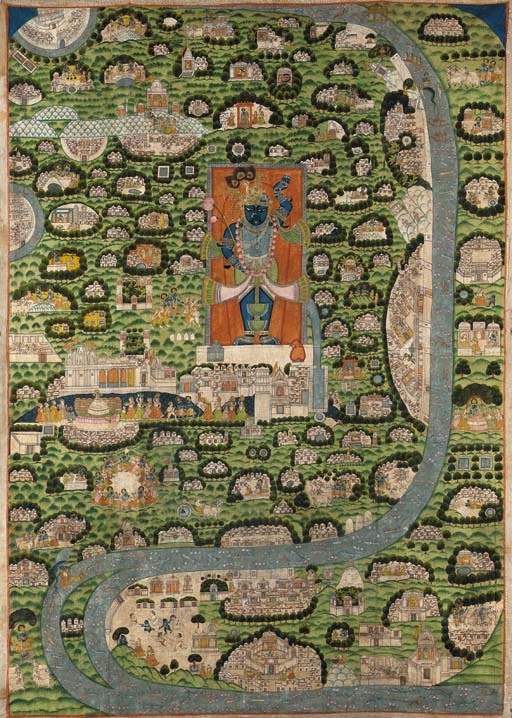
After settling near Radha-kunda, Narayana Bhatta Goswami spent roughly eight years walking, in person, through the entire sacred land of Vraja-mandala and writing down what he found. No single person before him is recorded to have done this as thoroughly.
Eight Years Among the Groves #
As later writers describe it, his method combined walking with listening and reading. He visited village after village and grove after grove, asked local people what they remembered, and checked what he heard against the Varaha Purana and other scripture. Where a pond, a small hill or a group of trees had a local tradition of some pastime of Radha and Krishna, he recorded it. Some deities had been lost, hidden, or simply forgotten over generations of trouble. He searched them out and helped to start their worship again. By then, Sri Chaitanya Mahaprabhu had passed from this world, and the first generation of His closest associates in Vraja was growing old. Much of this local knowledge was in danger of being scattered or lost with them. Narayana Bhatta Goswami's long walk was, in effect, a race to gather it into one lasting account before it disappeared.
Twelve Forests, Four Rings #
The result of this survey was an organized map of Vraja built around its twelve traditional forests: Mahavana, Kamyavana, Madhuvana, Talavana, Kumudavana, Bahulavana, Bhandiravana, Bhadravana, Khadiravana, Lohavana, Vrindavana and Belvana. Narayana Bhatta Goswami is credited with arranging this land into four levels, one inside another: vana, upavana, prativana and adhivana. Together they cover what tradition calls the eighty-four kos of Vraja-mandala. The kos is a traditional measure of distance, and later pilgrims and guidebooks generally measure this at somewhere near 270 kilometers of walking in total. In doing so he, in effect, fixed the boundary that later pilgrims would walk as the Chaurasi-kos Parikrama, the eighty-four kos circuit still followed today. He also gave that circuit a clear order within it, so that it was not left as a loose collection of holy sites.
Deities Brought to Light #
Tradition connects his prayers directly to at least one specific result that can still be seen. The deity now worshiped in the Shriji Temple at Barsana is said to have manifested on the second day of the bright half of the month of Ashadha in 1570 CE, in answer to Narayana Bhatta Goswami's devotion. This is temple tradition, not a historical record that can be checked independently. So it is given here as tradition, not as settled fact.
His work of rediscovery was not limited to uncovering hidden deities. It also meant identifying the memory of specific pastimes at specific spots, and then keeping that memory alive. At Sankari-khor, a narrow passage between two hills near Barsana, local memory held that Krishna and His cowherd friends used to stop the gopis as they carried milk, yoghurt and butter across the hills. Krishna and His friends would seize the gopis' loads, pretending to collect toll at a "toll gate," or dana-ghati. Narayana Bhatta Goswami is credited with turning that remembered pastime into a performed one. He started a yearly performance of it at Sankari-khor, a tradition described further on The Ban-Yatra Tradition.
According to at least one modern account, his work of uncovering lost pastime-places also overlapped with the efforts of Sri Rupa Goswami and Sanatana Goswami in Vrindavana proper. But the other available sources do not confirm any direct joint effort between them. There was also a generation gap between Narayana Bhatta Goswami's arrival in Vraja and the Six Goswamis' own decades of work there. Because of this, it is uncertain at best that they worked closely together. So this is reported here as a single, unconfirmed claim, not as an established fact.
A Landscape Later Scholars Still Study #
The twelve forests that Narayana Bhatta Goswami surveyed are not just a devotional curiosity found only in old guidebooks. They are still studied as a subject of their own. The American scholar David L. Haberman built an entire academic book, Journey Through the Twelve Forests: An Encounter with Krishna, around walking this same landscape and talking to the pilgrims and residents who still treat it as sacred ground. The way modern scholars approach this part of North India is still shaped by a sixteenth-century Vaishnava's fieldwork. This itself shows how thoroughly Narayana Bhatta Goswami's survey took hold.
What Narayana Bhatta Goswami wrote down from all this walking became his own book, described on Writing the Vraja-bhakti-vilasa, the text that, in turn, made possible the pilgrimage described on The Ban-Yatra Tradition.
