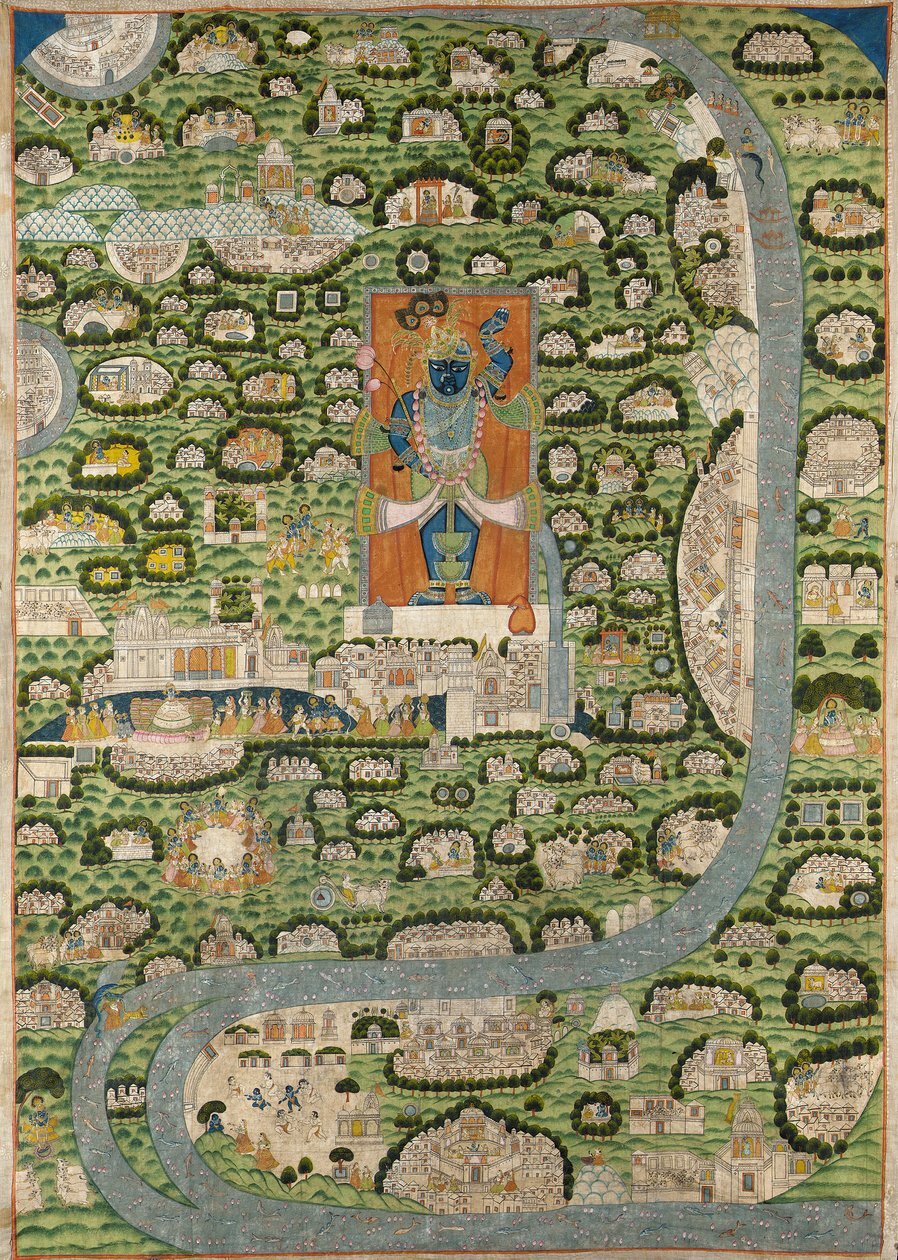
Narayana Bhatta Goswami gathered everything his years of walking Vraja had taught him into a single Sanskrit work, the Vraja-bhakti-vilasa. He composed it on the bank of Radha-kunda near Govardhan. Sources give its date as either 1552 or 1553 CE, so both years are given here.
A Guidebook Built on the Varaha Purana #
The book uses the Varaha Purana as its scriptural authority for the holiness of Vraja's sites. On that basis it does something very exact. It names, one by one, a very large number of Vraja's groves, ponds and villages (one count puts the figure at 333 forests and holy places). To almost every one of them it links the exact pastime of Krishna that tradition says took place there. Earlier tradition might have known, in general terms, that Krishna's pastimes happened "somewhere in Vraja," but the Vraja-bhakti-vilasa makes a point of naming the place.
An Author Who Names Himself Narada Muni #
His tradition holds that Narayana Bhatta Goswami was an avatara of Narada Muni. This is stated in the introduction to the Hindi edition of the Vraja-bhakti-vilasa and in later verses of praise. It does not come from Kavi Karnapura's Gaura-ganoddesha-dipika, the standard reference that lists the eternal identities of Sri Chaitanya Mahaprabhu's own associates. Narayana Bhatta Goswami belonged to a slightly later generation of Vraja Vaishnavas, and he does not appear in that text at all. So readers should take this as the belief of his own tradition. It is not a claim confirmed by any older source.
A Devotional Voice in Braj-Bhasha #
Besides his formal Sanskrit writing, at least one verse of his in the local language, Braj-bhasha, still survives. It praises the enchanting quality of Vraja itself. In it the groves, the river and the residents are all called "mohini," enchanting. The full verse is quoted in the citations for this history, and its translated line is quoted on Narayana Bhatta Goswami's main biography page. Elsewhere in the Vraja-bhakti-vilasa (verse 10.76, as preserved in Srila Bhaktivedanta Narayana Maharaja's Sri Vraja-mandala Parikrama), Narayana Bhatta Goswami offers a Sanskrit verse of homage to Govinda together with Vrinda-devi. This verse is also recorded in the citations here.
Even the title has meaning. Bhakti-vilasa can be read as something like "the delight, or the playful unfolding, of devotion". It is a guidebook that treats visiting Vraja's holy ground as an act of bhakti in itself, not as sightseeing. Each footstep becomes a small act of devotion, once the place it leads to is properly named and understood.
A Different Kind of Gaudiya Text #
Much of the great literature that came out of Vraja in this same period is mainly concerned with rasa, siddhanta and the inner life of bhakti. This includes the theological works of Jiva Goswami, the poetry and drama of Rupa Goswami, and the devotional memoirs later composed at Radha-kunda. The Vraja-bhakti-vilasa is different from those works. Above all, it is a book of geography, a tirtha-guide meant to be carried and used while walking. Because it is a different kind of book, Narayana Bhatta Goswami is remembered less as a theologian and more as the acharya who made Vraja's holy places easy to find and understand. This difference should be kept in mind when we compare his contribution with that of the Six Goswamis.
Other Attributed Works #
Some modern accounts credit Narayana Bhatta Goswami with other titles, among them Braj Pradipika and Braj Prakash. They even describe him as the author of some fifty bhakti texts in total. That longer list cannot be checked from the sources available. Only the Vraja-bhakti-vilasa is widely quoted, cited and available today.
A Text Still in Print #
Unlike a great many sixteenth-century Sanskrit works, the Vraja-bhakti-vilasa was not left forgotten in old manuscripts. Hindi translations of the text are still read and passed around among Vraja's pilgrims and scholars. Scanned copies of at least one such edition are available to the public today. So anyone who wants to can read Narayana Bhatta Goswami's own route through Vraja directly, instead of only reading about it secondhand.
Lasting Use #
Centuries later, Vrajavasis, pilgrims and scholars alike still use the Vraja-bhakti-vilasa as the main text for finding Vraja's sacred sites. It is a main source behind David Haberman's academic study Journey Through the Twelve Forests. Later Gaudiya Vaishnava teachers also built their own parikrama guides on it, openly using it as their basic source. One example is Srila Bhaktivedanta Narayana Maharaja's twentieth-century Sri Vraja-mandala Parikrama. In this way a single sixteenth-century book still shapes how pilgrims are guided through Vraja today. It also directly shaped the pilgrimage circuit described on The Ban-Yatra Tradition. Its place within the wider project of Rediscovering the Twelve Forests of Vraja is described on that page.
