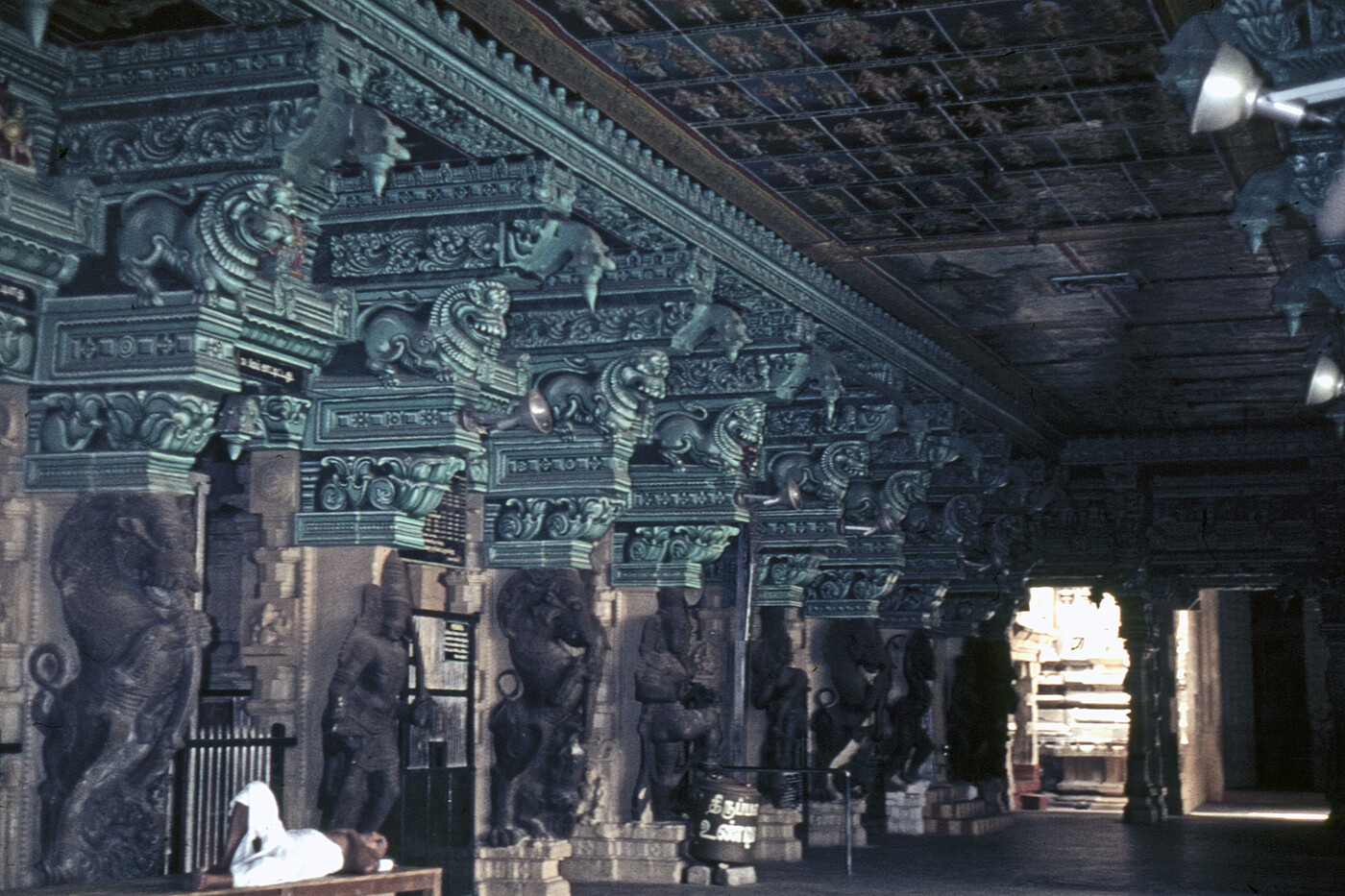
Narayana Bhatta Goswami was born into a Tailanga brahmana family in Madhurapattana, today's Madurai, in South India. Sources place his birth around 1531 CE. "Tailanga" points to a brahmana community with roots in the Telugu-speaking region. These brahmanas were known across India for their dedication to Vedic learning. His father, Sri Bhattaji, belonged to the Bhattabhaskara line of that community. By every account he was a truly learned man. Little else is recorded about Narayana Bhatta Goswami's childhood. The surviving sources move quickly from his birth to the time he left home.
A Name Worth a Careful Note #
Before going further, we should be clear about who Narayana Bhatta Goswami was not. A Sanskrit scholar named Nārāyaṇa Bhaṭṭa also lived in the sixteenth century. He lived in Benares, where he wrote on Dharmashastra, prosody and Alankara. His most famous work is the pilgrimage text Tristhalisetu. That Nārāyaṇa Bhaṭṭa was born around 1513 to a Maharashtrian brahmana family. His father, Rameshvara Bhatta, had moved to Banaras from the Deccan. So his family, region and writings were completely different from those of the Vraja Vaishnava acharya described here. The two men share little beyond a common name and a common century. But both are sometimes shortened to "Narayana Bhatta" in casual references, so the difference is stated plainly here, to avoid mixing them up.
Renouncing the World as a Boy #
Sources differ on the exact age at which Narayana Bhatta Goswami turned away from household life. Accounts give either twelve or fourteen. They also differ on the year he set out, and both 1545 and 1546 CE appear in different retellings. But they agree on the outcome. While still very young, he left South India and made the long journey to Vraja. He was drawn by devotion to Sri Radha, not by family or profession. By any account, it was an extraordinary journey for a boy of that age to make alone. He travelled on foot, or by whatever transport was available in the sixteenth century, across the whole length of India. He was going toward a land he had probably only heard described in scripture and in the accounts of other pilgrims and Vaishnavas passing through South India.
Finding a Guru Near Radha-Kunda #
In Vraja he received initiation from Krishna Dasa Brahmachari. Under his guru's guidance he settled near Radha-kunda to live and study. This is the same sacred kunda where Raghunatha Dasa Goswami spent his own life in bhajana. But the available sources do not record any direct meeting between the two. The sources are truly divided about who Krishna Dasa Brahmachari's own guru was. Some accounts place him in the line of Gadadhara Pandit, the intimate associate of Sri Chaitanya Mahaprabhu. At least one other account names him a disciple of Gopala Bhatta Goswami. The two claims cannot both be fully correct. Nothing in the available sources shows which is right, so both are given here.
Narayana Bhatta Goswami's South Indian birth also places him with two other prominent Gaudiya Vaishnavas of South Indian origin, Gopala Bhatta Goswami and Prabodhananda Saraswati. This likeness is real, but it is a likeness of homeland and background, not a recorded family tie. A shared homeland should not be turned into an invented relationship. Gopala Bhatta Goswami's family belonged to the Sri Vaishnava tradition of Ramanujacharya. But nothing in the available sources suggests that Narayana Bhatta Goswami also belonged to it before coming to Vraja. He is described simply as a brahmana from Madhurapattana, and no other religious background is added here beyond what is actually stated.
In these years Radha-kunda was becoming a settlement of serious Vaishnava practice, not an ordinary village. It was drawing people who had renounced the world and wanted to live close to the place of Krishna's meeting with the gopis after the rasa dance. This young newcomer from Madurai chose to settle and study there, not in the larger towns of Mathura or Vrindavana proper. That choice says something about the kind of devotion that shaped him. It was focused less on scholarship for its own sake and more on being physically near the ground where Radha and Krishna's pastimes were believed to have occurred. This focus would define his whole later career.
What Narayana Bhatta Goswami did next, once settled in Vraja, is the subject of Rediscovering the Twelve Forests of Vraja.
