Srila Narayana Bhatta Goswami
Rediscoverer of Vraja's Twelve Forests, Author of Vraja-bhakti-vilasa
The complete life, on one page: The main biography and every pastime page, in order, in one place
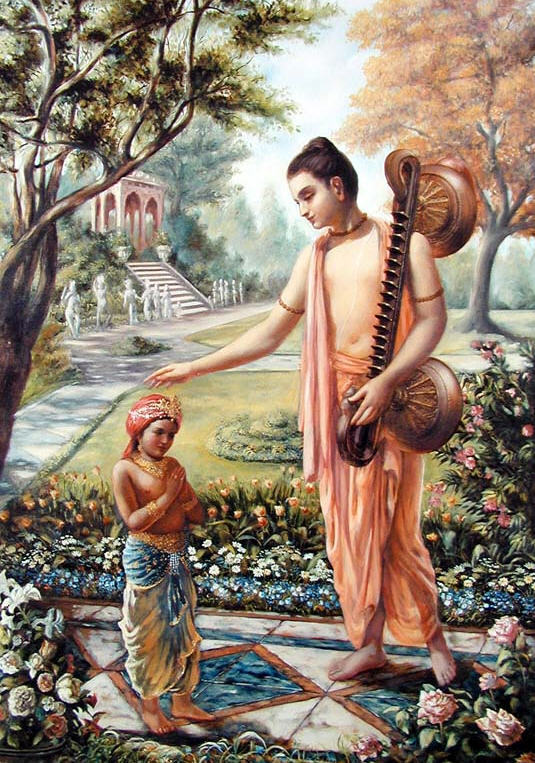
Introduction
Srila Narayana Bhatta Goswami was a Gaudiya Vaishnava acharya who spent most of a long life walking the forests, riverbanks and villages of Vraja. He matched almost every grove and pond to a specific pastime of Radha and Krishna. He is not one of the Six Goswamis of Vrindavana. They are Sri Rupa Goswami, Sanatana Goswami, Raghunatha Bhatta Goswami, Gopala Bhatta Goswami, Jiva Goswami and Raghunatha Dasa Goswami. But Vrajavasis have long spoken of him as an unofficial seventh Goswami, the Vrajacharya. His book laid out the holy places of Vraja in detail, as a route that pilgrims still follow on foot.
| Detail | Description |
|---|---|
| Birth | c. 1531 (sources vary), Madhurapattana (Madurai), South India |
| Identity | Held in his tradition to be an avatara of Narada Muni (Vraja-bhakti-vilasa, Hindi edition introduction) |
| Guru | Krishna Dasa Brahmachari |
| Arrived in Vraja | c. 1545–46 CE |
| Chief work | Vraja-bhakti-vilasa (composed c. 1552–53 at Radha-kunda) |
| Known as | Vrajacharya; informally, "the seventh Goswami" of Vrindavana |
| Disappearance | Not reliably documented; samadhi at Unchagaon, near Barsana |
Scriptural evidence for the introduction (1)
brajbhumi mohini main jani
mohini kunj, mohan sri-brndavan mohan jamuna pani
mohini nari sakal gokul ki boli mohini bani
sri-bhatt ke prabhu mohan nagar mohini radha rani
Vraja-bhumi is enchanting — the groves are enchanting, Sri Vrindavana is enchanting and the waters of the Yamuna are enchanting. All the women of Gokula are enchantresses who speak in an enchanting way. Sri Bhatta's own master and mistress are Mohana Nagara and Mohini Radharani.
A rare surviving vernacular Braj-bhasha verse attributed to Narayana Bhatta Goswami himself, used here as the source for the biography page's pull-quote.
Chapter 1
Birth in Madurai and the Journey to Vraja
A South Indian Brahmin boy renounces the world as a teenager and walks north to make Vraja his home.
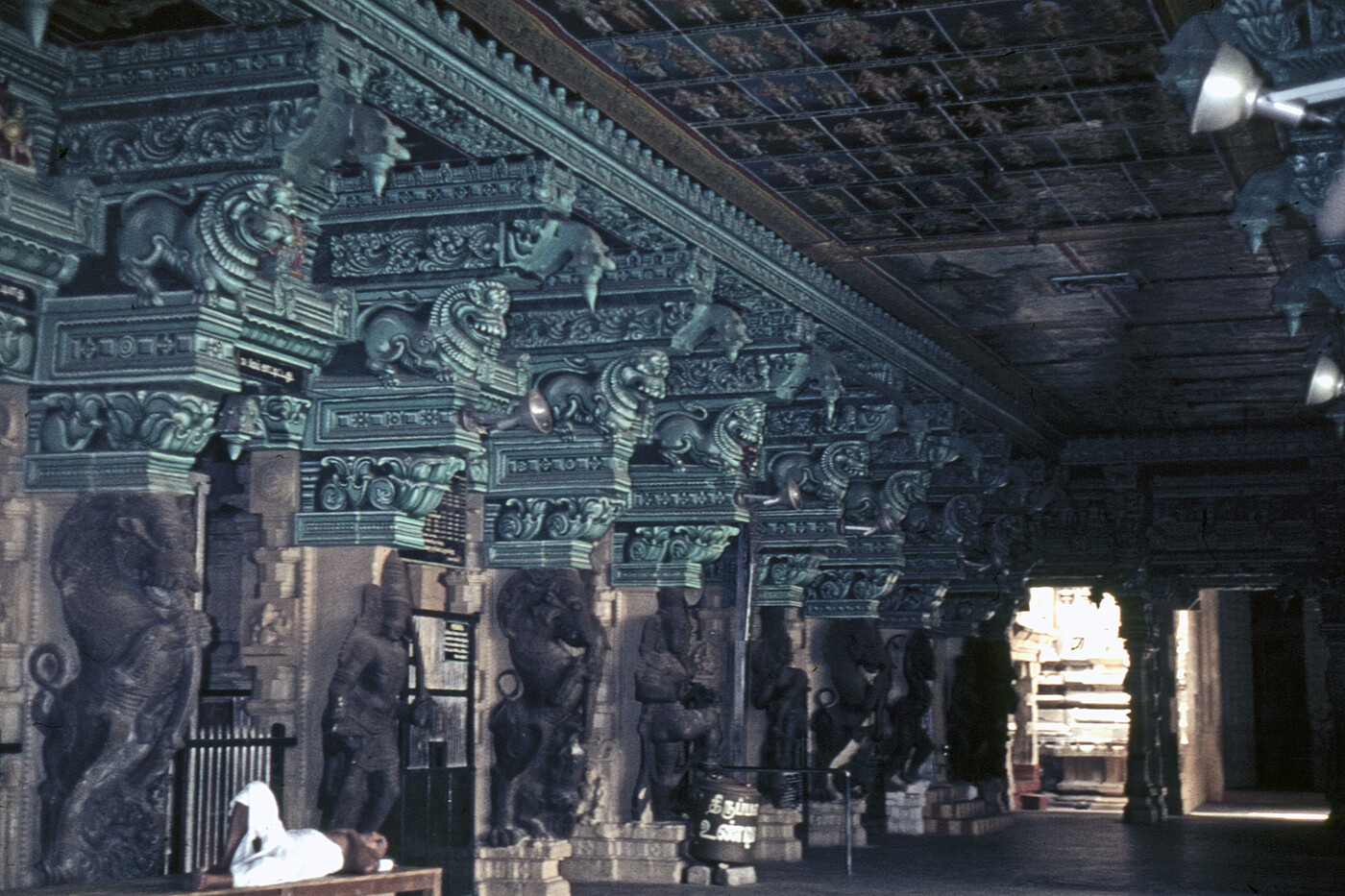
Narayana Bhatta Goswami was born into a Tailanga brahmana family in Madhurapattana, today's Madurai, in South India. Sources place his birth around 1531 CE. "Tailanga" points to a brahmana community with roots in the Telugu-speaking region. These brahmanas were known across India for their dedication to Vedic learning. His father, Sri Bhattaji, belonged to the Bhattabhaskara line of that community. By every account he was a truly learned man. Little else is recorded about Narayana Bhatta Goswami's childhood. The surviving sources move quickly from his birth to the time he left home.
A Name Worth a Careful Note #
Before going further, we should be clear about who Narayana Bhatta Goswami was not. A Sanskrit scholar named Nārāyaṇa Bhaṭṭa also lived in the sixteenth century. He lived in Benares, where he wrote on Dharmashastra, prosody and Alankara. His most famous work is the pilgrimage text Tristhalisetu. That Nārāyaṇa Bhaṭṭa was born around 1513 to a Maharashtrian brahmana family. His father, Rameshvara Bhatta, had moved to Banaras from the Deccan. So his family, region and writings were completely different from those of the Vraja Vaishnava acharya described here. The two men share little beyond a common name and a common century. But both are sometimes shortened to "Narayana Bhatta" in casual references, so the difference is stated plainly here, to avoid mixing them up.
Renouncing the World as a Boy #
Sources differ on the exact age at which Narayana Bhatta Goswami turned away from household life. Accounts give either twelve or fourteen. They also differ on the year he set out, and both 1545 and 1546 CE appear in different retellings. But they agree on the outcome. While still very young, he left South India and made the long journey to Vraja. He was drawn by devotion to Sri Radha, not by family or profession. By any account, it was an extraordinary journey for a boy of that age to make alone. He travelled on foot, or by whatever transport was available in the sixteenth century, across the whole length of India. He was going toward a land he had probably only heard described in scripture and in the accounts of other pilgrims and Vaishnavas passing through South India.
Finding a Guru Near Radha-Kunda #
In Vraja he received initiation from Krishna Dasa Brahmachari. Under his guru's guidance he settled near Radha-kunda to live and study. This is the same sacred kunda where Raghunatha Dasa Goswami spent his own life in bhajana. But the available sources do not record any direct meeting between the two. The sources are truly divided about who Krishna Dasa Brahmachari's own guru was. Some accounts place him in the line of Gadadhara Pandit, the intimate associate of Sri Chaitanya Mahaprabhu. At least one other account names him a disciple of Gopala Bhatta Goswami. The two claims cannot both be fully correct. Nothing in the available sources shows which is right, so both are given here.
Narayana Bhatta Goswami's South Indian birth also places him with two other prominent Gaudiya Vaishnavas of South Indian origin, Gopala Bhatta Goswami and Prabodhananda Saraswati. This likeness is real, but it is a likeness of homeland and background, not a recorded family tie. A shared homeland should not be turned into an invented relationship. Gopala Bhatta Goswami's family belonged to the Sri Vaishnava tradition of Ramanujacharya. But nothing in the available sources suggests that Narayana Bhatta Goswami also belonged to it before coming to Vraja. He is described simply as a brahmana from Madhurapattana, and no other religious background is added here beyond what is actually stated.
In these years Radha-kunda was becoming a settlement of serious Vaishnava practice, not an ordinary village. It was drawing people who had renounced the world and wanted to live close to the place of Krishna's meeting with the gopis after the rasa dance. This young newcomer from Madurai chose to settle and study there, not in the larger towns of Mathura or Vrindavana proper. That choice says something about the kind of devotion that shaped him. It was focused less on scholarship for its own sake and more on being physically near the ground where Radha and Krishna's pastimes were believed to have occurred. This focus would define his whole later career.
What Narayana Bhatta Goswami did next, once settled in Vraja, is the subject of Rediscovering the Twelve Forests of Vraja.
Chapter 2
Rediscovering the Twelve Forests of Vraja
Over years of walking, Narayana Bhatta Goswami turned scattered memories of Krishna's pastimes into a mapped, walkable Vraja.
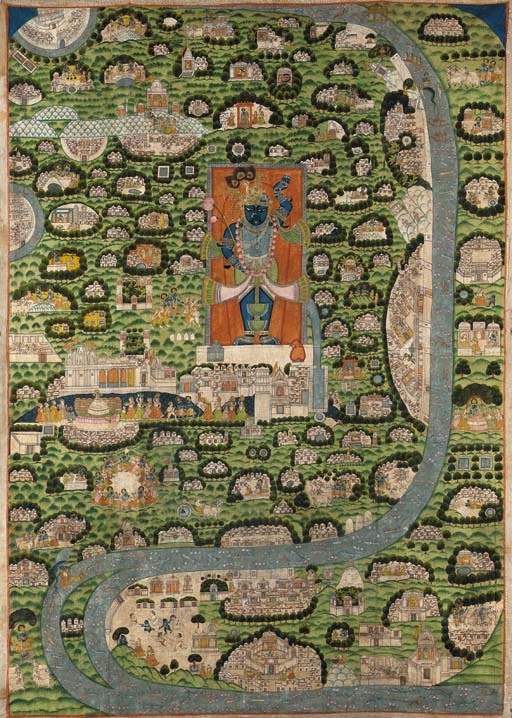
After settling near Radha-kunda, Narayana Bhatta Goswami spent roughly eight years walking, in person, through the entire sacred land of Vraja-mandala and writing down what he found. No single person before him is recorded to have done this as thoroughly.
Eight Years Among the Groves #
As later writers describe it, his method combined walking with listening and reading. He visited village after village and grove after grove, asked local people what they remembered, and checked what he heard against the Varaha Purana and other scripture. Where a pond, a small hill or a group of trees had a local tradition of some pastime of Radha and Krishna, he recorded it. Some deities had been lost, hidden, or simply forgotten over generations of trouble. He searched them out and helped to start their worship again. By then, Sri Chaitanya Mahaprabhu had passed from this world, and the first generation of His closest associates in Vraja was growing old. Much of this local knowledge was in danger of being scattered or lost with them. Narayana Bhatta Goswami's long walk was, in effect, a race to gather it into one lasting account before it disappeared.
Twelve Forests, Four Rings #
The result of this survey was an organized map of Vraja built around its twelve traditional forests: Mahavana, Kamyavana, Madhuvana, Talavana, Kumudavana, Bahulavana, Bhandiravana, Bhadravana, Khadiravana, Lohavana, Vrindavana and Belvana. Narayana Bhatta Goswami is credited with arranging this land into four levels, one inside another: vana, upavana, prativana and adhivana. Together they cover what tradition calls the eighty-four kos of Vraja-mandala. The kos is a traditional measure of distance, and later pilgrims and guidebooks generally measure this at somewhere near 270 kilometers of walking in total. In doing so he, in effect, fixed the boundary that later pilgrims would walk as the Chaurasi-kos Parikrama, the eighty-four kos circuit still followed today. He also gave that circuit a clear order within it, so that it was not left as a loose collection of holy sites.
Deities Brought to Light #
Tradition connects his prayers directly to at least one specific result that can still be seen. The deity now worshiped in the Shriji Temple at Barsana is said to have manifested on the second day of the bright half of the month of Ashadha in 1570 CE, in answer to Narayana Bhatta Goswami's devotion. This is temple tradition, not a historical record that can be checked independently. So it is given here as tradition, not as settled fact.
His work of rediscovery was not limited to uncovering hidden deities. It also meant identifying the memory of specific pastimes at specific spots, and then keeping that memory alive. At Sankari-khor, a narrow passage between two hills near Barsana, local memory held that Krishna and His cowherd friends used to stop the gopis as they carried milk, yoghurt and butter across the hills. Krishna and His friends would seize the gopis' loads, pretending to collect toll at a "toll gate," or dana-ghati. Narayana Bhatta Goswami is credited with turning that remembered pastime into a performed one. He started a yearly performance of it at Sankari-khor, a tradition described further on The Ban-Yatra Tradition.
According to at least one modern account, his work of uncovering lost pastime-places also overlapped with the efforts of Sri Rupa Goswami and Sanatana Goswami in Vrindavana proper. But the other available sources do not confirm any direct joint effort between them. There was also a generation gap between Narayana Bhatta Goswami's arrival in Vraja and the Six Goswamis' own decades of work there. Because of this, it is uncertain at best that they worked closely together. So this is reported here as a single, unconfirmed claim, not as an established fact.
A Landscape Later Scholars Still Study #
The twelve forests that Narayana Bhatta Goswami surveyed are not just a devotional curiosity found only in old guidebooks. They are still studied as a subject of their own. The American scholar David L. Haberman built an entire academic book, Journey Through the Twelve Forests: An Encounter with Krishna, around walking this same landscape and talking to the pilgrims and residents who still treat it as sacred ground. The way modern scholars approach this part of North India is still shaped by a sixteenth-century Vaishnava's fieldwork. This itself shows how thoroughly Narayana Bhatta Goswami's survey took hold.
What Narayana Bhatta Goswami wrote down from all this walking became his own book, described on Writing the Vraja-bhakti-vilasa, the text that, in turn, made possible the pilgrimage described on The Ban-Yatra Tradition.
Chapter 3
Writing the Vraja-Bhakti-Vilasa
A Sanskrit guidebook that named nearly every grove, pond and pastime-site in Vraja — and quietly named its own author as Narada Muni.
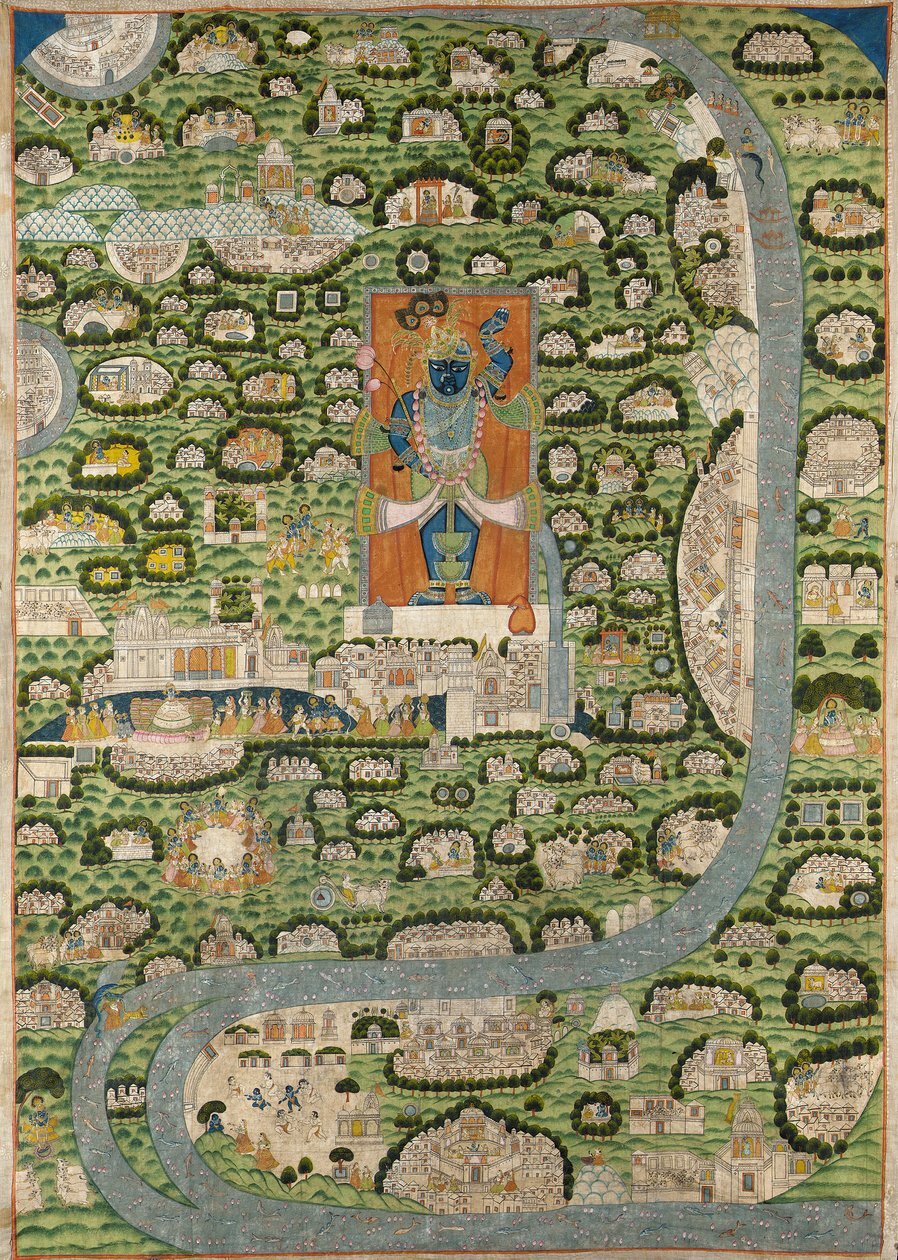
Narayana Bhatta Goswami gathered everything his years of walking Vraja had taught him into a single Sanskrit work, the Vraja-bhakti-vilasa. He composed it on the bank of Radha-kunda near Govardhan. Sources give its date as either 1552 or 1553 CE, so both years are given here.
A Guidebook Built on the Varaha Purana #
The book uses the Varaha Purana as its scriptural authority for the holiness of Vraja's sites. On that basis it does something very exact. It names, one by one, a very large number of Vraja's groves, ponds and villages (one count puts the figure at 333 forests and holy places). To almost every one of them it links the exact pastime of Krishna that tradition says took place there. Earlier tradition might have known, in general terms, that Krishna's pastimes happened "somewhere in Vraja," but the Vraja-bhakti-vilasa makes a point of naming the place.
An Author Who Names Himself Narada Muni #
His tradition holds that Narayana Bhatta Goswami was an avatara of Narada Muni. This is stated in the introduction to the Hindi edition of the Vraja-bhakti-vilasa and in later verses of praise. It does not come from Kavi Karnapura's Gaura-ganoddesha-dipika, the standard reference that lists the eternal identities of Sri Chaitanya Mahaprabhu's own associates. Narayana Bhatta Goswami belonged to a slightly later generation of Vraja Vaishnavas, and he does not appear in that text at all. So readers should take this as the belief of his own tradition. It is not a claim confirmed by any older source.
A Devotional Voice in Braj-Bhasha #
Besides his formal Sanskrit writing, at least one verse of his in the local language, Braj-bhasha, still survives. It praises the enchanting quality of Vraja itself. In it the groves, the river and the residents are all called "mohini," enchanting. The full verse is quoted in the citations for this history, and its translated line is quoted on Narayana Bhatta Goswami's main biography page. Elsewhere in the Vraja-bhakti-vilasa (verse 10.76, as preserved in Srila Bhaktivedanta Narayana Maharaja's Sri Vraja-mandala Parikrama), Narayana Bhatta Goswami offers a Sanskrit verse of homage to Govinda together with Vrinda-devi. This verse is also recorded in the citations here.
Even the title has meaning. Bhakti-vilasa can be read as something like "the delight, or the playful unfolding, of devotion". It is a guidebook that treats visiting Vraja's holy ground as an act of bhakti in itself, not as sightseeing. Each footstep becomes a small act of devotion, once the place it leads to is properly named and understood.
A Different Kind of Gaudiya Text #
Much of the great literature that came out of Vraja in this same period is mainly concerned with rasa, siddhanta and the inner life of bhakti. This includes the theological works of Jiva Goswami, the poetry and drama of Rupa Goswami, and the devotional memoirs later composed at Radha-kunda. The Vraja-bhakti-vilasa is different from those works. Above all, it is a book of geography, a tirtha-guide meant to be carried and used while walking. Because it is a different kind of book, Narayana Bhatta Goswami is remembered less as a theologian and more as the acharya who made Vraja's holy places easy to find and understand. This difference should be kept in mind when we compare his contribution with that of the Six Goswamis.
Other Attributed Works #
Some modern accounts credit Narayana Bhatta Goswami with other titles, among them Braj Pradipika and Braj Prakash. They even describe him as the author of some fifty bhakti texts in total. That longer list cannot be checked from the sources available. Only the Vraja-bhakti-vilasa is widely quoted, cited and available today.
A Text Still in Print #
Unlike a great many sixteenth-century Sanskrit works, the Vraja-bhakti-vilasa was not left forgotten in old manuscripts. Hindi translations of the text are still read and passed around among Vraja's pilgrims and scholars. Scanned copies of at least one such edition are available to the public today. So anyone who wants to can read Narayana Bhatta Goswami's own route through Vraja directly, instead of only reading about it secondhand.
Lasting Use #
Centuries later, Vrajavasis, pilgrims and scholars alike still use the Vraja-bhakti-vilasa as the main text for finding Vraja's sacred sites. It is a main source behind David Haberman's academic study Journey Through the Twelve Forests. Later Gaudiya Vaishnava teachers also built their own parikrama guides on it, openly using it as their basic source. One example is Srila Bhaktivedanta Narayana Maharaja's twentieth-century Sri Vraja-mandala Parikrama. In this way a single sixteenth-century book still shapes how pilgrims are guided through Vraja today. It also directly shaped the pilgrimage circuit described on The Ban-Yatra Tradition. Its place within the wider project of Rediscovering the Twelve Forests of Vraja is described on that page.
Scriptural evidence for this chapter (1)
vrnda-devi sametaya govindaya namo namah
loka-kalmasa-nasaya paramatma-svarupine
I pay my respects to Sri Govinda together with Vrinda-devi. He is the personification of the Supersoul and the destroyer of the sins of mankind.
A Sanskrit verse of homage from Narayana Bhatta Goswami's own Vraja-bhakti-vilasa, quoted in Srila Bhaktivedanta Narayana Maharaja's Sri Vraja-mandala Parikrama.
Chapter 4
The Ban-Yatra Tradition
The forest pilgrimage Narayana Bhatta Goswami named and organized is still walked by pilgrims every year in the month of Bhadrapada.
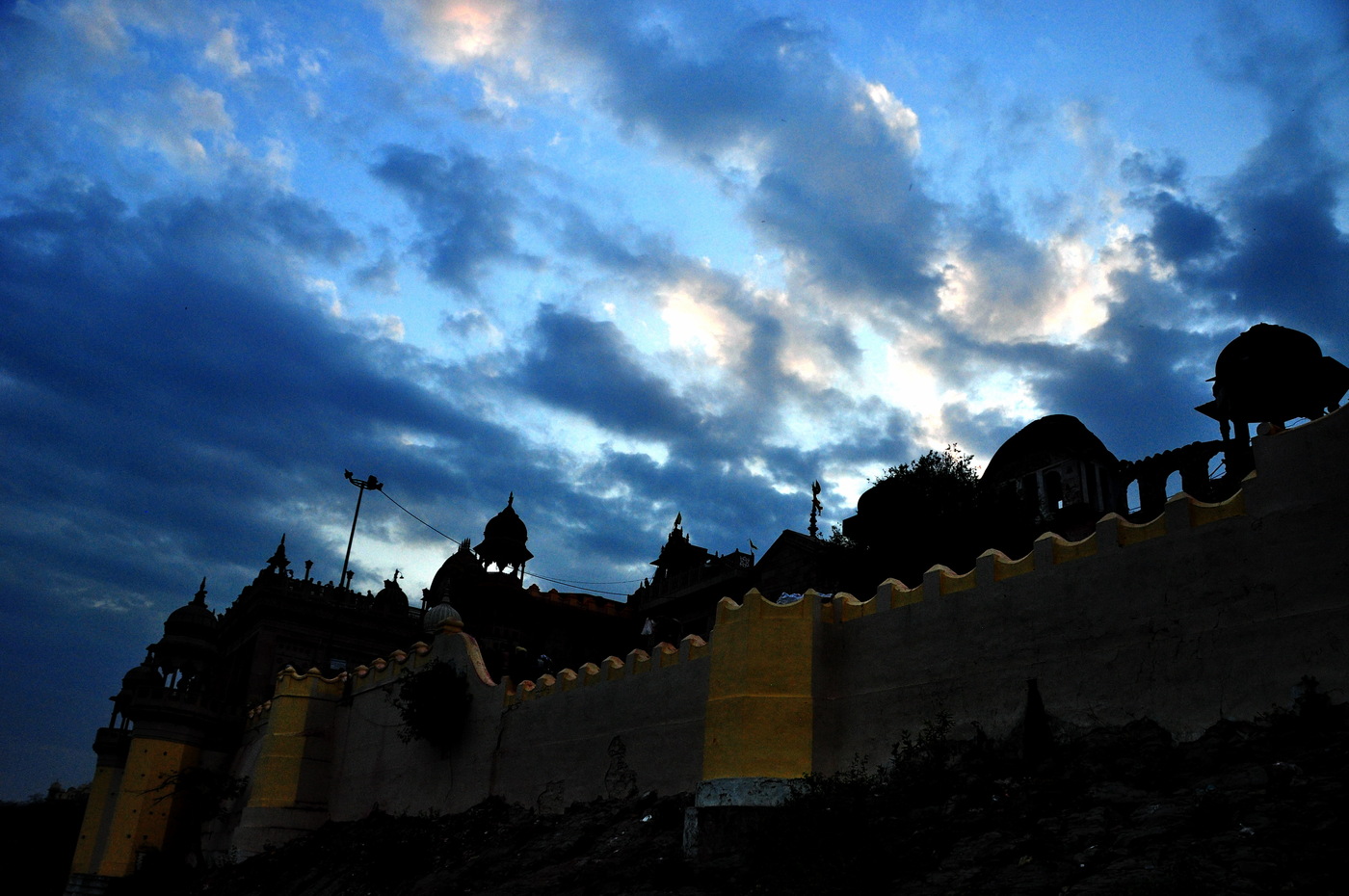
Having named and mapped Vraja's forests, ponds and villages in the Vraja-bhakti-vilasa, Narayana Bhatta Goswami turned that written map into a pilgrimage people could actually walk. He is credited with giving this forest circuit the name it still carries: the Bana-yatra, or Ban-yatra. Ban (or vana) means forest, and yatra means journey or pilgrimage. The name itself quietly teaches a theological point. Vraja's holiness is not limited to its temples and towns. It fills the forests, groves and open pastureland around them too. An ordinary tirtha-yatra to famous shrines might otherwise pass by this ground.
A Pilgrimage Bound to a Calendar #
Traditionally, the Ban-yatra runs for twenty-three days. It goes from Krishna Ashtami of the month of Bhadrapada through to the Bhadrapada Purnima (the full-moon day), that is, through most of August into September. The pilgrimage's opening day, Bhadrapada Krishna Ashtami, is the very day of Sri Krishna Janmashtami, His appearance day. So the Ban-yatra starts inside the same festival season as Janmashtami itself. This does not mean that Narayana Bhatta Goswami personally set or reformed the rites of Janmashtami worship. Nothing in the available sources records that he did. The real connection that can be checked is in the pilgrimage calendar, not in the rites of the festival.
Rasa-Lila Brought Back to Its Own Ground #
Alongside the walking pilgrimage, Narayana Bhatta Goswami is credited with reviving another practice. This was performing rasa-lila as drama at the very sites where the pastimes are said to have occurred, not only reciting or reading about them. Srila Bhaktivedanta Narayana Maharaja's Sri Vraja-mandala Parikrama records in detail one specific example of this that has survived. Sankari-khor is the narrow hill passage near Barsana associated with the dana-ghati pastime described on Rediscovering the Twelve Forests of Vraja. There a performance still called budhi-lila was traditionally held each year on Bhadra Shukla Trayodashi, the thirteenth day of the bright fortnight of Bhadrapada. This places it, again, inside the same Bhadrapada festival season as the Ban-yatra itself. Today the same performance is also staged on Radhashtami, Srimati Radharani's appearance day. This shows that the tradition has been kept alive, not frozen to a single fixed date.
A Pilgrimage That Still Runs #
The Ban-yatra Narayana Bhatta Goswami organized did not stay limited to the sixteenth century. Pilgrims today still walk a version of the same circuit, and more and more of them now drive it. It is more often called the Chaurasi-kos Parikrama or the Vraja-mandala Parikrama, and it covers the same twelve forests. On foot the journey traditionally took thirty to forty days, though organized groups using buses or cars now commonly complete it in five to ten days. Foot pilgrims still generally follow it in the same Bhadrapada season Narayana Bhatta Goswami fixed for it. In this way they keep the older calendar, even though the speed of travel has changed. The scholar David L. Haberman described this living tradition in detail in his academic study Journey Through the Twelve Forests: An Encounter with Krishna. He treated it as a practice that has continued without a break, not as a curiosity from history.
Closer to home for Gaudiya Vaishnavas, the twentieth-century sannyasi Srila Bhaktivedanta Narayana Maharaja led his own Vraja-mandala Parikrama groups. By his own account, he based his guidebook for them directly on Narayana Bhatta Goswami's Vraja-bhakti-vilasa, alongside works such as Sri Chaitanya-charitamrita and the writings of the Vraja Goswamis. This clearly shows that a sixteenth-century route was still guiding pilgrims at the close of the twentieth century. Various Gaudiya Vaishnava teachers and temples still organize guided Vraja-mandala parikrama groups every year for exactly this reason. The route itself, and the naming of what pilgrims see along it, is still largely based on the work Narayana Bhatta Goswami did.
Several ISKCON teachers today, among others in the wider Gaudiya community, lead their own annual Vraja parikrama yatras. These walk mostly the same forests and villages. They are adapted for modern travel, but they can clearly be traced back to the route Narayana Bhatta Goswami first set down in writing. Devotees within Srila Prabhupada's own Krishna consciousness movement who visit or walk around Vraja's holy places today are following ground that this one Vrajacharya first walked, named and organized into a pilgrimage, whether they know his name or not.
Chapter 5
Descendants and Legacy
A householder life at Unchagaon left behind a family of priests who still serve one of Vraja's great temples.
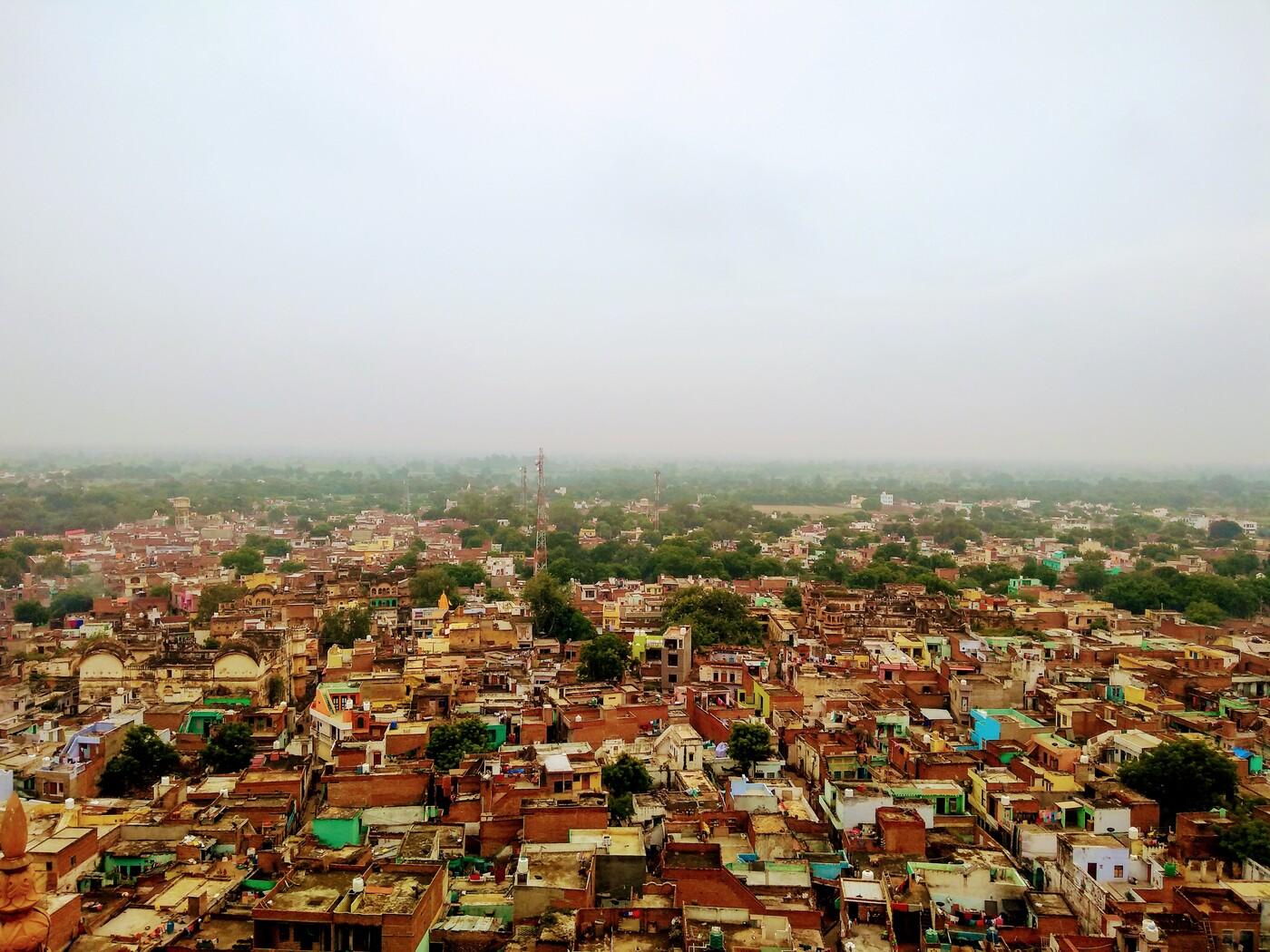
The written record of Narayana Bhatta Goswami's final decades has less detail than the record of his years of walking and writing. But a few specific details from good sources survive. Together they explain how a single wandering acharya came to leave behind not simply a book, but a settled family and a lasting role in the temple life of Vraja.
Marriage and Life at Unchagaon #
Later in life, by at least one account, he married and settled at Unchagaon (also spelled Unchagrama). This is a village near Barsana associated with Lalita-sakhi, Srimati Radharani's closest companion. His chief personal service there was at the Dauji Temple. Tradition says that Raja Todaramala built this temple on his instruction. Raja Todaramala was a Mughal-era official remembered in Vraja for paying for the building of temples in the region. Narayana Bhatta Goswami is described as marrying and raising a family. In this he was different from most of the Six Goswamis themselves, who followed the path of renunciation. His life was more like the pattern of a householder priest. This pattern later shaped how many of Vraja's major temples were served and passed down for generations.
A Family of Priests #
The clearest, most specific sign of Narayana Bhatta Goswami's lasting legacy is not a book but a living institution. According to Srila Bhaktivedanta Narayana Maharaja's Sri Vraja-mandala Parikrama, the priests and brahmanas who serve the Shriji Temple at Barsana take initiation from his own descendants down to the present day. This is the very temple built around the deity of Radharani who, tradition says, appeared through his prayers. The claim is specific and comes from a named source. It is about a real pujari lineage, not a vague mention of "descendants," and it is the strongest recorded link between Narayana Bhatta Goswami and the living temple culture of Vraja. Barsana is not a minor shrine. It is one of the main places of Radharani's worship in all of Vraja. For centuries, a family whose line of initiation reaches back to a single sixteenth-century Vrajacharya has held a place of real responsibility there.
Some popular modern accounts describe this family as part of the wider "Chaturvedi" Goswami pujari community found across Braj. In this kind of community, temple service is passed down in families. This became common at many of Vraja's major shrines in the centuries after the Six Goswamis and the devotees of their time. But the available sources do not independently confirm that surname for Narayana Bhatta Goswami's own line. So it is not stated here as fact. It is a gap in what we know, not a settled claim.
An Uncertain Disappearance #
Sources do not agree on when Narayana Bhatta Goswami passed from this world. One modern account gives a specific date (Vamana Jayanti in the year 1643). But that date does not fit well with a birth year of around 1531, because it would make him well past a hundred years old at the time. That year may simply be mistaken, so we do not quietly accept it. Instead we report the difference here. No disappearance date used here should be taken as firmly established. Tradition places his samadhi at Unchagaon. This is the same village associated with Lalita-sakhi's own childhood pastimes, and it is close to Srimati Radharani's palace at Barsana. So even in death, his resting place is within sight of the deity whose worship he is remembered for reviving.
His Lasting Place in Vraja #
Whatever the exact dates, Narayana Bhatta Goswami's impact on Vraja itself is not in doubt. The Vraja-bhakti-vilasa he wrote and the Ban-yatra he organized still shape how pilgrims and scholars alike walk, name and understand Vraja. This is nearly five centuries after a South Indian boy first walked into its groves. It is a different kind of legacy from that of the theologians and poets among the Six Goswamis. Narayana Bhatta Goswami did not leave behind a major commentary or drama. Instead he left a working map of the sacred land, and a family still living there. Vrajavasis remember him simply as the Vrajacharya. Informally they also call him the seventh Goswami of Vrindavana. He is never counted among the Six Goswamis themselves, but he is remembered close beside them.
Closing
Guru and Place in the Parampara #
In Vraja he took initiation from Krishna Dasa Brahmachari and settled near Radha-kunda under his guidance. Sources disagree about who Krishna Dasa Brahmachari's own guru was. Some say he stood in the line of Gadadhara Pandit, one of the closest associates of Sri Chaitanya Mahaprabhu. Others describe him as a disciple of Gopala Bhatta Goswami. This disagreement has not been resolved, so both views are given here without choosing one. Like Gopala Bhatta Goswami and Prabodhananda Saraswati, Narayana Bhatta Goswami himself came from a South Indian brahmana background. This pattern is seen among several of Vraja's early Vaishnavas. But no source records any direct family or personal connection between them beyond this shared origin.
- Narayana Bhatta Goswami | Gaudiya History
- Shri Narayan Bhatt: Redefining the Pilgrimage in Sixteenth Century Braj — Indica Today
- Who is Narayana Bhatta Goswami? — Moods of Vraja
- Sri Vraja-mandala Parikrama, Srila Bhaktivedanta Narayana Maharaja (full text)
- Journey Through the Twelve Forests: An Encounter with Krishna, David L. Haberman (Oxford University Press)
