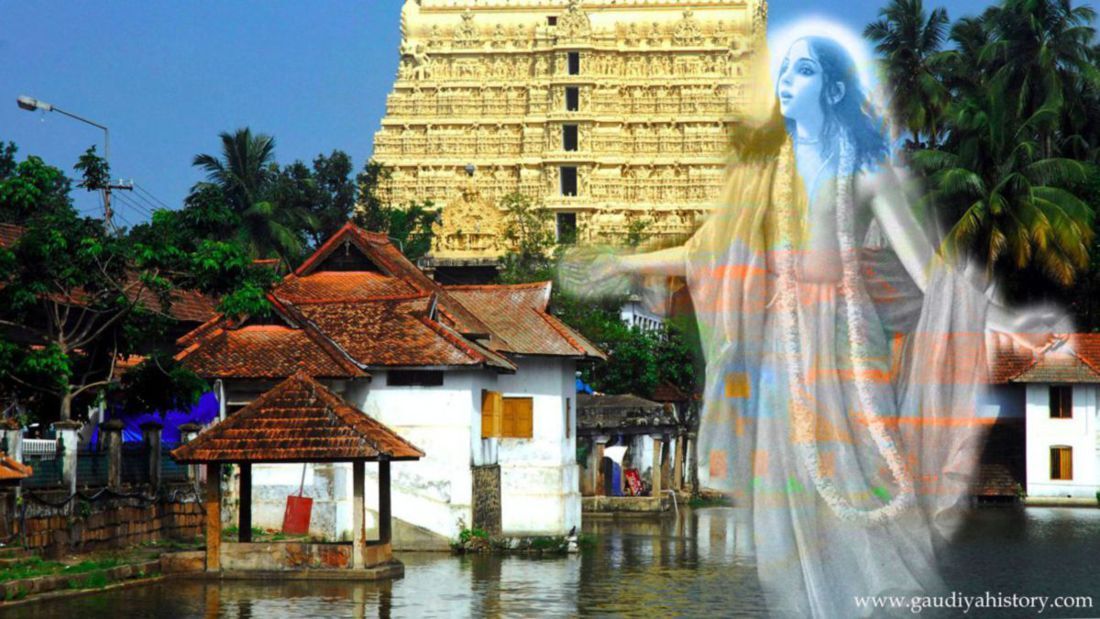
By the time the record says anything definite about Paramananda Puri, he is already a sannyasi. By every account, he is also already one of the two disciples closest to his guru, Srila Madhavendra Puri. What happened between his unrecorded boyhood in Trihut and that mature discipleship is lost. But the fruit of that discipleship is not lost. His spiritual training was so deep that Sri Chaitanya Mahaprabhu would later recognize Madhavendra Puri's presence in this man's face.
| Detail | Description |
|---|---|
| Guru | Srila Madhavendra Puri |
| Closest godbrother | Isvara Puri, Sri Chaitanya Mahaprabhu's own diksha-guru |
| Wider circle of godbrothers | Ramachandra Puri, Brahmananda Bharati, Keshava Bharati, Vishnu Puri, Keshava Puri, Krishnananda Puri, Nrisimha Tirtha, Sukhananda Puri |
| First meeting with Mahaprabhu | Rishabha Hill (Ashabha Parvata), Tamil Nadu, during the South India tour |
| Duration of that first meeting | Three days |
One of the Two Most Dear #
Chaitanya-bhagavata's Antya-khanda states the relationship very plainly. Among all of Madhavendra Puri's sannyasi disciples, only Isvara Puri and Paramananda Puri were counted as truly dear to their guru. Srila Prabhupada quotes this same passage in his purport to Chaitanya-charitamrita Adi 9.13-15. It pairs Paramananda Puri with a very different figure from Mahaprabhu's own later circle, Svarupa Damodara. The verse says that both of them were constantly engaged in the Lord's company, Paramananda Puri absorbed in meditation and Svarupa Damodara in kirtana. It calls them "like two arms" of Mahaprabhu's own sannyasa form. That comparison belongs to his years at Puri, not to his training under Madhavendra Puri. But it shows how consistently the tradition describes him. It does not describe him as a disciple on the edges, but as one of a small number of people trusted at the very center.
The Nine Roots of a Single Tree #
Krishnadasa Kaviraja Goswami uses his own image to explain the origin of the Gaudiya Vaishnava movement. This image is explained at length in the pages about Madhavendra Puri himself. It describes Madhavendra Puri as the seed of a desire tree of devotional service, Isvara Puri as its first sprout, and Sri Chaitanya Mahaprabhu as the trunk the whole tree became. Nine sannyasi disciples then sprang up as roots to hold that already-grown trunk steady. Paramananda Puri is named first among them, followed by Keshava Bharati, Brahmananda Puri, Brahmananda Bharati, Vishnu Puri, Keshava Puri, Krishnananda Puri, Nrisimha Tirtha and Sukhananda Puri (Adi 9.13-15). Gaudiya History's own account of him singles him out as "the central root" of these nine. This is a striking claim, because one of his fellow roots, Keshava Bharati, would later become the very sannyasi who gave Mahaprabhu His sannyasa at Katwa. A Name Attached to the Sannyasa-Danda examines that connection honestly, without forcing a conclusion.
After the Guru's Passing #
Madhavendra Puri's own page tells in full, in its account of Isvara Puri and His Disciples, about his final years and disappearance, and about the very different paths his two dearest disciples took afterward. No surviving text gives details of what happened to Paramananda Puri himself in the years right after. He simply appears again, years later, as an elderly wandering sannyasi, already deep in the south of India. He is observing the four-month rainy-season vow at a hill called Rishabha Parvata (identified by Gaudiya History with the modern Palni Hills of Tamil Nadu). At that very time, Sri Chaitanya Mahaprabhu happened to be passing through on His own tour of the south.
A Wanderer at Rishabha Hill #
Sri Chaitanya-charitamrita records the meeting in very few words, and this makes its feeling even stronger: "Paramananda Puri had stayed at Rishabha Hill during the four months of the rainy season, and when Sri Chaitanya Mahaprabhu heard this, He immediately went to see him" (Madhya 9.167). What followed was not a formal exchange between an already-famous preacher and an elder ascetic. It was closer to a family reunion that neither man could have planned for. "Upon meeting Paramananda Puri, Sri Chaitanya Mahaprabhu offered him all respects, touching his lotus feet, and Paramananda Puri embraced the Lord in ecstasy" (Madhya 9.168). Gaudiya History gives a fuller account of the same meeting, drawn from the same chapter. In it, Mahaprabhu cries out on seeing him, as if He were seeing Madhavendra Puri appear again in bodily form. This is the clearest single statement anywhere in these sources of exactly what this godbrother of His own guru meant to Him.
Three Days of Krishna-katha #
The two men then spent three days together doing nothing but discussing Krishna. One was the old sannyasi. The other was the young one, who by then had already begun to be recognized across India as far more than an ordinary renunciate. Yet neither treated the meeting as anything more than two godbrothers, one generation removed, meeting warmly for the first time. Paramananda Puri mentioned his plan to go on to Puri and then to Bengal to bathe in the Ganges. Then Mahaprabhu made him a direct request, not just a suggestion: come back to Puri, and stay. "It is My wish to stay with you," He said, "so please be kind to Me and come and take up permanent residence in Puri" (Chaitanya-charitamrita, Madhya-lila 9). Paramananda Puri agreed. Life at Jagannatha Puri tells what that residence at Puri actually looked like: the room he was given, the well that became his own small legend, and the honors Mahaprabhu paid him for the rest of both their lives.
