After three days of Krishna-katha at Rishabha Hill, and a direct personal request from Sri Chaitanya Mahaprabhu to come and stay, Paramananda Puri did not go straight to Puri. He went first to Bengal. There, on an unexpected side journey through the home of a grieving mother, the next chapter of his life actually began.
| Detail | Description |
|---|---|
| Residence | A private room in Kashi Mishra's house, near the Lord's own quarters |
| Notable landmark | His own small matha and well, west of the Jagannatha temple |
| Closest companions in Mahaprabhu's circle | Svarupa Damodara Goswami, Brahmananda Bharati |
| Honors received | First to receive sandalwood pulp and garlands from the Lord's own hand at Ratha-yatra |
| One recorded appeal | Pleaded for Chota Haridasa's forgiveness, with only partial success |
Arriving by Way of Sachi Devi's House #
While travelling through Navadwip, Paramananda Puri took lodging at the house of Sachi Devi, Sri Chaitanya Mahaprabhu's own mother. She had not seen her son in years. In the words the tradition preserves, she received the visiting sannyasi "very respectfully." In her house, news reached him that Mahaprabhu had returned to Jagannatha Puri from the South India tour. He set out from her house at once to rejoin Him. This detail matters for more than its charm. Chaitanya-charitamrita later records that Mahaprabhu began sending His mother cloth and prasadam offered to Lord Jagannatha every year, and that He did this specifically on Paramananda Puri's own order (Antya 19.12). So the sannyasi who had briefly stayed in Sachi Devi's house became the reason her son always kept up that connection.
A Room in Kashi Mishra's House #
At Puri, Mahaprabhu gave Paramananda Puri a private room in the house of Kashi Mishra, the same residence that held the Lord's own quarters, the Gambhira. Sri Chaitanya-charitamrita's own summary list of the Lord's permanent resident companions at Puri names him directly among the small number who stayed for the rest of Mahaprabhu's manifest life: "Jagadananda, Bhagavan, Govinda, Kashishvara, Paramananda Puri and Svarupa Damodara" (Madhya 1.253). Ramananda Raya himself finally arrived at Puri after giving up his post as governor. The first four people he went to pay his respects to were Paramananda Puri, Brahmananda Bharati, Svarupa Damodara Goswami and Nityananda Prabhu. Paramananda Puri is named first of all. Jagadananda Pandit arrived separately and paid his own respects to nearly the same circle. By his own account, he came to Paramananda Puri last of everyone, evidently out of respect for his seniority.
The Well That Ran With Ganges Water #
Paramananda Puri dug a well behind his small matha on the western side of the Jagannatha temple. Chaitanya-bhagavata records that its water came up bitter. Sri Chaitanya Mahaprabhu knew through His own perception that the water was undrinkable, even before Paramananda Puri told Him so directly. He stood with His arms raised and prayed to Lord Jagannatha: "Grant Me this boon: let the Ganges river enter into this well" (Chaitanya-bhagavata, Antya-khanda 3.235-236). By the next morning the water ran clear and sweet, and the devotees present declared it equal, ever after, to bathing in the Ganges itself. On this occasion Mahaprabhu made one of the most direct statements recorded anywhere in the tradition of what He owed to another person. He said that He remained in the world at all only on account of Paramananda Puri's own excellent conduct. He also said that anyone who even saw Paramananda Puri would receive love of Krishna (Chaitanya-bhagavata, Antya-khanda 3.255-257). Bhaktisiddhanta Sarasvati Thakura's own commentary on Chaitanya-bhagavata notes that the well had been pointed out earlier by Bhaktivinoda Thakura. It notes that, generations later, the well could still be found near the old police station on the road running west from the temple.
Honored Above Nearly Everyone Else #
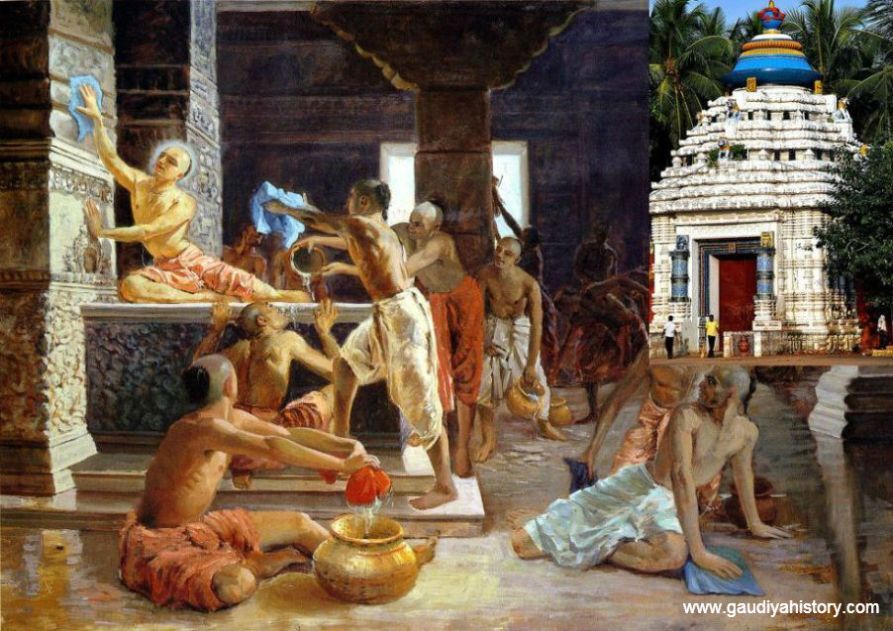
The Puri community showed its regard for Paramananda Puri in small gestures, again and again. Sri Chaitanya-charitamrita records them almost in passing, as though the pattern were too well known to need explaining. At the Ratha-yatra festival, Mahaprabhu personally placed sandalwood pulp and garlands on Paramananda Puri and Brahmananda Bharati before turning to anyone else, "which increased their transcendental pleasure" (Madhya 13.30). During the annual cleaning of the Gundicha temple, every other devotee carried water in buckets from the well. Only Nityananda Prabhu, Advaita Acharya, Svarupa Damodara, Brahmananda Bharati and Paramananda Puri were excused from that labor. Instead they worked alongside the Lord with water others had already brought (Madhya 12.109). These were not empty courtesies. The community was built entirely around service. In such a community, being spared physical labor while still standing at the center of the activity was itself a form of honor that few others received.
Pleading for Chota Haridasa #
His position gave him real influence, though not unlimited influence, as one episode from Antya-lila makes clear. Mahaprabhu banished the young devotee Chota Haridasa from His presence for an improper conversation with a woman. The wider community of devotees could not move Him to change His mind. So, as a last resort, they turned to Paramananda Puri. He went alone to the Lord's residence, was seated beside Him with full respect, and made his appeal directly: "please show favor to Junior Haridasa" (Antya 2.130). Mahaprabhu's answer was not the reversal the devotees had hoped for. He offered to let Chota Haridasa remain, but announced that He Himself would leave for Alalanath instead of staying (Antya 2.131-132). It took Paramananda Puri's own urgent and humble pleading to get Him to sit back down at all (Antya 2.134). Even then, Paramananda Puri himself admitted the deeper point: "You are the independent Personality of Godhead. You can do whatever You like. Who can say anything above You?" (Antya 2.135). He left without having softened anything in the underlying judgment. He had only kept the Lord from leaving Puri altogether. It was a small, human-sized success, but it still needed all the goodwill that his years of closeness had earned him.
A Presence, Not Just a Guest #
Taken together, these episodes do not show a lesser figure who was honored only because of whom he stood beside. They show something closer to what Chaitanya-bhagavata calls him outright: one of the two arms of Mahaprabhu's own sannyasa life. For as long as the record mentions him, he was present at the Ratha-yatra, the Gundicha cleaning, the Hari Dasa Thakura festivities, and the quiet daily routine of the Gambhira. By every account available, he was treated as family, precisely because Mahaprabhu Himself regarded him that way. He was the godbrother of Mahaprabhu's own guru. And in the Gaura-ganoddesha-dipika's own understanding, he was an old friend from another life entirely. Disappearance and Legacy tells what became of that closeness at the very end of Paramananda Puri's own life.
