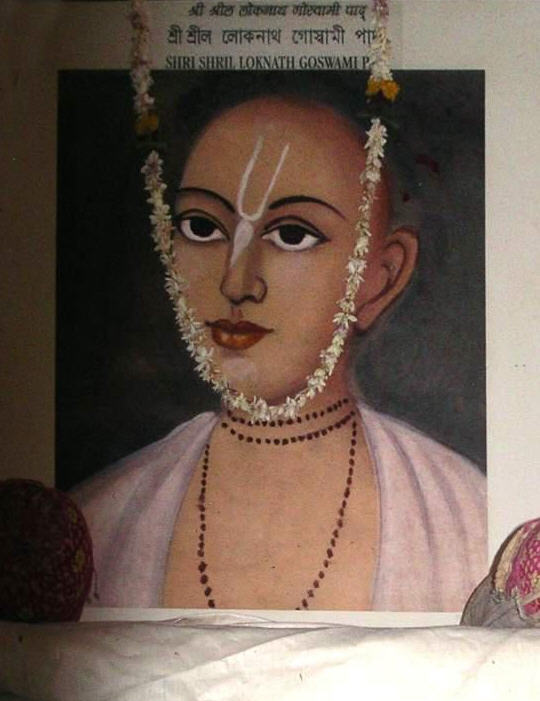
Srila Ramachandra Puri
The Godbrother Whose Criticism Chaitanya-charitamrita Turns Into a Warning
Also known as Ramacandra Puri, Rama Chandra Puri, Ramachandra Puri Gosani
“A sannyasi eats as much as necessary to maintain his body, but he does not enjoy satisfying his senses materially. Thus a sannyasi becomes perfect in his spiritual advancement in knowledge.”
Ramachandra Puri's own defense of his criticism, spoken to Sri Chaitanya Mahaprabhu at Jagannatha Puri (Chaitanya-charitamrita, Antya-lila 8.66)
Srila Ramachandra Puri holds an unusual place among the associates of Sri Chaitanya Mahaprabhu. An entire chapter of Sri Chaitanya-charitamrita's Antya-lila is devoted to him, and Krishnadasa Kaviraja Goswami plainly titles it "Ramachandra Puri Criticizes the Lord." He was an initiated disciple of Srila Madhavendra Puri. Through that shared guru, he was a godbrother of Srila Ishvara Puri, the sannyasi who would later give Sri Chaitanya Mahaprabhu His own diksha. Ishvara Puri is remembered for how completely he served a dying guru. Ramachandra Puri is remembered for the opposite. He had a habit of fault-finding that was fixed deep in him. Chaitanya-charitamrita tells his life deliberately and at some length, to warn readers what happens when that habit is turned even on the Supreme Lord Himself.
| Detail | Description |
|---|---|
| Guru | Srila Madhavendra Puri |
| Godbrother | Srila Ishvara Puri, who later gave diksha to Sri Chaitanya Mahaprabhu |
| Best known for | Criticizing Sri Chaitanya Mahaprabhu's eating at Jagannatha Puri, which led the Lord to cut His meals to a quarter, later raised to half at the devotees' request |
| Primary source | Sri Chaitanya-charitamrita, Antya-lila, Chapter Eight, titled "Ramachandra Puri Criticizes the Lord" |
| Identity | Remembered as Vibhishana; Jatila, Srimati Radharani's mother-in-law, entered him for a purpose (Gaura-ganoddesha-dipika 92) |
| Birth / disappearance | Not recorded in any source |
A Godbrother Under the Same Guru #
Srila Madhavendra Puri accepted a number of disciples in his life. But Sri Chaitanya-charitamrita speaks in detail about only two of them, and it does this by setting them directly against each other. Ishvara Puri is introduced as the disciple who served. Right alongside him, Ramachandra Puri is introduced as the disciple who did not. Krishnadasa Kaviraja Goswami says openly that Madhavendra Puri kept both men close to him for a reason: "these two persons, Ishvara Puri and Ramachandra Puri, are examples of the objects of a great personality's benediction and punishment. Madhavendra Puri instructed the entire world by presenting these two examples" (Chaitanya-charitamrita, Antya-lila 8.32). Nothing about Ramachandra Puri's family, his birthplace, or the name he had before he accepted sannyasa survives in any source. He appears in the historical record only as Madhavendra Puri's disciple, and in effect only as a contrast to Ishvara Puri.
There is one more detail that belongs here, and it should be read with care. The Gaura-ganoddesha-dipika is a traditional Gaudiya work that identifies the earlier spiritual identities of Sri Chaitanya Mahaprabhu's associates. It states that the soul who became Ramachandra Puri was, in an earlier appearance, Vibhishana, the brother of Ravana who was a great devotee of Lord Ramachandra. It also states that Jatila, the disapproving mother-in-law of Srimati Radharani in Krishna's pastimes, entered him for a purpose, and the text explains that this was so that Sri Chaitanya Mahaprabhu would be led to reduce His eating. This is a theological explanation, not a historical one. It shows how the tradition itself understood why such a severe nature appeared in a genuine disciple of Madhavendra Puri. It is not a claim that can be checked by any other means.
This is the verse itself, Gaura-ganoddesha-dipika 92. In its published English translation, Sri Chaitanya Mahaprabhu Himself sets the Vibhishana connection aside and points instead to Jatila's influence:
vibhīṣaṇo yaḥ prāg āsīd rāmacandra-purī smṛtaḥ
uvācāto gaura-harir naitad rāmasya kāraṇam
jaṭilā rādhikā-śvaśrūḥ kāryato’viśad eva tam
ato mahāprabhur bhikṣā-saṅkocādi tato’karot
"The devotee named Ramacandra Puri in Lord Caitanya's pastimes had previously been Vibhisana. ... Lord Caitanya Himself did not accept that Ramacandra Puri was the incarnation of Vibhisana, but the Lord himself said that Ramacandra Puri was the empowered incarnation of Srimati Radharani's mother-in-law Jatila. This Ramacandra Puri restricted Lord Caitanya in His acceptance of alms." (Gaura-ganoddesha-dipika 92)
The Rebuke at a Dying Guru's Bedside #
The pattern Chaitanya-charitamrita wants a reader to notice begins before Sri Chaitanya Mahaprabhu ever enters the story. As Madhavendra Puri lay dying, he was full of longing for Krishna and cried out that he had never reached Mathura. Ramachandra Puri came to his bedside, but he did not share in that longing. Instead, he judged it. He told his guru that a soul in full transcendental bliss should be absorbed in Brahman instead of weeping. Madhavendra Puri answered at once. He called him a "sinful rascal," refused to let him stay, and warned that seeing his face again while dying would cost him the fruit of his whole life. Ramachandra Puri had just committed an offense against his own spiritual master, and Chaitanya-charitamrita is direct about what followed from it. Discipleship Under Madhavendra Puri tells the full story of that bedside meeting. It gives what each man said, and why Krishnadasa Kaviraja Goswami treats it as the origin of everything that came later.
Turning That Habit on the Lord Himself #
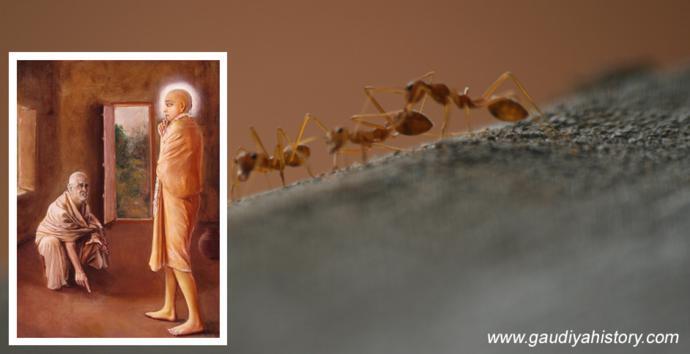
Years afterward, Ramachandra Puri arrived at Jagannatha Puri as a respected guest. He was a direct disciple of Sri Chaitanya Mahaprabhu's own param-guru, and he was received with real honor both by the Lord and by Srila Ishvara Puri's godbrother Paramananda Puri. During his stay he gathered information about how Sri Chaitanya Mahaprabhu ate, slept, and moved, looking for something to criticize. For some time he could not find anything. Then one morning he noticed ants in the Lord's room. He concluded that there must have been sweets the night before, and he criticized the sannyasi's supposed attachment to sense gratification. Sri Chaitanya Mahaprabhu had already heard rumors of this godbrother's fault-finding, and He took the accusation to heart. Out of concern for how His own conduct might be seen, He ordered His meals cut to a quarter of their normal size. The devotees around Him were shocked. Ramachandra Puri eventually left Puri, and the Lord's ordinary life resumed. What happened before he left is the richest and most specific material that survives about him at all. It is told in full in The Criticism of Mahaprabhu's Eating.
What Chaitanya-charitamrita Wants a Reader to See #
Krishnadasa Kaviraja Goswami does not tell this story as gossip about a difficult sannyasi. He tells it as a clear teaching about vaishnava-aparadha, offense against a devotee, and about how an offense at the feet of one's own spiritual master does not stop there: "if one's spiritual master rejects him, one becomes so fallen that he... commits offenses even to the Supreme Personality of Godhead" (Antya-lila 8.99). Srila Prabhupada's purports to this chapter make the same point in several ways. They trace Ramachandra Puri's fault-finding back to a Mayavadi, impersonalist way of thinking. Such a mind could not recognize genuine ecstatic love when it saw it, whether in a dying guru or in the Lord Himself. And yet the text is just as careful to record that Sri Chaitanya Mahaprabhu never withdrew ordinary respect from Ramachandra Puri. He honored him to the end as a godbrother of His own guru, even while He declined to accept his criticism. Both halves of that lesson, and what the tradition draws from them, are laid out in The Lesson and Its Legacy.
What the Record Leaves Unanswered #
Outside that one central episode, very little is recorded about him. No source gives Ramachandra Puri's birth year, birthplace, or disappearance. No source records the name he held before taking sannyasa. There is not even an English-language Wikipedia article about him. Most of his contemporaries in this section have one, so this is a real gap. The sources also disagree on one point, and this disagreement is reported here without trying to settle it. Vrindavana Dasa Thakura's Chaitanya-bhagavata states that Sri Chaitanya Mahaprabhu stayed for two months in "Ramachandra Puri's matha" while in Benares. But Srila Bhaktisiddhanta Sarasvati Thakura's Gaudiya-bhashya commentary on that passage holds that this should not be taken literally. It says that the Lord actually stayed with Chandrashekhara Acharya. He only let it be known publicly that He was with Ramachandra Puri, a sannyasi of a Shankarite order. He did this to avoid drawing criticism from non-devotees in a city known for its Mayavadi scholarship. What is not in dispute, in either account, is the reputation Ramachandra Puri carried by then. He was a genuine disciple of a genuine guru, whose name Chaitanya-charitamrita preserves chiefly as a warning.
Scriptural evidence
Quoted in the text above:
- Verse 92 Gaura-ganoddesha-dipika
Further verses:
taṁ vande kṛṣṇa-caitanyaṁ
rāmacandra-purī-bhayāt
laukikāhārataḥ svaṁ yo
bhikṣānnaṁ samakocayat
Word for word
tam: to Him; vande: I offer my respectful obeisances; kṛṣṇa-caitanyam: Lord Sri Caitanya Mahaprabhu; rāmacandra-purī-bhayāt: due to fear of Rāmacandra Purī; laukika: ordinary; āhārataḥ: from eating; svam: His own; yaḥ: who; bhikṣā-annam: quantity of food; samakocayat: reduced.
Let me offer my respectful obeisances to Sri Chaitanya Mahaprabhu, who reduced His eating due to fear of the criticism of Ramachandra Puri.
Krishnadasa Kaviraja Goswami's own opening verse for the chapter of Chaitanya-charitamrita devoted entirely to Ramachandra Puri, naming him in its very first line.
- Sri Chaitanya-caritamrta, Antya-lila, Chapter Eight: "Ramachandra Puri Criticizes the Lord" (full chapter)
- Sri Chaitanya-caritamrta, Antya-lila 8.1 (Krishnadasa Kaviraja Goswami's invocation verse)
- Sri Chaitanya-caritamrta, Antya-lila 8.22-32 (Madhavendra Puri's rebuke; the two examples)
- Sri Chaitanya-caritamrta, Antya-lila 8.99-100 (Krishnadasa Kaviraja Goswami's summary teaching)
- Sri Chaitanya-caritamrta, Madhya-lila 19.156 (the mad-elephant verse on vaishnava-aparadha)
- Gaudiya History (ISKCON Desire Tree): Ramachandra Puri
- Gaudiya History (ISKCON Desire Tree): Sri Isvara Puri
- Krishna.org: Ramacandra Puri Visits Jagannatha Puri
Frequently asked
When was Srila Ramachandra Puri born?
Srila Ramachandra Puri appeared Not recorded in Not recorded.
Who was the guru of Srila Ramachandra Puri?
The spiritual master of Srila Ramachandra Puri was Srila Madhavendra Puri.
When and where did Srila Ramachandra Puri disappear?
Srila Ramachandra Puri disappeared Not recorded at Not recorded.
What are the main pastimes of Srila Ramachandra Puri?
The pastimes covered here include: Discipleship Under Madhavendra Puri, The Criticism of Mahaprabhu's Eating, The Lesson and Its Legacy.