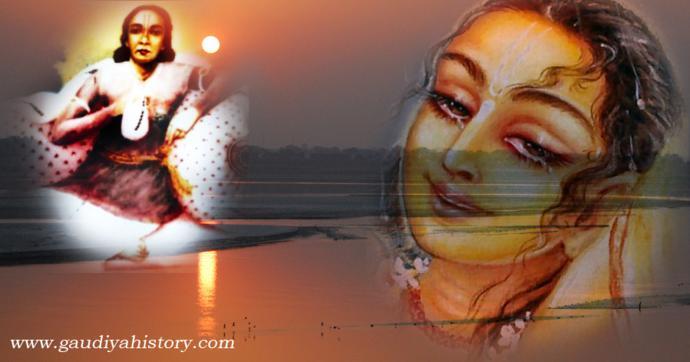
Some time during the Nabadwip years, before Pundarika Vidyanidhi had ever set foot in the town, the devotees gathered around Sri Chaitanya Mahaprabhu heard Him weeping and calling out for someone none of them had met. He was asking, again and again, when He would see His father. When they asked who this father was, Mahaprabhu explained that a great Vaishnava named Pundarika Vidyanidhi would soon be arriving from Chittagong. This Vaishnava wished to live by the Ganges. Mahaprabhu added that few would be able to see his devotion, but that it purified the world simply through the sound of his name.
Tears for a Stranger #
This was not a passing remark. Krishnadasa Kaviraja Goswami records in the Chaitanya-charitamrita that Mahaprabhu counted Pundarika Vidyanidhi as the third great branch of His own tree of devotees. He also records that the Lord would sometimes weep simply on hearing his name spoken. The reason for these tears lies in the identity described on Birth and Early Life in Mekhala. In that identity, Pundarika Vidyanidhi is Vrishabhanu, the father of Srimati Radharani. Mahaprabhu was absorbed in Radharani's own mood of separation, so He truly experienced Pundarika Vidyanidhi as a father He had not yet seen.
Sri Chaitanya-bhagavata records that Mahaprabhu went even further. He told the puzzled devotees exactly why they should expect to be fooled when Pundarika Vidyanidhi finally appeared. Mahaprabhu said that his character was extraordinary, far beyond what anyone could guess from looking at him. His very name purified the world. Yet he would arrive dressed and living like an ordinary man of pleasure, and no one watching him would be able to tell what he really was. In this way Mahaprabhu was warning them in advance of the misjudgment Gadadhara Pandit would go on to make in person not long afterward. When Pundarika Vidyanidhi finally arrived and came before Mahaprabhu late one night, he was so overcome with love that he could not even offer his obeisances. Mahaprabhu drew him to His chest and wept over him. The devotees present understood at once what this embrace meant. This stranger from Chittagong, whom Mahaprabhu's own circle now also knew as Acharyanidhi, stood among the very dearest of the Lord's associates.
Reunited Again at Puri #
The affection did not fade with time or distance. Years later, after Mahaprabhu had accepted sannyasa and was living at Jagannatha Puri, the devotees of Bengal came there to see Him. The Chaitanya-charitamrita describes Him meeting this whole gathering of devotees. Among them were Acharyaratna, Vidyanidhi, Pandita Gadadhara, Gangadasa, Hari Bhatta and Acharya Purandara. He embraced each of them again and again and never tired of praising their qualities. By then Pundarika Vidyanidhi was the diksha-guru of Gadadhara Pandit. He stood in that company as one of the Lord's most cherished associates, not simply as an old acquaintance from Chittagong.
Father Has Come #
The same longing appears again, on a smaller scale, at Jagannatha Puri. It comes in the story of how Gadadhara Pandit came to ask his guru to repeat the diksha mantra to him a second time. That story is told in full on Initiating Gadadhara Pandit. Mahaprabhu had to explain that only Pundarika Vidyanidhi himself could properly do this. Mahaprabhu is remembered as having then predicted the exact day Pundarika Vidyanidhi would arrive. When the news came, He greeted it with the same open joy He had shown years before in Nabadwip, crying out that His father had come. Chaitanya-bhagavata closes its own telling of the first meeting between Pundarika Vidyanidhi and Gadadhara Pandit with a promise. It says that whoever hears that story sincerely will receive a share of the very love of God it describes. The tradition makes this claim for very few episodes in the entire Chaitanya-lila.
