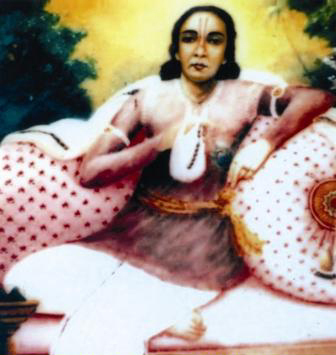
By the time Pundarika Vidyanidhi settled for periods at Nabadwip, he had every external mark of a well-off, worldly householder, and he did nothing to soften that impression. He dressed well, kept servants, and lived exactly as comfortably in Nabadwip as he did at home in Chittagong. Only one person among the Vaishnavas of the town was not fooled: Mukunda Datta, who had known him since they were both boys in Chittagong and understood perfectly well what lay beneath the appearance. Everyone else, including for a time Gadadhara Pandit himself, took him for what he seemed to be: a comfortable man of the world with no particular interest in Krishna.
The Ganges He Would Not Touch #
One detail recorded in Sri Chaitanya-bhagavata goes completely against this outward impression. According to this account, Pundarika Vidyanidhi never bathed in the Ganges, because he felt it was disrespectful to touch her sacred waters with his own feet. He would go to see her only at night, from a distance. He did this so that he would not have to see others washing their teeth, washing their hair, or rinsing clothes in her during the day, because he could not bear it. Before performing any act of worship, he would first drink a little Ganges water. None of this looked like the behavior of a man absorbed in worldly comfort. But because it happened privately, it went unnoticed by nearly everyone around him.
Why He Kept the Disguise #
Srila Bhaktisiddhanta Sarasvati Thakura comments on this period in his Gaudiya-bhashya to the Chaitanya-bhagavata. There he says plainly that Krishna's own devotees are sometimes reluctant to reveal themselves to people who are not ready to recognize them. So they let themselves be taken for ordinary people. Sri Chaitanya Mahaprabhu Himself is sometimes described in the tradition as a pracchanna-avatara, a hidden incarnation, for exactly this reason. Understood in this way, Pundarika Vidyanidhi's rich way of life did not go against his devotion. Instead it was a kind of shelter for it. It was a way of staying unnoticed by those who would only have judged him by what they saw.
Sitting Among the Devotees at Srivasa's House #
In the meantime, Pundarika Vidyanidhi was not a stranger to Nabadwip's devotional life. He simply blended into it without being noticed. He is remembered as having taken part in the nightly kirtan gatherings at Srivasa Thakura's house, where Mahaprabhu and His associates would chant long into the night. Tradition says that there he witnessed one of the most famous acts of deliverance of the whole Nabadwip period. This was the change of heart of the drunkards Jagai and Madhai. On Mahaprabhu's order, Nityananda Prabhu and Haridasa Thakura had gone door to door to win them back. When the two former sinners sat among the devotees before Mahaprabhu, they showed the same ecstatic symptoms of prema as everyone else. Pundarika Vidyanidhi is said to have been completely overcome with joy at their good fortune. Here was a wealthy outsider from Chittagong, moved to tears by the change in two men whom the town had given up as hopeless.
A Test No One Expected #
The disguise held until the day Mukunda Datta decided it should not. At last Mukunda Datta brought Gadadhara Pandit to meet Pundarika Vidyanidhi. What happened then, and the price Gadadhara paid for misjudging him, is told in full on Initiating Gadadhara Pandit. The tradition draws a lesson from that single afternoon: a Vaishnava's devotion simply cannot be measured by his outward circumstances. Gadadhara Pandit is said to have carried this lesson with him for the rest of his life, long after he had settled at Puri to serve the Deity of Tota Gopinatha.
