The best-known episode of Pundarika Vidyanidhi's life is one he shares with Gadadhara Pandit, who tells the same story from his own side on Initiation from Pundarika Vidyanidhi. It began with Mukunda Datta, who had grown up alongside Pundarika Vidyanidhi in Chittagong and alone among the devotees of Nabadwip knew what he really was. One day Mukunda told Gadadhara, then a young brahmachari known for his indifference to comfort, that he wanted to introduce him to an exceptional Vaishnava, and took him along.
A Disappointing First Impression #
What Gadadhara found was not what he expected. Pundarika Vidyanidhi was reclining on an expensive bed beneath a three-tiered canopy, on sheets as white as milk-foam, with a jewelled box of scented betel within reach, brass spittoons at either side, and two servants cooling him with fans. He received the two visitors warmly and talked pleasantly. Gadadhara had been ascetic by nature since childhood. He could not see how any of this fitted the word Vaishnava. He came away convinced that Mukunda had brought him to meet nothing more than a comfortable, ordinary rich man.
The Verse That Changed Everything #
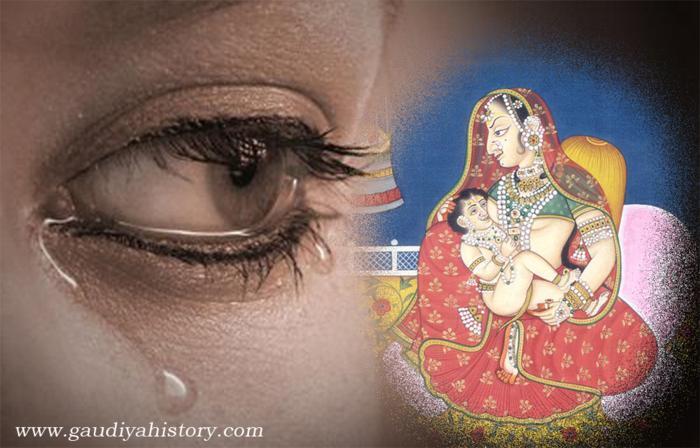
Mukunda Datta saw the doubt on Gadadhara's face, so he recited two verses from the Bhagavatam. In the first, from the Third Canto, Uddhava is astonished that Krishna gave the position of a nurse to the demoness Putana, who had come to kill Him with poison smeared on her breast. The second verse, from the Tenth Canto, makes the same point about her. The effect on Pundarika Vidyanidhi was immediate and overwhelming. He cried out and fell to the ground. He passed through the full range of ecstatic symptoms that the Vaishnava tradition describes: tears, trembling, and loss of self-control. He even tore apart the very bedding and canopy that, moments before, had seemed to show what kind of man he was. Several men together could not hold him still. When the storm of emotion finally passed, he lay unconscious for hours.
Gadadhara understood at once what he had done. In the Vaishnava tradition, misjudging a devotee by his outward circumstances is not treated as a private error. It is treated as vaishnava-aparadha, an offense at a devotee's feet, which is among the most serious faults the tradition recognizes. In the Chaitanya-charitamrita, Sri Chaitanya Mahaprabhu warns Rupa Goswami about this danger: "If the devotee commits an offense at the feet of a Vaishnava while cultivating the creeper of devotional service in the material world, his offense is compared to a mad elephant that uproots the creeper and breaks it. In this way the leaves of the creeper are dried up" (Chaitanya-charitamrita, Madhya-lila 19.156). In Chaitanya-bhagavata, Mahaprabhu Himself afterward draws the wider lesson in very humble words. What He says, in effect, is that even the demigods cannot always recognize who is a genuine Vaishnava, so how could a foolish child do so unaided? He was speaking less about Gadadhara's particular mistake and more about how easily anyone can make it. When Pundarika Vidyanidhi returned to ordinary consciousness, he was calm again and gave no sign of what had just happened. He then initiated Gadadhara Pandit, and remained his spiritual master for the rest of his life.
A Mantra Repeated, and a Second Initiation at Puri #
Years later, at Jagannatha Puri, Gadadhara came to Mahaprabhu with an unusual request. He explained that he had once repeated his own mantra aloud to another person, and after that he found he could no longer concentrate while chanting it. He asked Mahaprabhu to give it to him again so that his mind would settle. Mahaprabhu refused on principle. Gadadhara already had an initiating guru. Mahaprabhu said that it would be improper for anyone else to repeat the mantra while that guru was alive, even for Mahaprabhu Himself. When it was pointed out that Pundarika Vidyanidhi was not present, Mahaprabhu answered that destiny would bring him, and that he would arrive at Puri within ten days. Pundarika Vidyanidhi did arrive exactly as foretold. Mahaprabhu's joy at the sight of him matched the tears He had shed for him years before in Nabadwip. Gadadhara went to his guru and asked to hear the mantra again, and Pundarika Vidyanidhi lovingly did so. The Chaitanya-charitamrita records this second initiation in the same verse that mentions Pundarika Vidyanidhi witnessing that year's Odana-shashthi festival. That episode is told in full on Friendship with Svarupa Damodara at Puri.
