Srila Pundarika Vidyanidhi
The wealthy Vaishnava whom Mahaprabhu called father
The complete life, on one page: The main biography and every pastime page, in order, in one place
Introduction
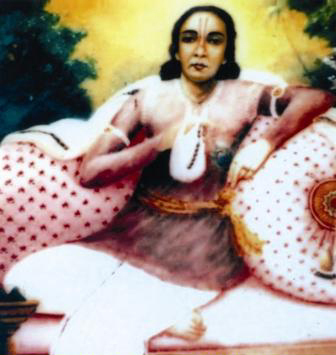
Srila Pundarika Vidyanidhi is one of the more surprising figures among Sri Chaitanya Mahaprabhu's associates. He was a rich man who lived in open luxury. At the same time his soul was so absorbed in love of Krishna that Mahaprabhu called him father and wept for him before the two had even met. Krishnadasa Kaviraja Goswami names him the third great branch of the Chaitanya tree. Kavi Karnapura's Gaura-ganoddesha-dipika identifies him as Vrishabhanu Maharaja, the father of Srimati Radharani, in Krishna's Vraja pastimes.
| Detail | Description |
|---|---|
| Native place | Chakrashala, near the village of Mekhala, Hathazari, Chittagong district |
| Father | Baneshvara, or by another account Shuklambara Brahmachari |
| Mother | Gangadevi |
| Community | Varendra brahmana |
| Spiritual master | Madhavendra Puri |
| Identity | Vrishabhanu, the father of Srimati Radharani (Gaura-ganoddesha-dipika 54; Chaitanya-charitamrita Adi 10.14 purport) |
| Title from Mahaprabhu | Premanidhi (also known to associates as Acharyanidhi) |
Scriptural evidence for the introduction (3)
puṇḍarīka vidyānidhi — baḍa-śākhā jāni
yāṅra nāma lañā prabhu kāndilā āpani
Word for word
puṇḍarīka vidyānidhi: Puṇḍarīka Vidyānidhi; baḍa-śākhā: another big branch; jāni: I know; yāṅra nāma: whose name; lañā: taking; prabhu: the Lord; kāndilā: cried; āpani: Himself.
Puṇḍarīka Vidyānidhi, the third big branch, was so dear to Lord Caitanya Mahāprabhu that in his absence Lord Caitanya Himself would sometimes cry.
From the purport: Purport excerpt: "In the Gaura-gaṇoddeśa-dīpikā (54), Śrīla Puṇḍarīka Vidyānidhi is described as the father of Śrīmatī Rādhārāṇī in kṛṣṇa-līlā. Caitanya Mahāprabhu therefore treated him as His father."
The single verse in which Krishnadasa Kaviraja Goswami himself names Pundarika Vidyanidhi and records that Mahaprabhu wept on hearing his name; the purport is also the primary source for his parents' names and native village.
वृषभानुतया ख्यातः पुरा यो व्रजमण्डले ।
अधुना पुण्डरीकाक्षो विद्यानिधि महाशयः ॥५४॥
vṛṣabhānutayā khyātaḥ purā yo vraja-maṇḍale
adhunā puṇḍarīkākṣo vidyānidhi mahāśayaḥ
The same person who was formerly known as Maharaja Vrsabhanu in the district of Vraja, appeared in Lord Caitanya's pastimes as the great personality Pundarika Vidyanidhi.
From the purport: In the Gaura-gaṇoddeśa-dīpikā (54), Śrīla Puṇḍarīka Vidyānidhi is described as the father of Śrīmatī Rādhārāṇī in kṛṣṇa-līlā. Caitanya Mahāprabhu therefore treated him as His father. (Srila Prabhupada, Chaitanya-charitamrita Adi 10.14 purport)
Kavi Karnapura's identification of Pundarika Vidyanidhi as Vrishabhanu, the father of Srimati Radharani, on which Mahaprabhu's calling him father rests. Sanskrit: diacritic edition of the Gaura-ganoddesha-dipika; English translation as published at bvmlu.org.
स्वकीय भावमासाद्य राधा विरह कातरः ।
चैतन्यः पुण्डरीकाह्वये तातावदत्स्वयम् ॥५५॥
svakīya bhāvam āsādya rādhā viraha kātaraḥ
caitanyaḥ puṇḍarīkāhvaye tātāvadat svayam
When He was afflicted by the feelings of Srimati Radharani's intense love in separation from Lord Krsna, Lord Caitanya would address Pundarika Vidyanidhi using the word "father".
Explains why Mahaprabhu called Pundarika Vidyanidhi father: in the mood of Srimati Radharani's separation from Krishna, He addressed Radharani's father. Sanskrit: diacritic edition of the Gaura-ganoddesha-dipika; English translation as published at bvmlu.org.
Chapter 1
Birth and Early Life in Mekhala
A zamindar family in Chittagong, and a marriage that mirrors Radharani's own parents.
Long before Sri Chaitanya Mahaprabhu wept for him in the middle of a crowded room in Nabadwip, Pundarika Vidyanidhi was simply a landowner's son in the east of Bengal, in a district that today lies in Bangladesh. His family's story is unusually well documented for someone of his generation, mostly because Srila Bhaktisiddhanta Sarasvati Thakura went looking for it and wrote down what he found in his Anubhashya to the Chaitanya-charitamrita.
| Detail | Description |
|---|---|
| Community | Varendra brahmana |
| Ancestral village | Baghiya, near Dhaka |
| Family home in his lifetime | Mekhala, near Hathazari, Chittagong |
| Birthplace | Chakrashala, about two miles from the Annapurna Ghat steamer station |
| Father | Baneshvara (or, by another account, Shuklambara Brahmachari) |
| Mother | Gangadevi |
| Wife | Ratnavati |
A Family Once Set Apart #
The family belonged to the Varendra group of brahmanas. This was one of two rival brahmana communities of old Bengal, the other being the Radhiya. At some point the two groups quarrelled, as they did from time to time. The Varendra families involved, Pundarika Vidyanidhi's among them, were put out of caste for a time. They lived without the social respect that their learning would otherwise have earned them. Bhaktisiddhanta Sarasvati also noted something unusual about the family line. Generation after generation, the family produced only one son, or none, so it never grew large. Even so, as he was able to confirm, it had not died out by his own lifetime.
Birth at Chakrashala #
Pundarika Vidyanidhi was born on Vasanta-panchami, the fifth day of the waxing moon in the month of Magha, at Chakrashala. This was a short distance from the village of Mekhala, where his family's shripat, or ancestral homestead, stood. Mekhala itself lay near the police outpost of Hathazari. It could be reached from Chittagong by horse, bullock cart, or the river steamer that ran to Annapurna Ghat. The tradition names his father as Baneshvara. Some say Baneshvara was descended from Sivarama Gangopadhyaya. But another account gives the father's name as Shuklambara Brahmachari. His mother was Gangadevi.
A Zamindar's Wealth and Learning #
The name Vidyanidhi is a straightforward Sanskrit compound: vidya, learning, and nidhi, a treasure or store, a treasure-house of learning. It was earned honestly. Pundarika Vidyanidhi was a real zamindar, a landholder of genuine wealth at Chakrashala, and he kept homes in both Chittagong and Nabadwip. His comfortable life was not a show. His outward life as a prosperous, cultured brahmana householder was exactly what it looked like. But the world could not see what lay beneath that wealth: a heart already given entirely to Krishna. This hidden devotion nearly went unrecognized, even by people who should have recognized it. How that happened is the subject of The Wealthy Vaishnava of Nabadwip.
A Marriage Within Radha's Own Circle #
The Vaishnava tradition, through Kavi Karnapura's Gaura-ganoddesha-dipika, identifies Pundarika Vidyanidhi as Vrishabhanu Maharaja, the father of Srimati Radharani, in Krishna's eternal Vraja pastimes. It is less often noticed that his wife, Ratnavati, is identified in the very same list as Kirtida, Radharani's mother. So, in the tradition's understanding, an ordinary-looking marriage in Chittagong carried the identities of the most honored parents in Vraja. This identity, more than any of his outward learning or wealth, explains why Sri Chaitanya Mahaprabhu would later call him father before the two had ever stood face to face. That story is told on Mahaprabhu's Longing for His Father.
An older devotional biography, the Prema-vilasa, sums up the young Pundarika Vidyanidhi in a single plain sentence: a zamindar of Chakrashala, extremely rich, very pure in his conduct, of a highly respectable Varendra brahmana lineage, a disciple of Madhavendra Puri, dividing his time between Chittagong and Nabadwip. Nothing in that description hints at anything unusual. As it turned out, that was exactly the point, because his great devotion was hidden behind that ordinary picture.
Chapter 2
The Wealthy Vaishnava of Nabadwip
Why a man who could easily have looked like a man of renunciation chose not to.
By the time Pundarika Vidyanidhi settled for periods at Nabadwip, he had every external mark of a well-off, worldly householder, and he did nothing to soften that impression. He dressed well, kept servants, and lived exactly as comfortably in Nabadwip as he did at home in Chittagong. Only one person among the Vaishnavas of the town was not fooled: Mukunda Datta, who had known him since they were both boys in Chittagong and understood perfectly well what lay beneath the appearance. Everyone else, including for a time Gadadhara Pandit himself, took him for what he seemed to be: a comfortable man of the world with no particular interest in Krishna.
The Ganges He Would Not Touch #
One detail recorded in Sri Chaitanya-bhagavata goes completely against this outward impression. According to this account, Pundarika Vidyanidhi never bathed in the Ganges, because he felt it was disrespectful to touch her sacred waters with his own feet. He would go to see her only at night, from a distance. He did this so that he would not have to see others washing their teeth, washing their hair, or rinsing clothes in her during the day, because he could not bear it. Before performing any act of worship, he would first drink a little Ganges water. None of this looked like the behavior of a man absorbed in worldly comfort. But because it happened privately, it went unnoticed by nearly everyone around him.
Why He Kept the Disguise #
Srila Bhaktisiddhanta Sarasvati Thakura comments on this period in his Gaudiya-bhashya to the Chaitanya-bhagavata. There he says plainly that Krishna's own devotees are sometimes reluctant to reveal themselves to people who are not ready to recognize them. So they let themselves be taken for ordinary people. Sri Chaitanya Mahaprabhu Himself is sometimes described in the tradition as a pracchanna-avatara, a hidden incarnation, for exactly this reason. Understood in this way, Pundarika Vidyanidhi's rich way of life did not go against his devotion. Instead it was a kind of shelter for it. It was a way of staying unnoticed by those who would only have judged him by what they saw.
Sitting Among the Devotees at Srivasa's House #
In the meantime, Pundarika Vidyanidhi was not a stranger to Nabadwip's devotional life. He simply blended into it without being noticed. He is remembered as having taken part in the nightly kirtan gatherings at Srivasa Thakura's house, where Mahaprabhu and His associates would chant long into the night. Tradition says that there he witnessed one of the most famous acts of deliverance of the whole Nabadwip period. This was the change of heart of the drunkards Jagai and Madhai. On Mahaprabhu's order, Nityananda Prabhu and Haridasa Thakura had gone door to door to win them back. When the two former sinners sat among the devotees before Mahaprabhu, they showed the same ecstatic symptoms of prema as everyone else. Pundarika Vidyanidhi is said to have been completely overcome with joy at their good fortune. Here was a wealthy outsider from Chittagong, moved to tears by the change in two men whom the town had given up as hopeless.
A Test No One Expected #
The disguise held until the day Mukunda Datta decided it should not. At last Mukunda Datta brought Gadadhara Pandit to meet Pundarika Vidyanidhi. What happened then, and the price Gadadhara paid for misjudging him, is told in full on Initiating Gadadhara Pandit. The tradition draws a lesson from that single afternoon: a Vaishnava's devotion simply cannot be measured by his outward circumstances. Gadadhara Pandit is said to have carried this lesson with him for the rest of his life, long after he had settled at Puri to serve the Deity of Tota Gopinatha.
Scriptural evidence for this chapter (1)
advaita, nityananda, mukunda, srivasa
vidyanidhi, vasudeva, murari, — yata dasa
prativarse aise sange rahe cari-masa
tan-saba lana prabhura vividha vilasa
Word for word
advaita, nityananda, mukunda, srivasa, vidyanidhi, vasudeva, murari: yata dasa: all these servants of the Lord; prativarse: every year; aise: come; sange rahe: remain with Him; cari-masa: for four months; tan-saba lana: taking all of them; prabhura: of the Lord; vividha vilasa: various pastimes.
Other devotees of the Lord — headed by Advaita Acharya, Nityananda Prabhu, Mukunda, Srivasa, Vidyanidhi, Vasudeva and Murari — used to visit Jagannatha Puri and remain with the Lord for four continuous months. The Lord enjoyed various pastimes in their company.
Confirms Pundarika Vidyanidhi as one of the regular circle of Bengali devotees who spent months each year with Mahaprabhu at Puri.
Chapter 3
Mahaprabhu's Longing for His Father
Weeping for a man He had not yet met, and embracing him again years later at Puri.
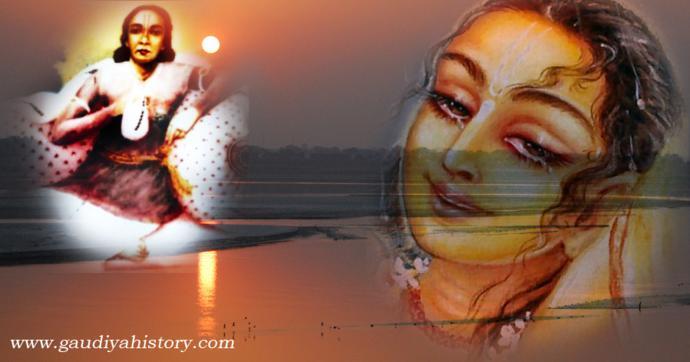
Some time during the Nabadwip years, before Pundarika Vidyanidhi had ever set foot in the town, the devotees gathered around Sri Chaitanya Mahaprabhu heard Him weeping and calling out for someone none of them had met. He was asking, again and again, when He would see His father. When they asked who this father was, Mahaprabhu explained that a great Vaishnava named Pundarika Vidyanidhi would soon be arriving from Chittagong. This Vaishnava wished to live by the Ganges. Mahaprabhu added that few would be able to see his devotion, but that it purified the world simply through the sound of his name.
Tears for a Stranger #
This was not a passing remark. Krishnadasa Kaviraja Goswami records in the Chaitanya-charitamrita that Mahaprabhu counted Pundarika Vidyanidhi as the third great branch of His own tree of devotees. He also records that the Lord would sometimes weep simply on hearing his name spoken. The reason for these tears lies in the identity described on Birth and Early Life in Mekhala. In that identity, Pundarika Vidyanidhi is Vrishabhanu, the father of Srimati Radharani. Mahaprabhu was absorbed in Radharani's own mood of separation, so He truly experienced Pundarika Vidyanidhi as a father He had not yet seen.
Sri Chaitanya-bhagavata records that Mahaprabhu went even further. He told the puzzled devotees exactly why they should expect to be fooled when Pundarika Vidyanidhi finally appeared. Mahaprabhu said that his character was extraordinary, far beyond what anyone could guess from looking at him. His very name purified the world. Yet he would arrive dressed and living like an ordinary man of pleasure, and no one watching him would be able to tell what he really was. In this way Mahaprabhu was warning them in advance of the misjudgment Gadadhara Pandit would go on to make in person not long afterward. When Pundarika Vidyanidhi finally arrived and came before Mahaprabhu late one night, he was so overcome with love that he could not even offer his obeisances. Mahaprabhu drew him to His chest and wept over him. The devotees present understood at once what this embrace meant. This stranger from Chittagong, whom Mahaprabhu's own circle now also knew as Acharyanidhi, stood among the very dearest of the Lord's associates.
Reunited Again at Puri #
The affection did not fade with time or distance. Years later, after Mahaprabhu had accepted sannyasa and was living at Jagannatha Puri, the devotees of Bengal came there to see Him. The Chaitanya-charitamrita describes Him meeting this whole gathering of devotees. Among them were Acharyaratna, Vidyanidhi, Pandita Gadadhara, Gangadasa, Hari Bhatta and Acharya Purandara. He embraced each of them again and again and never tired of praising their qualities. By then Pundarika Vidyanidhi was the diksha-guru of Gadadhara Pandit. He stood in that company as one of the Lord's most cherished associates, not simply as an old acquaintance from Chittagong.
Father Has Come #
The same longing appears again, on a smaller scale, at Jagannatha Puri. It comes in the story of how Gadadhara Pandit came to ask his guru to repeat the diksha mantra to him a second time. That story is told in full on Initiating Gadadhara Pandit. Mahaprabhu had to explain that only Pundarika Vidyanidhi himself could properly do this. Mahaprabhu is remembered as having then predicted the exact day Pundarika Vidyanidhi would arrive. When the news came, He greeted it with the same open joy He had shown years before in Nabadwip, crying out that His father had come. Chaitanya-bhagavata closes its own telling of the first meeting between Pundarika Vidyanidhi and Gadadhara Pandit with a promise. It says that whoever hears that story sincerely will receive a share of the very love of God it describes. The tradition makes this claim for very few episodes in the entire Chaitanya-lila.
Scriptural evidence for this chapter (1)
acaryaratna, vidyanidhi, pandita gadadhara
gangadasa, hari-bhatta, acarya purandara
Word for word
acaryaratna, vidyanidhi, pandita gadadhara, gangadasa, hari-bhatta, acarya purandara: the names of the devotees.
Lord Sri Caitanya Mahaprabhu then again and again embraced all the devotees, including Acaryaratna, Vidyanidhi, Pandita Gadadhara, Gangadasa, Hari Bhatta and Acarya Purandara. The Lord described their good qualities and glorified them again and again.
A later reunion, during Mahaprabhu's tour of Bengal, showing Pundarika Vidyanidhi still among the devotees the Lord singled out for repeated, joyful embrace.
Chapter 4
Initiating Gadadhara Pandit
A single verse of the Bhagavatam undoes a young brahmachari's misjudgment, twice.
The best-known episode of Pundarika Vidyanidhi's life is one he shares with Gadadhara Pandit, who tells the same story from his own side on Initiation from Pundarika Vidyanidhi. It began with Mukunda Datta, who had grown up alongside Pundarika Vidyanidhi in Chittagong and alone among the devotees of Nabadwip knew what he really was. One day Mukunda told Gadadhara, then a young brahmachari known for his indifference to comfort, that he wanted to introduce him to an exceptional Vaishnava, and took him along.
A Disappointing First Impression #
What Gadadhara found was not what he expected. Pundarika Vidyanidhi was reclining on an expensive bed beneath a three-tiered canopy, on sheets as white as milk-foam, with a jewelled box of scented betel within reach, brass spittoons at either side, and two servants cooling him with fans. He received the two visitors warmly and talked pleasantly. Gadadhara had been ascetic by nature since childhood. He could not see how any of this fitted the word Vaishnava. He came away convinced that Mukunda had brought him to meet nothing more than a comfortable, ordinary rich man.
The Verse That Changed Everything #
Mukunda Datta saw the doubt on Gadadhara's face, so he recited two verses from the Bhagavatam. In the first, from the Third Canto, Uddhava is astonished that Krishna gave the position of a nurse to the demoness Putana, who had come to kill Him with poison smeared on her breast. The second verse, from the Tenth Canto, makes the same point about her. The effect on Pundarika Vidyanidhi was immediate and overwhelming. He cried out and fell to the ground. He passed through the full range of ecstatic symptoms that the Vaishnava tradition describes: tears, trembling, and loss of self-control. He even tore apart the very bedding and canopy that, moments before, had seemed to show what kind of man he was. Several men together could not hold him still. When the storm of emotion finally passed, he lay unconscious for hours.
Gadadhara understood at once what he had done. In the Vaishnava tradition, misjudging a devotee by his outward circumstances is not treated as a private error. It is treated as vaishnava-aparadha, an offense at a devotee's feet, which is among the most serious faults the tradition recognizes. In the Chaitanya-charitamrita, Sri Chaitanya Mahaprabhu warns Rupa Goswami about this danger: "If the devotee commits an offense at the feet of a Vaishnava while cultivating the creeper of devotional service in the material world, his offense is compared to a mad elephant that uproots the creeper and breaks it. In this way the leaves of the creeper are dried up" (Chaitanya-charitamrita, Madhya-lila 19.156). In Chaitanya-bhagavata, Mahaprabhu Himself afterward draws the wider lesson in very humble words. What He says, in effect, is that even the demigods cannot always recognize who is a genuine Vaishnava, so how could a foolish child do so unaided? He was speaking less about Gadadhara's particular mistake and more about how easily anyone can make it. When Pundarika Vidyanidhi returned to ordinary consciousness, he was calm again and gave no sign of what had just happened. He then initiated Gadadhara Pandit, and remained his spiritual master for the rest of his life.
A Mantra Repeated, and a Second Initiation at Puri #
Years later, at Jagannatha Puri, Gadadhara came to Mahaprabhu with an unusual request. He explained that he had once repeated his own mantra aloud to another person, and after that he found he could no longer concentrate while chanting it. He asked Mahaprabhu to give it to him again so that his mind would settle. Mahaprabhu refused on principle. Gadadhara already had an initiating guru. Mahaprabhu said that it would be improper for anyone else to repeat the mantra while that guru was alive, even for Mahaprabhu Himself. When it was pointed out that Pundarika Vidyanidhi was not present, Mahaprabhu answered that destiny would bring him, and that he would arrive at Puri within ten days. Pundarika Vidyanidhi did arrive exactly as foretold. Mahaprabhu's joy at the sight of him matched the tears He had shed for him years before in Nabadwip. Gadadhara went to his guru and asked to hear the mantra again, and Pundarika Vidyanidhi lovingly did so. The Chaitanya-charitamrita records this second initiation in the same verse that mentions Pundarika Vidyanidhi witnessing that year's Odana-shashthi festival. That episode is told in full on Friendship with Svarupa Damodara at Puri.
Scriptural evidence for this chapter (4)
Quoted in the text above:
- CC Madhya 19.156-159 Sri Chaitanya-charitamrita
Further verses:
sri-mukunda-datta sakha — prabhura samadhyayi
yanhara kirtane nace caitanya-gosani
Word for word
sri-mukunda-datta sakha: Mukunda Datta, a class friend; prabhura samadhyayi: a class friend of the Lord's; yanhara kirtane: by whose chanting; nace: dances; caitanya-gosani: Lord Caitanya.
Mukunda Datta, a class friend of Lord Caitanya's, was another branch of the Caitanya tree. Lord Caitanya danced while he sang.
Establishes Mukunda Datta's standing among Mahaprabhu's closest associates, relevant to his role introducing Gadadhara Pandit to Pundarika Vidyanidhi.
aho baki yam stana-kala-kutam
jighamsayapayayad apy asadhvi
lebhe gatim dhatry-ucitam tato 'nyam
kam va dayalum saranam prapadye
Word for word
aho: alas; baki: the she-demon (Putana); yam: whom; stana: of her breast; kala-kutam: deadly poison; jighamsaya: out of envy; apayayat: nourished; api: although; asadhvi: unfaithful; lebhe: achieved; gatim: destination; dhatry-ucitam: worthy of a nurse; tatah anyam: than that; kam va: what other; dayalum: merciful one; saranam prapadye: I take shelter of.
Alas, how shall I take shelter of one more merciful than He who granted the position of mother to a she-demon [Putana] although she was unfaithful and she prepared deadly poison to be sucked from her breast?
Uddhava's verse of astonishment at Krishna's mercy; the first of the two verses Mukunda Datta recited that broke Pundarika Vidyanidhi's composure in front of Gadadhara Pandit.
putana loka-bala-ghni
raksasi rudhirasana
jighamsayapi haraye
stanam dattvapa sad-gatim
Word for word
putana: Putana, the professional Rakshasi; loka-bala-ghni: who used to kill human children; raksasi: the she-demon; rudhira-asana: simply hankering for blood; jighamsaya: with the desire to kill Krishna; api: still; haraye: unto the Supreme Personality of Godhead; stanam: her breast; dattva: after offering; apa: obtained; sad-gatim: the highest destination.
Putana was always hankering for the blood of human children, and with that desire she came to kill Krishna; but because she offered her breast to the Lord, she attained the greatest achievement.
The second of the two Bhagavatam verses Mukunda Datta recited; hearing it caused Pundarika Vidyanidhi to fall into open ecstatic symptoms in front of Gadadhara Pandit.
Chapter 5
Friendship with Svarupa Damodara at Puri
Two devotees on the same level, and the night Lord Jagannatha corrected one of them Himself.
In his later years Pundarika Vidyanidhi came to spend long periods at Jagannatha Puri. The Chaitanya-charitamrita notes that at least once he stayed on through the season when the rest of the Bengali devotees went home. During these Puri years his friendship with Svarupa Damodara Goswami grew deeper, and the tradition remembers it as a very special friendship.
An Equal in Krishna-katha #
Krishnadasa Kaviraja Goswami describes the two as having a warm and close friendship. He says plainly that when they discussed Krishna, they stood on exactly the same level. This is high praise, because Svarupa Damodara was Mahaprabhu's own closest literary companion. He was also the person at Puri most trusted to judge devotional feelings. One meeting between them, after a long separation, is fondly remembered. Each man wanted to take the dust of the other's feet as a mark of respect, and neither would allow it. So what began as courtesy turned into a friendly tussle. Each tried to catch the other's feet while guarding his own. Mahaprabhu laughed at the sight, along with everyone watching.
Splashing at the Chandana-yatra #
The friendship also shows itself in smaller, lighter moments. Each year at Puri's Chandana-yatra festival, Mahaprabhu and His devotees would gather to play in the water of Narendra Sarovara, also called Chandan Pukur. Pundarika Vidyanidhi and Svarupa Damodara are remembered as spending the festival happily splashing water at one another like two boys, laughing all the while. Pundarika Vidyanidhi is also recorded as taking part in the yearly cleaning of the Gundicha temple before Ratha-yatra, together with the rest of Mahaprabhu's Puri devotees. He shared in the mahaprasada that followed the work. This was the same yearly gathering of Bengali devotees at Puri, led by Advaita Acharya and Nityananda Prabhu. The Chaitanya-charitamrita says these devotees would stay with Mahaprabhu for four months at a time, enjoying His company in return.
The Unwashed Cloth #
That same closeness with Svarupa Damodara is the setting for the best-known incident of Pundarika Vidyanidhi's Puri years. Each year, at the beginning of winter, the temple observed a festival called Odana-shashthi, when Lord Jagannatha was given His first winter covering. Correct temple practice required the cloth to be washed free of starch before it touched the Deity. One year Pundarika Vidyanidhi was watching the ceremony. He noticed that the priests had skipped this step, and he unhappily pointed it out to Svarupa Damodara. Svarupa Damodara answered that the Supreme Lord is beyond all rules of purity and impurity, so the priests were not at fault for this. Pundarika Vidyanidhi was not satisfied. He said that this reasoning might be true for the Lord Himself, but His servants were not of the same nature. Their conduct could still be judged by the ordinary standards of scripture.
Jagannatha's Nighttime Correction #
That night, Lord Jagannatha visited Pundarika Vidyanidhi in a dream, together with Lord Balarama. The two brothers, smiling all the while, slapped his cheeks. There is no end to your fault-finding, Jagannatha told him: if there is no question of purity or impurity where I am concerned, the same holds for those who serve Me; if you thought Puri too impure a place, you were free to leave it. In the morning the other devotees saw the marks of the slaps still swollen on his cheeks, and they laughed. Although he had been corrected, Pundarika Vidyanidhi was inwardly delighted, not ashamed. The tradition says this proves how dear he was to Jagannatha, because the Lord takes the trouble to discipline in person only His closest devotees. Krishnadasa Kaviraja notes that Vrindavana Dasa Thakura had already told this incident in full in the Chaitanya-bhagavata. He himself gives only its outline.
The Chaitanya-charitamrita places this episode in the very same year as the story of Gadadhara Pandit's second initiation. It is a reminder that Pundarika Vidyanidhi's last years at Puri were still full of the same mixture that his whole life had shown. He had real devotion, but he could also make real mistakes of judgment. And his Lord loved him enough to correct him without loving him any less.
Scriptural evidence for this chapter (4)
Finally all the Vaishnavas returned to Bengal, but that year Pundarika Vidyanidhi remained at Jagannatha Puri.
Marks the year Pundarika Vidyanidhi stayed on at Puri instead of returning to Bengal with the other Bengali devotees, the setting for the events told here.
svarupa-sahita tanra haya sakhya-priti
dui-janaya krsna-kathaya ekatra-i sthiti
Word for word
svarupa-sahita: with Svarupa Damodara Gosvami; tanra: his; haya: there is; sakhya-priti: very intimate friendship; dui-janaya: of the two persons; krsna-kathaya: in discussing topics of Krishna; ekatra-i sthiti: situated on the same platform.
Svarupa Damodara Gosvami and Pundarika Vidyanidhi had a friendly, intimate relationship, and as far as discussing topics about Krishna, they were situated on the same platform.
Krishnadasa Kaviraja's own statement of the closeness between Pundarika Vidyanidhi and Svarupa Damodara Goswami, the basis for the account given here.
Pundarika Vidyanidhi initiated Gadadhara Pandita for the second time, and on the day of Odana-shashthi Pundarika Vidyanidhi saw the festival.
From the purport: Purport excerpt: "Puṇḍarīka Vidyānidhi saw that the priest neglected to wash the cloth before covering Lord Jagannātha. Since he wanted to find some fault in the devotees, he became indignant."
Places Gadadhara Pandit's second initiation and the Odana-shashthi incident in the same year, at Puri.
When Pundarika Vidyanidhi saw that Lord Jagannatha was given a starched garment, he became a little hateful, and in this way his mind was polluted. That night the brothers Lord Jagannatha and Balarama came to Pundarika Vidyanidhi and, smiling, began to slap him. Although his cheeks were swollen from the slapping, Pundarika Vidyanidhi was very happy within. This incident has been elaborately described by Thakura Vrindavana dasa.
The Odana-shashthi episode in Krishnadasa Kaviraja's own words, including his note that Vrindavana Dasa Thakura's Chaitanya-bhagavata gives the fuller account.
Chapter 6
Disappearance and Legacy
No recorded date of departure, a family that quietly endured, and a shripat still standing.
No source gives a year for Pundarika Vidyanidhi's disappearance, so we do not make one up. We can say more, and with more confidence, about how the tradition remembered him afterward. In its own way, this is almost as interesting as the events of his life.
A Genuine Puzzle About Vrindavana #
The Chaitanya-charitamrita itself states clearly that Pundarika Vidyanidhi never visited Vrindavana-dhama in this life. It says the same of Haridasa Thakura, Srivasa Thakura, Shivananda Sena, Ramananda Raya, Shikhi Mahiti, Madhavi-devi and Gadadhara Pandit. Srila Bhaktisiddhanta Sarasvati Thakura, commenting on this point, says plainly that there is no authorized record of any of these great devotees making the journey. But later pilgrimage tradition, as recorded in accounts of the samadhis at Radha-kunda, places a samadhi for Pundarika Vidyanidhi among the 64 Samadhis there. It stands alongside those of many of Mahaprabhu's other associates. So the two traditions disagree. Krishnadasa Kaviraja's own words say one thing, and the later samadhi tradition says another. A reader should take the samadhi as a mark of devotional honor, not as proof that Pundarika Vidyanidhi ever travelled there.
A Family That Did Not Vanish #
What is better recorded is the family he left behind. Bhaktisiddhanta Sarasvati Thakura wrote in the early twentieth century. He recorded that descendants of Pundarika Vidyanidhi's line were still living in his own time, among them Sri Harakumara Smrititirtha and Sri Krishnakinkara Vidyalankara. He also recorded that one member of the family, Sarojananda Gosvami, was by then living in Vrindavana itself. There is a quiet irony in this, because it is uncertain whether Pundarika Vidyanidhi himself ever reached that holy town. The family had kept its old pattern of one son in each generation, or none at all. So it had never grown large, but it had also never died out.
The Shripat at Mekhala #
According to Bhaktisiddhanta Sarasvati Thakura, the temple Pundarika Vidyanidhi built at his family's shripat in Mekhala was already very old and badly in need of repair. Its brick inscriptions were so worn that they could not be read. A second temple, possibly older, stood nearby. Bhaktisiddhanta Sarasvati did not try to give a complete family tree himself. Instead, he pointed readers who wished to trace the family further to the specialist reference work Vaishnava-manjusha. That same site, in what is now Bangladesh, is still maintained today. It is cared for by ISKCON devotees and known to pilgrims as Pundarika Dham. There visitors can see Pundarika Vidyanidhi's bhajan-kutir, along with a Radha-kunda, Shyama-kunda and small Govardhana built in his memory. Together they form a small devotional picture of Vraja, which reflects the Vraja identity the tradition gives him.
The Third Branch, Remembered #
The tradition uses several names for him. Vidyanidhi, treasure of learning, came from his own family's reputation. Premanidhi was given by Mahaprabhu. Acharyanidhi and Bhaktyanidhi were both used by later devotees. Read together, these names are almost like a record of how differently he appeared from the outside and from the inside over his life. Krishnadasa Kaviraja Goswami's own verse remains the simplest explanation of why any of this was recorded at all. It tells us that Sri Chaitanya Mahaprabhu Himself would sometimes weep on hearing this man's name. Pundarika Vidyanidhi was a wealthy landowner who lived exactly as rich as he looked. More than once he was misjudged by people who should have known better. And he was loved completely by Sri Chaitanya Mahaprabhu, Gadadhara Pandit and Svarupa Damodara Goswami alike. That is the picture of Pundarika Vidyanidhi that the sources leave us. It is not a thin one, even where the record runs out.
Scriptural evidence for this chapter (1)
Sri Pundarika Vidyanidhi, Sri Haridasa Thakura, Srivasa Pandita, Shivananda Sena, Sri Ramananda Raya, Sri Shikhi Mahiti, Sri Madhavi-devi and Sri Gadadhara Pandita Gosvami never visited Vrindavana-dhama. Srila Bhaktisiddhanta Sarasvati Thakura points out that we have no authorized documents stating that these exalted personalities visited Vrindavana.
An honest, direct statement from the tradition's own commentary that stands in tension with the later pilgrimage-tradition claim of a Pundarika Vidyanidhi samadhi at Radha-kunda; recorded here rather than silently resolved.
Closing
Family and Native Place #
Pundarika Vidyanidhi's people were Varendra brahmanas whose ancestral home was in a village called Baghiya near Dhaka. But the family had long since settled at Mekhala, a village near Hathazari in the Chittagong district of what is now Bangladesh. Srila Bhaktisiddhanta Sarasvati Thakura traced the family in his Anubhashya to the Chaitanya-charitamrita. He records that the family had been in conflict with another group of brahmanas, the Radhiya, in one of the disputes that arose from time to time between the two communities. For a time the family had lost the social respect its learning deserved. Pundarika Vidyanidhi's father is named Baneshvara, who is supposed to be a descendant of Sivarama Gangopadhyaya. Another account names his father as Shuklambara Brahmachari. His mother was Gangadevi. He was born on Vasanta-panchami, the fifth day of the bright fortnight of the month of Magha, at Chakrashala. His wife, Ratnavati, is identified in the same list of Vraja identities as Kirtida, the mother of Srimati Radharani. So husband and wife together carry the identities of Radharani's parents.
Disciple of Madhavendra Puri #
According to the Gaura-ganoddesha-dipika and the older devotional biography Prema-vilasa, Pundarika Vidyanidhi took initiation from Madhavendra Puri. Madhavendra Puri also initiated Advaita Acharya, and some accounts say they were both initiated at the same time. So, in the tradition's own understanding, Pundarika Vidyanidhi was almost like a godbrother of Mahaprabhu's own guru. This is one reason Krishnadasa Kaviraja shows him such special respect in the Chaitanya-charitamrita.
- Sri Chaitanya-charitamrita, Adi-lila 10.14 (verse, translation and purport)
- Sri Chaitanya-charitamrita, Madhya-lila 16.76-81
- Pundarika Vidyanidhi - a glorious personality (Vanipedia, compiled Prabhupada quotes)
- Pundarika Vidyanidhi - Biography (Gaudiya History, ISKCON Desire Tree)
- Pundarika Vidyanidhi (Gaudiya History, ISKCON Desire Tree)
- Sri Pundarika Vidyanidhi - Appearance (ISKCON Desire Tree)
- Samadhis of Vrindavan (archive.org scan)
