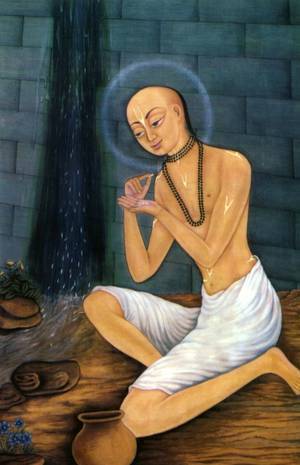
For roughly forty years, Radha-kunda was Raghunatha Dasa Goswami's whole world, as far as anyone could see. His bhajana-kutir, the simple hut where he lived and worshipped, still stands on the bank of the kunda and continues to draw pilgrims today. Inside it he kept a very strict discipline. Later Vaishnava writers recorded it in almost exact numbers, because its very strictness was considered a lesson in itself.
| Detail | Description |
|---|---|
| Residence | A simple bhajana-kutir beside Radha-kunda, still standing and visited today |
| Daily chanting | Around sixty-four rounds of japa, roughly 100,000 holy names |
| Daily obeisances | About 1,000 to Radha-Krishna and 2,000 to the Vaishnavas of Vraja, embracing each one |
| Bathing | Three times daily in Radha-kunda |
| Sleep | Under ninety minutes; some days none at all |
| Spiritual identity | Held by tradition to serve Radharani eternally as the manjari Rati-manjari (some accounts: Bhanumati) |
Building the Bhajana-Kutir #
When Raghunatha Dasa Goswami first arrived at Radha-kunda he did not build any shelter at all. He simply sat down in the open and absorbed himself in meditation on Radha and Krishna. Bhakti-ratnakara remembers that a tiger and tigress once came to drink from the nearby Shyama-kunda while he sat there undisturbed. It also says that Krishna Himself stood quiet watch nearby so that His devotee's meditation would not be broken. Sanatana Gosvami, passing by, urged him to build a proper hut. But Raghunatha Dasa, absorbed as ever, paid little attention to the advice. It took a second, gentler warning to move him. It is said that Srimati Radharani Herself saw him sitting unmoved through the blazing midday sun, and stood behind him holding out Her own cloth as shade. Then Sanatana Gosvami came by and saw Her, wet with sweat from the effort. He gently scolded Raghunatha Dasa for troubling his Lord's eternal consort in this way. Only then did Raghunatha Dasa allow a small kutir to be built. By tradition, it is the same modest hut that still stands on the bank of the kunda today.
Excavating the Twin Kundas #
When Raghunatha Dasa first settled there, Radha-kunda and Shyama-kunda were little more than shallow, muddy pools set in adjoining paddy fields. This was the same spot Sri Chaitanya Mahaprabhu himself had identified during His parikrama of Vraja. Jiva Gosvami arranged to purchase the two fields. Then, in 1545, Raghunatha Dasa took charge of digging out both kundas and building stone ghats around their banks. In the process he uncovered the far older Kanchana-kunda and Vajra-kunda, which are said to have been dug originally by Vajranabha Maharaja. Five trees stood on the bank of Shyama-kunda, and they are said to be the five Pandavas in another form. Yudhishthira appeared to Raghunatha Dasa in a dream and asked that they be left standing, so Raghunatha Dasa ordered that they be spared. That is why Shyama-kunda, unlike its neighbour, was never finished as a perfect rectangle.
The Tongue of Govardhana #
Concerned that pilgrims were washing clothes and utensils in Radha-kunda's sacred water, Raghunatha Dasa once had workers dig a separate well nearby for such use. When their digging struck something that began to bleed, he stopped the work at once, fearing an offense. That night it was revealed to him that the workers had struck the tongue of Govardhana Hill itself, and Raghunatha Dasa raised a small shrine on the spot in atonement, one still worshipped by pilgrims to this day.
A Schedule Without Rest #
Besides his own worship of the Govardhana-sila that Sri Chaitanya Mahaprabhu had given him, Raghunatha kept up a practice he had begun at Puri, speaking about the Lord's pastimes. Tradition says he spent several hours a day describing Mahaprabhu's years at Jagannatha Puri to the residents of Vraja who gathered to hear. As the years passed, he allowed himself less and less sleep and food. Even before he reached Radha-kunda, Sri Chaitanya-charitamrita already records him spending more than twenty-two of every twenty-four hours in chanting and remembrance. At Radha-kunda, all later accounts agree, that discipline only deepened. He also kept wearing the same single torn cloth and patchwork wrapper he had worn since his earliest days at Puri. In four decades he never once changed to anything more comfortable.
Grief as a Path of Love #
Each loss among his own teachers led him to eat even less. After Sri Chaitanya Mahaprabhu's disappearance he is remembered as living on little more than fruit and milk. After Sanatana Gosvami's disappearance, he is remembered as taking a single leaf-cup of buttermilk every day or two. When Rupa Gosvami himself finally left this world, Raghunatha Dasa is said to have given up eating and drinking altogether. The Vrajavasis who saw him in this condition reportedly wept at how visibly he was wasting away. Yet tradition insists that this was never neglect of the body for its own sake. It was his grief, deliberately and consciously turned into a more and more complete offering of his body. He had already renounced that body twice over.
Tears Beside the Water #
Above all, these years are remembered for an austerity that was not hardship but loving closeness. He spent long hours weeping alone beside Radha-kunda and on Govardhana Hill, pouring out his heart in continuous japa and in hearing and reciting scripture. Tradition also credits him with a practice called manasi-seva. In it he served Radha and Krishna in meditation, within a spiritual body dedicated entirely to that purpose. He carried on this practice quietly, alongside the external worship that anyone passing his hut could see. Gaudiya Vaishnava teachers have long said that even his rest was never truly rest at all. They hold that an eternal associate of the Lord continues to serve even while the body outwardly sleeps.
A Kunda Named for the Days That Followed #
Radha-kunda itself was not a chance choice of home. Sri Chaitanya Mahaprabhu had identified the lake during His own visit to Vraja as the place where Radha and Krishna once bathed together. Raghunatha Dasa's entire theology centered on service to Radharani specifically. So for him no other spot in Vrindavana could have been as suitable. From exactly this place, and in this state of heart, Raghunatha Dasa Goswami wrote the prayers gathered afterward as his Stavavali. Even now these verses read less like composed poetry and more like a private diary of longing that happened to survive. They are described in full in Literary Works and the Stavavali.
Two Well-Remembered Pastimes #
Bhakti-ratnakara preserves two smaller stories that Vraja still tells about these years. In one, a Vrajavasi devotee named Das was distressed that Raghunatha Dasa lived on so little. So he once brought him buttermilk in an unusually large leaf-bowl made from a tree in the village of Sakhisthali. Sakhisthali was the home of Chandravali, Radharani's rival for Krishna's love. As soon as Raghunatha Dasa heard the village's name, he threw down the bowl at once. Tradition does not read this flash of feeling as small-mindedness. It sees in it the intensity of an eternal servant's loyalty to Radharani alone. In the other story, devotees were waiting outside his kutir one afternoon. They grew alarmed when Raghunatha Dasa, who ate barely anything, did not come out. Physicians were called to examine him. They found nothing worse than that he had eaten too much sweet-rice. He explained that the sweet-rice had been offered in a deep trance of manasi-seva, while he was serving Radha and Krishna within his mind.
Jahnava Mata's Visit #
In his last years Raghunatha Dasa was worn down by grief for Rupa Gosvami and Sanatana Gosvami. At that time Jahnava Mata visited him at Radha-kunda. She came at Jiva Gosvami's own request, to give him some relief through her darshana. Bhakti-ratnakara describes both of them in tears at the meeting. Raghunatha Dasa was overwhelmed with ecstatic love, and Jahnava Mata's own heart, tradition says, was still burning with separation from her eternal consort Nityananda Prabhu.
