Srila Raghunatha Dasa Goswami
Foremost in Renunciation Among the Six Goswamis of Vrindavana
The complete life, on one page: The main biography and every pastime page, in order, in one place
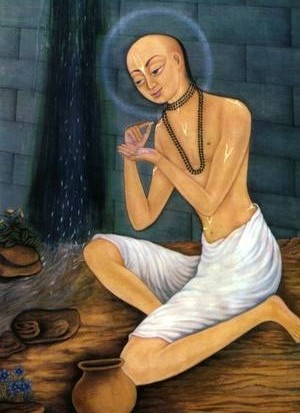
Introduction
dāsa-śrī-raghunāthasya pūrvākhyā rasa-mañjarī
amuṁ kecit prabhāṣante śrīmatīṁ rati-mañjarīm
bhānumaty-ākhyayā kecid āhus taṁ nāma-bhedataḥ
"Srila Raghunatha dasa Gosvami was the incarnation of Rasa-manjari. Some say that Raghunatha das Gosvami was the incarnation of Rati-manjari, and others say he was the incarnation of Bhanumati-devi." (Gaura-ganoddesha-dipika 186)
Srila Raghunatha Dasa Goswami is remembered among the Six Goswamis of Vrindavana as the perfect example of renunciation taken as far as it can go. He was born into more wealth than most people of his time would see in several lifetimes. Yet he walked away from all of it to beg his food at a temple gate. In his final decades he lived on a few mouthfuls of buttermilk a day beside a small lake in Vraja. Sri Chaitanya Mahaprabhu placed him in the personal care of His secretary Svarupa Damodara Gosvami at Jagannatha Puri. There, and later at Vrindavana under Rupa Gosvami and Sanatana Gosvami, Raghunatha Dasa became the standard by which every Gaudiya Vaishnava understands what surrender means. This was Srila Prabhupada's own view, and he expressed it many times.
| Detail | Description |
|---|---|
| Full name | Raghunatha Dasa Goswami |
| Born | c. 1494 (sources vary), Saptagrama area, Hooghly district, Bengal |
| Family | Only son of the landholder Govardhana Majumadara; nephew of Hiranya Dasa |
| Identity | In Krishna-lila: Rasa-manjari; some say Rati-manjari or Bhanumati (Gaura-ganoddesha-dipika 186; Chaitanya-charitamrita Adi 10.91 purport) |
| Diksha-guru | Yadunandana Acharya |
| Guided at Puri by | Sri Chaitanya Mahaprabhu and Svarupa Damodara Gosvami |
| Guided at Vrindavana by | Rupa Gosvami and Sanatana Gosvami |
| Chief works | Stavavali (including Manah-siksa and Vilapa-kusumanjali), Dana-keli-cintamani, Mukta-caritra |
| Disappeared | Traditionally dated 1586, Radha-kunda |
Scriptural evidence for the introduction (2)
Quoted in the text above:
- Verse 186 Gaura-ganoddesha-dipika
Further verses:
মহাপ্রভুর প্রিয় ভৃত্য—রঘুনাথদাস ।
সর্ব ত্যজি’ কৈল প্রভুর পদতলে বাস ॥
mahāprabhura priya bhṛtya — raghunātha-dāsa
sarva tyaji’ kaila prabhura pada-tale vāsa
Śrīla Raghunātha dāsa Gosvāmī, the forty-sixth branch of the tree, was one of the most dear servants of Lord Caitanya Mahāprabhu. He left all his material possessions to surrender completely unto the Lord and live at His lotus feet.
From the purport: In the Gaura-gaṇoddeśa-dīpikā (186) it is stated that Śrīla Raghunātha dāsa Gosvāmī was formerly the gopī named Rasa-mañjarī. Sometimes it is said that he was Rati-mañjarī. (Srila Prabhupada, purport purport)
Krishnadasa Kaviraja Goswami names Raghunatha Dasa Gosvami as a dear servant of Sri Chaitanya Mahaprabhu; the purport gives his identity from the Gaura-ganoddesha-dipika. Verse text, translation and purport: Srila Prabhupada, Sri Chaitanya-charitamrita (vedabase.io).
Chapter 1
Birth in a Wealthy Bengali Family
How a rich landholder's only son first fell under the spell of Sri Chaitanya Mahaprabhu
Raghunatha Dasa was born the only son of Govardhana Majumadara, a landholder of the Saptagrama area in Bengal's Hooghly district. Govardhana and his elder brother Hiranya Dasa together collected a share of the region's tax revenue on behalf of the ruling government. By the standards of sixteenth-century Bengal their household was extraordinarily rich. In a 1975 lecture at Vrindavana, Srila Prabhupada described the family and put his father's income at twelve lakhs of rupees. That was an almost unimaginable sum five hundred years ago. Srila Prabhupada noted that it would come to crores of rupees in modern terms.
| Detail | Description |
|---|---|
| Father | Govardhana Majumadara |
| Uncle | Hiranya Dasa |
| Region | Saptagrama, Hooghly district, Bengal |
| Family status | Wealthy landholders and tax-farmers for the ruling government |
| Boyhood influence | Association and blessing of Haridasa Thakura |
| Family priest | Balarama Acharya, a favorite of Haridasa Thakura |
| Diksha-guru | Yadunandana Acharya, a favorite of Vasudeva Datta Thakura |
| Birth village | Chandrapura, today known as Sri Krishnapura |
A Village Called Chandrapura #
Tradition remembers the family's own village as Chandrapura, a few miles from Saptagrama itself and known today as Sri Krishnapura. The household's own priest was Balarama Acharya, a favorite of Haridasa Thakura. He was a different person from Raghunatha's diksha-guru, Yadunandana Acharya, who was a favorite of Vasudeva Datta Thakura. So the mercy of two separate lines of devotees had already come to this one household, even before Raghunatha ever met Sri Chaitanya Mahaprabhu directly.
An Heir Tested Early #
Wealth of that scale drew attention, and it also drew trouble. Sri Chaitanya-charitamrita records that a rival Muslim tax official became envious of Hiranya Dasa's success in collecting the revenue of Saptagrama. So he had the household's men arrested. The young Raghunatha, not his father or uncle, was the one seized and questioned in their place. He was left to argue his family's case himself. He spoke to the official with such good sense and warmth, addressing him as a kind of adoptive father, that the man wept and released him. Raghunatha then arranged a meeting between the official and his uncle, and the dispute was settled peacefully. The story gives a small glimpse of a rare mind. Raghunatha was gentle and calm under pressure, and he already cared little for the wealth he was defending.
Drawn to Two Lords Before He Understood Why #
As a boy, Raghunatha received the direct association and blessing of Haridasa Thakura, one of Sri Chaitanya Mahaprabhu's most exalted early associates. Whatever happened between them, it had a lasting effect on him. Outwardly he continued to live, dress and do business exactly as his father's son was expected to. But inside, a completely different attachment had already taken hold of him. Sri Chaitanya-charitamrita speaks of this double life with some admiration. It says Raghunatha managed the family's affairs "like a first-class businessman," and satisfied his parents completely, while he remained inwardly renounced the whole time.
Marriage as a Last Anchor #
Raghunatha's father and uncle saw how little their son cared for the world he had been born into. So they tried the one remedy they had, and arranged his marriage. In Srila Prabhupada's words, it was to "a very beautiful wife." It did not work. According to his own family's account, Raghunatha would not even come inside the house at night. He chose to lie outside alone instead. He began to be called Raghunatha dasa, "servant of Raghunatha," only later, after he had actually joined Sri Chaitanya Mahaprabhu. This new name marked his final break with the life his family had tried to keep him in.
A First, Unfinished Meeting #
Before that break came, Raghunatha did meet Sri Chaitanya Mahaprabhu once already, while the Lord was passing through Santipura. The Lord did not accept him into the renounced life on the spot. Instead He told Raghunatha to go home and continue exactly as before. The lesson was that renunciation within the heart, not a change of clothing, was what mattered. Raghunatha obeyed and returned to his father's house. Later, word reached him that Sri Chaitanya Mahaprabhu had come back from His journey to Mathura. Then Raghunatha could no longer resist the pull, and the long, difficult work of actually leaving home began. This is the subject of The Struggle to Renounce the World.
A Birth Date That Sources Cannot Quite Fix #
Later tradition remembers Raghunatha Dasa as the youngest of the Six Goswamis of Vrindavana. But, as with several of his companions, no Bengali document from his own time records his birth with certainty. English-language sources most often cite a year around 1494. But that figure comes from a single twentieth-century Bengali biographical dictionary, not from any source from his own lifetime. So readers should treat it as an approximate, traditional date, not a documented fact. We can be more confident about his age compared with other events. He was already a young man, married and managing family business, by the time Sri Chaitanya Mahaprabhu passed through Bengal on the journeys that eventually drew him away for good.
Chapter 2
The Struggle to Renounce the World
Repeated attempts, a mother's despair, and the trick that finally set him free
For one full year after his first meeting with Sri Chaitanya Mahaprabhu at Santipura, Raghunatha Dasa did exactly as he had been told. He ran his father's affairs and gave no outward sign of what he intended. The next year he could wait no longer, and one night he simply got up and left. His father caught him at a distance and brought him home. It happened again, and then again. In the words of Sri Chaitanya-charitamrita itself, it became almost a daily affair. His mother, not knowing what else to do, told her husband to bind their son with ropes. Govardhana Majumadara's reply is remembered as one of the more moving lines in the whole account. He said that no rope could hold a boy on whom Sri Chaitanya Mahaprabhu's mercy had already fallen.
The Blessing of Nityananda Prabhu at Panihati #
Raghunatha could not leave directly for Puri. So he went instead to see Nityananda Prabhu, who was staying at Panihati on the bank of the Ganges, surrounded by kirtana performers and devotees. Raghunatha offered his obeisances from a respectful distance. Nityananda Prabhu laughed and called out that he was a thief who had finally come to be punished. As that punishment, He ordered Raghunatha to hold a festival and give chipped rice mixed with yogurt to everyone present. Raghunatha threw himself into the task. He bought up the food stocks of several villages and provided hundreds of earthen pots of chipped rice for a crowd that kept growing through the day. In the middle of the feast, Nityananda Prabhu brought Sri Chaitanya Mahaprabhu to the spot in meditation. The two brothers ate together on the riverbank, surrounded by devotees chanting the holy names. Gaudiya Vaishnavas still celebrate this event to this day as the chida-dadhi-mahotsava, or Panihati festival.
Afterward, Nityananda Prabhu called Raghunatha near and placed His feet on his head. He told him plainly that all obstacles to his taking shelter at Sri Chaitanya Mahaprabhu's feet were now removed. He also said that when Raghunatha reached the Lord, he would be placed in the personal care of Svarupa Damodara Gosvami.
The Priest Who Helped Him Vanish #
Even with that blessing, escaping from his own household needed some cleverness. By then Raghunatha had begun sleeping outside the inner rooms of the house, where alert guards watched over him. For some time he could find no way past them. The chance came from someone no one would have expected. Yadunandana Acharya was the family priest who had formally initiated Raghunatha, and he was himself a disciple of Advaita Acharya. Late one night he came to the house and asked Raghunatha to help him persuade a brahmana to take up his temple service again. So Yadunandana Acharya walked Raghunatha out through the sleeping household. Halfway there, Raghunatha respectfully asked permission to finish the errand by himself. Yadunandana Acharya let him go the rest of the way alone, and Raghunatha used this chance to escape. He never returned.
Twelve Days to Jagannatha Puri #
He travelled hard and fast, by back roads and jungle paths instead of the well-travelled route. He went this way so that the famous devotees also journeying to Puri that season would not draw attention to him. Some days he covered thirty miles on foot. In twelve days in all he reached Jagannatha Puri, having managed to eat only three times along the entire way. His father learned where he had gone. He sent ten men to stop him, and a letter to the Bengali devotee Sivananda Sena begging for his return. But by the time the men caught up with Sivananda Sena's party at Jhankara, Raghunatha was already well ahead of them. Sivananda Sena simply told them that Raghunatha had not come that way, whether because he did not know or because he chose not to say.
Thin, dirty and exhausted from the journey, Raghunatha Dasa arrived at last at the courtyard where Sri Chaitanya Mahaprabhu sat surrounded by His devotees. This was the beginning of the life described in Service Under Svarupa Damodara at Puri.
Already Famous by the Time He Arrived #
News of what Raghunatha Dasa had given up travelled ahead of him. Sri Chaitanya-charitamrita records that the Bengali poet Kavi-karnapura had already described him in his own separate work, Sri Chaitanya-candrodaya-nataka. Kavi-karnapura called him an "ocean of renunciation" whose example every resident of Jagannatha Puri recognized on sight. This was praise from someone who did not need to see the escape himself to understand what it had cost. Later, Raghunatha's father sent money and servants to Puri to check on his son. The Bengali devotee Sivananda Sena then had to explain that the father was asking about a man the whole Vaishnava community there already knew well. Raghunatha chanted the entire day, never left Sri Chaitanya Mahaprabhu's side even for a moment, and lived on whatever came to him at the temple gate.
Scriptural evidence for this chapter (2)
kṛpā-guṇair yaḥ kugṛhāndha-kūpād
uddhṛtya bhaṅgyā raghunātha-dāsam
nyasya svarūpe vidadhe 'ntar-aṅgaṁ
śrī-kṛṣṇa-caitanyam amuṁ prapadye
Word for word
kṛpā-guṇaiḥ - by the ropes of causeless mercy; ku-gṛha-andha-kūpāt - from the blind well of contemptible family life; uddhṛtya - having raised; bhaṅgyā - by a trick; raghunātha-dāsam - Raghunatha dasa Gosvami; nyasya - giving over; svarūpe - to Svarupa Damodara Gosvami; vidadhe antar-aṅgam - made a personal associate
With the ropes of His causeless mercy, Sri Krishna Chaitanya Mahaprabhu employed a trick to deliver Raghunatha dasa Gosvami from the blind well of contemptible family life. He made Raghunatha dasa Gosvami one of His personal associates, placing him under the charge of Svarupa Damodara Gosvami.
The opening invocatory verse of the Chaitanya-charitamrita chapter devoted entirely to Raghunatha Dasa Goswami's meeting with Sri Chaitanya Mahaprabhu.
svarūpera sthāne tomā karibe samarpaṇe
'antaraṅga' bhṛtya bali' rākhibe caraṇe
niścinta hañā yāha āpana-bhavana
acire nirvighne pābe caitanya-caraṇa
Word for word
svarūpera sthāne - unto Svarupa Damodara; tomā karibe samarpaṇe - He will give you over; antaraṅga bhṛtya - a very confidential servant; niścinta hañā - being without anxiety; yāha āpana-bhavana - go to your own home; acire nirvighne - very soon, without impediments; pābe caitanya-caraṇa - you will get the shelter of Chaitanya's feet
"Sri Chaitanya Mahaprabhu will accept you and place you under the charge of His secretary, Svarupa Damodara. You will thus become one of the most confidential internal servants... Being assured of all this, return to your own home. Very soon, without impediments, you will attain shelter at the lotus feet of Lord Sri Chaitanya Mahaprabhu."
Lord Nityananda Prabhu's private assurance to Raghunatha Dasa at Panihati, foretelling his placement under Svarupa Damodara Gosvami's care.
Chapter 3
Service Under Svarupa Damodara at Puri
How Sri Chaitanya Mahaprabhu entrusted His most renounced follower to His own secretary
When Mukunda Datta announced his arrival, Sri Chaitanya Mahaprabhu called Raghunatha Dasa forward at once, stood up, and embraced him. The assembled devotees, Svarupa Damodara Gosvami among them, were filled with wonder at this mercy. Mahaprabhu told him gently that Krishna's mercy alone had pulled him out of what He called the ditch of materialistic family life. Then, making a light family joke, He remarked that Raghunatha's father and uncle were in fact His own distant relatives through His grandfather Nilambara Cakravarti. They were good men, He said, charitable to brahmanas, but not yet pure Vaishnavas.
| Detail | Description |
|---|---|
| Assigned guardian | Svarupa Damodara Gosvami, Mahaprabhu's personal secretary |
| New name | "Svarupera Raghu", the Raghu of Svarupa Damodara |
| Daily discipline | More than twenty-two of twenty-four hours in chanting; under ninety minutes for eating and sleeping |
| Gifts from Mahaprabhu | A Govardhana-sila and a garland of small conchshells, which He had personally kept for three years |
| Total years at Puri | Roughly sixteen, spanning Mahaprabhu's final years and beyond |
Handed to Svarupa Damodara #
Turning to His secretary, Sri Chaitanya Mahaprabhu spoke the words that would define the rest of Raghunatha's life: "I entrust this Raghunatha Dasa to you. Please accept him as your son or servant." Svarupa Damodara agreed at once and embraced him in turn. Because there were already two other associates named Raghunatha in Mahaprabhu's circle, the Lord declared that from that day this one would be known specifically as the Raghunatha of Svarupa Damodara, Svarupera Raghu. Govinda, the Lord's personal servant, was told to see that the exhausted traveler ate well for a few days before anything else was expected of him.
Chanting, Begging, and the Discipline of a Vairagi #
After five days of taking the Lord's own remnants, Raghunatha began standing at the Simha-dvara gate each night. There he received alms from temple servants returning home, which was the accepted way for a penniless Vaishnava to live at Puri. When Sri Chaitanya Mahaprabhu heard of it, He was pleased, not concerned. He told Svarupa Damodara that this was exactly the conduct expected of one in the renounced order. He also said that a person who is a servant of the tongue could never attain Krishna. Some time later Raghunatha judged even this practice too uncertain a thing to depend on. So instead he began eating at a booth where food was given out free. When Mahaprabhu learned of this change, He again approved. For two years Raghunatha also invited Mahaprabhu to dine at his residence twice a month, using money sent by well-wishing relatives back home. Then his conscience troubled him about accepting gifts given with material motives, and he stopped. Raghunatha had feared that Mahaprabhu would be disappointed. But the Lord accepted his decision with a smile.
The Govardhana-sila and the Conchshell Garland #
Sri Chaitanya Mahaprabhu recognized how deep Raghunatha's renunciation was. So He gave him two objects He personally treasured: a small stone from Govardhana Hill and a garland of conchshells. Both had originally been brought from Vrindavana years earlier, and the Lord had kept them close to His own heart the entire time. He instructed Raghunatha to worship the stone with water and tulasi leaves alone. He promised that such simple worship, offered with faith, would bring more ecstatic love than elaborate ritual ever could. Raghunatha understood the gifts as a double blessing. Through the stone he received shelter near Govardhana Hill, and through the garland, shelter at Radha's own feet. He worshipped both for the rest of his days with what Sri Chaitanya-charitamrita calls unlimited transcendental bliss.
Twenty-Two Hours of Chanting #
At Puri, Mahaprabhu also gave Raghunatha personal instruction in a verse that has since become one of the most quoted in Gaudiya Vaishnavism. It says that one who considers himself lower than a blade of grass, more tolerant than a tree, and free of any desire for personal honor can chant the holy name without any obstacle. Raghunatha took the teaching almost literally. He wore nothing but a single torn cloth. He allowed himself less than ninety minutes a day in all for eating and sleep. At night he began collecting the temple's spoiled, discarded prasadam. This rice was so far gone that even the cows near the Simha-dvara gate would not touch it. He washed it and ate only the hard inner part that could still be eaten. When Svarupa Damodara discovered the practice, he tasted a portion himself out of curiosity. Then he teased Raghunatha for hoarding such "nectar." Mahaprabhu heard of it and came the next day. He took a morsel by force before Svarupa Damodara could stop Him. He declared that in all His years at Puri He had never tasted prasadam so fine.
This was the life that shaped Raghunatha Dasa for everything that followed. First Sri Chaitanya Mahaprabhu left this world, and later Svarupa Damodara Gosvami himself. That turning point is told in Arrival in Vrindavana.
Scriptural evidence for this chapter (3)
prabhu kahena, — 'āisa', teṅho dharilā caraṇa
uṭhi' prabhu kṛpāya tāṅre kailā āliṅgana
Word for word
prabhu kahena - the Lord said; āisa - come here; teṅho dharilā caraṇa - he caught His lotus feet; uṭhi' - standing up; prabhu kṛpāya - the Lord out of mercy; tāṅre kailā āliṅgana - embraced him
As soon as Sri Chaitanya Mahaprabhu heard these words, He immediately welcomed Raghunatha dasa. "Come here," He said. Raghunatha dasa then clasped the lotus feet of the Lord, but the Lord stood up and embraced him out of His causeless mercy.
The moment of Raghunatha Dasa Goswami's arrival before Sri Chaitanya Mahaprabhu at Jagannatha Puri, after his twelve-day journey from Bengal.
'ei raghunāthe āmi saṅpinu tomāre
putra-bhṛtya-rūpe tumi kara aṅgīkāre
tina 'raghunātha'-nāma haya āmāra gaṇe
'svarūpera raghu' — āji haite ihāra nāme
Word for word
ei raghunāthe āmi saṅpinu tomāre - I entrust this Raghunatha dasa to you; putra-bhṛtya-rūpe kara aṅgīkāre - accept him as your son or servant; tina raghunātha-nāma - three named Raghunatha; āmāra gaṇe - among My associates; svarūpera raghu - the Raghu of Svarupa Damodara; āji haite - from today
"My dear Svarupa," He said, "I entrust this Raghunatha dasa to you. Please accept him as your son or servant... There are now three Raghunathas among My associates. From this day forward, this Raghunatha should be known as the Raghu of Svarupa Damodara."
From the purport: "Lord Sri Chaitanya Mahaprabhu had three Raghus among His associates — Vaidya Raghunatha, Bhatta Raghunatha and Dasa Raghunatha. Dasa Raghunatha became celebrated as the Raghunatha of Svarupa."
The formal entrustment of Raghunatha Dasa to Svarupa Damodara Gosvami's care, and the origin of his epithet Svarupera Raghu.
grāmya-kathā nā śunibe, grāmya-vārtā nā kahibe
bhāla nā khāibe āra bhāla nā paribe
amānī mānada hañā kṛṣṇa-nāma sadā la'be
vraje rādhā-kṛṣṇa-sevā mānase karibe
tṛṇād api su-nīcena taror iva sahiṣṇunā
amāninā māna-dena kīrtanīyaḥ sadā hariḥ
Word for word
grāmya-kathā nā śunibe - do not hear ordinary talk; bhāla nā khāibe - do not eat very palatable food; amānī māna-da - not expecting honor, giving honor to others; tṛṇād api su-nīcena - lower than downtrodden grass; taror iva sahiṣṇunā - tolerant like a tree; kīrtanīyaḥ sadā hariḥ - the holy name should always be chanted
"Do not talk like people in general or hear what they say. You should not eat very palatable food, nor should you dress very nicely. Do not expect honor, but offer all respect to others... One who thinks himself lower than grass, who is more tolerant than a tree, and who does not expect personal honor but is always prepared to give respect to others can very easily always chant the holy name of the Lord."
Sri Chaitanya Mahaprabhu's own personal instruction to Raghunatha Dasa Goswami, including the celebrated trnad api sunicena verse.
Chapter 4
Arrival in Vrindavana
After two irreplaceable losses, a broken heart is drawn back to life by Rupa and Sanatana Goswami
Sri Chaitanya-charitamrita itself, written by Krishnadasa Kaviraja Goswami, does not directly describe how Sri Chaitanya Mahaprabhu disappeared. Gaudiya Vaishnava tradition has generally kept this silence out of reverence. It is not simply a gap in the history. What is clear is that Raghunatha Dasa stayed on at Jagannatha Puri afterward. He continued to serve under Svarupa Damodara Gosvami, who himself carried on the kirtana life of the Puri circle for some years more. When Svarupa Damodara in turn left this world, all accounts agree that Raghunatha's life at Puri became unbearable.
The Walk to Vrindavana #
Raghunatha Dasa had served at Puri for roughly sixteen years in all. Then he too set out for Vrindavana, arriving there in the early-to-mid 1540s according to most accounts. His grief on the journey was so overwhelming that he intended to see the lotus feet of Rupa and Sanatana in Vrindavana and then end his life by jumping from Govardhana Hill. Sri Chaitanya-charitamrita itself records this intention (Adi-lila 10.94). It has long been a well-known part of how Vaishnavas tell Raghunatha Dasa's story.
Received by Rupa and Sanatana Goswami #
Whatever the exact circumstances, Rupa Gosvami and Sanatana Gosvami received him at Vrindavana with clear affection. They were the ones who persuaded him to live instead of ending his grief by dying. As tradition remembers it, their reason was practical as well as kind. No one else was left who could tell the Vrajavasis what had actually happened during Sri Chaitanya Mahaprabhu's eighteen years at Puri. Only Raghunatha had lived at the Lord's side through nearly all of them, under Svarupa Damodara's direct supervision. He agreed. For the rest of his life he spent several hours each day telling those Puri pastimes to the Vaishnavas of Vrindavana.
The Source Behind Chaitanya-charitamrita #
Among those who came to hear him was Krishnadasa Kaviraja Goswami. He arrived in Vrindavana in the following years and eventually accepted Raghunatha Dasa as his own initiating spiritual master. This relationship shaped Gaudiya Vaishnava literature very deeply. The Antya-lila of Sri Chaitanya-charitamrita is the only major written record of Sri Chaitanya Mahaprabhu's final, most private years. Its close, personal details trace back to Raghunatha Dasa's own memory, and in places to his own earlier poem, the Gauranga-stava-kalpavrksa. This literary legacy, and the works Raghunatha Dasa himself wrote, are described more fully in Literary Works and the Stavavali.
Joining a Mission Already Under Way #
Raghunatha Dasa arrived, according to most accounts, somewhere in the early-to-mid 1540s. By then Rupa Gosvami and Sanatana Gosvami had already spent years in Vrindavana doing the work Sri Chaitanya Mahaprabhu had given them. They were recovering the lost sites of Krishna's pastimes and giving Gaudiya theology its first systematic foundation in scripture. Raghunatha Dasa brought something that neither of them could supply from their own experience. He carried a witness's memory of the Lord's last eighteen years, which were spent almost entirely outside Vraja, at Jagannatha Puri. In that sense his arrival did more than add something. It made the picture complete. With the two Goswamis' scholarship and Raghunatha Dasa's firsthand memory, the Vrindavana Vaishnava community now had as full a picture of Sri Chaitanya Mahaprabhu's life as anyone would ever be able to put together.
The Only Witness Who Remained #
What made Raghunatha Dasa's presence at Vrindavana so important was not so much his scholarship. It was the simple fact that no one else could take his place. Svarupa Damodara Gosvami, who had watched over Sri Chaitanya Mahaprabhu's private life at Puri more closely than anyone, had died there without leaving behind a written account. Raghunatha Dasa was the one person who had lived through nearly all of those years at the Lord's side and could still describe them firsthand. Later, Krishnadasa Kaviraja Goswami needed exactly that material for the Antya-lila of Sri Chaitanya-charitamrita. That is why the tradition points to Raghunatha Dasa as its original source.
Settling Beside Radha-kunda #
Raghunatha Dasa did not remain near Rupa and Sanatana Gosvami at the center of Vrindavana town. Instead he made his home beside Radha-kunda, the small lake a few miles away. Sri Chaitanya Mahaprabhu Himself was said to have identified this lake, during His own visit to Vraja, as the very spot where Radha and Krishna had once bathed together. For the next four decades Radha-kunda was the fixed center of his life, and the place connected with him more than any other. This is the subject of Bhajana at Radha-kunda.
Chapter 5
Bhajana at Radha-kunda
Forty years of tears, japa, and a single leaf-cup of buttermilk
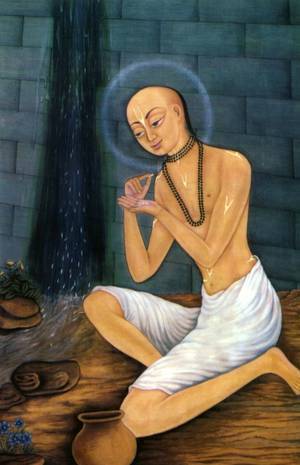
For roughly forty years, Radha-kunda was Raghunatha Dasa Goswami's whole world, as far as anyone could see. His bhajana-kutir, the simple hut where he lived and worshipped, still stands on the bank of the kunda and continues to draw pilgrims today. Inside it he kept a very strict discipline. Later Vaishnava writers recorded it in almost exact numbers, because its very strictness was considered a lesson in itself.
| Detail | Description |
|---|---|
| Residence | A simple bhajana-kutir beside Radha-kunda, still standing and visited today |
| Daily chanting | Around sixty-four rounds of japa, roughly 100,000 holy names |
| Daily obeisances | About 1,000 to Radha-Krishna and 2,000 to the Vaishnavas of Vraja, embracing each one |
| Bathing | Three times daily in Radha-kunda |
| Sleep | Under ninety minutes; some days none at all |
| Spiritual identity | Held by tradition to serve Radharani eternally as the manjari Rati-manjari (some accounts: Bhanumati) |
Building the Bhajana-Kutir #
When Raghunatha Dasa Goswami first arrived at Radha-kunda he did not build any shelter at all. He simply sat down in the open and absorbed himself in meditation on Radha and Krishna. Bhakti-ratnakara remembers that a tiger and tigress once came to drink from the nearby Shyama-kunda while he sat there undisturbed. It also says that Krishna Himself stood quiet watch nearby so that His devotee's meditation would not be broken. Sanatana Gosvami, passing by, urged him to build a proper hut. But Raghunatha Dasa, absorbed as ever, paid little attention to the advice. It took a second, gentler warning to move him. It is said that Srimati Radharani Herself saw him sitting unmoved through the blazing midday sun, and stood behind him holding out Her own cloth as shade. Then Sanatana Gosvami came by and saw Her, wet with sweat from the effort. He gently scolded Raghunatha Dasa for troubling his Lord's eternal consort in this way. Only then did Raghunatha Dasa allow a small kutir to be built. By tradition, it is the same modest hut that still stands on the bank of the kunda today.
Excavating the Twin Kundas #
When Raghunatha Dasa first settled there, Radha-kunda and Shyama-kunda were little more than shallow, muddy pools set in adjoining paddy fields. This was the same spot Sri Chaitanya Mahaprabhu himself had identified during His parikrama of Vraja. Jiva Gosvami arranged to purchase the two fields. Then, in 1545, Raghunatha Dasa took charge of digging out both kundas and building stone ghats around their banks. In the process he uncovered the far older Kanchana-kunda and Vajra-kunda, which are said to have been dug originally by Vajranabha Maharaja. Five trees stood on the bank of Shyama-kunda, and they are said to be the five Pandavas in another form. Yudhishthira appeared to Raghunatha Dasa in a dream and asked that they be left standing, so Raghunatha Dasa ordered that they be spared. That is why Shyama-kunda, unlike its neighbour, was never finished as a perfect rectangle.
The Tongue of Govardhana #
Concerned that pilgrims were washing clothes and utensils in Radha-kunda's sacred water, Raghunatha Dasa once had workers dig a separate well nearby for such use. When their digging struck something that began to bleed, he stopped the work at once, fearing an offense. That night it was revealed to him that the workers had struck the tongue of Govardhana Hill itself, and Raghunatha Dasa raised a small shrine on the spot in atonement, one still worshipped by pilgrims to this day.
A Schedule Without Rest #
Besides his own worship of the Govardhana-sila that Sri Chaitanya Mahaprabhu had given him, Raghunatha kept up a practice he had begun at Puri, speaking about the Lord's pastimes. Tradition says he spent several hours a day describing Mahaprabhu's years at Jagannatha Puri to the residents of Vraja who gathered to hear. As the years passed, he allowed himself less and less sleep and food. Even before he reached Radha-kunda, Sri Chaitanya-charitamrita already records him spending more than twenty-two of every twenty-four hours in chanting and remembrance. At Radha-kunda, all later accounts agree, that discipline only deepened. He also kept wearing the same single torn cloth and patchwork wrapper he had worn since his earliest days at Puri. In four decades he never once changed to anything more comfortable.
Grief as a Path of Love #
Each loss among his own teachers led him to eat even less. After Sri Chaitanya Mahaprabhu's disappearance he is remembered as living on little more than fruit and milk. After Sanatana Gosvami's disappearance, he is remembered as taking a single leaf-cup of buttermilk every day or two. When Rupa Gosvami himself finally left this world, Raghunatha Dasa is said to have given up eating and drinking altogether. The Vrajavasis who saw him in this condition reportedly wept at how visibly he was wasting away. Yet tradition insists that this was never neglect of the body for its own sake. It was his grief, deliberately and consciously turned into a more and more complete offering of his body. He had already renounced that body twice over.
Tears Beside the Water #
Above all, these years are remembered for an austerity that was not hardship but loving closeness. He spent long hours weeping alone beside Radha-kunda and on Govardhana Hill, pouring out his heart in continuous japa and in hearing and reciting scripture. Tradition also credits him with a practice called manasi-seva. In it he served Radha and Krishna in meditation, within a spiritual body dedicated entirely to that purpose. He carried on this practice quietly, alongside the external worship that anyone passing his hut could see. Gaudiya Vaishnava teachers have long said that even his rest was never truly rest at all. They hold that an eternal associate of the Lord continues to serve even while the body outwardly sleeps.
A Kunda Named for the Days That Followed #
Radha-kunda itself was not a chance choice of home. Sri Chaitanya Mahaprabhu had identified the lake during His own visit to Vraja as the place where Radha and Krishna once bathed together. Raghunatha Dasa's entire theology centered on service to Radharani specifically. So for him no other spot in Vrindavana could have been as suitable. From exactly this place, and in this state of heart, Raghunatha Dasa Goswami wrote the prayers gathered afterward as his Stavavali. Even now these verses read less like composed poetry and more like a private diary of longing that happened to survive. They are described in full in Literary Works and the Stavavali.
Two Well-Remembered Pastimes #
Bhakti-ratnakara preserves two smaller stories that Vraja still tells about these years. In one, a Vrajavasi devotee named Das was distressed that Raghunatha Dasa lived on so little. So he once brought him buttermilk in an unusually large leaf-bowl made from a tree in the village of Sakhisthali. Sakhisthali was the home of Chandravali, Radharani's rival for Krishna's love. As soon as Raghunatha Dasa heard the village's name, he threw down the bowl at once. Tradition does not read this flash of feeling as small-mindedness. It sees in it the intensity of an eternal servant's loyalty to Radharani alone. In the other story, devotees were waiting outside his kutir one afternoon. They grew alarmed when Raghunatha Dasa, who ate barely anything, did not come out. Physicians were called to examine him. They found nothing worse than that he had eaten too much sweet-rice. He explained that the sweet-rice had been offered in a deep trance of manasi-seva, while he was serving Radha and Krishna within his mind.
Jahnava Mata's Visit #
In his last years Raghunatha Dasa was worn down by grief for Rupa Gosvami and Sanatana Gosvami. At that time Jahnava Mata visited him at Radha-kunda. She came at Jiva Gosvami's own request, to give him some relief through her darshana. Bhakti-ratnakara describes both of them in tears at the meeting. Raghunatha Dasa was overwhelmed with ecstatic love, and Jahnava Mata's own heart, tradition says, was still burning with separation from her eternal consort Nityananda Prabhu.
Scriptural evidence for this chapter (1)
sāḍe sāta prahara yāya kīrtana-smaraṇe
āhāra-nidrā cāri daṇḍa seha nahe kona dine
Word for word
sāḍe sāta prahara - seven and a half praharas (about 22.5 hours); yāya kīrtana-smaraṇe - is spent in chanting and remembrance; āhāra-nidrā cāri daṇḍa - four dandas (about 96 minutes) for eating and sleeping; seha nahe kona dine - on some days not even that
Raghunatha dasa spent more than twenty-two hours out of every twenty-four chanting the Hare Krishna maha-mantra and remembering the lotus feet of the Lord. He ate and slept for less than an hour and a half, and on some days that also was impossible.
Sri Chaitanya-charitamrita's own summary of Raghunatha Dasa Goswami's daily discipline of chanting, later continued and intensified at Radha-kunda.
Chapter 6
Literary Works and the Stavavali
Instructing his own mind, and giving Krishnadasa Kaviraja Goswami the story of Puri
Raghunatha Dasa Goswami is not remembered as a philosopher who wrote long, orderly works, as Jiva Gosvami and Rupa Gosvami are. His writing is almost entirely devotional poetry. In it he speaks to his own heart. He does not argue for a point of view. Tradition honors him with the title prayojana-acharya, the teacher of life's ultimate goal. This is because his few, short works focus so single-mindedly on one subject. That subject is loving service to Radha and Krishna in Vraja, with no distraction and no compromise.
| Detail | Description |
|---|---|
| Stavavali | A collected anthology of his devotional poems and prayers |
| Manah-siksa | Twelve verses of "instructions to the mind," among the most quoted in Gaudiya Vaishnavism |
| Vilapa-kusumanjali | "An Offering of Flowers in Lamentation", prayers of separation addressed to Radha's sakhis |
| Dana-keli-cintamani | A short devotional drama on Krishna's toll-collecting pastime with the gopis |
| Mukta-caritra | A shorter devotional composition |
| Traditional title | Prayojana-acharya, teacher of life's ultimate goal |
Twelve Verses to a Restless Mind #
The best known of his works, Sri Manah-siksa, speaks directly to Raghunatha's own mind. It treats the mind as a stubborn friend who must be pleaded with, not commanded. Its opening verse begs the mind to give up its pride and give itself completely to the spiritual master, to Vraja and its residents, to the Vaishnavas, to the holy name, and to Radha and Krishna. The remaining verses continue in the same close, personal tone. One by one, they deal with the particular obstacles that stand between ordinary attachment and the love Raghunatha Dasa considered the only thing worth having. These obstacles are false pride, the appeal of impersonal liberation, and attachment to fame. Two of his shorter poems, this same Manah-siksa and the Govardhana-vasa-prarthana-dasaka, are still sung today.
An Offering of Flowers in Lamentation #
Where Manah-siksa instructs, Vilapa-kusumanjali simply weeps. It is a series of prayers addressed to the sakhis of Radha. It expresses a devotee's raw impatience and near-despair at being kept from Her service. Here Raghunatha Dasa states most plainly the theology his whole life had already shown. He says that service to Srimati Radharani, not even to Krishna directly, is the highest attainment available to a soul in Vraja. Centuries later, in Jaiva Dharma, Bhaktivinoda Thakura credited Raghunatha Dasa specifically with having shown the "esoteric method" of engaging in Radha-Krishna's loving service. That description fits the raw, unguarded tone of Vilapa-kusumanjali better than almost anything else Raghunatha Dasa wrote.
Dana-keli-cintamani and Mukta-caritra #
Besides these prayers from the heart, Raghunatha Dasa also wrote Dana-keli-cintamani (some later writers call it by other titles that refer to the same pastime). It is a short devotional drama built around Krishna's playful pretense of collecting a mock "toll" from the gopis as they carry milk and yogurt to market. Read on its surface, it is simply a charming scene of playful village teasing. Read as Gaudiya Vaishnava theology, the toll Krishna demands stands for the loving exchange devotees long to offer Him. The gopis' pretended resistance reflects the very hesitation Raghunatha Dasa spent his own life trying to overcome. The same man ate only spoiled rice at Puri, yet he could also write with such dramatic lightness. This says something about how much lay hidden behind his strict outward life. A shorter composition, Mukta-caritra, completes the small body of writing he left behind. He did not write nearly as much as Rupa Gosvami or Jiva Gosvami did. But his writings have influenced later Gaudiya devotional poetry far more than their small size would suggest.
A Play Written Just for Him #
Rupa Gosvami's own devotion to Raghunatha Dasa produced one more small work, almost by accident. When Raghunatha Dasa read Rupa Gosvami's drama Lalita-madhava, with its central theme of separation from Krishna, he was so overwhelmed by its mood that it seemed his very life was in danger. Seeing this, Rupa Gosvami wrote a short, light-hearted companion piece, Dana-keli-kaumudi. He exchanged it for his friend's copy of the heavier play, and Raghunatha Dasa became himself again almost at once. It is a small but telling example of how closely these Goswamis watched over one another's hearts.
Guru to the Author of Chaitanya-charitamrita #
However, Raghunatha Dasa's most important legacy may not be anything he wrote himself. It may be what he made possible for someone else. Krishnadasa Kaviraja Goswami plainly named him as his own spiritual master in the closing lines of the Antya-lila of Sri Chaitanya-charitamrita. There he lists Raghunatha Dasa among those who gave him mercy: Govindadeva, Sri Chaitanya Mahaprabhu, Nityananda Prabhu, Advaita Acharya, Svarupa Damodara, Rupa and Sanatana Gosvami, and Jiva Gosvami. It was through their grace alone, he says, that the book could be written at all. Raghunatha Dasa spent years telling Mahaprabhu's Puri pastimes to the Vaishnavas of Vrindavana. Without those years, the most detailed record of Sri Chaitanya Mahaprabhu's final years might not exist in the form it does today.
Scriptural evidence for this chapter (2)
gurau gosthe gosthālayiṣu sujane bhūsura-gaṇe
sva-mantre śrī-nāmni vraja-nava-yuva-dvandva-śaraṇe
sadā dambhaṁ hitvā kuru ratim apūrvām atitarām
aye svāntar bhrātaś caṭubhir abhiyāce dhṛta-padaḥ
O mind, I grasp your feet and beg you with sweet words: please cast away all hypocrisy and develop intense, unprecedented love for my spiritual master, Vrajabhumi, the people of Vraja, the Vaishnavas, the brahmanas, the holy name, and the transcendental shelter that is the fresh young couple of Vraja, Radha and Krishna.
The opening verse of Raghunatha Dasa Goswami's own best-known composition, addressed to his own mind; this is the same verse used as the pull-quote for his biography page. The song 'Gurau Gosthe Gosthalayisu' in the /songs/ archive is this verse.
"My life is worthless. I will give it up without receiving Your mercy. Living in Radha-kunda and Vrindavana is meaningless to me. To say nothing of Vrindavana, even Krishna Himself is useless to me without You. O Shrimati Radharani, You are the only object of my life. Please be merciful to me."
A widely circulated English rendering of one of the Vilapa-kusumanjali prayers; the exact verse number could not be independently confirmed from a primary edition, so it is cited here bibliographically rather than as a verified critical-edition citation.
Chapter 7
Disappearance and Legacy
The samadhi that pilgrims still circle at Radha-kunda
By the time Rupa Gosvami himself left this world, tradition says, Raghunatha Dasa Goswami had already given up eating and drinking almost completely. He lived on little more than chanting and grief. Sources differ on the exact year of his own disappearance. Most give 1586, on Shukla Dvadasi of the month of Ashvina, while a small number of accounts place it slightly earlier. But all agree that it took place on the bank of Radha-kunda, in the area now known as the Chausath Samadhi, the sixty-four samadhis of Vraja's departed Vaishnavas. On this same stretch of the bank are the nearby resting places of Raghunatha Bhatta Goswami and Krishnadasa Kaviraja Goswami. Both of them are said to have disappeared on the same date, in different years. Vraja tradition also remembers this stretch of the bank as the Teen Gosvami Samadhi. So readers will find both names, Chausath Samadhi and Teen Gosvami Samadhi, used for this general area in different sources.
| Detail | Description |
|---|---|
| Disappearance | Traditionally Shukla Dvadasi of Ashvina, 1586 (a few sources place it slightly earlier) |
| Samadhi | On the bank of Radha-kunda, in the area of the sixty-four samadhis |
| Direct disciple | Krishnadasa Kaviraja Goswami, author of Sri Chaitanya-charitamrita |
| Remembered by Srila Prabhupada as | The clearest working example of real vairagya among the Six Goswamis |
What Srila Prabhupada Said of Him #
Over decades of lectures, Srila Prabhupada returned again and again to Raghunatha Dasa Goswami's example, almost always for the same reason. Raghunatha Dasa gave clear, undeniable proof that renunciation could be real, not just a show. In a 1974 lecture in Bombay, and again the following year in Vrindavana, Prabhupada told the same story in almost the same words. Here was a young man whose father earned twelve lakhs of rupees. He had been given a beautiful wife just to keep him at home. Yet he chose instead to eat a little butter once every two or three days at Radha-kunda. In a 1968 lecture explaining the opening prayer verse to the Six Goswamis, Prabhupada also took care to explain why this Raghunatha carried the title dasa Gosvami, not simply Gosvami. It was a small point of social position. But in Prabhupada's telling, it only showed how completely spiritual qualification had risen above birth in this one life.
The Guru Named in Chaitanya-charitamrita's Final Words #
Raghunatha Dasa Goswami's place in the Gaudiya Vaishnava lineage is stated most directly in the closing verses of Sri Chaitanya-charitamrita's Antya-lila. There Krishnadasa Kaviraja Goswami lists him by name among those whose mercy alone made the book possible, and plainly calls him "my spiritual master." In this tradition it is rare for a guru to be named so clearly, and so late in a life's work. This settles Raghunatha Dasa's place in the parampara beyond any real dispute. Here was the man who once could not walk past his own front door without a guard. Now, in the tradition's own understanding, he stands as the teacher of the man who wrote its central scripture. In the end, his years of training under Svarupa Damodara Gosvami at Puri passed the teaching on, exactly as Sri Chaitanya Mahaprabhu seems to have intended.
This passing on of the teaching did not end with Krishnadasa Kaviraja Goswami either. The wider Gaudiya Vaishnava tradition he helped carry forward went on to include Narottama Dasa Thakura and Vishvanatha Chakravarti Thakura in the generations that followed. Much later it included the Gaudiya Math and, through Srila Prabhupada, the worldwide Hare Krishna movement itself. Every part of that tradition owes something, in the end, to a landholder's son who once refused to come inside his own house at night.
A Place Still Visited Today #
Raghunatha Dasa Goswami's samadhi and his bhajana-kutir both remain at Radha-kunda. Both are still part of the daily round of pilgrims who come to Vraja seeking exactly what he spent his life pursuing there. His appearance day is still observed every year across ISKCON and other Gaudiya Vaishnava communities. It is usually marked by reciting the chapters of Sri Chaitanya-charitamrita that were drawn from his own life. Very little of what he left behind is grand: a handful of short poems, a stone from Govardhana Hill, a small hut beside a lake. More than anything else, this simplicity is the lesson his life still teaches. Srila Prabhupada returned again and again to this gap between what Raghunatha Dasa was born with and what he chose to keep. He used it to explain what real renunciation actually requires.
Scriptural evidence for this chapter (1)
śrī-govinda, śrī-caitanya, śrī-nityānanda
śrī-advaita, śrī-bhakta, āra śrī-śrotṛ-vṛnda
śrī-svarūpa, śrī-rūpa, śrī-sanātana
śrī-raghunātha-dāsa śrī-guru, śrī-jīva-caraṇa
Word for word
śrī-raghunātha-dāsa śrī-guru - Sri Raghunatha dasa Gosvami, my spiritual master; śrī-jīva-caraṇa - the lotus feet of Sri Jiva Gosvami; iṅhā-sabāra caraṇa-kṛpāya - by the mercy of the feet of all of them; lekhāya āmāre - causes me to write
I am writing this book by the mercy of the lotus feet of Sri Govindadeva, Sri Chaitanya Mahaprabhu, Lord Nityananda, Advaita Acharya, other devotees and the readers of this book, as well as Svarupa Damodara Gosvami, Sri Rupa Gosvami, Sri Sanatana Gosvami, Sri Raghunatha dasa Gosvami, who is my spiritual master, and Sri Jiva Gosvami.
Krishnadasa Kaviraja Goswami's own closing declaration naming Raghunatha Dasa Goswami as his diksha-guru, near the very end of Sri Chaitanya-charitamrita.
Closing
Birth into Wealth in Bengal #
Raghunatha Dasa was born the only son of Govardhana Majumadara, a landholder of the Saptagrama area of Hooghly district in Bengal. Govardhana and his brother Hiranya Dasa held the right to collect a share of the region's imperial tax revenue, and the family lived in great wealth. According to Srila Prabhupada's own description in a 1975 Vrindavana lecture, his father's income was twelve lakhs of rupees, an extraordinary sum for that time. As a boy Raghunatha received the association and blessing of Haridasa Thakura. From an early age his heart was already drawn toward Sri Chaitanya Mahaprabhu and Nityananda Prabhu. Outwardly, however, he continued to live in his father's prosperous household, and later married there.
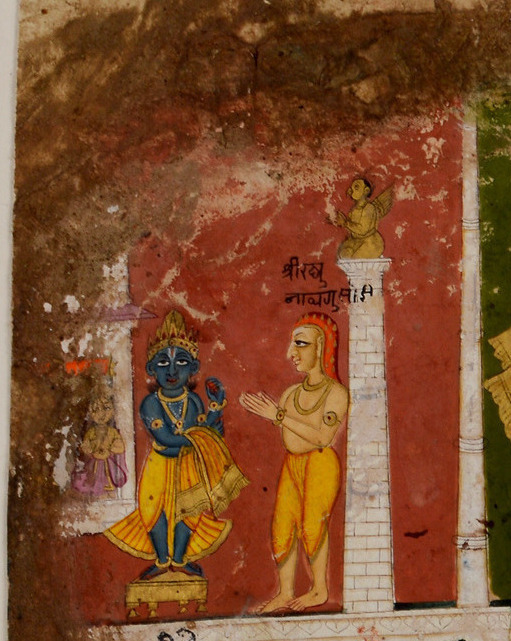
In Sri Chaitanya-charitamrita (Adi 10.91), Krishnadasa Kaviraja Goswami counts him among the branches of the Chaitanya tree:
mahāprabhura priya bhṛtya - raghunātha-dāsa
sarva tyaji’ kaila prabhura pada-tale vāsa
"Śrīla Raghunātha dāsa Gosvāmī, the forty-sixth branch of the tree, was one of the most dear servants of Lord Caitanya Mahāprabhu. He left all his material possessions to surrender completely unto the Lord and live at His lotus feet." (Chaitanya-charitamrita Adi 10.91)
In his purport Srila Prabhupada gives his eternal identity from the Gaura-ganoddesha-dipika: "In the Gaura-gaṇoddeśa-dīpikā (186) it is stated that Śrīla Raghunātha dāsa Gosvāmī was formerly the gopī named Rasa-mañjarī. Sometimes it is said that he was Rati-mañjarī."
To Vrindavana After the Lord's Disappearance #
Raghunatha Dasa remained at Puri roughly sixteen years in all. He served Svarupa Damodara Gosvami through the time of Sri Chaitanya Mahaprabhu's own disappearance and for some years after. When Svarupa Damodara himself left this world, Raghunatha could no longer bear to stay. He made his way to Vrindavana, where Rupa Gosvami and Sanatana Gosvami received him and drew him back from the edge of despair. There he became a living link between the Lord's pastimes at Puri and the Vaishnava community of Vrindavana. Krishnadasa Kaviraja Goswami accepted Raghunatha as his diksha-guru. Krishnadasa Kaviraja received the details that fill the Antya-lila of Sri Chaitanya-charitamrita from Raghunatha more than from anyone else.
Disappearance and Place in the Parampara #
Raghunatha Dasa Goswami is traditionally said to have left this world in 1586, on Shukla Dvadasi of the month of Ashvina. His samadhi still stands on the bank of Radha-kunda, and pilgrims visit it to this day. Srila Prabhupada returned to his example again and again to show what vairagya, renunciation, really means and what it really costs. Raghunatha was a rich man's son who was offered every comfort, yet he chose a leaf-cup of buttermilk instead. In the closing words of the Antya-lila of Sri Chaitanya-charitamrita, its author Krishnadasa Kaviraja Goswami names Raghunatha Dasa Goswami as his spiritual master. In this way Raghunatha's legacy passed directly into the book that has shaped Gaudiya Vaishnavism ever since.
Songs in the Vaishnava Song Book #
The Vaishnava Song Book carries 2 songs attributed to Srila Raghunatha Dasa Goswami. See the full author page here.
- Sri Chaitanya-charitamrita, Antya-lila, Chapter 6 (Bhaktivedanta VedaBase)
- Sri Chaitanya-charitamrita, Antya-lila 20.96-98 (Bhaktivedanta VedaBase)
- Raghunatha Dasa Goswami - Gaudiya History
- Raghunatha Dasa Goswami - Vrindavan Chandrodaya Mandir
- Srila Prabhupada lecture, Srimad-Bhagavatam 6.2.14, Vrindavana, September 17 1975
- Srila Prabhupada lecture, Bhagavad-gita 4.22, Bombay, April 11 1974
- Sri Manah-siksa - Sri Narasingha Chaitanya Ashram
