Sri Ranga Puri
Sannyasi Godbrother of Isvara Puri, Met at Pandarpur
The complete life, on one page: The main biography and every pastime page, in order, in one place
Introduction
Sri Chaitanya-charitamrita gives Sri Ranga Puri exactly one scene, spread over seven days and set in a single town on the banks of the Bhima River. In that one scene he does something no other devotee in the text does: he tells Sri Chaitanya Mahaprabhu what became of His own long-lost elder brother. Ranga Puri was a sannyasi disciple of Srila Madhavendra Puri. This made him a direct godbrother of Isvara Puri, Mahaprabhu's own diksha-guru, and of Paramananda Puri, who became one of Mahaprabhu's closest companions at Jagannatha Puri. Nothing else about his life survives in any detail that the tradition is ready to confirm. There is no record of his birth, his family or his disappearance. But the one meeting that Chaitanya-charitamrita does record is detailed enough, and important enough, to give him his own place among the sannyasi disciples of Madhavendra Puri.
| Detail | Description |
|---|---|
| Sannyasa order | A disciple of Srila Madhavendra Puri, in the Madhva (Tattvavadi) sampradaya |
| Sannyasi godbrothers | Isvara Puri, Paramananda Puri, Ramachandra Puri and others |
| Met Sri Chaitanya Mahaprabhu | At Pandarpur, on the Bhima River, during the Lord's South India tour |
| Best known for | An ecstatic reunion with Mahaprabhu, and revealing that the sannyasi Sankararanya, who had passed away at Pandarpur, was Mahaprabhu's own elder brother Vishvarupa |
| Primary source | Sri Chaitanya-charitamrita, Madhya-lila 9.279-303, summarized again at Madhya-lila 1.113 |
| Birth / disappearance | Neither is recorded |
Scriptural evidence for the introduction (1)
paramānanda purī, āra keśava bhāratī
brahmānanda purī, āra brahmānanda bhāratī
viṣṇu-purī, keśava-purī, purī kṛṣṇānanda
śrī-nṛsiṁhatīrtha, āra purī sukhānanda
ei nava mūla nikasila vṛkṣa-mūle
ei nava mūle vṛkṣa karila niścale
Paramananda Puri, Keshava Bharati, Brahmananda Puri and Brahmananda Bharati, Sri Vishnu Puri, Keshava Puri, Krishnananda Puri, Sri Nrisimha Tirtha and Sukhananda Puri: these nine sannyasi roots all sprouted from the trunk of the tree. Thus the tree stood steadfastly on the strength of these nine roots.
Chaitanya-charitamrita's own list of the nine sannyasi "roots" of the bhakti-kalpataru under Madhavendra Puri, the formal list Ranga Puri himself is not part of.
Chapter 1
The Meeting at Pandarpur
The ecstatic embrace of a stranger, in a brahmana's house in Maharashtra, turned out to lead straight back to Sri Chaitanya Mahaprabhu's own guru.
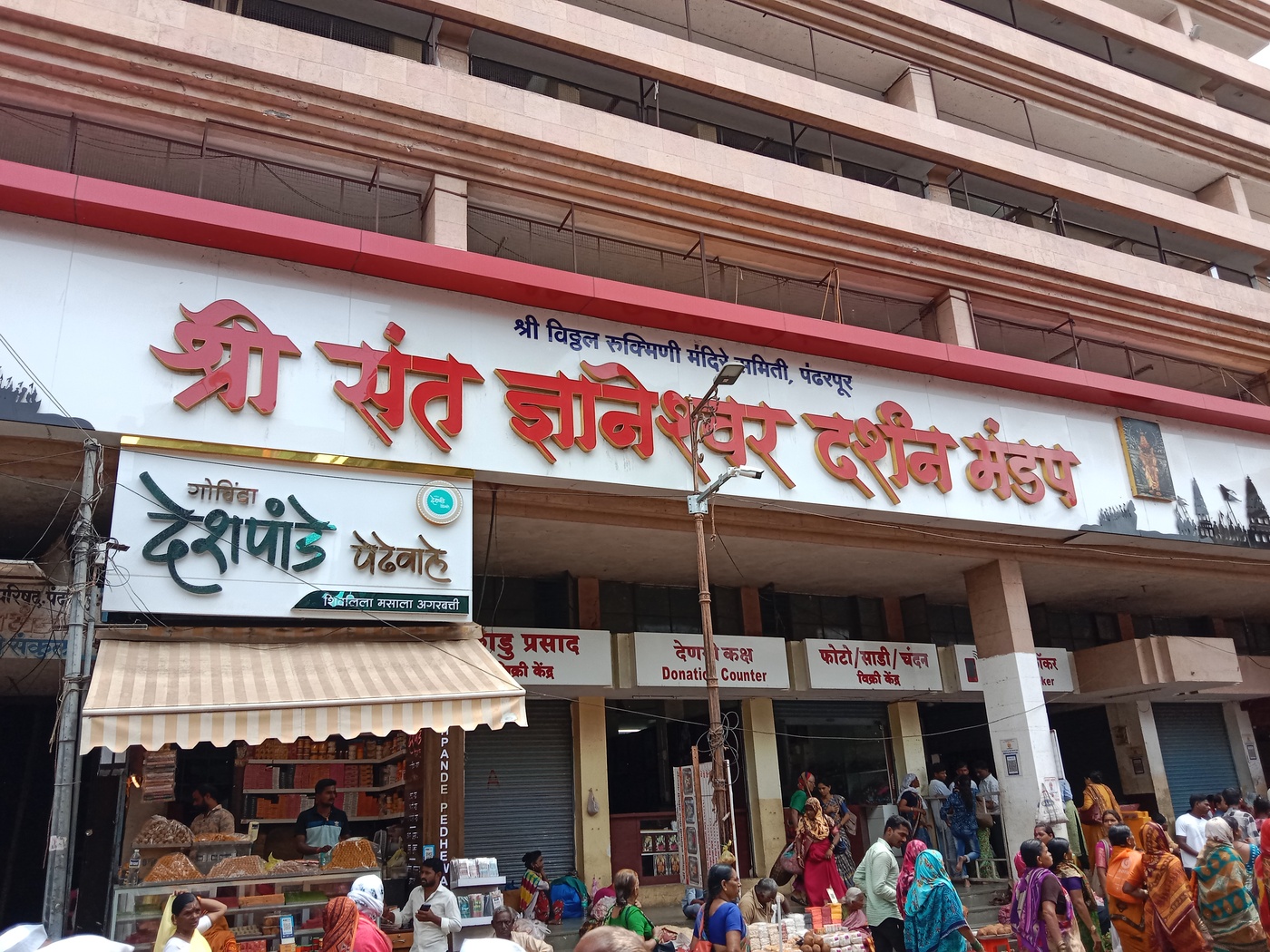
When Sri Chaitanya Mahaprabhu's tour of South India carried Him past Kolapura and on to Pandarpur, a temple town on the banks of the Bhima River, He went straight to the temple of Vitthala Thakura and stood before the Deity in open joy. He chanted and danced there as He had at every stop on the journey, and a brahmana who happened to see Him, moved by the sight, invited Him home. The brahmana fed Him with great love and respect, and only once the meal was finished did the Lord receive the piece of news that would shape the rest of His stay in the town.
A Brahmana Named Ramadasa #
Chaitanya-charitamrita names this host only once, and only in its own summary chapter. He is a brahmana called Ramadasa, whose sufferings Mahaprabhu is said to have relieved simply by meeting him (Madhya-lila 1.113). Nothing more about him survives. There is no family, no later life, not even a description of what those sufferings were. The name Ramadasa appears several times in Chaitanya-charitamrita for different devotees Mahaprabhu met in the south. This Pandarpur brahmana is a separate man from any of them. Apart from sharing a common name, the text gives no reason to connect him with the others.
Word of Another Sannyasi Nearby #
While Mahaprabhu was resting at Ramadasa's house, He learned that another sannyasi was staying at a second brahmana's home nearby. This was Sri Ranga Puri, a disciple of Srila Madhavendra Puri. Mahaprabhu went there immediately. Entering the house and seeing Ranga Puri seated there, He fell flat on the ground in obeisance. All at once His body was overtaken by the visible marks of ecstatic love: tears, the hairs of His body standing on end, trembling, and perspiration breaking out over His whole frame. Not a word had yet passed between the two men.
Recognized by a Symptom, Not a Name #
Ranga Puri was astonished at what he was seeing. He called out, "Your Holiness, please get up," asking the stranger to rise. Then, before any introduction was made, he offered a guess that turned out to be exactly right: "Your Holiness is certainly related to Sri Madhavendra Puri, without whom there is no fragrance of ecstatic love." He had not been told who this visitor was. He had simply recognized the flavor of the devotion itself, and from it he reasoned back to its only possible source. Srila Bhaktisiddhanta Sarasvati Thakura's own remark on this exchange explains why that guess meant so much. Before Madhavendra Puri, the Madhva line of sannyasis worshipped Krishna alone, in a mood the tradition treats as more formal. It was Madhavendra Puri who first brought the sweeter, more intimate mood of Radha and Krishna together into that worship. Life in the Madhva Sampradaya tells this in fuller detail. So when a disciple of that same line saw this kind of ecstasy in a total stranger, he had only one place to look for its origin.
The Embrace #
Ranga Puri lifted Mahaprabhu up from the ground and embraced Him. Shoulder to shoulder, the two men wept together in ecstasy, and neither seems to have needed any words to explain it. Only when they had both grown calm enough to speak did Mahaprabhu complete the introduction that Ranga Puri had already partly guessed. He was the disciple of Isvara Puri, Ranga Puri's own godbrother under Madhavendra Puri. For a moment it had looked like a meeting between total strangers. But it turned out to be a reunion inside the same small family of sannyasis. Once that was settled, the two of them simply sat down and talked. Krishnadasa Kaviraja Goswami records that they continued discussing Krishna together, without interruption, for five to seven days.
That conversation did not stay on general devotional subjects the whole time. Before it ended, an ordinary question about Mahaprabhu's birthplace brought up something neither man could have expected. It was a piece of family news thirty years old, waiting in an old sannyasi's memory. That part of the same conversation is told on News of Vishvarupa. This meeting is also told from the other side of the lineage, on Mahaprabhu's Reverence for His Guru. That page describes how Mahaprabhu treated His own guru's memory throughout His life.
Scriptural evidence for this chapter (4)
Quoted in the text above:
- CC Madhya 9.289 Sri Chaitanya-charitamrita
Further verses:
mādhava-purīra śiṣya 'śrī-raṅga-purī' nāma
sei grāme vipra-gṛhe karena viśrāma
Sri Chaitanya Mahaprabhu received word that Sri Ranga Puri, one of the disciples of Sri Madhavendra Puri, was present in that village at the home of a brahmana.
The verse that first identifies Ranga Puri, at the moment Mahaprabhu learns he is resting nearby at Pandarpur.
premāveśe kare tāṅre daṇḍa-paraṇāma
aśru, pulaka, kampa, sarvāṅge paḍe ghāma
As soon as Sri Chaitanya Mahaprabhu saw Sri Ranga Puri, He immediately offered him obeisances in ecstatic love, falling flat on the ground. The symptoms of transcendental transformation were visible — namely, tears, jubilation, trembling and perspiration.
The specific bodily symptoms of ecstasy Chaitanya-charitamrita records at the moment of recognition.
śrī-raṅga-purī saha tāhāñi milana
rāma-dāsa viprera kaila duḥkha-vimocana
Sri Chaitanya Mahaprabhu then met Sri Ranga Puri and mitigated all the sufferings of a brahmana named Ramadasa.
The chapter-summary verse that names the brahmana host at whose neighbor's house Ranga Puri was staying.
Chapter 2
News of Vishvarupa
From an old man's memory of a lunch in Navadvipa, Sri Chaitanya Mahaprabhu learned what had become of the brother He had spent two years quietly searching for.
According to Chaitanya-charitamrita, for five to seven days at Pandarpur the two men talked about Krishna's pastimes freely, without any particular plan. But at some point Sri Ranga Puri's own curiosity turned the talk toward his companion instead of toward Krishna. He asked a simple question: where had this young sannyasi been born?
A Question That Opened an Old Memory #
Mahaprabhu answered plainly, Navadvipa, and the name had an effect Ranga Puri had not expected. Years earlier he had been to Navadvipa himself, travelling with his own guru, Srila Madhavendra Puri. The mention of the place brought back a memory that he had evidently kept in some detail. He recalled a meal at the home of a brahmana named Jagannatha Mishra. Oddly, he also remembered the food itself: an unfamiliar preparation of banana flowers, cooked in a way he had never tasted before or since. He remembered Jagannatha Mishra's wife too. He described her as devoted and chaste. Her affection for the wandering sannyasis who passed through her home was so warm that Ranga Puri compared her, without hesitation, to the mother of the universe herself. She had fed them, he said, exactly as she would have fed her own sons.
The Name That Closed the Circle #
Then came the detail that mattered. Ranga Puri remembered that one of that couple's sons had left home and accepted the renounced order of life at a strikingly young age, taking the name Sankararanya. And he had more than a memory of that departure. He had, it turned out, also learned of its end: the sannyasi Sankararanya, he told Mahaprabhu, had attained perfection in this very holy place, Pandarpur, where the two of them were now sitting.
Mahaprabhu's answer left nothing to interpret. "In My previous asrama," He said, "Sankararanya was My brother, and Jagannatha Mishra was My father." The sannyasi whom Ranga Puri remembered as a boy from a single lunch in Navadvipa was Vishvarupa, Mahaprabhu's own elder brother. Vishvarupa had taken sannyasa years before Mahaprabhu did and had vanished into the south. The South India Tour notes that Mahaprabhu had given His search for that missing brother as the public reason for leaving Jagannatha Puri in the first place. But the biographies say plainly that by then He already knew that Vishvarupa had passed away. The search served as a reason to travel, not as a genuine uncertainty. So Ranga Puri's memory did not really surprise Mahaprabhu with new information. Instead, without being asked, it gave Him confirmation from another person of what He had already quietly accepted. It confirmed the place, and the name Sankararanya had died under. And it showed that Ranga Puri, a godbrother of Mahaprabhu's own guru, had unknowingly carried that knowledge halfway across India for years, without knowing what it would one day mean to Mahaprabhu.
A Departure, and a Silence After It #
Once their talk was finished, Sri Ranga Puri set out for Dvaraka-dhama. Sri Chaitanya Mahaprabhu remained at Pandarpur four days more, bathing in the Bhima River and returning again to the temple of Vitthala Thakura before continuing His own journey north. Chaitanya-charitamrita does not mention Ranga Puri again after this point, in this chapter or any other. No later meeting between the two men is recorded anywhere in the text. Nothing is said of where Ranga Puri went, or what became of him, after he left for Dvaraka. All that remains is those seven days at Pandarpur. They were long enough for an old man's memory of a single lunch, decades earlier, to give Sri Chaitanya Mahaprabhu a piece of news about His own family. As far as the historical record shows, this is the only such news He ever received directly, from another person's own mouth.
Scriptural evidence for this chapter (2)
ei tīrthe śaṅkarāraṇyera siddhi-prāpti haila
prastāve śrī-raṅga-purī eteka kahila
Sri Ranga Puri informed Sri Chaitanya Mahaprabhu that the sannyasi named Sankararanya had attained perfection in that holy place, Pandarapura.
From the purport: Purport excerpt: "Sri Ranga Puri, a disciple of Sri Madhavendra Puri and Godbrother of Isvara Puri, disclosed this important news to Sri Caitanya Mahaprabhu."
The purport is the single place in Chaitanya-charitamrita's own commentary that states Ranga Puri's relationship to Isvara Puri outright.
prabhu kahe, — pūrvāśrame teṅha mora bhrātā
jagannātha miśra — pūrvāśrame mora pitā
Sri Chaitanya Mahaprabhu said, "In My previous asrama, Sankararanya was My brother and Jagannatha Misra was My father."
Mahaprabhu's own confirmation, given directly to Ranga Puri, of what had become of His elder brother Vishvarupa.
Closing
A Godbrother Under Madhavendra Puri #
Chaitanya-charitamrita introduces him in one simple line: a man staying in a village near Pandarpur, "the disciple of Madhavendra Puri, named Sri Ranga Puri." In his purport to a later verse in the same episode, Srila Prabhupada states the relationship even more directly. He calls him "a disciple of Sri Madhavendra Puri and Godbrother of Isvara Puri," and this is the one place in the text where his position in the lineage is clearly stated. So he belongs to the same generation, under the same guru, as Isvara Puri and Paramananda Puri. Both of them are already described among Srila Madhavendra Puri's sannyasi disciples. He also belongs to the same generation as Ramachandra Puri. Madhavendra Puri once rebuked this godbrother for misreading his tears of divine longing as ordinary grief.
But he is not one of the nine sannyasi disciples whom Chaitanya-charitamrita names by title as the "roots" of the bhakti-kalpataru: Paramananda Puri, Keshava Bharati, Brahmananda Puri, Brahmananda Bharati, Vishnu Puri, Keshava Puri, Krishnananda Puri, Nrisimha Tirtha and Sukhananda Puri. Ranga Puri appears separately, later in the text. He is not in that formal list. He is known only through his one meeting with Mahaprabhu. The later Gaudiya compilation Bhakti-ratnakara groups him with Isvara Puri as an example of disciples "similarly intoxicated with the moods of sacred rapture" under Madhavendra Puri. But it adds no fact about his life beyond what Chaitanya-charitamrita already records.
A Life the Record Leaves Almost Blank #
Once their talk ended, Ranga Puri left for Dvaraka-dhama, and Mahaprabhu stayed on another four days at Pandarpur, bathing in the Bhima and visiting the Vitthala temple once more. Chaitanya-charitamrita never mentions Ranga Puri again. No source assigns him a birth year, a birthplace, or a date or place of disappearance. The Gaura-ganoddesha-dipika names Paramananda Puri as Krishna's friend Uddhava, appearing again. But no such identity is recorded for Ranga Puri in any source. The text simply does not say. One later tradition holds that he eventually travelled on to Jagannatha Puri to join Mahaprabhu for the rest of his life. This is reported only on gaudiyahistory.iskcondesiretree.com, with no textual source cited. Nothing in Chaitanya-charitamrita or Chaitanya-bhagavata confirms it, so it remains an unverified claim, not a fact. What we can say with confidence is smaller, but in its own way more striking. For seven days on a riverbank in Maharashtra, an almost unknown godbrother of Mahaprabhu's own guru held a piece of family news without knowing it. It was news the Lord Himself had been quietly carrying for two years.
- Sri Chaitanya-charitamrita, Madhya-lila 9.279-303 (vedabase.io)
- Sri Chaitanya-charitamrita, Madhya-lila 1.113 (vedabase.io)
- Sri Chaitanya-charitamrita, Adi-lila 9.13-15, purport (vedabase.io)
- Ranga Puri — Gaudiya History (ISKCON Desire Tree), excerpted from Shrila Bhakti Ballabh Tirtha Maharaj, "Shri Chaitanya: His Life & Associates"
- Sri Chaitanya Mahaprabhu — The South India Tour (this site's own account of the same episode)
