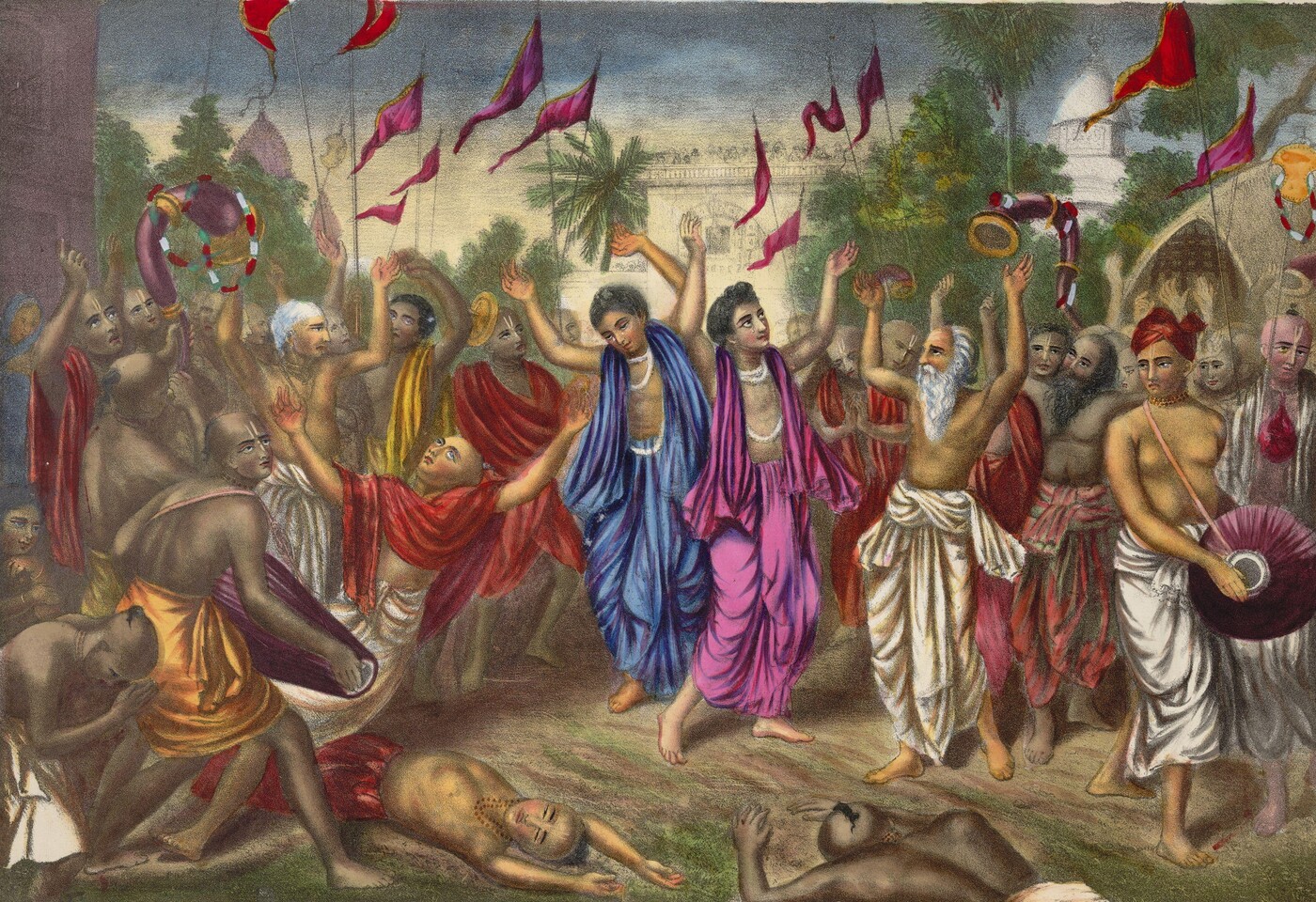
Sri Chaitanya Mahaprabhu's years as a householder in Navadvipa, before He accepted sannyasa in 1510, were the years of His most intense and most public sankirtana. Night after night He gathered with Nityananda Prabhu, Advaita Acharya, Srivasa Thakura and dozens of other devotees, often at Srivasa's own courtyard. Together they chanted and danced until the moods that came over Him could no longer be called ordinary devotion. Krishnadasa Kaviraja Goswami wrote Sri Chaitanya-charitamrita decades later. In it he lists the men who made up that circle as branches and sub-branches of a single tree. This image is a way of saying that each of them, however small his part, belonged to something far greater than any one of them. Shriman Pandita is named as the fifteenth branch of that tree. The one detail Krishnadasa Kaviraja Goswami records about him is tied to one of the most striking of Mahaprabhu's ecstasies from this period.
A Servant Kept Close #
The verse describing Shriman Pandita is very short, even for a list that names dozens of people in a few dozen lines. It calls him "prabhura nija bhrtya," the Lord's own personal servant, and says only that he carried a torch when Mahaprabhu danced. There is no family history, no hometown, and no mention of when he joined the circle of devotees. But even in so few words, the verse shows a kind of trust. It calls him a servant who is "personal," not just a servant in general. Such a servant is kept near enough to be given a specific, repeated task, not a general one.
Dancing as Lakshmi #
The dance in question was not ordinary kirtana movement. Srila Prabhupada's purport to this verse recalls a night when Mahaprabhu, immersed in a mood identified with the goddess Lakshmi, danced through the streets of Navadvipa itself, instead of staying within a courtyard. This belongs to a group of pastimes from Mahaprabhu's Navadvipa years. In them He is described as showing a specific divine mood so completely that observers could recognize whose part He was playing only by what He did next. A similar pattern, in a different form, is also recorded in Chaitanya-bhagavata. There Srila Vrindavana Dasa Thakura gives fuller accounts of His ecstatic dancing.
Why a Torch Mattered #
Sixteenth-century Navadvipa had no street lighting. A kirtana party moving from a courtyard into the open streets after dark needed someone walking with a lamp. The lamp kept the procession from losing its footing on uneven ground. It also kept the dancing visible to the crowds it was meant to draw. This detail is easy to miss, but it places Shriman Pandita physically at the center of the scene, not at its edge. He was close enough to Mahaprabhu to be trusted with keeping the light on Him, night after night. He did this while the Lord danced in a mood that most of the devotees present were struggling simply to witness.
Neighbors in the List #
Besides describing Shriman Pandita, Krishnadasa Kaviraja Goswami's list also shows who is named next to him. The branch named just before him is Narayana Pandita, the fourteenth, described as a devotee who "did not know any shelter but Lord Chaitanya's lotus feet." The branch named just after him, the sixteenth, is Shuklambara Brahmachari, from whom Mahaprabhu would sometimes jokingly snatch food. Read together, the three verses give a small picture of the company Shriman Pandita kept in the text. They were unrelated men, each minor on his own. They were set down one after another because each had his own particular way of serving the same Lord.
Chosen to Be Remembered #
Krishnadasa Kaviraja Goswami wrote Chaitanya-charitamrita many decades after these events. He worked from the earlier accounts of Murari Gupta, Svarupa Damodara Goswami and others, and from what he could still confirm from those who remembered. He preserved Shriman Pandita's single line, and did not let a minor servant's part disappear into the larger crowd. This says something about how the tradition understood its own history. The acharyas who wrote books and the associates given entire chapters were worth setting down by name. But so were the men who did smaller, physical work close to the Lord. Shriman Pandita's name appears three more times later in the same text, during the years after Mahaprabhu moved to Jagannatha Puri. These appearances are told on Named Among the Associates at Puri.
