Shriman Pandita
Torch-Bearer Among Sri Chaitanya Mahaprabhu's Personal Servants
The complete life, on one page: The main biography and every pastime page, in order, in one place
Introduction
Shriman Pandita is named directly by Krishnadasa Kaviraja Goswami in Sri Chaitanya Mahaprabhu's own Sri Chaitanya-charitamrita as one of the personal servants and sankirtana associates who surrounded the Lord. He appears by name in four separate places across the Adi, Madhya and Antya-lilas of that text. He is always in the company of other named devotees, and never the subject of a story told about him alone. So what survives of his life is a handful of exact facts, each tied to a verse of the text, not a connected life story. It is good to say this plainly before anything else.
| Detail | Description |
|---|---|
| Name | Shriman Pandita (also spelled Sriman Pandit) |
| Position among Mahaprabhu's associates | Fifteenth branch of the Chaitanya tree (CC Adi-lila 10.37) |
| Known for | Carrying a torch while Sri Chaitanya Mahaprabhu danced in Navadvipa |
| Also named in | CC Madhya-lila 10.83 and 11.89; CC Antya-lila 10.9-11 and 10.122 |
| Birth / disappearance | Not recorded in the surviving sources |
| Role | Personal servant (nija bhrtya) and sankirtana singer |
Scriptural evidence for the introduction (1)
শ্রীমান্পণ্ডিত শাখা—প্রভুর নিজ ভৃত্য । দেউটি ধরেন, যবে প্রভু করেন নৃত্য ॥ ৩৭ ॥
srimat-pandita sakha -- prabhura nija bhrtya
deuti dharena, yabe prabhu karena nrtya
Word for word
srimat-pandita sakha -- the branch named Srimat Pandita; prabhura -- of the Lord; nija -- own; bhrtya -- servant; deuti -- torch light; dharena -- carries; yabe -- while; prabhu -- Lord Chaitanya; karena -- does; nrtya -- dance.
The fifteenth branch was Shriman Pandita, who was a constant servitor of Lord Chaitanya Mahaprabhu. He used to carry a torch while the Lord danced.
From the purport: Purport excerpt: "When Lord Chaitanya dressed Himself in the form of the goddess Lakshmi and danced in the streets of Navadvipa, Shriman Pandita carried a torch to light the way."
The primary textual source for Shriman Pandita's identity as the fifteenth branch of the Chaitanya tree and for his one recorded episode, carrying a torch during Mahaprabhu's ecstatic dancing.
Chapter 1
The Torch Bearer of Navadvipa
During Sri Chaitanya Mahaprabhu's most ecstatic nights of sankirtana in Navadvipa, one personal servant kept the way lit.
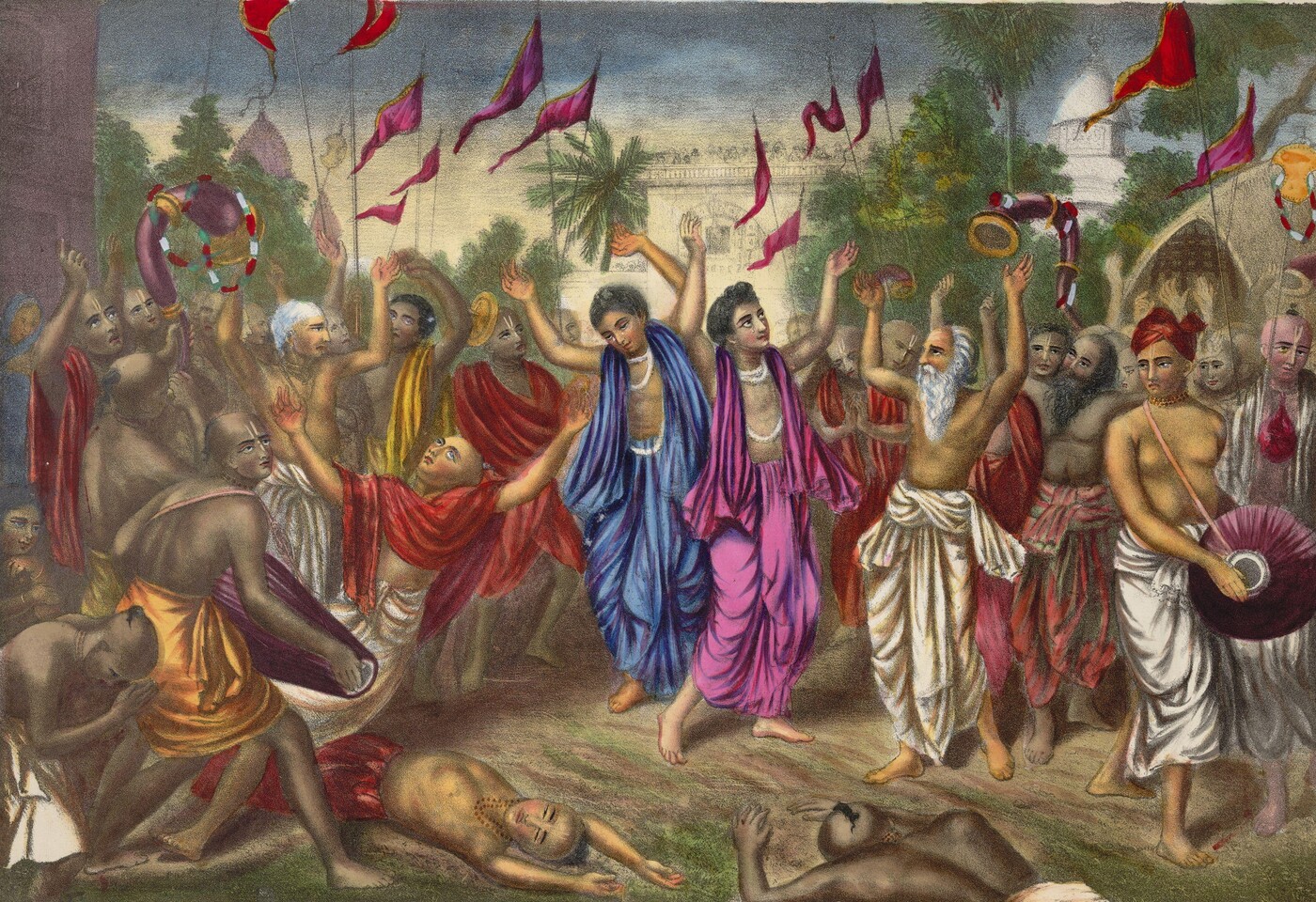
Sri Chaitanya Mahaprabhu's years as a householder in Navadvipa, before He accepted sannyasa in 1510, were the years of His most intense and most public sankirtana. Night after night He gathered with Nityananda Prabhu, Advaita Acharya, Srivasa Thakura and dozens of other devotees, often at Srivasa's own courtyard. Together they chanted and danced until the moods that came over Him could no longer be called ordinary devotion. Krishnadasa Kaviraja Goswami wrote Sri Chaitanya-charitamrita decades later. In it he lists the men who made up that circle as branches and sub-branches of a single tree. This image is a way of saying that each of them, however small his part, belonged to something far greater than any one of them. Shriman Pandita is named as the fifteenth branch of that tree. The one detail Krishnadasa Kaviraja Goswami records about him is tied to one of the most striking of Mahaprabhu's ecstasies from this period.
A Servant Kept Close #
The verse describing Shriman Pandita is very short, even for a list that names dozens of people in a few dozen lines. It calls him "prabhura nija bhrtya," the Lord's own personal servant, and says only that he carried a torch when Mahaprabhu danced. There is no family history, no hometown, and no mention of when he joined the circle of devotees. But even in so few words, the verse shows a kind of trust. It calls him a servant who is "personal," not just a servant in general. Such a servant is kept near enough to be given a specific, repeated task, not a general one.
Dancing as Lakshmi #
The dance in question was not ordinary kirtana movement. Srila Prabhupada's purport to this verse recalls a night when Mahaprabhu, immersed in a mood identified with the goddess Lakshmi, danced through the streets of Navadvipa itself, instead of staying within a courtyard. This belongs to a group of pastimes from Mahaprabhu's Navadvipa years. In them He is described as showing a specific divine mood so completely that observers could recognize whose part He was playing only by what He did next. A similar pattern, in a different form, is also recorded in Chaitanya-bhagavata. There Srila Vrindavana Dasa Thakura gives fuller accounts of His ecstatic dancing.
Why a Torch Mattered #
Sixteenth-century Navadvipa had no street lighting. A kirtana party moving from a courtyard into the open streets after dark needed someone walking with a lamp. The lamp kept the procession from losing its footing on uneven ground. It also kept the dancing visible to the crowds it was meant to draw. This detail is easy to miss, but it places Shriman Pandita physically at the center of the scene, not at its edge. He was close enough to Mahaprabhu to be trusted with keeping the light on Him, night after night. He did this while the Lord danced in a mood that most of the devotees present were struggling simply to witness.
Neighbors in the List #
Besides describing Shriman Pandita, Krishnadasa Kaviraja Goswami's list also shows who is named next to him. The branch named just before him is Narayana Pandita, the fourteenth, described as a devotee who "did not know any shelter but Lord Chaitanya's lotus feet." The branch named just after him, the sixteenth, is Shuklambara Brahmachari, from whom Mahaprabhu would sometimes jokingly snatch food. Read together, the three verses give a small picture of the company Shriman Pandita kept in the text. They were unrelated men, each minor on his own. They were set down one after another because each had his own particular way of serving the same Lord.
Chosen to Be Remembered #
Krishnadasa Kaviraja Goswami wrote Chaitanya-charitamrita many decades after these events. He worked from the earlier accounts of Murari Gupta, Svarupa Damodara Goswami and others, and from what he could still confirm from those who remembered. He preserved Shriman Pandita's single line, and did not let a minor servant's part disappear into the larger crowd. This says something about how the tradition understood its own history. The acharyas who wrote books and the associates given entire chapters were worth setting down by name. But so were the men who did smaller, physical work close to the Lord. Shriman Pandita's name appears three more times later in the same text, during the years after Mahaprabhu moved to Jagannatha Puri. These appearances are told on Named Among the Associates at Puri.
Scriptural evidence for this chapter (2)
narayana pandita, saha-caturdasa sakha
mahasaya, caitanya-carane yara raksa
Narayana Pandita, the fourteenth branch, a great and liberal devotee, did not know any shelter but Lord Chaitanya's lotus feet.
The branch named immediately before Shriman Pandita in Krishnadasa Kaviraja Goswami's list, cited here to show his place among named neighbors in the text.
শুক্লাম্বর–ব্রহ্মচারী বড় ভাগ্যবান্ ।
যাঁর অন্ন মাগি' কাড়ি' খাইলা ভগবান্ ॥ ৩৮ ॥
suklambara-brahmacari bada bhagyavan
yara anna magi' kadi' khaila bhagavan
Word for word
suklambara-brahmacari -- Shuklambara Brahmachari; bada -- very; bhagyavan -- fortunate; yara -- whose; anna -- food; magi' -- begging; kadi' -- snatching; khaila -- ate; bhagavan -- the Supreme Personality of Godhead.
The sixteenth branch, Shuklambara Brahmachari, was very fortunate because Lord Chaitanya Mahaprabhu jokingly or seriously begged food from him or sometimes snatched it from him forcibly and ate it.
From the purport: Purport excerpt: "It is stated that Shuklambara Brahmachari, an inhabitant of Navadvipa, was Lord Chaitanya Mahaprabhu's first companion in the sankirtana movement."
Cited to identify Shuklambara Brahmachari, the sixteenth branch named immediately after Shriman Pandita in Krishnadasa Kaviraja Goswami's list.
Chapter 2
Named Among the Associates at Puri
Three more times, in three different settings, Chaitanya-charitamrita lists this same personal servant among the devotees gathered around Sri Chaitanya Mahaprabhu at Jagannatha Puri.
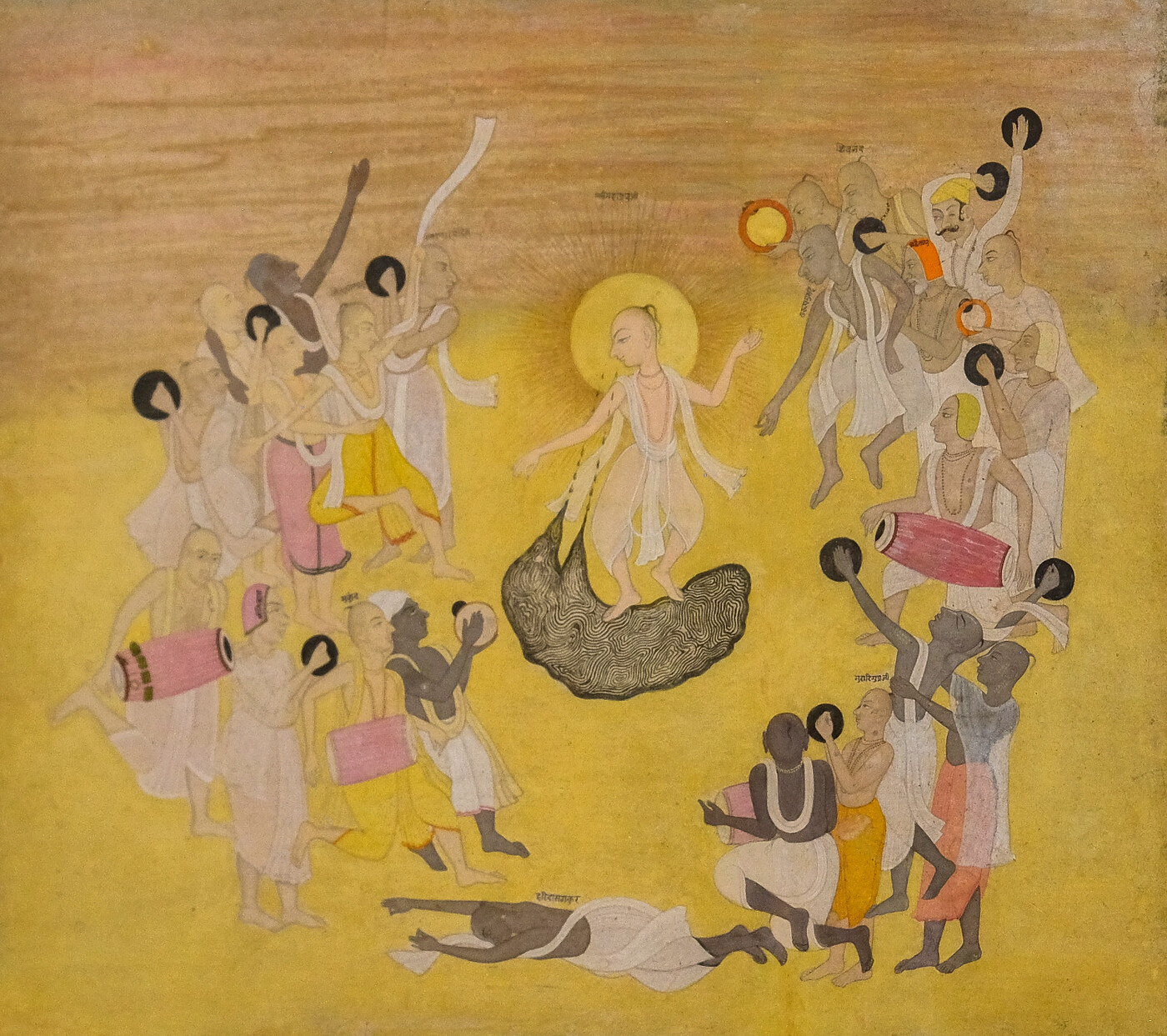
After Sri Chaitanya Mahaprabhu accepted the sannyasa order in 1510 and settled in Jagannatha Puri, most of His Bengali associates could see Him only once a year, when large parties travelled from Bengal for the four months of the rainy season. Shriman Pandita's name appears in Chaitanya-charitamrita three more times in connection with this later period, each time in the company of other named devotees rather than as the subject of his own story. But each mention adds a small, specific detail to what the torch-carrying episode in Navadvipa had already established about him.
Rejoicing at the Lord's Return #
Madhya-lila 10.83 places Shriman Pandita among a named group of devotees, alongside Damodara Pandit, who were "very pleased to hear" that Mahaprabhu was returning to Puri after a visit to Bengal. The verse just before it names another such group hearing the same news with joy, including Vakresvara Pandit and Gadadhara Pandit. This gives a sense of how many devotees, well known and little known alike, were named together whenever Krishnadasa Kaviraja Goswami described the mood of the Puri community. It is a small mention, one line among many in a chapter mostly about the Lord's journey. But it places Shriman Pandita among those close enough to that community to be named in such a list. It was a list of people whose personal happiness at the Lord's homecoming was thought worth recording.
Named Before King Prataparudra #
The fullest of the three later mentions comes in Madhya-lila chapter 11, the chapter of the beda-kirtana pastimes. As the devotees from Bengal arrived at Puri, King Prataparudra watched from the roof of his palace. Gopinatha Acharya pointed them out to him one by one, calling out their names. In verse 89, Gopinatha Acharya names Shriman Pandita directly, between Raghava Pandit and Nandana Acharya on one side and Shrikanta on the other. To be named in this list is itself a sign of his place in the community. He was a servant so little known that he left no other record. Yet he was known well enough among the Lord's devotees to be named without hesitation before the king.
A Gift Named and Eaten #
The most personal of the four mentions comes from Antya-lila chapter 10. This chapter describes Mahaprabhu accepting and tasting food that Bengali devotees carried to Puri as gifts. Shriman Pandita is named among the group of devotees, including Murari Gupta and Vasudeva Datta Thakura, who travelled together to Jagannatha Puri for this purpose (Antya-lila 10.9-11). Later in the same chapter, while distributing the food to those present, Mahaprabhu Himself says, "these are gifts given by Shriman Sena, Shriman Pandita and Nandana Acharya" (Antya-lila 10.122). It is a very ordinary moment: a plate of food and a name spoken aloud. Yet it comes closer than anything else in the text to showing Shriman Pandita's devotion in its plainest form. It was something cooked and carried a long way, for no reason but that Mahaprabhu might eat it.
A Loose Thread #
One further verse, Madhya-lila 13.39, names five singers at a Ratha-yatra kirtana, one of them called simply "Shriman." Elsewhere, Chaitanya-charitamrita uses "Shriman" as a short form of both Shriman Sena and Shriman Pandita. So we do not guess which of the two this shorter verse means. It remains a small open question in a record that already tells us little, and it is not quietly treated as a fact.
Scriptural evidence for this chapter (6)
আচার্যরত্ন, আর পণ্ডিত বক্রেশ্বর ।
আচার্যনিধি, আর পণ্ডিত গদাধর ॥ ৮২ ॥
acaryaratna, ara pandita vakresvara
acaryanidhi, ara pandita gadadhara
Word for word
acaryaratna -- Acharyaratna; ara -- and; pandita vakresvara -- Vakresvara Pandita; acaryanidhi -- Acharyanidhi; ara -- also; pandita gadadhara -- Gadadhara Pandita.
Acharyaratna, Vakresvara Pandita, Acharyanidhi and Gadadhara Pandita were all very pleased to hear this news.
The verse immediately before Madhya-lila 10.83, naming another group of devotees who rejoiced at the same news, cited to show the size of the community counted together in this passage.
শ্রীরাম পণ্ডিত আর পণ্ডিত দামোদর । শ্রীমান্ পণ্ডিত, আর বিজয়, শ্রীধর ॥ ৮৩ ॥
srirama pandita ara pandita damodara
srimat pandita, ara vijaya, sridhara
Word for word
sri-rama pandita -- Sriram Pandita; ara -- and; pandita damodara -- Damodara Pandita; srimat pandita -- Shriman Pandita; ara -- and; vijaya -- Vijaya; sridhara -- Sridhara.
Sriram Pandita, Damodara Pandita, Shriman Pandita, Vijaya and Sridhara were also very pleased to hear it.
Shows Shriman Pandita named among the devotees who rejoiced on hearing of Mahaprabhu's return to Jagannatha Puri.
রাঘব পণ্ডিত, ইঁহ আচার্য নন্দন । শ্রীমান্ পণ্ডিত এই, শ্রীকান্ত, নারায়ণ ॥ ৮৯ ॥
raghava pandita, iha acarya nandana
srimat pandita ei, srikanta, narayana
Word for word
raghava pandita -- Raghava Pandita; iha -- here; acarya nandana -- Nandana Acharya; srimat pandita ei -- here is Shriman Pandita; srikanta -- Shrikanta; narayana -- and Narayana.
Here is Raghava Pandita, here is Nandana Acharya, there is Shriman Pandita, and here are Shrikanta and Narayana.
From the purport: Purport excerpt: "One who is intelligent understands that all the personal associates and devotees of Lord Sri Chaitanya Mahaprabhu are ever liberated."
Gopinatha Acharya names Shriman Pandita while pointing out the arriving devotees from Bengal to King Prataparudra, in the chapter of the beda-kirtana pastimes.
vasudeva-datta, murari-gupta, gangadasa
srimat-sena, srimat-pandita, akincana krsnadasa
murari, garuda-pandita, buddhimanta-khana
sanjaya-purusottama, pandita-bhagavan
suklambara, nrsimhananda ara yata jana
sabai calila, nama na yaya likhana
Vasudeva Datta, Murari Gupta, Gangadasa, Shriman Sena, Shriman Pandita, Akincana Krishnadasa, Murari, Garuda Pandita, Buddhimanta Khan, Sanjaya Purushottama, Bhagavan Pandita, Shuklambara Brahmachari, Nrisimhananda Brahmachari and many others joined together to go to Jagannatha Puri. It would be impossible to mention the names of them all.
Places Shriman Pandita among the named group of Bengali devotees who travelled together to Jagannatha Puri.
শ্রীমান্-সেন, শ্রীমান্-পণ্ডিত, আচার্যনন্দন । তাঁ-সবার দত্ত এই করহ ভোজন ॥ ১২২ ॥
srimat-sena, srimat-pandita, acarya-nandana
tan-sabara datta ei karaha bhojana
Word for word
srimat-sena -- Shriman Sena; srimat-pandita -- Shriman Pandita; acaryanandana -- Nandana Acharya; tan-sabara -- of all of them; datta -- given; ei -- these; karaha bhojana -- please eat.
These are gifts given by Shriman Sena, Shriman Pandita and Nandana Acharya. Please eat them all.
Mahaprabhu personally names Shriman Pandita's food-gift while accepting and distributing prasadam from His Bengali devotees at Puri.
গঙ্গাদাস, হরিদাস, শ্রীমান্, শুভানন্দ ।
শ্রীরাম পণ্ডিত, তাহাঁ নাচে নিত্যানন্দ ॥ ৩৯ ॥
gangadasa, haridasa, srimana, subhananda
sri-rama pandita, tahan nace nityananda
Word for word
gangadasa -- Gangadasa; haridasa -- Haridasa; srimana -- Shrimana (Shriman); subhananda -- Shubhananda; sri-rama pandita -- Sri Rama Pandita; tahan -- there; nace -- dances; nityananda -- Lord Nityananda.
The five singers who responded to the singing of Shrivasa Thakura were Gangadasa, Haridasa, Shrimana, Shubhananda and Sri Rama Pandita. Sri Nityananda Prabhu was appointed as a dancer.
Cited for the possible fifth mention of Shriman Pandita's name, rendered here simply as "Shriman," among singers at a Ratha-yatra kirtana; the identification is left unconfirmed rather than assumed, as noted on the acharya's own page.
Closing
A Name Among Many Panditas #
"Pandita" is a title, not a surname. Gaudiya Vaishnava literature is full of devotees who carry it, including Gadadhara Pandit, Jagadananda Pandit, Shrinatha Pandita, Shyamananda Pandit and Raghava Pandit, among others. None of them is the man described here. Shriman Pandita is a separate person. He is named clearly as "Srimat-pandita" in the Bengali text of Chaitanya-charitamrita, and he is listed alongside these other Panditas, not confused with them. Krishnadasa Kaviraja Goswami is such a careful writer that each of these men keeps his own identity in the text, even when three or four of them are named together in the same verse.
The Fifteenth Branch #
In Adi-lila chapter 10, Krishnadasa Kaviraja Goswami describes Mahaprabhu's early companions in Navadvipa as branches and sub-branches of a great tree, moving down a long list one devotee at a time. Shriman Pandita is the fifteenth branch named, immediately after Narayana Pandita, the fourteenth. The verse identifies him in a single line as "prabhura nija bhrtya," the Lord's own personal servant, and adds nothing else about his family or background. It is a small, exact description, and it is almost everything the text tells us about his place among the associates. He was not a Goswami, and not a scholar remembered for a book. He was a servant kept close.
What the Record Does Not Say #
Nothing in the surviving sources gives Shriman Pandita's birthplace, family, or dates of birth and disappearance. No source names his diksha-guru. The Gaura-ganoddesha-dipika of Kavi Karnapura assigns Krishna-lila identities to many of Mahaprabhu's associates. It does contain one line naming a "Shriman Pandita Goswami" as the guru of Achyutananda, the son of Sri Advaita Acharya. But most other accounts of Achyutananda name Gadadhara Pandit as his guru. And there is no reliable way to confirm that the "Shriman Pandita Goswami" of that one verse is the same torch-bearing servant described in Adi-lila 10.37. The name may instead be a title of respect for someone else. So that identification should not be treated as settled. What we can say with confidence is narrower and plainer. He was a personal servant of Sri Chaitanya Mahaprabhu, present at both ends of the Lord's manifest pastimes, in Navadvipa and at Puri. He is remembered by name four times in the text Krishnadasa Kaviraja Goswami wrote so that no one who served the Lord would be forgotten.
- Sri Chaitanya-charitamrita, Adi-lila 10.37 (verse, synonyms, translation and purport)
- Sri Chaitanya-charitamrita, Madhya-lila 10.83
- Sri Chaitanya-charitamrita, Madhya-lila 11.89
- Sri Chaitanya-charitamrita, Antya-lila 10.9-11
- Sri Chaitanya-charitamrita, Antya-lila 10.122
- Shriman Pandita - Gaudiya History (ISKCON Desire Tree)
- Shri Gaura Ganoddesha Dipika - Gaudiya History (ISKCON Desire Tree)
