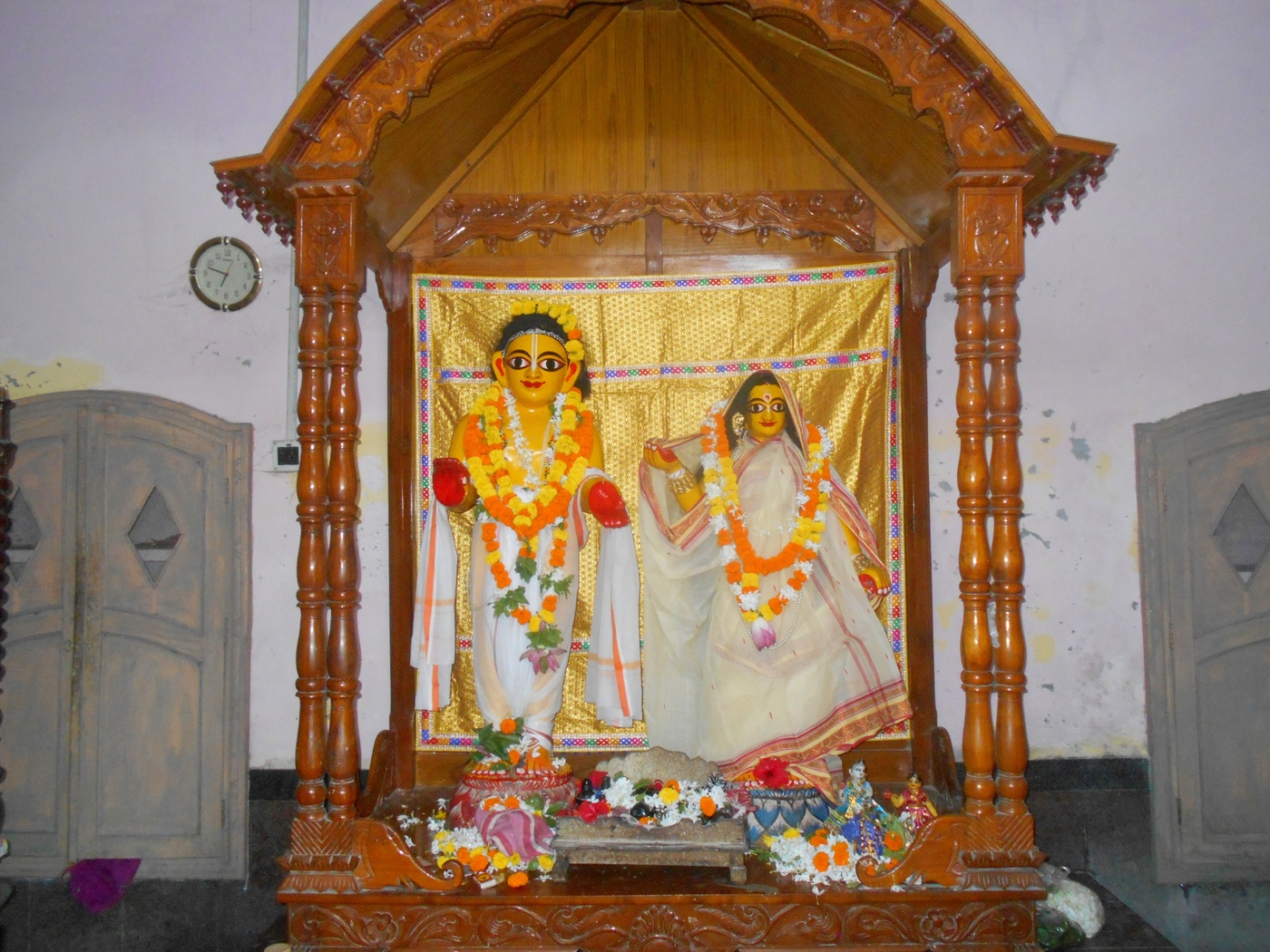
Sita Thakurani enters the story of Gaudiya Vaishnavism in the same way that most women of fifteenth-century Bengal enter their family's records. She appears through her marriage, when she joins a household, and almost nothing is preserved about the years before it. She was the daughter of Nrsimha Bhaduri, and tradition places her wedding to Sri Advaita Acharya at Phuliya Nagar. After the wedding the couple made their home at Shantipura, on the bank of the Ganges in Nadia district. That house would later become one of the two or three central gathering places of the whole sankirtana movement.
| Detail | Description |
|---|---|
| Father | Nrsimha Bhaduri |
| Marriage | At Phuliya Nagar, Bengal; exact year not recorded |
| Household | Shantipura, Nadia, on the Ganges |
| Sister | Sri, herself identified in Gaudiya theology as a further manifestation of Yogamaya |
| Spiritual identity | Yogamaya, the Lord's potency of arrangement and concealment, per Gaura-Ganoddesha-Dipika |
| Recognition | One of four leading women Vaishnava devotees around Sri Chaitanya Mahaprabhu, with Sachi Devi, Vishnupriya Devi and Malini Devi |
That is nearly everything the sources say about her life before the sankirtana movement began. No birth year survives. No account tells of her childhood or her education. Advaita Acharya was already a famous scholar and worshiper of Vishnu, but no account tells how her marriage to him came about. We know only the bare fact that it happened at Phuliya. The tradition does not remember her through a biography in the ordinary sense. It remembers her through a role, the kind of wife, mother and devotee she was after the household at Shantipura was set up. Above all, it remembers what she became once Sri Chaitanya Mahaprabhu came into the world.
Worshiped By The Whole World #
Sri Chaitanya-charitamrita introduces her by name only once. This is at the exact moment she first acts in the story, when she goes to Mayapur to see the newborn Lord. Krishnadasa Kaviraja Goswami chooses these words: advaita-acarya-bharya, jagat-pujita arya, "the wife of Advaita Acharya, worshiped by the whole world, the most advanced and cultured lady." The text does not use this phrase for every devotee's wife. It is a special and serious description. It also shows how she is treated in the rest of the literature, as someone honoured for her own devotion, not simply as a reflection of her husband's devotion.
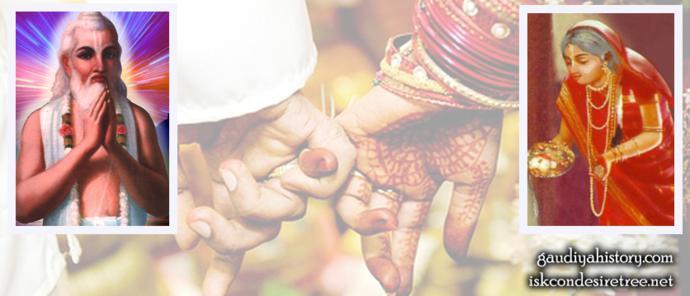
Bengali Vaishnava theology gives a reason why she is so highly honoured. The Gaura-Ganoddesha-Dipika is the traditional record of who each of Sri Chaitanya Mahaprabhu's associates had been in Krishna's own pastimes. According to this book, Sita Thakurani is Yogamaya. Yogamaya is the Lord's internal potency that arranges His activities and, when needed, hides them. A verse quoted from this text in later Vaishnava writing puts it directly: yogamaya bhagavati, grihini tasya sampratam, sita rupenavatirna, "the goddess Yogamaya has now descended in the form of Sita, as his [Advaita Acharya's] wife." The same source extends this to her sister Sri. It calls her a further manifestation, a prakasha, of that same potency. This is a theological claim, not a historical one. It should be read as the tradition presents it, as a statement about who Sita Thakurani is understood to be in the deepest sense. Gaudiya Vaishnavism has held this view of her since at least the sixteenth century, and still does.
One Of Four #
The biographical writing collected at gaudiyahistory.iskcondesiretree.com places Sita Thakurani in a special group. Along with Sachi Devi (Sri Chaitanya Mahaprabhu's mother), Vishnupriya Devi (His wife) and Malini Devi (the wife of Srivasa Thakura), she is remembered as one of four leading women devotees who supported and gave strength to Mahaprabhu's mission during His lifetime. It is a small detail, but it shapes how the tradition sees her. She is not seen as one woman among many attached to famous husbands. She is one of four whose own devotion the movement singled out by name.
A Household Waiting To Become Something Larger #
None of this by itself explains why Shantipura became so important, or why a woman with almost no personal biography came to be remembered by later generations as "mother of all Vaishnavas." That story begins with what she did after the Lord Himself was born nearby. It is told in full on Mother of All Vaishnavas and Daily Devotion and Legacy. The fuller story of the household itself is told on Sri Advaita Acharya's own page and on Sita Thakurani and the Family at Shantipura, so it is not repeated here. That story includes the naming of Nimai, the sons born to Sita Thakurani and Advaita Acharya, and the division that later split the family.
