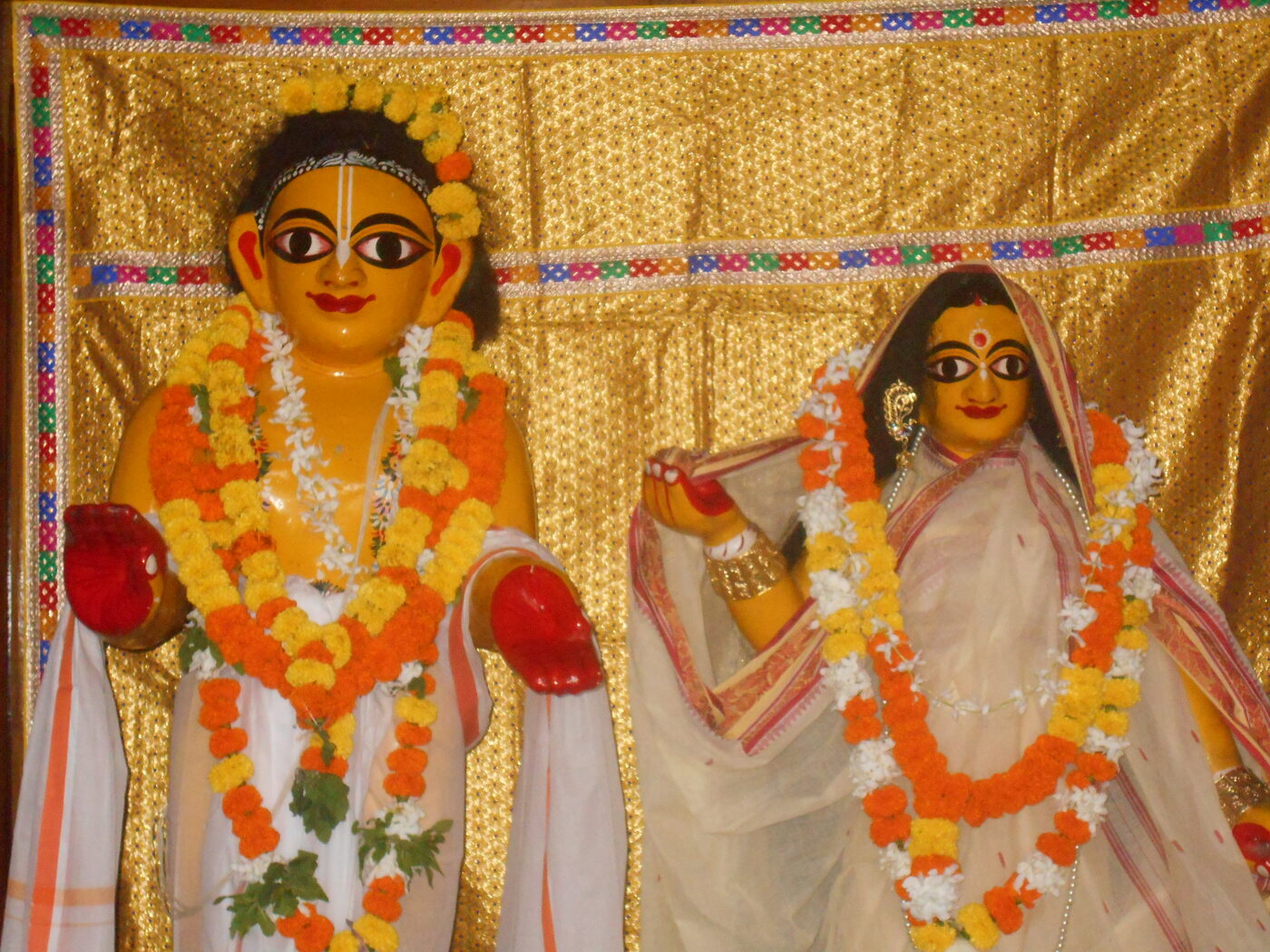
Two things show most clearly Sita Thakurani's direct, personal bond with Sri Chaitanya Mahaprabhu, apart from her place in the wider household at Shantipura. The first is a single day in Sri Chaitanya-charitamrita. The second is a devotional memory, repeated across many later sources, of what she did every year afterward.
| Detail | Description |
|---|---|
| Direct address | Devotional tradition holds that Mahaprabhu called her Mother, and she loved Him with a mother's vatsalya-prema |
| Key episode | Personally cooked the meal that broke Mahaprabhu's three-day fast, the day He took sannyasa and came to Shantipura (Sri Chaitanya-charitamrita, Madhya-lila 3) |
| Annual practice | Traditionally accompanied Advaita Acharya and their son Acyutananda to Jagannatha Puri every year, cooking Mahaprabhu's favourite foods for Him there |
| Possible connection | Shivananda Sena led the yearly Bengali pilgrimage party to Puri that regularly included Advaita Acharya |
| Epithet | Remembered as "worshiped by the whole world" and "mother of the universe"; some devotional writers call her mother to the whole Vaishnava community |
The Meal That Broke A Three-Day Fast #
After accepting the sannyasa order at Katwa, Sri Chaitanya Mahaprabhu set out toward Vrindavana in an ecstasy of love so complete that He barely knew where He was going. He wandered for three days through Radha-desa without eating. Nityananda Prabhu, through a gentle deception, brought Him instead to the bank of the Ganges at Shantipura, where Advaita Acharya was waiting with a boat. "You have been fasting continuously for three days," Advaita Acharya told Him. "I therefore invite You to My home, where You may kindly take Your alms." He added, with the humility of a poor householder rather than the wealthy scholar he actually was, "At My home I have just cooked one palmful of rice. The vegetables are always very simple."
What happened next is recorded in a single, easily missed verse: "All the eatables were first cooked by the wife of Advaita Acharya. Then Srila Advaita Acharya personally offered everything to Lord Vishnu." So Sita Thakurani's cooking, and no one else's, broke the three-day fast that the Lord Himself had kept in a state of spiritual ecstasy. In fact, it was a full and rich meal. A few verses later the text describes it as filling three full plates of rice, dal and vegetables. It was prepared with real care, even though Advaita Acharya had modestly warned that the food was simple. Srila Prabhupada's purport to this verse calls the scene "the ideal householder's life," where "the wife at home cooks a variety of foods for Lord Vishnu, and the husband offers it to the Deity." The verse itself calls her only "the wife of Advaita Acharya," and does not give her own name, because at that point the text simply speaks of her in this plain way. But the act it records belongs to her alone.
The Yearly Journey To Puri #
Sri Chaitanya Mahaprabhu settled at Jagannatha Puri for the rest of His manifest life. After that, several devotional sources say, Advaita Acharya and Sita Thakurani travelled there every year with their son Acyutananda. Among these sources are gaudiyahistory.iskcondesiretree.com and the biographical literature of the Sri Chaitanya Saraswat Math. On these visits, the tradition says, Sita Thakurani would personally prepare Mahaprabhu's favourite dishes and invite Him to take lunch at their lodging. He accepted, out of the same affection He held for Sachi Devi. Unlike the Madhya-lila 3 episode above, this detail does not appear to rest on a specific verse of Sri Chaitanya-charitamrita itself. It comes from the wider devotional tradition, and we report it as tradition, not as a scriptural episode that can be directly cited.
That yearly journey suggests one more possible connection, and we offer it with care. Shivananda Sena is remembered in Sri Chaitanya-charitamrita as the devotee who organized and funded the annual pilgrimage that carried Bengal's devotees to Jagannatha Puri "every year," and Advaita Acharya is named as one of the regular members of that party. Devotional tradition holds that Sita Thakurani travelled with her husband on these yearly visits. If she did, she likely went within Shivananda Sena's annual pilgrimage, not through some separate arrangement. No available source states this connection directly using her name. So it is offered here only as a reasonable conclusion from two facts that are each well supported on their own. It is not a settled fact in itself.
Mother Of The Universe #
Gaudiya tradition remembers Sita Thakurani with titles that reach beyond her own household. Sri Chaitanya-charitamrita calls her "worshiped by the whole world," and later devotional writing says she is owed the same worship as Sachi Devi, "the mother of the universe." Titles like these might suggest that there is a single, specific story behind them. We might expect a named episode in which she showed mercy to one particular person of low birth. The tradition tells this kind of story about several other great Vaishnavas.
No such specific, named episode could be found for Sita Thakurani. It could not be found in Sri Chaitanya-charitamrita itself, in the biographical accounts published at gaudiyahistory.iskcondesiretree.com, in the Sri Chaitanya Saraswat Math's devotional literature, in Jagadananda Das's survey of Gaudiya women saints, or in the Vaniquotes archive of Srila Prabhupada's own words. But again and again, independent sources record something broader and just as real. In the tradition's own telling, her vatsalya-prema reached the whole Vaishnava community, not her family alone. The sources also record her title, "worshiped by the whole world," a title never limited by caste or class. That is a true and well supported claim about her character. It is simply not the same as one documented act of mercy toward one named person. It is better to say so than to invent such a story.
